


Located in:
- III. Operational Planning Elements
The Unified or Combined State Plan must include an Operational Planning Elements section that supports the State’s strategy and the system-wide vision described in Section II(c) above. Unless otherwise noted, all Operational Planning Elements apply to Combined State Plan partner programs included in the plan as well as to core programs. This section must include—
- a. State Strategy Implementation
The Unified or Combined State Plan must include–
- 2. Implementation of State Strategy
Describe how the lead State agency with responsibility for the administration of each core program or a Combined Plan partner program included in this plan will implement the State’s Strategies identified in Section II(c). above. This must include a description of—
- 2. Implementation of State Strategy
- a. State Strategy Implementation
III. a. 2. A. Core Program Activities to Implement the State’s Strategy
Describe the activities the entities carrying out the respective core programs will fund to implement the State’s strategies. Also, describe how such activities will be aligned across the core programs and Combined State Plan partner programs included in this plan and among the entities administering the programs, including using co-enrollment and other strategies, as appropriate.
Current Narrative:
WIOA Services delivered by Department of Labor and Workforce Development through One-Stop Career Centers (WIOA Title I Activities)
New Jersey is committed to providing local Workforce Development Boards with the vision, tools, and support to create a dynamic, locally driven and managed One-Stop Career Center system for assisting unemployed and underemployed customers with acquiring new skills and employment leading to economic self-sufficiency.
Strategies to further that commitment include promoting a functionally aligned and integrated service delivery strategy via local area contract language that includes expectations for the role of the One-Stop Operator beyond coordination and convening of core and required partners, common customer intake and co-enrollment procedures, more closely interconnecting state and federally funded programs with related missions, and focusing on traditionally left behind sub-populations including transgender and opioid addicted career seekers and returning citizens.
One-Stops will also be vehicles to provide information to customers about rights and protections afforded to workers under state and federal law. This expands a long-standing NJDOL policy of protecting jobseekers from unscrupulous employers by explaining, for example, minimum wage and overtime rules, differences between an employee and independent contractor, and laws around family leave and earned sick time.
New Jersey maintains and will continue to build a strong network of One-Stop Career Centers, community colleges, libraries, community and faith‐based organizations, labor unions and educational institutions to ensure that jobseekers and students, at all levels, have access to high‐quality career guidance and job search information and assistance. New Jersey will invest in professional development and staff training and in on‐line resources to support this effort.
The New Jersey Department of Labor and Workforce Development (NJDOL) is the state agency responsible for delivery of the majority of WIOA core programs. The table below outlines the roles and responsibilities for the various State programs:
| Division | Core Programs | Non-Core Programs |
|---|---|---|
| NJDOL via funding to Local Workforce Development Boards | Adult WIOA Title I | WorkFirst New Jersey (TANF Employment & Training) |
| Dislocated Worker WIOA Title I | SNAP Employment & Training | |
| Youth WIOA Title I | ||
| NJDOL via State and Local Government Staff | Wagner-Peyser WIOA Title III | Trade Adjustment Assistance for Worker Program (Chapter 2, Title II Trade Act) |
| Jobs for Veterans State Grants (Title 38, Chapter 41) | ||
| Unemployment Insurance | ||
| Senior Community Service Employment Program (Title V Older Americans Act) | ||
| NJDOL via competitive contracts | Adult Basic Education and Family Literacy (WIOA Title II) | |
| NJDOL Division of Vocational Rehabilitation Services AND Department of Human Services, Commission for the Blind and Visually Impaired | Vocational Rehabilitation (Title I Rehabilitation Act, as amended by Title IV) | |
| New Jersey Department of Education | Career and Technical Education (Carl D. Perkins Career and Technical Education Act) |
New Jersey’s WIOA system is delivered through State and local government staff, and vendor staff, at the State’s 30 One-Stop Career Centers. These include at least one Center in each of New Jersey’s 21 counties, and multiple centers in some of the State’s 17 Workforce Development Areas. New Jersey’s local workforce development system and One-Stop Career Centers are described in greater detail in Section VI.
Services at each One-Stop Career Center follow the service flow in the chart below. This is a renewed method of service delivery in keeping with a deeper engagement between WIOA Title I, Title II, Title III and Title IV services, and aligns with expectations of WIOA around coordinated service across Titles, building career pathways, deeper business services and regional collaboration.
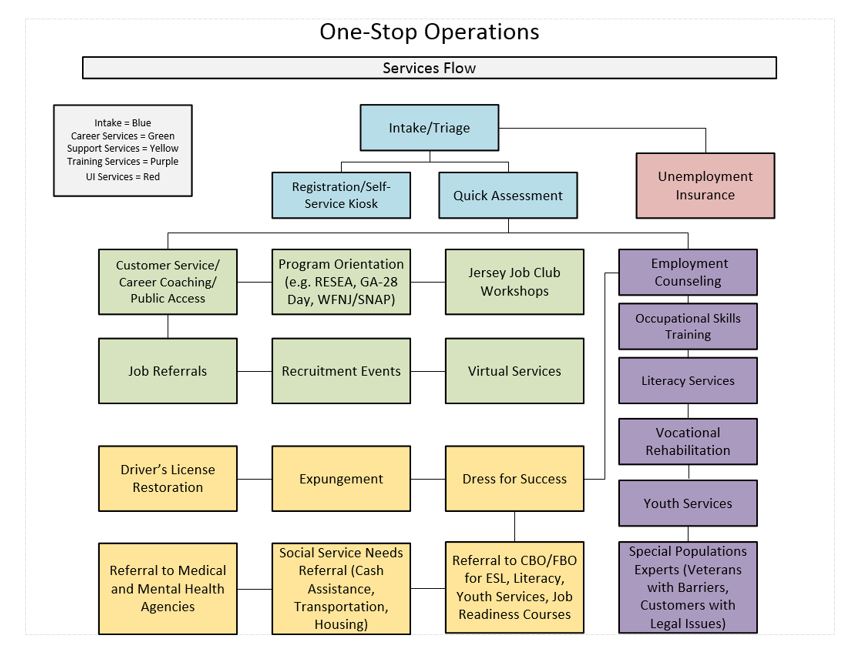
In New Jersey’s WIOA system, each One-Stop Operator serves to integrate partner services, manage activity, ensure collaboration and coordination of services, and work to build a smooth system of services that maximizes the impact and value of each distinct program and funding stream. Additionally, NJDOL works with each WDB and One-Stop Operator to standardize these elements across the state.
One-Stop Operators promote the integration of State, local government, and vendor agency staff providing WorkFirst NJ (TANF and GA), SNAP, and WIOA funded employability assessment, service identification and sequencing, Individual Employment Plan (IEP) development, and case management services. The staff at each One-Stop includes a mix of NJDOL and local government staff, as well as those from other partners such as national SCSEP grantees.
Customer Flow and Counseling
On-site customer flow begins with intake. When a customer enters the One-Stop Career Center, they are greeted by designated triage professionals composed of core partner staff knowledgeable about all One-Stop service offerings. Scheduled customers pre-selected for participation in programs such as RESEA, G-Jobs (TANF/GA/SNAP), and GA-28 Day are directed to the appropriate orientation. Likewise, customers with one-on-one appointments are directed to the appropriate staff.
Intake staff serve a critical role in quickly assessing the needs of walk in customers, ensuring that they are registered in the One-Stop case management system, and routing those customers to the most appropriate partner or service based on the customers’ needs. Ensuring that intake staff are adequately trained on this triage function promotes the WIOA objective that services can be provided in any order based on customer need which replaces the rigid sequence of service model under WIA.
Depending on the outcome of the initial quick assessment performed by triage staff, WIOA Eligibility Determination and Literacy/Occupational Skills Assessment process may be the next step. This process is being standardized statewide, such that the same menu of vetted and approved assessment instruments is used across the system. New Jersey will use the following tools across all One-Stops:
- CASAS – Measures basic skill and academic achievement in reading, listening, math, writing, and related areas. Best Plus – Face-to-face oral interview of listening and speaking skills to assess English language proficiency
- Best Literacy – Test of reading and writing skills using authentic situations to assess skill level
- New Jersey Career Assistance Navigator (NJCAN) – Several assessments of skills, career interest and suitability.
- Prove It – Assessment used to show proficiency in multiple occupations and skillsets. More than 30,000 test modules are available that can be used in a customized manner to determine customers’ readiness for specific jobs.
In New Jersey’s prior system, both WIOA and ES had separate counselors who worked in parallel with customers, and sometimes overlapped in interaction with a given customer. This duplication has been removed in the current model. Integrated service delivery selected co-enrollment, and functional alignment of partner staff performing similar functions transforms One-Stops from a loosely connected group of partners operating in silos to an efficient and coordinated collection of staff each focused on what they do best.
As part of this integrated approach, customers are referred based on their needs and who can best help them.
Functionally aligned staff have the same tools in their toolbox so there is no wrong door approach. Historically in New Jersey, training opportunities could vary depending on the partner. State funded training programs were offered by Employment Services staff and WIOA Title I-funded opportunities were available from local government staff. Customer choice was therefore more limited than necessary. Aligning partner staff by their function such as those providing counseling, interviewing, or group activities results in the ability to provide customers a better range of services when they need them, leading to improved efficiency and, most importantly, improved customer service and outcomes.
Training and Partner Services
Subsequent to the assessment process, individuals will have access to services in keeping with the goals and activities of their Individual Employment Plan (IEP), drawn from the following:
Training Services
The New Jersey Department of Labor is required by statute to create a labor demand occupations list and update it every two years. Under the Workforce Innovation and Opportunity Act (WIOA), the list is used to identify occupational skills training programs that are eligible for Individual Training Accounts (ITA). An updated list of labor demand occupations will take effect on July 1, 2020. Only occupations on this list will be eligible for an ITA unless a waiver is granted in accordance with NJDOL policy.
As an overarching guide to New Jersey’s training efforts, the State has developed a policy with an intent toward maintaining a high proportion of industry-valued credentials in publicly funded training. New Jersey will develop a new industry-valued credentials list in 2020 based on an analysis of labor market data, feedback from employers and stakeholders, and other available information. The original list is available on the New Jersey Career Connections website at: http://careerconnections.nj.gov/careerconnections/prepare/skills/credentials/industry_valued_credentials.shtml.
New Jersey prioritizes strategies and investments in work-based learning opportunities including Pre-apprenticeship, Apprenticeship, Internship, Job Shadowing, Job Coaching, Mentoring and On-the-Job Training models. The following make up New Jersey’s main training methods:
- Adult Basic Education (Title II): If a customer is determined in need of these services, they are referred directly to WIOA Title II Adult Education services for remedial basic skills, English as a Second/Other Language and related services.
- Literacy Labs: Computer labs at One-Stop Career Centers (often blended with the Resource Centers) with extensive computer-based learning tools and are the state’s main effort to provide basic skills, literacy, and English as Second Language training to customers on a drop-in, open-access basis.
- Individual Training Accounts (ITAs) for vocational training through training providers on the Eligible Training Provider List (ETPL) as outlined later in this section and in Section VI. ITA training is delivered based on customer choice, labor demand occupations, and in keeping with the customer’s IEP.
- On-the-Job Training (OJT): Business Services staff at each One-Stop may work with customers and area businesses to develop On-the-Job Training (OJT) agreements when appropriate. New Jersey continues to promote greater use of OJT as it is a method of ensuring that employers gain a workforce with the exact skills and training desired.
- Apprenticeship and Pre-Apprenticeship: The New Jersey Apprenticeship Network is focused on driving economic development through skills and educational attainment by concentrating efforts on sector-focused, demand-driven training programs that lead to meaningful employment; attainment of advanced credentials; diversity and inclusion; and sustainable linkages between employer needs, training providers, and the workforce. Registered Apprenticeship and pre-apprenticeship programs and initiatives have and will remain continued strategies for New Jersey. The models, by design, incorporate both theory and experiential learning that business and industry often request, and simultaneously create career pathways for participants. The Registered Apprenticeship model leads to a nationally recognized industry credential that is both portable and stackable. Strategies to incorporate Registered Apprenticeship and pre-apprenticeship are project-specific, allowing NJDOL and its partners to build specific solutions to identified needs and incorporate promising practices gleaned from previous projects.
- Opportunity Partnership: This program utilizes State funds to support cohort training for dislocated workers. Employers or groups of employers work with community colleges or private trainers to develop curricula that are needed for targeted openings at their firms, and then commit to interview successful completers from a cohort enrolled in the program. These trainings are paid for by the class rather than through an ITA or another customer-level manner.
- Other Work-Based Training including Internships, Job Shadowing, Job Coaching, Mentoring and a number of customized training and related services built to benefit employers and jobseekers; provide better exposure of jobseekers, especially Youth and those with limited work history to the State’s key industries and in-demand occupations; and offer customized methods of preparing new and existing workers for specific job opportunities.
Partner Services
Additionally, referrals may be made to the following partner programs that offer a full menu of integrated and unique services alongside the WIOA Title I activities:
- Employment Services programs including basic career services, Juvenile Justice Commission Re-entry and Labor Exchange/Job Development (for direct placement)
- Division of Vocational Rehabilitation Services (DVRS) services as outlined throughout this Plan.
- Commission for the Blind and Visually Impaired (CBVI) services as outlined throughout this Plan.
- Trade Adjustment Act and access to Trade Readjustment Allowances (TRAs), providing services and aid to American workers who have lost their jobs as a result of foreign trade.
- Senior Community Services Employment Program (SCSEP): Also known in New Jersey as the WorkForce 55+ Program, this is a federally funded program that offers economically disadvantaged seniors, 55 years of age and older, jobs and training. Participants receive the counseling, assessment, and training necessary to enable them to be placed in unsubsidized employment. The program pays full training salary at a non-profit or public employer for up to 48 months
- State Rental Assistance Program (SRAP): This program provides tenant-based and project-based rental assistance grants for up to five years to recipients who are not currently holding a federal Section 8 voucher. Individuals residing in a household receiving an SRAP subsidy are required to participate in the One-Stop Career Centers employment and training services that help them become employed and self-sufficient.
- Helmets to Hardhats (H2H): Designed to help transition active duty military, members of the National Guard and Reserves, and veterans into the best careers in the construction industry in New Jersey.
- NJ BUILD (New Jersey Builders Utilization Initiative for Labor Diversity): Program designed to provide training opportunities for minorities and women in the construction trades and construction related trades so that they can have equal employment opportunity in public contracting.
- Federal Bonding Program: A program that gives an incentive for hiring employers through Fidelity Bonds that guarantee honesty for “at-risk” hard-to-place jobseekers. Bonds cover the first six months of employment and are at no cost to both employer and applicant. It is a unique job placement tool to assist ex-offenders and other at-risk/hard-to-place job applicants.
Job Placement and Business Services
When a jobseeker is prepared to engage in a job search, either after assessment and developing an IEP or after training has completed, their resume is shared with state and local government business outreach staff serving as job developers under the leadership of the Workforce Development Boards.
Industry Specialization
New Jersey is moving toward developing teams of industry-specific experts among the business representatives. NJDOL is promoting a process whereby Business Representatives develop specialization in specific industries or sub-industries. The State recognize that not all One-Stop sites have enough Business Representatives to have distinct individuals for all of the State’s targeted industries, but as much as possible, are working toward processes to allow for specialization to avoid duplication of effort within industries and collaboration across the state. Serving as part of sector teams, Business Representatives statewide who work within each target industry will coordinate efforts, collect and share labor market information, share business connections and job orders across sites as appropriate (given the State’s extensive cross-workforce area and cross-region commuting patterns), and build methods of collaboration and specialization within industries. These efforts will be informed and refined based on the Industry Partnerships strategy that was recently launched in New Jersey.
New Jersey Virtual Services
To assist customers as they work to complete activities associated with their Individual Employment Plan (IEP), counselors utilize online tools such as careeronestop.org, NJDOL websites, and O*Net to inform their decision making and customer recommendations.
Virtual triaging is also being slowly introduced as a way to get a head start before a customer physically steps foot in the One-Stop. Virtually triaging includes using the worker profiling score from unemployment insurance to pre-select individuals for services based on their probability of exhausting UI benefits.
Jersey Job Clubs
Jersey Job Clubs serve as the backbone of service delivery for most customers entering the One-Stop system. Partner programs refer customers to it as it has been shown effective at giving participants a competitive edge in finding employment. The Jersey Job Clubs are the statewide method of delivering job readiness workshops and related career advising work. Core workshops are provided on topics including résumé writing, interview skills, networking, social media in job search, job search assistance, and orientation to other available services. Specific workshops for various populations and about specific programs are delivered as needed within the requirements of those programs.
America’s One-Stop Operating System (AOSOS)
New Jersey currently utilizes the AOSOS system across all One-Stops, and all core partner programs are able to utilize it as the primary case management resource, for recording and accessing all jobseeker customer data, as well as for reporting on NJDOL performance measures. Staff use the system in collaborative case management across sites and the multiple staff working with customers. New Jersey is in the process of undertaking a comprehensive assessment of the State’s case management system needs as well as identifying any new or updated requirements for case management and reporting systems in WIOA. This work will be undertaken in coming years, but for the present AOSOS will remain for current and immediately expected purposes.
Re-Employment Portal
Through funding from the U.S. Department of Labor (USDOL), New Jersey developed a single sign-on workforce profile page and system for unemployment insurance (UI) and workforce participants. Once logged in, the customer can access a personalized dashboard to look at their UI system profile and status, review UI claim information, coordinate their job search activity, access career guidance content, and also set up and receive information and educational content related to their activities, career goals, and other workforce topics.
One-Stop Operator Selection and Certification
The SETC is committed to Local Workforce Board Certification and Capacity Building. The Commission will build on its foundation of required certification and capacity building for local boards, with an expanded certification process that includes enhanced communication, capacity building and technical assistance in partnership with the Department of Labor and Workforce Development.
WIOA requires that local areas competitively select the One-Stop Operator. Based on WIOA, One-Stop Operators may be an institution of higher education; an employment service State agency established under the Wagner-Peyser Act (29 U.S.C. 49 et seq.), on behalf of the local office of the agency; a community-based organization, nonprofit organization, or intermediary; a private for-profit entity; a government agency; or another interested organization or entity, which may include a local chamber of commerce or other business organization, or a labor organization.
State law N.J.S.A 34:15D-4.7 and 21 also requires that all counseling services in One-Stop Career Centers must be either provided by a job counselor hired and employed by the State pursuant to N.J.S.A 11A or hired and employed by a political subdivision of the State with the exception of those One-Stop Centers grandfathered under P.L. 2004, c. 39. State law further requires that all staff who are hired and supported by moneys from the Workforce Development Partnership Fund or the Supplemental Workforce Fund for Basic Skills, including any of those staff located at any One-Stop Career Center will be hired and employed by the State pursuant to N.J.S.A 11A or hired and employed by a political subdivision of the State, with the exception of those One-Stop Centers grandfathered under P.L. 2004, c. 39.
Local Boards are required to comply with both the federal and State law.
Role of the One-Stop Operator
WIOA defines the minimum role of the One-Stop Operator as a convener, coordinator and manager of the one-stop delivery system in a local workforce area. NJDOL envisions the One-Stop Operator as the entity who promotes an integrated, customer-focused delivery system that maximizes each partner’s strength and reduces redundancies. Local boards can develop a more expanded definition of the role of the One-Stop Operator as long as that role is consistent with state law.
The One-Stop Operator roles are to:
- Provide an integrated delivery system;
- Ensure hardest to serve populations are prioritized;
- Coordinate service delivery among partners;
- Coordinate service delivery among physical and electronic sites; and
- Coordinate services across the local workforce area.
Other responsibilities are to:
- Maintain a common intake system among core partners;
- Manage hours of operation at all sites;
- Manage technological resources such as websites, case management information, business networking software, on-line testing sites;
- Manage daily operations through coordination with WIOA Fiscal Agent for lease, utilities, and other invoice remittance;
- Manage partner responsibilities as defined in MOU;
- Manage services for individuals;
- Manage services for business;
- Provide of basic services such as orientations, information on careers and labor markets, and resource rooms;
- Submit annual staffing plans and operational budgets;
- Following federal and state regulations pertaining to handling of EEO responsibilities, customer complaints, and physical and programmatic accessibility;
- Implement board policies; and
- Report to the Board on operations, performance accountability, and continuous improvements.
Each local board selects the One-Stop Operator through a competitive process. Any Request for Proposal shall clearly delineate the role of the prospective one-stop operator to deliver services “at a minimum” level described within proposed 20 CFR 678.620 or near it, so as to ensure continued compliance with state and federal law. The local area process for Competitive Selection of the One-Stop Operator must be open, transparent and made available to all eligible entities. Local areas must follow state procurement laws at a minimum. Competitive selection must be made no less than every two years. Local areas may offer no more than two one-year extensions to successful One-Stop Operator contracts. A successful One-Stop Operator meets or exceeds local area and state performance standards, as applicable; satisfies the requirements of the One-Stop Career Center Certification, provided in SETC Policy Resolution #2016-14, included in Appendix 3 of this Plan. Further, the local Workforce Development Board (WDB) must have determined that neither its One-Stop Operator, nor any of its sub-contracted entities, has engaged in fraud or abuse, as those terms are used within 29 U.S.C. 3122 (c)(3)(A), and that neither the One-Stop Operator, nor any of its sub-contracted entities, has engaged in any of the prohibited conduct listed as cause for corrective actions and penalties under N.J.A.C. 12:42-3.6.
The local area grant recipient retains the financial and administrative responsibility to ensure that the procurement and resultant system is appropriate, aligns with area needs and service structure, and is consistent with the local plan as approved by the local Workforce Development Board.
Local boards must also ensure that the selected One-Stop Operator:
- Discloses any potential conflicts of interest arising from the relationships of the operators with particular training service providers or other service providers;
- Does not establish practices that create disincentives to providing services to individuals with barriers to employment who may require longer-term services, such as intensive employment, training, and education services; and
- Complies with Federal regulations, and procurement policies, relating to the calculation and use of profits.
On September 20, 2016, the State Employment and Training Commission (SETC) adopted Policy Resolution #2016-14, creating the One-Stop Career Center Certification Process. New Jersey’s One-Stop Career Center Certification process had an effective date of July 1, 2017. It considers the requirement that a competitively selected One-Stop Operator should be in place in each local Workforce Development Area. Under this policy, local Workforce Development Boards are to establish a local process of review that may include a qualified group of non-conflicted local board members or a qualified third-party entity. All local areas will have the responsibility to ensure that the group established locally is qualified and able to perform such work. Pre-requisites to One-Stop certification are necessary. This recognizes essential elements of programming and services that must be in place prior to certification. The pre-requisites include accessibility standards, establishment of a grievance/complaint system for customers, a certified local Workforce Development Board (WDB), and a local memorandum of understanding (MOU) that includes the local WDB and its partners. SETC Policy #2016-14 is provided in Appendix 3 of this Plan.