



Located in:
- II. Strategic Elements
The Unified or Combined State Plan must include a Strategic Planning Elements section that analyzes the State’s current economic environment and identifies the State’s overall vision for its workforce development system. The required elements in this section allow the State to develop data-driven goals for preparing an educated and skilled workforce and to identify successful strategies for aligning workforce development programs to support economic growth. Unless otherwise noted, all Strategic Planning Elements apply to Combined State Plan partner programs included in the plan as well as to core programs.
- a. Economic, Workforce, and Workforce Development Activities Analysis
The Unified or Combined State Plan must include an analysis of the economic conditions, economic development strategies, and labor market in which the State’s workforce system and programs will operate.
- a. Economic, Workforce, and Workforce Development Activities Analysis
II. a. 1. A. Economic Analysis
The Unified or Combined State Plan must include an analysis of the economic conditions and trends in the State, including sub-State regions and any specific economic areas identified by the State. This must include—
i. Existing Demand Industry Sectors and Occupations
Provide an analysis of the industries and occupations for which there is existing demand.
ii. Emerging Demand Industry Sectors and Occupations
Provide an analysis of the industries and occupations for which demand is emerging.
iii. Employers’ Employment Needs
With regard to the industry sectors and occupations identified in (A)(i) and (ii), provide an assessment of the employment needs of employers, including a description of the knowledge, skills, and abilities required, including credentials and licenses.
Current Narrative:
Ohio has 17 state agencies, including the Ohio Department of Job and Family Services (ODJFS), the Ohio Department of Higher Education (ODHE), Opportunities for Ohioans with Disabilities (OOD), the Ohio Department of Education (ODE), and the Ohio Department of Aging (ODA), and others that offer almost 200 workforce-related programs. The Governor’s Office of Workforce Transformation (OWT) serves as the lead convening entity for these agencies, promoting the alignment of strategies, funding investments, and outcomes. Ohio will use this strong foundation of inter-agency partnerships and workforce programs to implement new and innovative strategies that will continue to grow its economy and improve the health and well-being of its citizens.
With respect to the portrait of Ohio, the State has a population of 11.7 million, the 7th largest in the country. It has the 10th largest highway network and is centrally located within a day’s drive of 50 percent of all of North America’s population. Its major metropolitan areas of Columbus, Cleveland, Cincinnati, and Toledo are strategically situated in the central, northeast, southwest, and northwest areas of the state. Rural Appalachia includes 32 counties that sweep across the south to southeast portion of the State.
Ohio is home to many historically strong industries, such as banking and insurance, plastics and rubber manufacturing, research and development, automotive assembly, steel production, and traditional agriculture. The State’s industries are also expanding to include new and developing sectors, including technology, bioscience, green energy, information, and food processing.
To ensure the State accurately identifies its demand industry sectors and occupations, the OWT, Governor’s Executive Workforce Board (GEWB), and JobsOhio gather, analyze, and consider information from the following sources.
- Labor Market Information. Labor Market Information (LMI) about occupational wages, projected annual job openings, and projected job growth forms the initial basis of the analysis. Biennial occupational employment forecasts are developed from business employment forecasts, providing an across-the-board assessment of employer jobs needs.
- Economic Drivers. The following industry clusters and business functions have been identified by JobsOhio as critical to Ohio’s economy and are closely analyzed for existing workforce needs: Aerospace and Aviation; Automotive; Financial Services; BioHealth; Advanced Manufacturing; Energy and Chemicals; Food and Agribusiness; Information Technology; and Logistics and Distribution.
- In-Demand Jobs Survey. In July 2019, OWT launched the In-Demand Jobs Survey that is open to all registered Ohio businesses. This innovative new online tool allows employers to provide direct, real-time data about their existing and emerging workforce needs, including the number of current and projected job openings along with related education, skill, and certification requirements.
The culmination of this economic analysis results in Ohio’s In-Demand Jobs List. To be included, sectors and occupations must have greater than average projected job openings or growth, along with median wages equal to or greater than 80 percent of Ohio’s median wage. Overall, the In-Demand Jobs List fosters cross-agency workforce alignment, prioritizes training investments and curricula development, and improves career planning services.
As shown in Figure 1. Top 10 Occupations with the Greatest Anticipated Growth on the In-Demand Jobs List, December 2019, the Healthcare and Social Assistance sector occupations of Registered Nurses; Medical Assistants; and Licensed Practical and Licensed Vocational Nurses account for 42.9 percent (2,685 of 6,263) of growth.
Figure 1. Top 10 Occupations with the Greatest Growth on the In-Demand Jobs List, December 2019
| Occupation Title | Starting Wage | Median Wage | Education Level | On-the-Job Training | Relevant Work Experience | Growth |
|---|---|---|---|---|---|---|
| Registered Nurses | $52,780 | $65,707 | Bachelor’s degree | None | None | 1,839 |
| Laborers/Freight/Stock/ Material Movers, Hand | $20,850 | $29,596 | Less than high school | Short-term on-the-job training | None | 761 |
| Medical Secretaries | $25,390 | $34,962 | High school diploma | Moderate-term on-the-job training | None | 654 |
| Software Developers, Applications | $58,530 | $93,422 | Bachelor’s degree | None | None | 615 |
| Medical Assistants | $25,160 | $33,028 | Certificate/Some college | None | None | 464 |
| Market Research Analysts and Marketing Specialists | $38,110 | $61,593 | Bachelor’s degree | None | None | 434 |
| Construction Laborers | $27,040 | $41,088 | Less than high school | Short-term on-the-job training | None | 392 |
| Licensed Practical and Licensed Vocational Nurses | $34,220 | $44,285 | Certificate/Some college | None | None | 382 |
| Financial Managers | $73,450 | $121,356 | Bachelor’s degree | None | 5 years or more | 362 |
| General and Operations Managers | $50,180 | $98,760 | Bachelor’s degree | None | 5 years or more | 360 |
Source: OhioMeansJobs.com
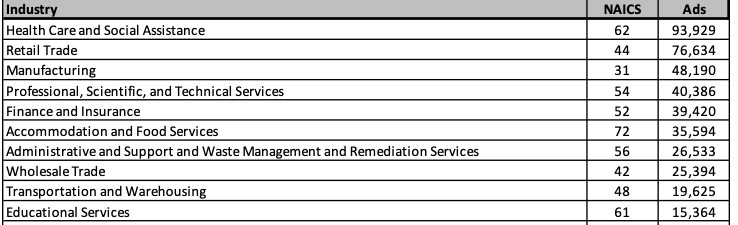
Figure 2. Online Job Postings by Top 10 Industries, January – June 2019 identifies the most frequent online job advertisements on OhioMeansJobs.com sorted by North American Industry Classification System (NAICS).
As shown, the Health Care and Social Assistance industry accounts for 14.1 percent (93,929 of 666,437), the Manufacturing industry accounts for 7.2 percent (48,190 of 666,437) and the Administrative and Support and Waste Management and Remediation Services industry accounts for 4.0 percent (26,533 of 666,437).
Figure 2. Online Job Postings by Top 10 Industries, January – June 2019
- Emerging Demand Industry Sectors and Occupations. Provide an analysis of the industries and occupations for which demand is emerging.
The Bureau of Labor Market Information within the ODJFS forecasts long-term employment and identifies emerging industries and occupations using a combination of data from a variety of sources, including business surveys and economic analyses.
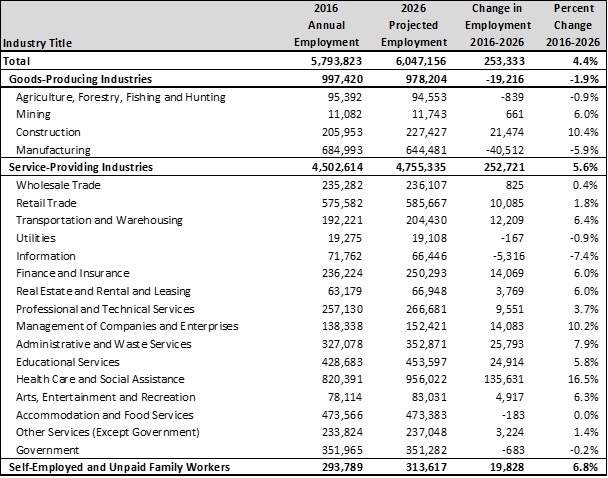
As shown in Figure 3. Ohio 2016-2026 Long-Term Employment Projections by Major Industry, it is expected that there will be significant job growth in Health Care and Social Assistance (16.5 percent), Construction (10.4 percent), Management of Companies and Enterprises (10.2 percent), Administrative and Waste Services (7.9 percent), Transportation and Warehousing (6.4 percent), and Finance and Insurance (6.0 percent).
At the same time, changes in the nature of work and advancements in technology are projected to cause a decrease in employment in Manufacturing (-5.9 percent) and Information (-7.4 percent). To prepare for this shift, a cross-agency workforce team is proactively identifying the new and emerging skill sets that will be required for its long-term talent pipeline. As automation and technology become more common in the workplace, the State will promote and expand education and training opportunities that enable individuals to successfully transition into new jobs and careers within their current employment sectors.
Figure 3. Ohio 2016-2026 Long-Term Employment Projections by Major Industry
Source: ODJFS-Bureau of Labor Market Information (ODJFS-BLMI), September 2018
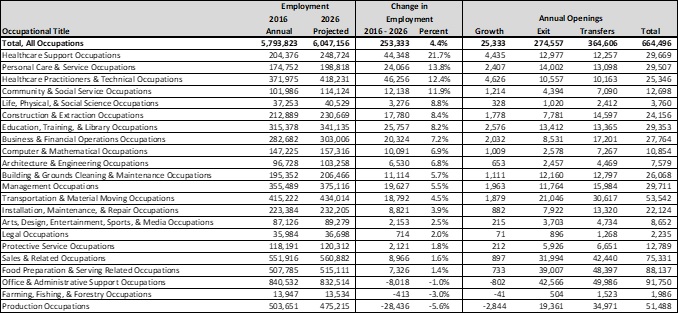
The emerging growth by industry is further supported in Figure 4. Ohio Occupational Employment Projections by Occupational Group, 2016-2026 that shows increases in the Health Care and Social Assistance sector, including Healthcare Support Occupations (21.7 percent), Healthcare Practitioners & Technical Occupations (12.4 percent), Community & Social Service Occupations (11.9 percent), and Life, Physical, & Social Science Occupations (8.8 percent).
Additionally, growth in Construction is supported by increased need in Construction and Extraction Occupations (8.4 percent). The sector of Management of Companies and Enterprises’ growth is supported by increase in Business and Financial Operations (7.2 percent) along with Management Occupations (5.5 percent).
The decline in the Manufacturing sector is supported by the decrease in Production Occupations (-5.6 percent). Ohio is using data from JobsOhio to anticipate changes to the industry and proactively train workers to work alongside new technologies. It will identify the education and skill sets that will be required as a result of automation, empowering workers to remain competitive and to continue to progress in their careers.
Figure 4. Ohio Occupational Employment Projections by Occupational Group, 2016-2026
Source: ODJFS-BLMI, September 2017
- Employers’ Employment Needs. With regard to the industry sectors and occupations identified in (A)(i) and (ii), provide an assessment of the employment needs of employers, including a description of the knowledge, skills, and abilities required, including credentials and licenses.
The table below uses a Burning Glass analysis of over 1.3 million job postings to compile the knowledge, skills and abilities required for the occupations shown in Figure 1. Top 10 Occupations with the Greatest Growth on the In-Demand Jobs List, December 2019. The data represents insights drawn from job postings over the last 12 months within the state of Ohio.
| Occupation | Top 5 Skills | Top 5 Certifications |
|---|---|---|
| Registered Nurses | Patient Care, Advanced Cardiac Life Support (ACLS), Treatment Planning, Cardiopulmonary Resuscitation (CPR), Acute Care | Registered Nurse, Advanced Cardiac Life Support (ACLS) Certification, First Aid Cpr Aed, Basic Life Saving (BLS), American Heart Association Certification |
| Laborers/Freight/Stock/ Material Movers, Hand | Forklift Operation, Packaging, Scheduling, Lifting Ability, Sorting | Driver's License, Forklift Operator Certification, CDL Class A, Good Conduct, Occupational Safety and Health Administration Certification |
| Medical Secretaries | Administrative Support, Scheduling, Appointment Setting, Customer Service, Front Office | Health Unit Coordinator, First Aid Cpr Aed, Basic Life Saving (BLS), Driver's License, American Heart Association Certification |
| Software Developers, Applications | Java, SQL, Software Development, JavaScript, Software Engineering | Security Clearance, IT Infrastructure Library (ITIL) Certification, Driver's License, ITIL Certification, Certified Information Systems Security Professional (CISSP) |
| Medical Assistants | Patient Care, Medical Assistance Scheduling, Vital Signs Measurement, Cardiopulmonary Resuscitation (CPR) | Certified Medical Assistant, Phlebotomy Certification, Basic Life Saving (BLS), AAMA Certified Medical Assistant, Clinical Medical Assistant (CCMA) |
| Market Research Analysts and Marketing Specialists | Marketing, Social Media, Project Management, Digital Marketing Sales | Driver's License, Project Management Certification, Chartered Property Casualty Underwriter (CPCU), Google AdWords Training, Chartered Life Underwriter (ClU) |
| Construction Laborers | Construction Labor, Carpentry Hand Tools, Plumbing, Repair | Driver's License, Occupational Safety and Health Administration Certification, CDL Class A, OSHA Safety 10 Hour, Forklift Operator Certification |
| Licensed Practical and Licensed Vocational Nurses | Patient Care, Cardiopulmonary Resuscitation (CPR), Treatment Planning, Medication Administration, Home Health | Licensed Practical Nurse (LPN), First Aid Cpr Aed, Licensed Vocational Nurse (LVN), Driver's License, Basic Life Saving (BLS) |
| Financial Managers | Accounting, Budgeting, Financial Reporting, Financial Statements, Generally Accepted Accounting Principles (GAAP) | Certified Public Accountant (CPA), Driver's License, Licensed Attorney, Series 6, Series 7 |
| General and Operations Managers | Communication Skills, Teamwork / Collaboration, Planning Problem Solving, Organizational Skills | Driver’s License, CDL Class A, First Aid Cpr Aed, Project Management Certification, Six Sigma Certification |
The occupations of Laborers/Freight/Stock/Material Movers, and Construction Laborers require no formal educational credential. These have starting wages of $20,850 and $27,040, respectively.
Medical Secretaries have minimum requirements of a high school diploma along with moderate-term on-the-job training and have a starting wage of $25,390.
The occupations of Medical Assistants, and Licensed Practical and Licensed Vocational Nurses require some college or postsecondary certificate. They have starting wages of $25,160 and $34,220, respectively.
The occupations requiring a Bachelor’s degree have much higher starting wages than the lesser credentialed positions. They include Registered Nurses, Software Developers, Applications; and Market Research Analysts at $52,780, $58,530, and $38,110. Moreover, the occupations of Financial Managers, and General and Operations Managers that require a Bachelor’s degree along with five years or more of relevant work experience have starting wages of $73,450 and $50,180 respectively.