


Located in:
Other Appendices
Current Narrative:
REENTRY EMPLOYMENT OPPORTUNITIES PROGRAM
Governor Murphy’s commitment to a stronger and fairer New Jersey is reflected in the priorities of NJDOL, including providing a full suite of employment services to returning citizens. This section describes the state’s efforts to build on its past work coordinating services for justice-involved individuals to connect them to employment and help them along the pathway to a rewarding career.
Currently, there are about 215,000 justice-involved individuals statewide, including approximately 20,000 inmates in prison, 15,000 inmates in jail, 15,000 paroles, 15,000 in Drug Court, and 150,000 on probation. This number does not reflect the number of job seekers who are no longer justice-involved but do have a conviction that would preclude them from certain jobs. While this section of the 2020 WIOA Combined Plan focuses on strategies to serve those currently involved in the justice system, it should be noted the Governor and his administration are actively promoting initiatives to support record expungement and the amelioration of other barriers to employment, and the state’s One-Stops help individuals with this barrier as part of the normal course of business on a daily basis.
Pre-Release Services
Ensuring continuity of services for offenders transitioning from prison back to their communities is an important goal for New Jersey. WIOA Title II and State Literacy funds (Workforce Learning Link) are provided to the state correctional system so that work readiness services can be implemented prior to release. This approach supports a seamless transition to community-based One-Stop Career Center services and then into employment.
The Adult Education and Family Literacy Act (AEFLA) program ensures that not more than 10 percent of 82.5 percent of the funding for the cost of educational programs is allocated for programs for criminal offenders in the correctional facilities as well as for other institutional individuals. Emphasis is on programs that promote:
- Adult Basic Education;
- Programs for individuals with disabilities as well as other special needs;
- English literacy programs;
- Secondary school credit programs;
- Transitional support to prepare students to make a successful transition to the community; and
- Life skills and employability skill development to prepare students to gain employment.
NJDOL Office of Adult Literacy Services utilizes the same grant announcement and application process to provide funds to serve individuals in correctional facilities and other institutions that is being used for all other eligible providers and anticipates a 2020 NGO release and a July 1, 2020 program start for all selected NJ Title II providers. Grantees that receive funds to provide programs and services to correctional facilities will be required to describe in their grant application, in addition to all other program requirements, how they will give priority to serving individuals who are likely to leave the correctional institution within five years of participation in the program.
NJDOL, through its Reentry Specialists (described below), works with the Department of Corrections and their newly created Providing Access to Community Employment (PACE) program to facilitate transition of incarcerated individuals into society and employment. The PACE program is currently at the following facilities:
- Bayside State Prison
- Edna Mahan Correctional Facility
- Mountainview Youth Correctional Facility
- Northern State Prison
- Southern State Correctional Facility
- South Woods State Prison
Currently, NJDOL is working with the PACE staff at the statewide level to develop a workflow model of collaboration between the PACE employment specialists and the One-Stop Reentry Specialists to assist in a seamless transition from incarceration to employment. Additionally, NJDOL will be assisting DOC with upcoming employer jobs fairs held at correctional facilities.
In FY 2018 NJDOL funded a “behind-the-walls” pre-apprenticeship program in the building and construction trades at Edna Mahan Correctional Facility for Women.
Further, NJDOL is a participant in a monthly workgroup, the Vocational Training Planning Board, which is addressing employment and training services for inmates in the State Penal system. Representatives include:
- NJ Department of Corrections
- NJ Department of Labor and Workforce Development (NJDOL)
- NJ Department of Education
- NJ State Building and Construction Trades Council
- NJ Business & Industry Association
- NJ Council of County Vocational-Technical Schools
- Three public members
The goal of the Planning Board is to establish a pilot program within one the Department of Corrections facilities in vocational trades. A report is to be filed annually with the Governor and the Legislature. The objectives of the planning board are to improve upon the facility's most successful vocational programming offerings; introduce new vocational programming offerings to inmates of the facility; and provide vocational programming which is consistent with actual post-release employment opportunities and reflects the State’s emerging industry and business workforce needs.
It should also be noted that NJDOL is required to evaluate the relevance of vocational training services in the Department of Corrections to ensure that training services are in job demand occupations. The evaluation of vocational training services is to be accomplished on a semi-annual basis.
Post-Release Services
New Jersey’s one-year recidivism rate is approximately 31 percent, far lower than the estimated national average of 44 percent as reported by the USDOJ Bureau of Justice Statistics (see https://www.bjs.gov/content/pub/pdf/18upr9yfup0514.pdf). With the state’s expansion of efforts to assist ex-offenders to return to work, we hope to lower that rate even further for the benefit of those who have served their time, their families, their communities, and the state as a whole.
To assist parolees in re-entering society following incarceration, NJDOL entered into a Memorandum of Understanding with the New Jersey State Parole Board (SPB) to set forth their responsibilities for a collaborative reentry program, the Parolee Employment Placement Program (PEPP). NJDOL has allocated $2.0 million for the period of July 1, 2019 – September 30, 2020. PEPP provides employment assistance and case management services to men and women under supervision of the State Parole Board.
Utilizing performance-based contacts, NJDOL provides grants for direct services to PEPP program enrollees to three community-based agencies. Grantee deliverables and fee-for-service schedule follow:
- Assessment/Job Coaching/Case Management - $600 per participant
- Job Placement with 30-day employment retention - $900 per participant
- 60-day retention - $700 per participant
- 90-day retention - $700 per participant
- 150-day retention - $1,100 per participant
- Maximum payment for participant who completes all deliverables is $4,000
Agency Roles
- Regional Parole Offices
- Identification of eligible parolees and referral to designated grantees
- Monitor the progress and attendance of all program participants
- Grantees
- Coordinate case management services for parolees enrolled in the program
- Placement of the program participants into sustainable employment
- Case management of all program participants
- Referral of program participants to the One-Stop Career Center for employment registration
- Employment verification for all program participants who secure employment
- One-Stop Career Centers
- Registration of all PEPP trainees in AOSOS
- Assignment of PEPP, Parole, Legal and Wagner-Peyser identifiers in AOSOS Programs and Public Assistance drop-down screen
- Delivery of appropriate labor exchange and employability development services per needs of registrant
- Federal Bonding and WOTC certification, when appropriate
- Linkage with special population’s service staff (Veterans Services, WorkFirst New Jersey, Vocational Rehabilitation, etc.)
Wagner-Peyser provides accessibility for all populations to the full range of One-Stop Career Center employment and training programs. Programs designed to serve the needs of special populations with or without significant barriers to employment are integrated into the universal access provided by Wagner-Peyser and WIOA staff. Justice-involved populations often have significant barriers to employment that require more intensive services to attain employment goals. These barriers may include poor previous attachment to the workforce, literacy or language barriers, ex-offender status, educational or occupational skills gap or lack of a credential, physical or mental disability, and driver’s license suspension.
To better address the challenges experienced by this population, New Jersey has created targeted programs with a dedicated Reentry Specialist on staff at each One-Stop Career Center.
- Some Reentry Specialists have obtained the Offender Employment Specialist Certification and/or Offender Specialist training. The Offender Employment Specialist Certification offered through the National Institute of Corrections (NIC) is being revised for release after July 2020; we plan to offer additional staff the opportunity to obtain this credential after July. Online courses are also available the NIC and staff members are encouraged to participate.
- Many Reentry Specialists have completed Mental Health First Aid Training, a program implemented at NJDOL to provide our One-Stop staff, especially those working with customers with multiple barriers, with additional tools for assisting customers. Mental Health First Aid is a course that builds learner competency to identify, understand and respond to signs of mental illnesses and substance use disorders. The training gives participants the skills needed to reach out and provide initial help and support to someone who may be developing a mental health or substance use problem or experiencing a crisis.
- Reentry Specialists have also attended Reentry Simulation Training. During the simulation, participants assumed the identity of an offender reentering society. Participants had an hour to experience various scenarios such as obtaining a driver’s license, visiting social services, finding housing, and visiting their parole officer. At the end, the participants’ performance was evaluated to see if they had met enough goals to remain out of jail. The simulation showed the frustration and hopelessness many individuals reentering society face and offered ways to better support them to create safer communities and lower recidivism rates.
To assist in identifying this population, NJ created a “Legal” tab on AOSOS to track the number of ex-offenders/justice-involved individuals that we serve. NJDOL is also working with our reentry partners to ensure that individuals leaving the prisons and jails and those participating in the Drug Court Program and/or on probation are aware of the services offered at the One-Stops.
To further break the cycle of recidivism, NJDOL, along with the State Parole Board, is a partner with the New Jersey State Library in their $628,774 National Leadership Grant from the Institute of Museum and Library Services, Fresh Start @ Your Library. Six libraries (Atlantic City Free Public Library, Cumberland County Library, Long Branch Free Public Library, Newark Public Library, Trenton Free Public Library, and the Paterson Free Public Library) will serve as Reconnection Centers which will provide on-site social workers and referrals. The One-Stop Career Centers provide in-kind resources of education and training. A Fresh Start referral indicator has been added to AOSOS.
NJDOL is actively working with the State Parole Board to support and re-invigorate the local Reentry Task Forces. The goal of these task forces is to develop partnerships with all levels of government, local employers, churches and charities, county colleges and trade schools, housing facilities, and the community at large to actively assist post-incarceration individuals with the entire reintegration process, thereby decreasing recidivism and maintaining public safety. In an effort to promote safe and healthy communities, these task forces seek to support current collaborative efforts in New Jersey that are focused on crime prevention and prisoner reentry by:
- Creating a forum for the exchange of ideas and initiatives that will strengthen neighborhoods and help prevent crime;
- Identifying collaborative reentry efforts already present in the community, and developing working relationships to achieve common goals;
- Encouraging broad-based community support and involvement to assist formerly incarcerated individuals and their families striving to re-establish healthy, productive and rewarding lives.
In addition to our partnerships with the Department of Corrections, the State Parole Board and the State Library and Drug Courts, NJDOL also partners with Probation and has begun to hold joint employment specialist meetings on a regular basis. A presentation about emergency housing was a featured presentation at our first meeting.
NJDOL will continue to utilize the Federal Bonding Program to provide fidelity bonds to increase employment opportunities for justice-involved jobseekers, as well as to all other populations eligible under federal guidelines. Through this program, employers that hire justice-involved individuals may obtain up to $25,000 of insurance for a period of 6 months. New Jersey is a nation leader in the utilization of this valuable resource. NJDOL has implemented a “Certification of Eligibility” for jobseekers, have provide literature and training to employers, agencies and jobseekers, and participate in job fairs as well as employer informational sessions. Additionally, NJDOL will continue to promote on-the-job training (OJT) and the Work Opportunity Tax Credit (WOTC) to improve employment outcomes for justice-involved individuals.
APPENDIX 2: PUBLIC COMMENT SUMMARY
The comments summarized below were received during the public comment period for the New Jersey Combined State Plan, held from February 27 through March 8, 2020.
Comment #2020-01
Topic: Services to Individuals with Disabilities
Summary:
- Raised a question about individuals with undiagnosed mental and physical disabilities and made suggestions regarding ways that services to individuals with disabilities might be enhanced.
Disposition: Referred to NJDOL Division of Vocational Rehabilitation Services (DVRS).
Comment #2020-02
Topic: Individual Training Accounts (ITAs)
Summary:
- Recommended NJDOL allow all out of school youth 16 or older who earn their high school diploma or equivalent to access an ITA. The current policy, as documented on page 141 of the draft Combined State Plan, is to allow out of school youth 18 or older to access an ITA.
- Related to New Jersey’s development of revised guidance relating to ITA funding caps, the commenter welcomed to the change from a hard cap to an average amount available model. However, it was noted that “average amount” requires clarification.
Disposition: Referred to the NJDOL Workforce Development - Division of Career Services.
Comment #2020-03
Topic: Apprenticeship
Summary: Complimentary of the State’s focus on growing apprenticeship opportunities and, in particular, the GAINS grants, of which the commenter is a recipient. Shared enrollment and design progress to date and reported the projected demand for over 12,000 new automotive technicians by 2026.
Disposition: Referred to the NJDOL Office of Apprenticeship.
Comment #2020-04
Topic: Senior Community Service Employment Program (SCSEP)
Summary: Recommendations focused on enhancements to the SCSEP section of the Combined State Plan:
- Adding successful organizational partnerships in Union, Middlesex, Hudson, and Bergan Counties;
- Including additional demographic data for the four counties listed above; and
- A correction to an organization name in the Combined State Plan.
Disposition: Referred to NJDOL Workforce Development–SCSEP. Updates were made to the language in the SCSEP portion (Section VII) of the Combined State Plan as appropriate.
Comment #2020-05
Topic: Contributions of Libraries to Vocational Rehabilitation and SCSEP Programs
Summary: The recommendations focused on enhancing the Combined State Plan language to more fully and accurately reflect the role of the New Jersey State Library (NJSL) and the role that NJSL Talking Book & Braille Center programs play in helping New Jersey residents reach their career goals.
Disposition: Referred to NJDHS Commission for the Blind and Visually Impaired (CBVI) and NJDOL Workforce Development–SCSEP. Updates were made to the Combined State Plan language as appropriate, including a correction to the NJSL link.
Comment #2020-06
Topic: Career Pathways for Individuals with Disabilities
Summary: Addressed the need for effective career pathways for individuals with disabilies. Included recommendations for expanding employment opportunities for these individuals.
Disposition: Referred to NJDOL DVRS and NJDHS CBVI.
Topic: Direct Care Workers for Individuals with Intellectual and Developmental Disabilities (I/DD)
Summary: Addressed the shortage of I/DD direct care workers. Included recommendations for expanding programs to train such workers.
Disposition: Referred to NJDOL DVRS and NJDHS CBVI.
Topic: Certifications for Individuals with Disabilities
Summary: Noted in-demand certificates that could improve career outcomes for individuals with disabilities; expressed interest in seeing more outcome data for these programs available on New Jersey’s Eligible Training Provider List (ETPL) website.
Disposition: Referred to NJDOL Office of Research and Information.
Topic: Tax Credits
Summary: Related to the $10M annual tax credits offered to employers of individuals with disabilities to the extent they are impacted by the increases in the New Jersey’s minimum wage. Expressed concern that the Employer Tax Credit Certification form for 2019 does not require evidence of the employee’s impairment(s).
Disposition: Referred to NJDOL Office of Income Security.
Topic: Pre-Employment Transition Services (Pre-ETS)
Summary: Indicated that there is an underutilization of Pre-ETS in New Jersey and attributes this in part to the absence of a fully executed Pre-ETS Memorandum of Understanding among NJDOL DVRS, NJDHS CBVI, and NJDOE Office of Special Education. Further, the comment includes several observations/recommendations to inform the development and success of the Pre-ETS program moving forward.
Disposition: Referred to NJDOL DVRS and NJDHS CBVI.
Topic: Vocational Rehabilitation/Workforce Development Collaboration
Summary: Recommended several strategies to strengthen services to individuals with disabilities through the work-based learning and pre-apprenticeship models that are outlined in the Combined State Plan.
Disposition: Referred to NJDOL DVRS and NJDHS CBVI.
APPENDIX 3: NJ WORKFORCE DEVELOPMENT POLICIES
NJ workforce development policies are posted at: http://njsetc.net/njsetc/policy/resolutions/.
The following is a list of policies included in this appendix.
- SETC #2015-01: Local Workforce Development Board Member Appointments and Process
- SETC #2015-02: New Jersey Local Area Designations
- SETC #2015-03: New Jersey Out-of-School Youth Definition and Youth Work Experience Definition
- SETC #2015-04: New Jersey Regional Designations
- SETC #2015-06: SCALES Policy Recommendations: Adult Basic Education – WIOA Title II Adult Education and Family Literacy Act
- SETC #2016-02: New Jersey Subsequent Local Area Designation
- SETC #2016-03: New Jersey Local Workforce Development Area (LWDA) Programs Budget and Local Workforce Development Board (WDB) Budget and Staffing Requirements
- SETC #2016-05: College and Career Readiness Standards for Adult Education
- SETC #2016-06: New Jersey’s Definition for Employment First
- SETC #2016-07:Employment First Career Pathways Framework
- SETC #2016-08: The relationship between the State Employment and Training Commission (SETC) and the State Rehabilitation Councils (SRCs) for both the Division of Vocational Rehabilitation Services (DVRS) and Commission for the Blind and Visually Impaired (CBVI)
- SETC #2016-09: SETC Approval of New Jersey Initial Local Area Designations
- SETC #2016-11: Industry-Valued Credentials
- SETC #2016-13: SETC Approval of Local Area Designation for Cumberland-Salem-Cape May
- SETC #2016-14: New Jersey Local One-Stop Career Center Certification Process
- SETC #2017-01: New Jersey Credential Attainment Goal, 65 by 25 Initiative
- SETC #2017-02: SCALES – Coordination of Adult Literacy Services
- SETC #2017-03: State Funding Mechanism for Local Infrastructure Costs
- SETC #2018-02: New Jersey Local Workforce Development Board Certification Process for 2018
- SETC #2018-03: Youth Council Vision and Mission
- SETC #2018-05: WIOA Adult and Dislocated Worker Funds Transfer Requests
- SETC #2019-01: Shared Youth Council Vision Tool
- SETC #2020-01: Approval of NJ Combined State Plan for WIOA, 2020
Also included in this Appendix are the following NJDOL workforce guidance policies:
- WD-PY19-6.1: WIOA Eligibility and Self-Attestation Policy
- NJ WIN 4-15 Change 1: WIOA Adult and Dislocated Worker Transfer Authority
POLICY RESOLUTION: SETC #2015‐01
SUBJECT: Local Workforce Development Board Member Appointments and Process
Purpose
This policy provides the membership requirements for Local Workforce Development Boards (LWDBs),
as well as the process for appointing members to the local boards, under the Workforce Innovation and
Opportunity Act (WIOA).
Note: WIOA renames two local entities established under the Workforce Investment Act (WIA) and
relevant to this policy as follows:
- Local Workforce Investment Area is renamed Local Workforce Development Area (LWDA); and
- Local Workforce Investment Board (LWIB) is renamed Local Workforce Development Board (LWDB)
Background
The Local Chief Elected Official (LCEO) of the designated local Workforce Development Board Area (LWDA) is responsible for the process for appointing and reappointing members to the local Workforce Development Board. The state‐led WIOA Governance and Planning Workgroup, comprised of LWDB directors and State Employment and Training Commission (SETC) members, examined the requirements of WIOA and the current structure of local boards, and considered the potential opportunities and challenges involved in re‐aligning board membership. The SETC Governance Committee reviewed the workgroup recommendations, the existing SETC policy and WIOA requirements and is proposing the attached “Policy on LWDB Member Appointments and Process”. The purpose of the new policy is to create a process that supports the roles and work of the local Workforce Development Boards and is in alignment with WIOA. Upon formal resolution by the SETC, the policy will be posted on the SETC website and the policy document distributed to the Local Chief Elected Officials, local Workforce Development Board Chairs, and Executive Directors. Subsequently, the policy will be submitted to the U.S. Department of Labor as part of the New Jersey Combined State Plan, and be available for public comment as part of the State Plan.
Resolution: It is hereby resolved that the State Employment and Training Commission formally adopts the “Policy on Local Workforce Development Board (LWDB) Member Appointments and Process”. This policy takes immediate effect and will be included in the New Jersey Combined State Plan and SETC local board member handbook.
Commission Approved: October 9, 2015 - Replaces SETC #2010‐01 (9/17/2013)
Policy on Local Workforce Development Board (LWDB) Member Appointments and Process
Board Member Requirements
The Chief Elected Official (CEO) is responsible for the process of appointing members to the local Workforce Development Board (LWDB). The following are the categories and required representatives of Board membership:
Business Representatives (51%)
- Local WDB membership must have a majority (minimum 51%) of business representatives who reflect the composition of the local and regional pool of employers. [WIOA Section 107 (b)(2)(A)(i)]
- The Chair of the Board must be a private sector representative elected by the Board. [WIOA Section 107 (b)(3)]
- Business members shall be business owners, chief executives, or chief operating officers of nongovernmental employers, or other private sector executives who have optimum policy‐making or hiring authority. [NPRM Proposed §NPRM 20(f)] [20 CFR 661.315(a)] “Optimum policy‐making authority” is described as an individual who can reasonably be expected to speak affirmatively on behalf of the entity he or she represents and to commit that entity to a chosen course of action. [NPRM Proposed § 679.120(a)] [20 CFR 661.203(a)]
- Business members should represent the local area’s key industry sectors as defined in the LWDB regional and local plans; these local sectors should align in whole or in part with the state’s key industry sectors. Additional business members should be appointed if needed to represent significant employers in the region. Membership should include women, minorities and individuals who have disabilities.
- Representatives from private not‐for‐profit entities that operate as businesses and are employers may be considered business sector members on the local WDB. The not‐for‐profit entities should align with the key industry sectors for the local area, as identified in the WDB regional and local plans. Membership should include representatives from small businesses.
- Representatives from proprietary schools cannot be considered a business sector member.
- Process for securing nominations for business representatives:
- Business representatives on the Board are selected from individuals nominated by local business organizations and trade organizations. [WIOA Section 107(b)(2)(A) (iii)]
- Nominations must be aligned to the business representation described above.
- Nominations are submitted to the Chief Elected Official. Copies of the nominations must be provided to the local WDB Chair and Executive Director.
Economic Development
- Local WDB membership must have, at a minimum, one (1) representative from economic development authorities, agencies or organizations. Representatives must be board members or employees of an economicdevelopment organization and must be individuals with optimum policy‐making authority within their own organization. Economic development representatives may be considered business sector members.
Organized Labor and Community Based Organization Representatives (20%)
- Local WDB membership must have not less than 20% of its members be representatives from organized labor and community‐based organizations. WIOA Section 107(b)(2)(B)(i‐ii).
- Local WDB membership must include representatives of labor organizations, who should reflect the various types of industries that have substantial employment in the local or regional area.
- Local WDB membership must include one (1) joint labor‐management apprenticeship program representative. If no such joint program exists in the area, then an apprenticeship program representative shall be a member, if such program exists in the area. The representative must be a member of a labor organization or a training director.
- Representatives of labor organizations must be individuals with optimum policy-making authority within their own organization.
- Labor representatives must be affiliated with organized labor by being a union member, labor union staff, or other individual participating in labor union activities. A labor federation is defined as an alliance of two or more organized labor unions for the purpose of mutual support and action. [NPRM Proposed § 675.300] [20 CFR 661.203(a)] [ [20 CFR 660.300]
- Representatives of labor organizations should be active in apprenticeship programs such as the Apprenticeship Advisory Committee or serve in an advisory capacity for a college or school board.
- Process for securing nominations for labor representatives:
- Recognized state and local labor federations submit nominations to the Chief Elected Officials. Nominations must be aligned to the labor representation described above. Copies of the nominations must be provided to both the local WDB Chair and local WDB Executive Director.
Community‐Based Organizations (CBO) (Included in 20% above)
- Local WDB membership may include representatives from CBOs that have demonstrated experience and expertise in serving those with barriers to employment (including individuals with disabilities and veterans) and organizations with experience and expertise addressing the employment, training or education needs of youth. WIOA Section 107(b)(2)(B)(iii‐iv).
- The term CBO refers to a private nonprofit organization (which may include a faith-based organization) that is representative of a community or a significant segment of a community and has demonstrated expertise and effectiveness in the field of workforce development. WIOA Section 3(10). Additional representatives of CBOs should be appointed if needed to reflect significant population segments. Representatives of local Community Action Agencies, designated by the NJ Department of Community Affairs, may be considered CBO members on the local WDB.
- Representatives of CBOs must be individuals with optimum policy‐making authority within their own organization
- Members appointed to the local WDB must be actively engaged with a CBO as a board member, employee, or active member.
- Process for securing nominations for CBO representatives:
- Community leaders may submit nominations to the CEO. Copies of the nominations must be provided to both the local WDB Chair and Executive Director.
Education Representatives
- Local WDB membership must have, at a minimum
- one (1) member from a Title II Adult Education and Literacy provider**
- one (1) member from a higher education entity, including Community Colleges, that provides workforce training
- one (1) member representing a County Vocational‐Technical School in the local area (SETC Requirement)
Other members may include:
- Superintendent from a K‐12 system
- Representatives of local educational agencies or CBOs with demonstrated experience and expertise in addressing the training and education needs of individuals with barriers to employment.
- **If there are multiple eligible providers of Title II serving the local area, or multiple institutions of higher education serving the local area by providing workforce investment activities, each representative on the local board shall be appointed from among individuals nominated by the local providers or institutions. WIOA Section 107(b)(6)
- Process for securing nominations for Education Representatives:
- Education leaders may submit nominations to the Chief Elected Official with a copy to the local WDB Chair and local WDB Executive Director except in those instances where a specific individual is required to be appointed to the local WDB. WIOA Section 107(b)(2)(C)
Government Partners
- Local WDB membership must have, at a minimum
- one (1) member representing the State Employment Service (Wagner‐Peyser) Office, with optimal policy‐making authority
- one (1) member representing the Division of Vocational Rehabilitation Services, with optimal policy‐making authority
- Other members may include representatives from agencies providing local area programs related to transportation, housing and public assistance, such as:
- Housing and Urban Development or local Housing Authority
- Local Community Services Block Grant, http://www.nj.gov/dca/divisions/dhcr/offices/caalist.html
- Carl D. Perkins programs
- County Board of Social Services
- Human Services Advisory Council Director/Coordinator/Chair
- Other Individuals Local Elected Officials may appoint other individuals to the Board. These appointments should be consistent with the required membership of the board and should primarily reflect a business majority on the board.
Multiple Entity Representation
- An individual may be appointed as a representative of more than one entity, except business representatives, if the individual meets all the criteria for representation, for each entity. [NPRM Proposed § 679.320(h)]
Multi County/City jurisdictions
- In local Workforce Investment Areas that are comprised of more than one County and/or City, CEOs by agreement, may rotate membership among specific institutions and programs within any one of the categories.
Process for local WDB Nominations and Appointments:
The Chief Elected Official (CEO) is responsible for the process of appointing members to the local WDB. Private Sector representatives, labor representatives, community‐based organization representatives and several education representatives must be nominated by a highly regarded local organization in accordance with the requirements of Section 107 of the Workforce Innovation and Opportunity Act (WIOA) and as stipulated in New Jersey’s State Plan and any modifications thereto. The CEO may require each of the nominating organizations recommend a minimum of 1‐1/2 individuals (but no more than two individuals) per each open slot.
At the time of appointment, the term of the member’s seat is established. Local WDB member terms must be fixed and staggered over a three year period of time. “Fixed” means that they must be from one point in time to another. “Staggered” means that membership turnover must be less than one‐third in any given year.
Organizations submitting a nomination must use a nominating form and be accompanied by a current resume or curriculum vitae. The local nominating organizations must submit their nominations to the CEO with a copy to both the local WDB Chair and WDB Executive Director.
In many jurisdictions, the local Board of Chosen Freeholders and/or the local Municipal Authority formally approve appointments to the local WDB. The CEO, acting on behalf of the Board of Chosen Freeholders/Municipal Authority is responsible for providing notification of the appointments in writing to both the local WDB Chair and WDB Executive Director. Similarly, the CEO must provide a copy of all letters of appointments and written letters of acceptance by the new Board member to both the local WDB Chair and WDB Executive Director within fifteen days. A copy of the written appointment, letters of notification of appointments and letters of acceptance must be maintained in the files by the local WDB Executive Director. WDB Executive Directors must also notify the SETC immediately when appointments to the Board are made and the term of membership. Board members serve until their successor is appointed.
Process for Filling Vacancies: When a vacancy occurs, the local WDB is required to notify the CEO in writing within 30 days of
receiving the notice. In addition, the local WDB must notify the CEO of terms expiring 120 days prior to the expiration, or sooner. When a Board Member’s term has expired, the CEO must submit a written notification to the Board Member indicating either that they are being reappointed to the Board or notifying them that their term has expired. All vacancies should be filled within 90 days from the time a vacancy occurs. The CEO must ensure that the vacancy is filled in the same manner as the original process. Appointees to vacant positions will serve until the end of the term assigned to the vacant position. Copies of
all notifications must be kept on file at the local WDB office.
Local WDB Attendance Policy: Board members are expected to be actively engaged in the work of the local WDB, attending
meetings as well as serving on local WDB Committees. The local WDB by‐laws must include an attendance policy which establishes minimum attendance requirements at Board meetings and/or Committee meetings. Local WDB Chairs are responsible for notifying the Board member, in writing, that s/he is in violation of the local WDB’s attendance policy and that the
members’ term has lapsed due to attendance requirements in the By‐laws. An appeal process must be included in the by‐laws. Copies of the correspondence must be submitted to the CEO and WDB Executive Director. The CEOs must fill this vacancy in the same manner as the original process and within the time frame described above.
POLICY RESOLUTION: SETC #2015-02
SUBJECT: New Jersey Local Area Designations
Background
The Workforce Innovation and Opportunity Act (WIOA) of 2014 requires that the Governor designate local areas that are consistent with labor market areas in the State, are consistent with regional economic development areas in the State, and have available the Federal and non-Federal resources necessary to effectively administer activities under 29 U.S.C. 3151 through 3181 (Chapter 32, Subchapter I, Part B, of WIOA) and any other applicable provisions of WIOA, including whether the areas have the appropriate education and training providers, such as institutions of higher education and area career and technical education schools. This is to be done through consultation with the State workforce development board and after consultation with chief elected officials and local boards, and after consideration of comments received through the public comment process as described within 29 U.S.C. 3112(b)(2)(E)(iii)(II).
Initial Designation and Timeframe
WIOA states that during the first 2 full program years following July 22, 2014, the Governor shall approve a request for initial designation as a local area from any area that was designated as a local area for purposes of the Workforce Investment Act of 1998 (WIA) for the 2-year period preceding July 22, 2014, performed successfully, and sustained fiscal integrity.
The period of initial designation for local areas will be from July 1, 2015 – June 30, 2017. This covers Program Years 2015 and 2016. Local areas must submit requests for initial designation using the process included in this policy.
Subsequent Designation and Timeframe
WIOA further states that after the initial designation period, the Governor shall approve a request for subsequent designation as a local area from such local area, if such area has performed successfully, sustained fiscal integrity and in the case of a local area in a planning region, met the requirements described in 29 U.S.C. 3121(c)(1).
The SETC will create a policy and process for subsequent local area designations, which will be set forth with the Governor’s approval in the New Jersey Combined State Plan. The State Plan will be submitted to USDOL by March 3, 2016. The subsequent local area designation will be effective July 1, 2017.
RESOLUTION: As required under the Workforce Innovation and Opportunity Act (WIOA) of 2014, the State Employment and Training Commission hereby resolves that local area requests for initial designation be reviewed and approved or denied, as outlined in this document, for a period of initial designation from July 1, 2015 through June 30, 2017. At such time, a policy for subsequent designations of local areas will take effect.
Attachment: Local Area Initial Designation Request Letter Template
Commission Approved: October 9, 2015
New Jersey Local Area Initial Designation Policy, Process and Definitions
Initial Designation Submission Items
- Letter of Request approved by local workforce development board, signed by board chairperson
- Proof of Approval of request by local elected officials, signed by chief local elected official
Initial Designation Submission Process/Timeline
- SETC provides local areas with Initial Designation Request letter Template for local board signature and approval by Local Elected Officials: October 2015
- Local areas submit signed request letter with local elected official approval to SETC: December 28, 2015
- SETC and NJLWD verify local area performance and fiscal integrity for PY 2012 and PY 2013: January 2016
- SETC approves or denies local area requests for initial designation: January 2016
- SETC provides notice of approval/denial of initial designation requests to local areas: February 2016
Performance Success
An area shall be determined to have performed successfully, for the purposes of initial designation, if:
a) the local area has met or exceeded all common measures under WIA in the two preceding years, Program Years 2012 and 2013. To meet the measure, the local area must have achieved at least 80% of the performance target
OR
b) the local area did not meet one or more of the common measures in either/both of these program years and subsequently created a performance improvement plan or corrective action plan, which was approved by the SETC. The area must have followed through on the planned improvements and subsequently met or exceeded that measure in the following program year.
With regard to the above definition of “performance success,” the State has provided local areas with a degree of flexibility in a manner consistent with pertinent State rules; specifically, N.J.A.C. 12:42-3.1 et seq.
Fiscal Integrity
An area shall be determined to have sustained fiscal integrity, if the Secretary of the United States Department of Labor has not made a formal determination, during either of the last 2 consecutive years preceding the determination regarding such integrity, that either the grant recipient or the administrative entity of the area misexpended funds provided under 29 U.S.C. 3151 through 3181 (Chapter 32, Subchapter 1, Part B, of WIOA) (or, if applicable, title I of the Workforce Investment Act of 1998 as in effect prior to the effective date of such part B of this subchapter) due to willful disregard of the requirements of the provision involved, gross negligence, or failure to comply with accepted standards of administration.
Appeals
Any unit of general local government (including a combination of such units) or grant recipient that requests but is not granted designation of an area as a local area may appeal that determination pursuant to the procedure set forth at N.J.A.C. 12;42-3.11 (Appeals). When utilizing the procedure at N.J.A.C. 12;42-3.11 for the purpose of challenging a denial of local area designation, one should substitute the phrase, “denial of local area designation” for the phrase, “corrective action and/or penalty determination;” and one should substitute the term “State Employment and Training Commission” for the term “Assistant Commissioner.”
SETC Resolution #2015-02 - Attachment: Local Area Initial Designation Request Letter Template
Dennis M. Bone, Chairman,
New Jersey State Employment and Training Commission
PO Box 940
Trenton, NJ 08625-0940
Chairman Bone:
On behalf of the ___ Local Area and the ____ Workforce Development Board, we are formally requesting the initial designation of the ___ Local Area, as outlined under the Workforce Innovation and Opportunity Act (WIOA) of 2014.
As required in WIOA Section 106(b)(2), the ___ Local Area was designated as a local area under the Workforce Investment Act of 1998, and functioned as a local area for the 2-year period preceding the enactment of WIOA in July 2014.
Under the prior Workforce Investment Act (WIA) of 1998, the ___ Local Area performed successfully and met or exceeded the required WIA performance measures for each of the last 2 consecutive years. The performance measures are recorded as Program Year 2012 (July 1, 2012 - June 30, 2013) and Program Year 2013 (July 1, 2013 - June 30, 2014). [In __ instance(s), __ common measure(s) was/were not met in __ Program Year; a performance improvement plan or corrective action plan was developed by the ___ Local Area in coordination with the New Jersey State Employment and Training Commission (SETC) and the New Jersey Department of Labor and Workforce Development (NJLWD). Technical assistance was provided by these agencies and the performance measure was subsequently met or exceeded in the following year.]
The ___ Local Area also confirms that it has sustained fiscal integrity in this time period and meets the requirements of fiscal integrity as defined in SETC Policy #2015-02.
As part of this request, the ____ Local Area acknowledges that it does not, by itself, constitute a labor market area, and therefore commits to participate in New Jersey’s regional coordination efforts, including regional planning, regional resource allocation and regional coordination of services, as part of the region identified by the State.
We thank you for your consideration of this request and look forward to serving the workforce system of New Jersey under the Workforce Innovation and Opportunity Act.
Sincerely,
Chairperson
_____________ Workforce Development Board
cc: Harold J. Wirths, NJLWD Commissioner
Aaron R. Fichtner, NJLWD Deputy Commissioner
SETC Executive Director
POLICY RESOLUTION: SETC #2015-03
SUBJECT: New Jersey Out-of-School Youth Definition and Youth Work Experiences Definition
Purpose
The Shared Youth Vision Council recommends establishing a clear and comprehensive definition for Out-of-School Youth and definitions of the various Work Experiences which the State and Local Workforce Development Boards (LWDBs) must provide to New Jersey’s priority youth populations. The Workforce Innovation and Opportunity Act (WIOA) requires states and their LWDBs to invest prescribed resources to promote the creation and implementation of programs and services for Out-of-School Youth that provide both theoretical and practical methods of application. The Out-of-School Youth and Work Experiences definitions will ensure those investments will have the potential for yielding the highest returns.
Background
The State of New Jersey, the 18 local areas and the One-Stop Career Centers are responsible for investing 75% of WIOA youth funds to serve Out-of-School Youth populations, as identified by WIOA. The State of New Jersey and the local areas are required to invest 20% of WIOA youth funds for the purpose of providing New Jersey’s priority youth populations identified under WIOA, with work experience activities.
The SETC’s Shared Youth Vison Council (SYVC) is comprised of employers, state agencies, local area representatives, educational entities, community and faith-based organizations. The SYVC examined the requirements of WIOA, and considered the existing state definitions for In-School Youth and national organization definitions for Out-of-School Youth. The SYVC examined the definitions for the various work experiences that WIOA-funded youth programs must provide. The SYVC is proposing the attached “New Jersey Out-of-School Youth Definition and Youth Work Experiences Definition.” The purpose of the definitions is to provide the State of New Jersey and the local areas with the language necessary to articulate the needs and direct the investments for priority youth populations, as prescribed by WIOA.
Upon formal resolution by the SETC, the policy will be posted on the SETC website and shared with the NJ Department of Labor and Workforce Development, LWDBs, and One-Stop Career Centers. Subsequently, the policy will be submitted to the U.S. Department of Labor as part of the New Jersey Combined State Plan.
RESOLUTION: As required under the Workforce Innovation and Opportunity Act (WIOA) of 2014, the State Employment and Training Commission formally adopts the “New Jersey Out-of-School Youth Definition and Youth Work Experiences Definition.” This policy takes immediate effect and will be included in the New Jersey Combined State Plan
Attachment: New Jersey Out-of-School Youth Definition and Youth Work Experiences Definition
Commission Approved: October 9, 2015
Commission Approved as Updated: January 19, 2016
New Jersey Out-of-School Youth Definition
Out-of-school, or disconnected youth are young people between the ages of 16 – 24, that do not have a high school diploma or, have a high school diploma and are deficient in basic skills, are not enrolled in school, and are disconnected from work and/or underemployed.
New Jersey Youth Work Experiences Definition
On-The-Job Training; means training by an employer that is provided to a paid participant while engaged in productive work in a job that—
- Provides knowledge or skills essential to the full and adequate performance of the job;
- Is made available through a program that provides reimbursement to the employer of up to 50 percent of the wage rate of the participant, except as provided in section 134(c)(3)(H), for the extraordinary costs of providing the training and additional supervision related to the training; and
- Is limited in duration as appropriate to the occupation for which the participant is being trained, taking into account the content of the training, the prior work experience of the participant, and the service strategy of the participant, as appropriate. [WIOA Section 3 (44)]
Pre-Apprenticeship; is a program or set of strategies designed to prepare individuals to enter and succeed in a registered apprenticeship program and has a documented partnership with at least one, if not more, registered apprenticeship program(s).
- Approved training and curriculum
- Strategies for long term success
- Access to appropriate support services
- Promotes greater use of Registered Apprenticeship
- Hands on Training
- Facilitated Entry and or Articulation
Community Service/Volunteerism; is the principle that an individual or a group of individuals will donate their time and energy as a civic responsibility. These types of activities are performed for the benefit of the community and are coordinated with public entities such as; nonprofit organizations, government entities, community and faith based organizations.
Internship;is a pre-professional experience that provides an opportunity to gain relevant knowledge and skills prior to starting out in a particular career field.
According to the U.S. Department of Labor (USDOL), whether interns are deemed “employees” of an employer under the Fair Labor Standards Act (FLSA) (i.e., due at least minimum wage and overtime compensation) depends on all of the circumstances surrounding their activities for the employer. If the following criteria apply, interns are not “employees” within the meaning of the FLSA:
- The internship includes supervised practical training.
- The internship is for the benefit of the interns.
- The interns do not displace regular employees, but work under close supervision.
- The interns are not necessarily entitled to a job at the conclusion of the training period.
Unpaid Intern; is an individual who performs work for an employer for the purpose of training, under the following circumstances:
- The internship, even though it includes actual operation of the facilities of the employer, is similar to training which would be given in an educational environment;
- The internship experience is for the benefit of the intern;
- The intern does not displace regular employees, but works under close supervision of existing staff;
- The employer that provides the training derives no immediate advantage from the activities of the intern; and on occasion its operations may actually be impeded;
- The intern is not necessarily entitled to a job at the conclusion of the internship; and
- The employer and the intern understand that the intern is not entitled to wages for the time spent in the internship.
Externship/Job Shadowing; means to observe and evaluate an individual, typically a professional within an industry or a workplace of the individual’s areas of interest.
- Externships are typically held for short time period lasting anywhere from a single day to eight weeks.
POLICY RESOLUTION: SETC #2015-04
SUBJECT: New Jersey Regional Designations
Background
The Workforce Innovation and Opportunity Act (WIOA) of 2014 requires that the State identify regions in the State, after consultation with the local boards and chief elected officials in the local areas, that are consistent with labor market areas in the State, are consistent with regional economic development areas in the State, and have available the Federal and non-Federal resources necessary to effectively administer activities under 29 U.S.C. 3151 through 3181 (Chapter 32, Subchapter I, Part B, of WIOA) and any other applicable provisions of WIOA, including whether the areas have the appropriate education and training providers, such as institutions of higher education and area career and technical education schools.
Process to Identify Workforce Planning Regions
The state-led WIOA Governance and Planning Workgroup, comprised of Local Workforce Development Board (LWDB) directors and State Employment and Training Commission (SETC) members, examined the requirements of WIOA, the labor market areas and regional economic development areas, and resources in the State, and considered the potential opportunities and challenges involved in creating regional partnerships.
The SETC adopted three regional designation options as part of “Pathways and Partnerships: New Jersey’s Blueprint for Talent Development” in June 2015. Presentations of these three regional designation options were subsequently provided to the New Jersey Association of Counties, to LWDB Chairpersons and Directors, and One-Stop Operators, and Local Chief Elected Officials at regional meetings held throughout the state. In addition, the regional designations presentation was made available for written public comment.
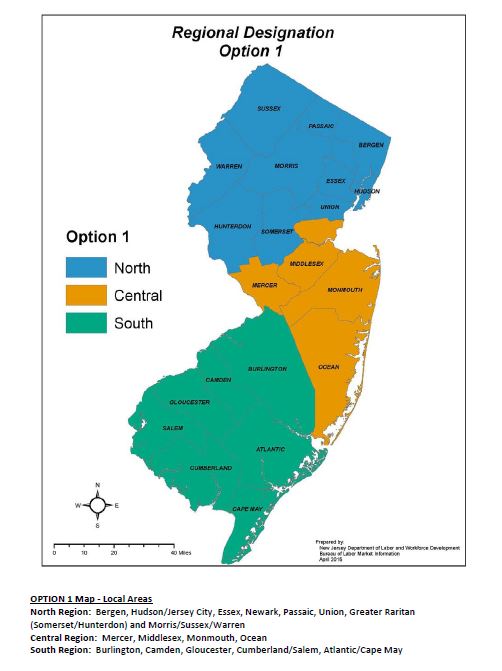
The SETC Governance Committee reviewed the workgroup recommendations, the feedback provided through the regional workforce meetings, and the public comment received. The committee is now proposing that Option 1, as illustrated by the attached regional map, be used for the purpose of creating three (3) workforce planning regions in New Jersey:
- North Region: Bergen, Essex, Newark, Hudson/Jersey City, Passaic, Union, Greater Raritan (Somerset/Hunterdon) and Morris/Sussex/Warren
- Central Region: Mercer, Middlesex, Monmouth, Ocean
- South Region: Burlington, Camden, Gloucester, Cumberland/Salem, Atlantic/Cape May
Upon formal resolution by the SETC, the policy will be posted on the SETC website and the policy document distributed to the Local Chief Elected Officials and Local Workforce Development Board Chairpersons and Directors. Subsequently, the policy will be submitted to the U.S. Department of Labor as part of the New Jersey Combined State Plan, and be available for public comment as part of the State Plan.
RESOLUTION: As required under the Workforce Innovation and Opportunity Act (WIOA) of 2014, the State Employment and Training Commission hereby resolves that three (3) workforce planning regions be designated in New Jersey: North, Central and South, as illustrated in the attached regional map. This policy takes immediate effect and will be included in the New Jersey Combined State Plan.
Attachment: Regional Designation Option 1 Map
Commission Approved: November 10, 2015
POLICY RESOLUTION: SETC #2015-06
SUBJECT: SCALES Policy Recommendations: Adult Basic Education - WIOA Title II Adult Education and Family Literacy Act
Purpose
The importance of New Jersey’s adult literacy system to the overall success of the state’s public workforce system is clearly and concisely articulated throughout New Jersey’s combined state plan under WIOA.
Background
The State Council for Adult Literacy Education Services (SCALES) focuses on improving the adult literacy delivery system. It is a bipartisan body created within the SETC by statute in 1999 to facilitate state and local policy development, planning and oversight in consultation with stakeholders in the area of adult literacy education.
In July 2015, SCALES created a taskforce that consisted of current SCALES members and local area adult basic education practitioners and experts. The taskforce held weekly conference calls and reported to the broader SCALES members through quarterly meetings. Over three months, SCALES was able to focus on three policy initiatives that can effectively strengthen both New Jersey’s adult literacy system and the public workforce system. The recommendations are provided here as the Adult Basic Education - WIOA Title II Policy Recommendations framework document.
For more than ten years, federal program aid coming from the Workforce Investment Act has been allotted to a lead agency in each county or workforce area. The lead agency selects other eligible agencies in the region to also deliver adult literacy services, and manages the funding and compiles the required fiscal and programmatic data and reports. The grants are not managed by the local Workforce Development Boards (WDBs). The aid is awarded directly to the lead agency, based on an annual application process to the NJ Department of Labor and Workforce Development (NJLWD). The role of each WDB has been to review and comment on the application before it is submitted to NJLWD to ensure alignment with the local area’s WDB plan.
Because no individual program has the resources and expertise to provide appropriate services to learners at each stage of their chosen career pathway, collaboration between programs is a necessity, rather than a luxury. WIOA requires programs at the regional and local levels to coordinate their activities in order to place career pathways at the heart of various services. For adult literacy learners to successfully navigate their chosen career pathway, there needs to be a partnership between adult literacy providers, postsecondary education and the employer system. SCALES will recommend three over-arching policy initiatives that have the potential to positively direct the adult literacy system in a more substantial role within New Jersey’s public workforce system.
Upon formal resolution by the SETC, the policy will be posted on the SETC website and shared with the NJ Department of Labor and Workforce Development, LWDBs, and One-Stop Career Centers. Subsequently, the policy will be submitted to the U.S. Department of Labor as part of the New Jersey Combined State Plan.
RESOLUTION: The State Employment and Training Commission accepts the policy recommendations in the attached Adult Basic Education - WIOA Title II Policy Recommendations framework document provided by SCALES, for incorporation into New Jersey’s Combined State Plan.
Commission Approval: November 10, 2015
SCALES Policy Recommendations: ADULT BASIC EDUCATION, WIOATITLE II ADULT EDUCATION AND FAMILY LITERACY ACT
This Act provides most of the aid for adult literacy, adult secondary education and English-as-Second Language in New Jersey. The purpose of the adult literacy programs is to enable undereducated adults to obtain the knowledge and skills for employment and economic self-sufficiency, and to succeed in their roles as family members and citizens.
Major Changes for Adult Literacy Programs As Required by WIOA
- Performance accountability measures focus primarily on employment outcomes, not on basic skills;
- Career pathways are emphasized as the way to move learners through adult literacy to postsecondary education and family-sustaining employment;
- It will be necessary for adult literacy to establish and maintain working partnerships with a variety of other programs and organizations if it is to achieve its goals under WIOA;
- The emphasis changes from enrolling students in “siloed’ programs to transitioning them into postsecondary education and family-sustaining employment.
Policy Recommendations for the NJ State Employment and Training Commission
- How do we ensure that all levels of adult learners are adequately served by the New Jersey Workforce System?
- The educational needs of all learners, including access to career pathways, must be considered in designing the Workforce System. This is particularly true in respect to lower-level learners.
- Programs need to tailor curriculum to each student’s level;
- For all level of learners, the Workforce System needs to provide the support (e.g. counseling, financial aid) that is necessary for progress through career pathways;
- For lower-level students, there needs to be recognition of realistic student outcomes, including indicators of “measurable skill gains”.
- How do we develop and support the program partnerships that are necessary to enable adult learners to move through adult literacy to postsecondary education and family-sustaining employment?
- State, regional and local collaborations are necessary if the Workforce System is to meet its goals. This is true because individual programs and organizations alone cannot develop the programs that are necessary for students to transition from adult literacy to postsecondary education and family-sustaining employment. Assistance in developing and maintaining partnerships must be provided at all levels and local WDB plans must specify how One-Stop programs will be coordinated to promote partnerships.
- Local planning must include identifying, combining and coordinating multiple sources of funding and directing the resulting “consolidated’ funding to adult literacy goal attainment.
- WDB plans for local and regional adult education networks will require that WDBs establish active Adult Literacy Councils representing all literacy providers in the area.
- How to develop the skills and knowledge adult literacy teachers, administrators and counselors need to function effectively in the New Jersey Workforce System?
- The state must develop, and adequately fund, a comprehensive, ongoing professional development system that enables adult literacy staff to meet new WIOA requirements,
- The state must require WDBS to conduct joint planning and training for One-Stop, adult literacy and WDB staff directed toward establishing partnerships, resource sharing and appropriate and necessary student referrals
- Professional development must utilize multiple delivery modes to reach part-time and other hard to reach staff. This includes a mix of in-person meetings, synchronous online events and resources made available online.
POLICY RESOLUTION: SETC #2016-02
SUBJECT: New Jersey Subsequent Local Area Designation
Background
The Workforce Innovation and Opportunity Act (WIOA) of 2014 requires that the Governor designate local areas that are consistent with labor market areas in the State, are consistent with regional economic development areas in the State, and have available the Federal and non-Federal resources necessary to effectively administer activities under 29 U.S.C. 3151 through 3181 (Chapter 32, Subchapter I, Part B, of WIOA) and any other applicable provisions of WIOA, including whether the areas have the appropriate education and training providers, such as institutions of higher education and area career and technical education schools. This is to be done through consultation with the State workforce development board and after consultation with chief elected officials and local boards, and after consideration of comments received through the public comment process as described within 29 U.S.C. 3112(b)(2)(E)(iii)(II).
Initial Designation and Timeframe
WIOA states that during the first 2 full program years following July 22, 2014, the Governor shall approve a request for initial designation as a local area from any area that was designated as a local area for purposes of the Workforce Investment Act of 1998 (WIA) for the 2-year period preceding July 22, 2014, performed successfully, and sustained fiscal integrity. The period of initial designation for local areas is from July 1, 2015 – June 30, 2017. This covers Program Years 2015 and 2016. Local areas must submit requests for initial designation using the process included in SETC Policy #2015-02.
Subsequent Designation and Timeframe
WIOA further states that after the initial designation period, the Governor shall approve a request for subsequent designation as a Local Workforce Development Area (LWDA) from such local area, if such area has performed successfully, sustained fiscal integrity and in the case of a local area in a planning region, met the requirements described in 29 U.S.C. 3121(c)(1). In addition, the SETC is requiring that the LWDA demonstrate its ability to coordinate planning with its regional partners, and fully support its WDB roles, through the Regional Coordination metric and WDB Certification metric, as defined in the Combined State Plan. Requests from local areas for subsequent designation must be provided to the SETC by March 31, 2017. The subsequent Local Workforce Area designation will be effective July 1, 2017.
Option 1: Existing Local Area, No Changes
The Local Workforce Development Area (LWDA) requests that its designation be continued under WIOA, with no changes to its current area configuration. The LWDA provides a letter of request to the SETC and NJLWD, and a signed Agreement with the Chief Elected Official, using the process, timelines and templates provided in this policy. The existing LWDA must demonstrate its ability to work effectively with its regional partners, as measured by the Regional Coordination metric outlined below. The existing LWDA must also demonstrate its ability to effectively carry out the WDB duties required under WIOA, as measured by the WDB Certification metric defined in the Combined State Plan.
Option 2: Modification of Local Area
If a local area, after consultation with all affected Local Workforce Development Board Directors and CEOs, opts to be subsequently designated as a different Local Workforce Development Area (LWDA) under WIOA, the Board Directors must contact the SETC and NJLWD by December 31, 2016. The SETC and NJLWD will then work with the Board Director and CEO(s) to plan the designation of the new LWDA, which will be held to the same criteria as other local areas seeking subsequent designation.
The new proposed LWDA must be consistent with labor market areas, align with regional economic development areas, must have available resources necessary to effectively administer activities under WIOA, must demonstrate performance success under the initial local area designation period, and must conform with New Jersey regional designation areas. The new LWDA must demonstrate how it will successfully achieve the Regional Coordination metric and WDB Certification metric, as defined in the Combined State Plan.
Examples of local area modification include: two existing local areas proposing to merge into a new combined single LWDA or various local areas that will be combined into a new single LWDA.
The new LWDA will then provide a letter of request to the SETC and NJLWD, and a signed Agreement with the Chief Elected Official, using the process, timelines and templates provided in this policy.
RESOLUTION: As required under the Workforce Innovation and Opportunity Act (WIOA) of 2014, the State Employment and Training Commission hereby resolves that Local Workforce Development Area (LWDA) requests for subsequent Local Workforce Development Area (LWDA) designation be submitted, and approved or denied, as outlined in this document, for subsequent LWDA designation beginning on July 1, 2017.
Commission Approved: January 19, 2016
New Jersey Local Area Initial Designation Policy, Process and Definitions
Option 1 - Timeline/Process for Existing Local Area, No Changes
- Letter of Request, signed by LWDB Chair, with Local Elected Official Approval of Request, and CEO Agreement for Single or Multi-Jurisdictional Local Area: Submit to SETC by February 28, 2017.
- SETC and NJLWD verify local area performance and fiscal integrity by March 31, 2017.
- SETC approves or denies local area requests for initial designation: April 2017
- SETC provides notice of approval/denial of initial designation requests to local areas: May 2017
Option 2 - Timeline/Process for Option 1 (Modification of Local Area)
- Local WDB Directors must contact the SETC and NJLWD to advise of the desired modification to the local area by December 31, 2016.
- The SETC and NJLWD will then work with the affected local area(s) to determine if the required conditions are met to enable this modification.
- Letter of Request, signed by LWDB Chair, with Local Elected Official Approval of Request, and CEO Agreement for Single or Multi-Jurisdictional Local Area: Submit to SETC by February 28, 2017.
- SETC and NJLWD verify local area performance and fiscal integrity by March 31, 2017.
- SETC approves or denies local area requests for initial designation: April 2017
- SETC provides notice of approval/denial of initial designation requests to local areas: May 2017
Chief Elected Official(s) (CEOs) Memoranda of Understanding (MOU) Executed with the Local Workforce Development Board(s)
This agreement ensures the local CEO of a single jurisdiction LWDA, or all local CEOs in a multi-jurisdiction LWDA understand and agree to the following items.
- Identification of counties and/or cities comprising the LWDA.
- Compliance with statutory and regulatory requirements In accordance with WIOA (P.L. 113-128), and organize and implement activities pursuant to WIOA and in accordance with requirements established by the Governor of the State of New Jersey for purposes of implementing programs and services under WIOA.
- Identification of the Chief Elected Official(s) in the LWDA who are parties to the agreement.
- Designation of the Grant recipient – Identification of the CEO who will serve as the local Grant Recipient responsible for the WIOA funds allocated to the LWDA.
- Designation of the Fiscal Agent – Designation by the Grant Recipient CEO of:
- A local governmental grant sub-recipient or fiscal agent to assist the CEO in the administration of the grant funds; or
- Acknowledgement that a Fiscal Agent will be designated, and that the entity will have reliable internal controls for financial management and disbursement of funds.
- Membership of the LWDB – Recognition to appoint a LWDB. If the LWDA is multi-jurisdictional, then identification of each local CEO’s role in appointing the LWDB.
Local boards should take steps to ensure that the MOUs with the Chief Elected Officials are kept current. The SETC will require the latest version to be submitted as part of the Local Workforce Development Board Certification process.
Performance Success
An area shall be determined to have performed successfully, for the purposes of subsequent designation, if:
- the local area has met any additional metrics, including the Regional Coordination metric and WDB Certification metric, as defined in the Combined State Plan
AND met either of the following criteria:
b) the local area has met or exceeded all common measures under WIA in the two preceding program years, Program Years 2014 and 2015. To meet the measure, the local area must have achieved at least 80% of the performance target
OR
c) the local area did not meet one or more of the common measures in either/both of these program years and subsequently created a performance improvement plan or corrective action plan, which was approved by the SETC. The area must have followed through on the planned improvements and subsequently met or exceeded that measure in the following program year.
With regard to the above definition of “performance success,” the State has provided local areas with a degree of flexibility in a manner consistent with pertinent State rules; specifically, N.J.A.C. 12:42-3.1 et seq.
Fiscal Integrity
An area shall be determined to have sustained fiscal integrity, if the Secretary of the United States Department of Labor has not made a formal determination, during either of the last 2 consecutive years preceding the determination regarding such integrity, that either the grant recipient or the administrative entity of the area misexpended funds provided under 29 U.S.C. 3151 through 3181 (Chapter 32, Subchapter 1, Part B, of WIOA) (or, if applicable, title I of the Workforce Investment Act of 1998 as in effect prior to the effective date of such part B of this subchapter) due to willful disregard of the requirements of the provision involved, gross negligence, or failure to comply with accepted standards of administration.
Appeals
Any unit of general local government (including a combination of such units) or grant recipient that requests but is not granted designation of an area as a local area may appeal that determination pursuant to the procedure set forth at N.J.A.C. 12;42-3.11 (Appeals). When utilizing the procedure at N.J.A.C. 12;42-3.11 for the purpose of challenging a denial of local area designation, one should substitute the phrase, “denial of local area designation” for the phrase, “corrective action and/or penalty determination;” and one should substitute the term “State Employment and Training Commission” for the term “Assistant Commissioner.”
POLICY RESOLUTION: SETC #2016-03
SUBJECT: New Jersey Local Workforce Development Area (LWDA) Programs Budget and Local Workforce Development Board (WDB) Budget and Staffing Requirements
LWDA Programs Budget – Background
Local Workforce Development Boards (WDBs) have specific oversight roles and responsibilities, including budgeting, which are outlined in WIOA Section 107. As part of the board’s responsibility for strategic planning, the board must ensure that the Local Workforce Development Area (LWDA) program budget reflects the goals and priorities of the regional and local workforce plans.
LWDA Programs Budget - Process and Requirements
- Workforce funding allocations are provided by the NJ Department of Labor and Workforce Development (NJLWD) through Notices of Obligation (NOOs) to the Local Workforce Development Areas (LWDAs) for each new Program Year (PY), beginning July 1, 2016 (PY 2016).
- The Local Workforce Development Board (WDB) staff will provide the local board with a draft LWDA Programs Budget showing all workforce funding streams, including the WorkFirst New Jersey (WFNJ) program, any external workforce grants received, and other sources of funding for the local area. The budget must also include the anticipated Level of Service (number of customers to be served) under each program in the local area. A template budget will be provided by the SETC.
- The LWDA Programs Budget must reflect the amount set aside for local board staffing requirements. Local boards should review and approve the LWDA Programs budget and the WDB Staff Budget at the same time.
- The local board will review and approve the LWDA Programs Budget and the WDB Staff Budget in an open and public process. This process must include:
- Initial budget review by a WDB-led budget committee, or an existing WDB committee;
- Budget presentation and recommendations made by this committee to the full WDB at one of its quarterly meetings;
- Approval by the full WDB within 90 days of receipt of the NOOs by the LWDA.
- The WDB must then provide the approved LWDA Programs Budget and the WDB Staff Budget to the SETC and NJLWD within ten (10) days of approval.
- If the budget(s) are modified at any time during the year, the modified budget must be approved by the local board in the same manner as outlined above, and the modified budget must be provided to the SETC and NJLWD within ten (10) days of approval.
- Failure to provide these budgets to the SETC and NJLWD may negatively impact the provision of workforce funds to the local area.
WDB Budget and Staffing Requirements
The Workforce Innovation and Opportunity Act (WIOA) stipulates specific functions and responsibilities of the local workforce boards under P.L. 112-128 Section 107(d). Requirements fall within three primary categories: Strategic Functions; System Capacity Building; and Systems Alignment and Effective Operations. To provide the best opportunity for local area success, the State Employment and Training Commission (SETC) and the New Jersey Department of Labor and Workforce Development (NJLWD) are requiring a fiscal set-aside for Workforce Development Board (WDB) staff.
At a minimum, the staff must include a full-time WDB Director, two full-time professional policy staff, and a full-time support person to execute the WDB functions that fall within the three primary categories identified above. The staff must also operate the required councils and committees as outlined within WIOA and required by the SETC. Job descriptions that clearly identify functions to be performed by each WDB staff must be developed.
Staff Functions and Cost Classification
Staff functions are what influences the cost classifications of personnel. Costs are Administrative or Program and can be Direct or Indirect. The Code of Federal Regulations (CFR) defines Administrative Costs as a portion of necessary and reasonable costs that are not related to direct provision of workforce services. These are further defined around financial management, procurement and purchasing, personnel and property management, payroll, audit and general legal services, oversight and monitoring of administrative activities, developing information systems and procedures related to administrative functions. Administrative costs are limited to a percentage of the total award (program or grant). The CFR also defines direct and indirect costs, and indicates they can be either Administrative or Program. Direct Costs are costs identified with a specific grant or program and can be readily identified with a particular cost objective, and are program specific. Indirect Costs are costs shared among multiple programs or categories and are not readily identifiable with a particular cost objective but are rather shared across objectives. Indirect cost rates are a percentage of a specific direct cost base and are negotiated. Local areas negotiate independently to establish their indirect cost rate. If the local area has already negotiated an indirect cost rate with a Federal agency, that rate remains in effect until they renegotiate a new rate. For example, NJLWD has an indirect cost rate of 2.87% set with USDOL, which remains in effect through June 30, 2016. The local area fiscal agent should have the specific knowledge pertaining to the indirect cost rate for the local area.
WDB Budget - Process
Workforce funding allocations are provided by the NJ Department of Labor and Workforce Development through Notices of Obligation (NOOs) to each Local Workforce Development Area (LWDA). Local areas are then required to develop a budget (template to be provided by the SETC) that reflects all workforce funding streams, including WorkFirst New Jersey, all external workforce grants, and any additional sources of funding for the local area.
The LWDA Programs Budget, beginning with PY16, must clearly delineate a sufficient set-aside for the WDB staff. The local board will be required to develop job descriptions that define staff functions to ensure the local area can properly classify functions with cost categories of administrative, program, direct or indirect. The WDB Staff Budget and Job Descriptions must be approved by the local board and submitted to the SETC and LWD within 100 days of receiving the NOO, along with the LWDA Programs Budget, as outlined above. The contract between LWD and the local fiscal agent should include the budget that reflects the amount set aside for local board staffing.
RESOLUTION: The State Employment and Training Commission hereby resolves that the Local Workforce Development Area Programs Budget and the Workforce Development Board Budget, including the required staffing costs, must be reviewed and approved by the Local Workforce Development Board, through an open and public process, within 90 days of the receipt of the Notice of Obligations by the LWDA, and provided to the SETC and NJLWD within 10 days of that approval. This policy takes effect for the Program Year 2016 budgets, starting July 1, 2016.
Commission Approved: January 19, 2016
POLICY RESOLUTION: SETC #2016‐05
SUBJECT: College and Career Readiness Standards for Adult Education
Purpose: The State Council for Adult Literacy Education Services (SCALES) recommends establishing the College and Career Readiness Standards as the standards for New Jersey’s Adult Basic Education (ABE) and English as a Second Language (ESL) System. Equipped for the Future (EFF) standards are currently the recognized standards for New Jersey’s Adult Literacy system. In order to create a consistent and comprehensive adult literacy system, the standards should align with the standards recognized by USDOL-OCTAE (Office of Career, Technical and Adult Education) and NRS (National Reporting System for Adult Education).
Background: SCALES focuses on improving the adult literacy delivery system. It is a bi‐partisan body created within the SETC by statute in 1999, to facilitate state and local policy development, planning and oversight in consultation with stakeholders in the area of adult literacy education. In carrying out its role, the Council is responsible for developing a broad‐based State Literacy Plan, appropriate performance standards, system‐wide impact measures, statewide benchmarks to evaluate adult literacy services, and advocating for professional development and information sharing for practitioners and policy makers.
In 2000, Equipped for the Future (EFF) were established as standards for New Jersey’s Adult Literacy system. The EFF standards expanded the traditional goals of adult literacy reading, writing and math, to include a wider range of the skills adults need to be successful in their families, communities and work. The EFF standards created broad guidelines for New Jersey’s Adult Literacy system.
In 2013, USDOL-OCTAE released the College and Career Readiness (CCR) Standards for Adult Education. These standards include a subset of the Common Core State Standards in English language arts/literacy and mathematics that are most appropriate for adult education. The College and Career Readiness Standards for Adult Education are aligned to the needs of both employers and the post-secondary community. Many states have adopted these standards for their adult literacy systems, in order to meet the new requirements under WIOA. The College and Career Readiness Standards for Adult Literacy not only meet the requirements of WIOA, the standards measure proficiencies up to a 12th grade level and beyond. In turn, USDOL-OCTAE is revising the EFL descriptors for Adult Basic Education and Adult Secondary Education to reflect the CCR standards.
The NRS is the state accountability system for the federally funded adult education program. It defines the descriptive, participation and outcome measures that each state must report on adult education students, specifes the methods states are to use to collect these measures and establishes reporting procedures. States report NRS data annually to the USDOL-OCTAE using data tables that contain aggregated state totals. The data provide a picture of adult education students that USDOL-OCTAE uses to report about the program to Congress, other Federal agencies, states and the public. USDOL-OCTAE also uses this data to set state performance levels and incentive awards.
WIOA promotes better coordination between local area Title II providers,One‐Stop Career Center programs and services, and the various workforce development partners. Better collaboration of One-Stop partners, implementation of proven EFF concepts and resources and alignment of college and career readiness standards, presents NewJersey’s Adult Literacy system with the opportunity to improve. The opportunities for improvement include service delivery,leveraging of available resources, professional and curriculum development.
RESOLUTION: In order to better align WIOA Title II programs with the federally recognized standards and data measures, the SETC formally adopts the College and Career Readiness Standards for Adult Education as the standards for New Jersey’s Adult Literacy system. This policy takes immediate effect and will be included in the New Jersey Combined State Plan.
Commission Approved: January 19, 2016
POLICY RESOLUTION: SETC #2016-06
SUBJECT: New Jersey’s Definition for Employment First
Purpose: In April 2012, Governor Chris Christie declared that New Jersey would become the 14th Employment First state in the United States. According to the United States Department of Labor’s, Office of Disability Employment Policy; Employment First means that competitive employment is the first and preferred post-education activity for everyone, including individuals with the most significant disabilities. The Workforce Innovation and Opportunity Act (WIOA) requires states and their LWDBs to invest prescribed resources to promote the creation and implementation of workforce development and training programs and services designed specifically for individuals with significant disabilities. A unified Employment First Definition for New Jersey would ensure the public workforce system has a singular focus and vision that ensures all workforce development/training resources dedicated for individuals with disabilities, including individuals with the most significant disabilities, have the potential for yielding the highest return on investment.
Background: Employment First, a framework for systems change that is centered on the premise that all citizens with disabilities, including individuals with the most significant disabilities, are capable of full participation in integrated employment and community life. Individuals with disabilities are a multi-skilled workforce resource for employers. An inclusive workplace promotes diversity, expands the tax base and creates an expanded pool of qualified candidates for available jobs. ‘Employment First’ is about creating an environment for individuals with disabilities, including individuals with the most significant disabilities, that empowers them with choices for their future, reduces poverty, shrinks enrollment in entitlement programs, eases demand on state and community based social service agencies and provides workers with a sense of achievement.
Employment First Definition
Competitive integrated employment will be seen as the first and primary option for all individuals with disabilities, including individuals with the most significant intellectual and developmental disabilities (ID/DD), who apply through informed choice for workforce services.
RESOLUTION: The State Employment and Training Commission hereby resolves that the State of New Jersey and its local area requests for defining Employment First for New Jersey, as identified above, be reviewed and approved or denied, as defined in this policy.
Commission Approved: January 19, 2016
POLICY RESOLUTION: SETC #2016-07
SUBJECT: Employment First Career Pathways Framework
Purpose: In April 2012, Governor Chris Christie declared that New Jersey would become the 14th Employment First state in the United States. According to the United States Department of Labor’s, Office of Disability Employment Policy; Employment First means that competitive employment is the first and preferred post-education activity for everyone, including individuals with disabilities. The Workforce Innovation and Opportunity Act (WIOA) of 2014 places a greater emphasis on career pathways across its titles. Employment First strategies must be developed within a Career Pathways Framework to ensure that individuals with disabilities, including individuals with significant intellectual and developmental disabilities, have equal access to competitive integrated employment in the general workforce and opportunities for economic self-sufficiency.
Background: Employment First is a framework centering on the premise that competitive integrated employment is the first and preferred outcome for individuals with disabilities, and New Jersey commits to support the development of an Employment First Framework utilizing Career Pathways to improve competitive integrated employment for individuals with significant intellectual and developmental disabilities.
Capitalizing on the work already done by the New Jersey Department of Labor in identifying industry sectors that engage employers and align the skills and training to the needs of targeted industry sectors, New Jersey’s workforce development system will strive to:
- Increase the availability of integrated workforce, education and employment opportunities for individuals with disabilities.
- Increase the number of youth with disabilities who earn a post-secondary industry-valued credential or degree in their chosen careers;
- Increase knowledge among individuals with disabilities and their families of the variety of pathways that lead to competitive integrated employment; and
- Increase the number of individuals with disabilities who obtain competitive integrated employment.
RESOLUTION: The State Employment and Training Commission undertakes a commitment to support the development of an Employment First Career Pathways Framework to improve competitive integrated employment for individuals with disabilities, including individuals with significant intellectual and developmental disabilities.
Commission Approved: January 19, 2016
POLICY RESOLUTION: SETC #2016-08
SUBJECT: The relationship between the State Employment and Training Commission (SETC) and the State Rehabilitation Councils (SRCs) for both the Division of Vocational Rehabilitation Services (DVRS) and Commission for the Blind and Visually Impaired (CBVI).
Purpose: It is recommended that both the State Rehabilitation Councils (SRCs) of the Division of Vocational Rehabilitation Services (DVRS) and the Commission for the Blind and Visually Impaired (CBVI) be recognized as the disability advisory and policy development entities for the SETC. The two SRCs are able to provide the SETC with expertise, advocacy and data when necessary, as it pertains to disability employment and workforce related issues that will impact New Jersey’s public workforce system.
Background: Under WIOA, State and Local Workforce Development Boards are encouraged to establish and maintain a standing committee that focuses on all the development of policies, planning, and performance for individuals with disabilities in New Jersey’s public workforce system. The SETC first established a disabilities issues committee in 2001. In 2008, the SETC’s Disabilities Issues Committee was rebranded as the Discoverability Committee. The committee’s work focused on a Medicaid Infrastructure Grant that had various policy-related initiatives, however the work of the committee became more operational in nature and was less focused on policy development and advisory roles.
The two State Rehabilitation Councils (SRCs) were established in Section 105 of the Rehabilitation Act of 1973, as amended. The Governor appoints the members of the SRCs. The SRCs give advice to, and work in partnership with, DVRS and CBVI. The two SRCs assist their respective agencies with the development of state goals and priorities, and evaluate the effectiveness of Vocational Rehabilitation programs. The SRCs are a partnership of individuals with disabilities, community-based organizations, state government agencies, advocates, employers and other interested persons. They are committed to ensuring through policy development, implementation and advocacy that New Jersey has rehabilitation programs that are not only comprehensive and consumer-responsive but also effective, efficient and significantly funded. The SRCs are dedicated to ensuring that individuals with disabilities receive rehabilitation services that result in employment. The SRCs are performing many of the functions that the SETC Disability Issues Committee was tasked with providing for the SETC in the past.
The SRCs will provide the SETC with information as it pertains to the needs, wants, and barriers facing individuals with disabilities who are served by Vocational Rehabilitation programs within New Jersey’s public workforce system. The SRCs are qualified to perform this function for the following reasons:
- Each SRC contains members who have the expertise and depth of knowledge to appropriately inform the SETC on the policy needs of individuals with disabilities.
- The SRCs conduct extensive statewide needs assessments of their customers, employees and employers, as well as ongoing customer satisfaction surveys.
- The SRCs provide oversight of programs and services for their respective state agencies.
- Each SRC has the necessary data that will help the SETC in making policy decisions that will further advance the opportunities for individuals with disabilities.
Process: As appropriate, the chairs of the DVRS and CBVI State Rehabilitation Councils will present information, reports, and policy recommendations to the SETC for its consideration. Agenda items will be considered at the discretion of the SETC Chairperson.
RESOLUTION: The State Employment and Training Commission hereby recognizes the DVRS and CBVI State Rehabilitation Councils as the entities which will provide disability expertise, policy recommendations and information to the SETC in order to improve New Jersey’s public workforce system and its services to individuals with disabilities.
Commission Approved: January 19, 2016
POLICY RESOLUTION: SETC #2016-09
SUBJECT: SETC Approval of New Jersey Initial Local Area Designations
Background: The Workforce Innovation and Opportunity Act (WIOA) of 2014 requires that the Governor designate local areas that are consistent with labor market areas in the State, are consistent with regional economic development areas in the State, and have available the Federal and non-Federal resources necessary to effectively administer activities under 29 U.S.C. 3151 through 3181 (Chapter 32, Subchapter I, Part B, of WIOA) and any other applicable provisions of WIOA, including whether the areas have the appropriate education and training providers, such as institutions of higher education and area career and technical education schools. This is to be done through consultation with the State workforce development board and after consultation with chief elected officials and local boards, and after consideration of comments received through the public comment process as described within 29 U.S.C. 3112(b)(2)(E)(iii)(II).
Initial Designation and Timeframe
WIOA states that during the first 2 full program years following July 22, 2014, the Governor shall approve a request for initial designation as a local area from any area that was designated as a local area for purposes of the Workforce Investment Act of 1998 (WIA) for the 2-year period preceding July 22, 2014, performed successfully, and sustained fiscal integrity.
The period of initial designation for local areas will be from July 1, 2015 – June 30, 2017. This covers Program Years 2015 and 2016. Local areas must submit requests for initial designation using the process included in SETC Policy #2015-02, approved October 9, 2015. Subsequent local area designations will be reviewed by the SETC in 2017, and will be effective July 1, 2017.
As shown in the attached summary, complete requests for initial designation have been received from 18 local areas. It has been determined that each of these areas has met the designation requirements, and has sustained performance success and fiscal integrity, as required under WIOA and SETC Policy #2015-02.
RESOLUTION: As required under the Workforce Innovation and Opportunity Act (WIOA) of 2014, the State Employment and Training Commission hereby approves the 18 local area designation requests received, for a period of initial designation from July 1, 2015 through June 30, 2017.
Attachment: Local Area Initial Designation Requests Received as of 3/29/2016
Commission Approved: March 29, 2016
Summary of Initial Local Area Designation Requests Received: 3/29/2016
Under SETC Policy Resolution #2015-02, and as required under WIOA, local areas are required to submit a letter of request, signed by the local Board Chairperson and approved by local elected officials, for the local area’s initial designation under WIOA. The period of initial designation for local areas will be from July 1, 2015 – June 30, 2017. This covers Program Years 2015 and 2016. The policy provided a template letter for local boards to use.
| Local Area | Request Letter Received | Board Chair Signature | Local Elected Official Approval | Performance Success Confirmed (SETC) | Fiscal Integrity Confirmed (LWD) |
|---|---|---|---|---|---|
| Atlantic-Cape May | 12/28/2015 | 10/14/2015 | 2/25/16 | Yes | Yes |
| Bergen | 1/21/2016 | 1/15/2015 | 1/21/2016 | Yes | Yes |
| Burlington | 12/17/2015 | 12/10/2015 | 12/9/2015 | Yes | Yes |
| Camden | 10/15/2015 | 10/13/2015 | 8/20/2015 | Yes | Yes |
| Cumberland-Salem | 12/23/2015 | 11/25/2015 | 12/22/15 | Yes | Yes |
| Essex | 1/15/2016 | 11/4/2015 | 2/10/2016 | Yes | Yes |
| Gloucester | 12/01/2015 | 11/25/2015 | 11/24/2015 | Yes | Yes |
| Greater Raritan | 11/10/2015 | 11/9/2015 | 11/9/2015 | Yes | Yes |
| Hudson | 2/9/2016 | 10/27/2015 | 3/8/2016 | Yes | Yes |
| Jersey City | 2/9/2016 | 10/27/2015 | 3/22/2016 | Yes | Yes |
| Mercer | 1/7/2016 | 10/27/2015 | 11/24/2015 | Yes | Yes |
| Middlesex | 1/26/2016 | 1/26/2016 | 2/4/2016 | Yes | Yes |
| Monmouth | 1/20/2016 | 11/30/2015 | 12/10/2015 | Yes | Yes |
| Morris-Sussex-Warren | 12/8/2015 | 12/7/2015 | 11/23/15 | Yes | Yes |
| Newark | 1/18/2016 | 1/13/2016 | 1/15/2016 | Yes | Yes |
| Ocean | 12/8/2015 | 10/14/2015 | 12/2/2015 | Yes | Yes |
| Passaic | 1/28/2016 | 12/28/2016 | 1/26/2016 | Yes | Yes |
| Union | 1/22/2016 | 1/7/2016 | 1/21/2016 | Yes | Yes |
POLICY RESOLUTION: SETC #2016-11
SUBJECT: Industry-Valued Credentials
Background: In preparation to implement the Workforce Innovation and Opportunity Act (WIOA) of 2014, New Jersey adopted Pathways and Partnerships: New Jersey’s Blueprint for Talent Development that includes seven policy goals and related strategic actions as a guide. Among those strategic actions is a focus on increasing the number of individuals in New Jersey who have earned an industry-valued post-secondary credential or degree. To support this goal, New Jersey is developing a list of industry-valued credentials based on extensive analysis of labor market data and based on extensive feedback from employers.
A credential is defined as a recognized degree, diploma, certificate or certification; awarded by an occupation. Industry-valued credentials will have the following characteristics:
- Valued and demanded by employers
- Portable – skills learned are transferable and provide broad opportunities
- Stackable – skills learned may lead to opportunities for continuous or advanced training and education
- Leads to higher wages, career advancement, and/or increased job security
The State will use this list to guide training investments across federal and state workforce programs. This list will also act as a consumer protection for those in search of training. Job seekers and those seeking career advancement can be assured that a credential is valid and recommended by knowledgeable employers, educators, and workforce professionals.
The Statewide Demand Occupations List still stands and will be maintained as required by New Jersey state law.
Process to Create and Recognize the Industry-Valued Credentials List
New Jersey will develop the industry-valued credential list on an annual basis using the following process. This effort is currently underway and a draft Industry-Valued Credentials list was released for public comment in March 2016. The final list for 2016-2017 will be released in May 2016 and will go into effect on July 1, 2016.
- Analysis of Labor Market Data
Labor market analysts in the Department of Labor and Workforce Development (LWD) have initially identified credentials in demand by the seven major industry clusters in New Jersey.
These are Advanced Manufacturing; Financial Services; Health Care; Life Sciences; Retail, Hospitality & Tourism; Technology; and Transportation, Logistics & Distribution. Credential information will also be included for the Utility and Construction industries. This research includes the review of New Jersey specific labor data and occupational employment projections. LWD has identified occupational employment trends by industry and wages, major employers, demand occupations, and demand degrees/certifications. LWD has also analyzed job-postings data to identify credentials and degrees that are included in employer’s hiring efforts. Labor market analysts have also reviewed relevant labor market reports and analysis developed by established industry associations, universities and the federal government.
- Feedback from Employers
The state’s Talent Networks are being used to obtain feedback from employers and industry experts during the development of the industry-valued credentials list. Directors associated with our major industries reviewed and updated the draft credentials list prior to meetings with all Talent Network partners. Subsequently, ten industry-specific meetings were held with those partners to solicit additional employer feedback and create a preliminary list of industry-valued credentials. Among the topics discussed in the meetings were current credentials in demand, relevance of current labor market information, and the importance of credentials in the hiring process.
Expanded input from employers is being gathered through an on-line survey distributed by the LWD Office of Research and Information with the assistance of the Talent Networks and industry associations. The survey will be used to obtain direct feedback from employers on the value of various credentials and degrees.
- Feedback from Stakeholders
In February, an initial list of industry-valued credentials and degrees was released for public comment. Educational institutions, workforce development boards, training providers and other stakeholders will be encouraged to provide feedback on the initial list.
- Formal adoption of the list by the Credential Review Board
In accordance with state law, LWD’s Center for Occupational Employment Information will create a Credential Review Board. This Board, made up of representatives from LWD, the Department of Education, the Office of the Secretary of Higher Education and the State Employment and Training Commission, will review the draft list, all available data and information and the feedback from employers and stakeholders. The Credential Review Board will establish the industry-valued credentials list. The Credential Review Board will make final recommendations and approve the list no later than May 2016. The adopted list will be published no later than May 31, 2016.
Process to Maintain and Update the Industry-Valued Credentials List
There will exist a need to update the list based on changes in an industry or the economy. In the first year following adoption of the list by the Credentials Review Board, the Board will be assembled at least once per quarter to review and update the existing list. Subsequently, the CRB will be assembled at least once every six months to review and update the existing list. Changes to the list may be initiated at any time by changing labor market conditions, a request by an employer or other responsible and authorized body, or by call of the CRB itself. A public comment period will be held for any proposed changes to the list prior to adoption by the CRB.
Goals
The State intends to create a workforce system valued by employers that also creates bridges for individuals to attain post-secondary credits. Our goal is to dedicate at least 80% of all federal and state funds spent on occupational training to programs that result in an industry-valued credential or degree. The five-year plan will proceed incrementally for each Local Area as follows:
State Fiscal Year 2017(July 1, 2016 through June 30, 2017) – 50%
State Fiscal Year 2018(July 1, 2017 through June 30, 2018) – 60%
State Fiscal Year 2019(July 1, 2018 through June 30, 2019) – 70%
State Fiscal Year 2020(July 1, 2019 through June 30, 2020) – 75%
State Fiscal Year 2021(July 1, 2020 through June 30, 2021) – 80%
Resolution: It is hereby resolved that the State Employment and Training Commission formally adopts the “Policy on Industry-Valued Credentials”. This policy takes immediate effect and will be included in the New Jersey Combined State Plan, 2016.
Commission Approved: March 29, 2016
POLICY RESOLUTION: SETC #2016-13
SUBJECT: SETC Approval of Local Area Designation for Cumberland-Salem-Cape May
Background: The Workforce Innovation and Opportunity Act (WIOA) of 2014 requires that the Governor designate local areas that are consistent with labor market areas in the State, are consistent with regional economic development areas in the State, and have available the Federal and non-Federal resources necessary to effectively administer activities under 29 U.S.C. 3151 through 3181 (Chapter 32, Subchapter I, Part B, of WIOA) and any other applicable provisions of WIOA, including whether the areas have the appropriate education and training providers, such as institutions of higher education and area career and technical education schools. This is to be done through consultation with the State workforce development board and after consultation with chief elected officials and local boards, and after consideration of comments received through the public comment process as described within 29 U.S.C. 3112(b)(2)(E)(iii)(II). WIOA states that during the first 2 full program years following July 22, 2014, the Governor shall approve a request for initial designation as a local area from any area that was designated as a local area for purposes of the Workforce Investment Act of 1998 (WIA) for the 2-year period preceding July 22, 2014, performed successfully, and sustained fiscal integrity. The period of initial designation for local areas is from July 1, 2015 – June 30, 2017. This covers Program Years 2015 and 2016. Subsequent local area designations will be reviewed by the SETC in 2017, and will be effective July 1, 2017.
On March 29, 2016, the SETC approved the requests for initial designation from 18 local areas, including the Atlantic-Cape May and Cumberland-Salem areas. Each of these areas met the designation requirements, and sustained performance success and fiscal integrity, as required under WIOA and SETC Policy #2015-02.
Request and Process: The SETC has received a request for a new local area designation of Cumberland-Salem-Cape May. This request was received from the Cumberland-Salem Workforce Development Board, with the approval of Cumberland County, Salem County and Cape May County Freeholders. The attached letter of request and partnership proposal outlines the designation request for these three counties to form a local area, operating under one local Workforce Development Board. The approval of this request will establish the Cumberland-Salem-Cape May Local Area, and as a result, Atlantic County will then operate as a separate local area.
Timeframe: The Cumberland-Salem-Cape May Local Area and the Atlantic County Local Area will be designated from July 1, 2016 – June 30, 2017. Subsequent local area designation requests will be required from all local areas, and will be effective July 1, 2017.
RESOLUTION: The State Employment and Training Commission hereby approves the local area designation request received from Cumberland-Salem-Cape May for designation as a Local Area, from July 1, 2016 through June 30, 2017.
Attachments: Cumberland-Salem Workforce Development Board Request Letter, 4/7/2016; Cumberland-Salem-Cape May Proposed Workforce Development Partnership
Commission Approved: May 3, 2016
POLICY RESOLUTION: SETC #2016-14
SUBJECT: New Jersey Local One-Stop Career Center Certification Process
Purpose: Local One-Stop Career Centers are critical to the provision of programs and services in the local area. The Workforce Innovation and Opportunity Act (WIOA) of 2014 reinforces the importance of each Local One-Stop by requiring the Governor in partnership with the State Workforce Development Board and local workforce boards, to establish criteria based on items outlined in WIOA Section 121 to certify One-Stop Career Centers.
Background: WIOA Section 121, requires that local One-Stop Career Centers shall be certified. The law links such certification to the ability to receive potential infrastructure funding for the One-Stop. Such certification shall be based on established criteria and the extent to which the One-Stop provides programs and services in the local area that have enabled that area to satisfy or exceed performance and quality service criterion.
The Malcolm Baldrige National Quality Award principles establish an approach to performance excellence with a focus on continuous improvement. WIOA requires that the State establish a level of expectation for One-Stop certification that local boards must utilize (or may exceed) as a basis to certify a One-Stop under its auspices. The Baldrige approach to gauging efforts regarding leadership, strategic planning, customer and market focus, information and analysis, human resource focus, process management and business results has been adopted in many states as a format in establishing such a certification process.
The New Jersey State Combined Plan requires that local workforce areas competitively procure a One-Stop Operator every 2 years. While the WIOA law speaks to a 4-year requirement, New Jersey would need to be consistent with its existing plan.
New Jersey’s One-Stop Career Center certification process will be put into effect as of July 1, 2017; consistent with the requirement for a competitively procured One-Stop Operator to be in place in each local workforce development area. Local procurement efforts typically require a multi-month process to complete. Having this information available should assist in establishing a baseline for One-Stop efforts.
The first part of the policy establishes a yes/no set of requirements to determine whether One-Stops satisfy a number of requirements. The policy further establishes a work group including state and local representatives who would be charged with establishing future quantitative objective standards.
Under this policy local workforce boards must establish a local process of review that may include a qualified group of non-conflicted local board members or a qualified third party. All local areas will have the responsibility to ensure that the group established locally is qualified and able to perform such work.
Pre-requisites to certification are necessary. This recognizes essential elements of programming/service that must be in place prior to certification. This includes matters like accessibility standards, establishment of a grievance/complaint system for customers, a certified local Workforce Development Board and a local MOU that includes the workforce board and its partners.
A local workforce area will submit a request for local One-Stop Certification. The area will show to document that they have satisfied requirements by documenting that all pre-requisite matters and the Certification Checklist, or a similar document that satisfies the specific requirements of the Checklist and more, are completed. Those responses will be shared with the SETC/LWD which will review the request, assess its credibility and determine whether the request should be brought to the full SETC for consideration.
Timeframe: All items identified in the One-Stop Certification process are due to the SETC through the period July 1, 2017 to June 30, 2019.
| Date | Activity/Outcome |
|---|---|
| October 2016 | One-Stop Certification Process Rollout |
| November 2016 – June 2017 | Technical Assistance and Capacity Inventory made available |
| April 1, 2017 | SETC/LWD establish One-Stop Certification Request Review Panel(s) |
| July 1, 2017 to June 30, 2019 | Local workforce board may refer locally approved certification request to the SETC |
| July 1, 2017 to June 30, 2019 | SETC/LWD review panel approval process ongoing |
| September 2017 to June 2019 | Full SETC consideration for recommended certifications |
| October 2017 | Convene State/Local body to develop future certification criterion |
| July 2018 | SETC consideration of State/Local body for future certification criterion |
| July 1, 2019 | New certification criterion to be implemented |
| Process Guide | Required Materials and Information |
|---|---|
Local workforce development boards will submit a One-Stop Certification package for SETC consideration during the two-year period. That request should include:
| |
Documentation of the pre-requisite requirements prior to certification consideration:
| |
Subsequent certifications:
|
Attachments: NJ One-Stop Certification Checklist
Commission Approved: September 20, 2016
New Jersey One-Stop Certification Process Checklist
Background – The following documents are required to be submitted by each local Workforce Investment Area seeking One-Stop Certification. These may be considered gateways to certification consideration:
- A completed cover document / letter of transmittal requesting State of New Jersey One-Stop certification;
- Current/Full Workforce Development Board Certification
- Verification of meeting disability/accessibility standards;
- Verification of meeting grievance/complaint/EO standards;
- Local Memorandum of Understanding between the Workforce Board and its local one-stop partners;
- A completed Quality Benchmarking Tool;
- Completed Minimum Standard of Service Delivery Checklist.
ONE-STOP CERTIFICATION - QUALITY BENCHMARKING TOOL
Category No. 1: Leadership
Partners agree on a shared vision for a customer-driven service delivery system. Yes No
Evidence Indicator: A shared vision among all required partners is documented in MOU.
Agreements (e.g. MOUs) indicate that partners/suppliers have agreed to short/long-term goals regarding broader economic/political goals of the community. Yes No
Evidence Indicator: Agreements recognize goals established by Workforce Development Board, State of New Jersey and United States Department of Labor.
Systems exist that demonstrate the existence and utilization of regional efforts including a collaborative plan and resource sharing that indicate efforts are not constrained by governmental or political boundaries. Yes No
Evidence Indicator: Regional plans and service agreements indicate joint utilization of services with a breakdown of shared costs.
A local governance process that is charged with overseeing the planning and provision of one-stop services. Yes No
Evidence Indicator: Workforce Board (or committee) includes this as among its charges and is corroborated by minutes/documentation.
Community partners have been educated in such a manner that a wide range of partners have participated in discussions regarding the model/management of the One-Stop. Yes No
Evidence Indicator: Attendance/public hearing lists for presentations/meetings where the discussions are held are maintained/available.
Category No. 2: Strategic Planning
All required programs/partners are involved in strategy development and are appropriately represented in full service One-Stop Career Centers. Yes No
Evidence Indicator: Records indicate participation and organizations are providing services in One-Stop on a regularly scheduled basis.
Process in place to document expectations of board, partners, staff and service clients. Provided in manner in which activity may be measured against goals. Yes No
Evidence Indicator: Records maintained documenting efforts/results of associated groups.
Local certification plans exist for centers/affiliates as appropriate. Yes No
Evidence Indicator: Copies of plans/associated guidelines.
Federal and NJ performance metrics are utilized for measuring performance against plan and as decision-making tool. Yes No
Evidence Indicator: Documentation for decision-making maintained/reviewable. Confirms decisions.
Eligible Training Provider List, Consumer Report Card, performance data and evidence-based results are utilized in decision-making. Yes No
Evidence Indicator: Documentation for decision-making Maintained/reviewable. Confirms decisions.
Training opportunities are linked, where appropriate, to career pathways and industry-based credentials. System ensures that service clients may build upon their skills throughout their career. Yes No
Evidence Indicator: Client folder discusses career paths, future opportunities and manners of accomplishment.
Clear area commitment to Employment First for applicable service clients. Yes No
Evidence Indicator: File indicates placement/wages for service clients. Wage should satisfy requirements of Employment First.
Category No. 3: Customer and Market Focus
Public hearings/focus groups used to attain customer input as part of service planning. Yes No
Evidence Indicator: Records/minutes of proceedings are kept and included in plans as appropriate.
Single points of contact have been established in the area for business and client customers. Yes No
Evidence Indicator: Records indicate single point of contact for each appropriate client.
Client customer satisfaction data (e.g. surveys, etc.) is used as justification for service/products and as documentation of continuous improvement. Yes No
Evidence Indicator: Records are maintained that indicate satisfaction and used as a basis for service/product provision.
Partnerships exist that cut across the market to ensure access to groups/individuals that may help ensure success. Yes No
Evidence Indicator: Agreements/MOUs are maintained/signed that document relationships, and the basis of the relationship that include, but are not limited to organizations such as community colleges, employer groups, trade associations, talent networks/targeted industries, labor organizations and community/faith-based organizations.
Foundation for workforce development investments have been established with industry-focused Talent Networks, Targeted Industry Partnerships and Talent Development Centers. Yes No
Evidence Indicators: Records indicate service focus on supporting targeted fields.
Review local services/approach to examine how Career Center system determines customer/market requirements; expectations and preferences; successes/failures; and, adjusts to findings as step towards continuous improvement. Yes No
Evidence Indicator: Records document that local determination took place, information reviewed, acted upon and that service/program structure reflects the results.
Category No. 4: Information and Analysis
Operator demonstrates how use of information and information technologies support/enhance customer service and staff effectiveness. Yes No
Evidence Indicator: Documentation exists that demonstrates use of information/technology in supporting/enhancing customer service and staff effectiveness.
Local service audit utilized to identify areas/opportunities for new/improved products/services. Yes No
Evidence Indicators: Audit result leading to changes reviewed.
Stakeholder training teaching stakeholders how to analyze the relationship between quality improvement, customer satisfaction and financial performance. Yes No
Evidence Indicator: Documentation of training/attendance exists and is reviewable.
System-wide method for collection, analysis and use for data exists and is used by Operator. Yes No
Evidence Indicator: Documentation is reviewed that details methods of collection and use. Analysis is made available and is indicative of activities/actions taken in area.
Category No. 5: Human Resource Focus
Guidelines and a plan for ongoing capacity building have been developed to ensure that staff at all levels of process are trained and expert in providing customer oriented services at a high level. Yes No
Evidence Indicator: Training schedules, content and attendance list are maintained and reviewable.
Process exists to identify and conduct necessary training sessions for all levels of system staff and program/service suppliers. Yes No
Evidence Indicator: Process is documented; results are in reviewable form and attendance lists maintained.
Information systems and work processes are designed to promote collaboration and sharing of findings across multiple partner organizations and work units. Data is used as a basis for performance review. Yes No
Evidence Indicator: Processes and systems for sharing are documented and use of data for performance is available for review.
Category No. 6: Process Management
Local certification process based upon quality/Baldrige criteria for performance measures and quality assurance has been established for product/service suppliers. Yes No
Evidence Indicator: Process is documented and available for supplier review and adaptation.
A documented service flow for each One-Stop exists. The process indicates timelines and methods for referral and how Eligible Training Provider list and Consumer Report Card is managed and how ITAs are made available within process. Yes No
Evidence Indicator: Service flow is available for review. It documents time lines and methodologies for potential actions/activities.
Processes for the handling of poor performance by Operator, partner and service/product provider are documented. Yes No
Evidence Indicator: Documents are available; processes are realistic/implementable.
System has been established to document strengths/weaknesses of processes to develop more effective, customer-oriented processes. Yes No
Evidence Indicator: Document is available; process improvement is realistic/implementable
Services/Programs are organized functionally; not be funding source, program or staff. Yes No
Evidence Indicator: Documentation and physical structure demonstrate functional alignment.
Category No. 7: Business Results
Service renewal and incentive programs are linked to meeting/exceeding specific performance standards. Yes No
Evidence Indicator: A documented policy is available for review and any renewals are consistent with process stated.
Business results are defined within context of improved service quality for customers by center and by system. Success measures go beyond measures such as placement rates. Yes No
Evidence Indicator: Performance is documented by measures beyond placement and consider referral location, one-stop (where applicable) and other factors (e.g. referral staff, skill levels, etc.)
Service supports are measured to determine impact on service results. Yes No
Evidence Indicator: Measures/analysis is performed for various forms of support (e.g. transportation, counseling, child care etc.) has taken place and is documented/available for review.
Guidelines and a plan for ongoing capacity building have been developed to ensure that business volunteers at all levels of process are trained and prepared to understand the needs of the workforce system at a high level. Yes No
Evidence Indicator: Training schedules, content and attendance list are maintained and reviewable.
Process exists to identify and conduct necessary training sessions for all levels of business volunteers. Yes No
Evidence Indicator: Process is documented; results are in reviewable form and attendance lists maintained.
Business partners have been educated in such a manner that a wide range of partners have participated in discussions regarding the model/management of the One-Stop. Yes No
Evidence Indicator: Attendance/public hearing lists for presentations/meetings where the discussions are held are maintained/available.
Processes for ongoing private sector membership, participation and outreach are in place along with systems that ensure linkages between ongoing workforce services with the needs of the business community and employers. Yes No
Evidence Indicator: Levels of business board membership, business association memberships and links between program services and business/employer demand.
Employer customer satisfaction data (e.g. surveys, etc.) is used as justification for service/products and as documentation of continuous improvement. Yes No
Evidence Indicator: Records are maintained that indicate satisfaction and used as a basis for service/product provision.
POLICY RESOLUTION: SETC #2017-01
SUBJECT: New Jersey Credential Attainment Goal, 65 by 25 Initiative
Purpose: The New Jersey Combined State Plan for the Workforce Innovation and Opportunity Act (WIOA), 2016, focused on two critical goals - building an innovative skilled workforce to power economic growth and building economic opportunity for all New Jersey residents. The State Plan outlined a mission: New Jersey will increase the number of residents with an industry‐valued credential or degree through high quality partnerships and integrated investments. To support this effort, the State Employment and Training Commission endorses the creation of a statewide credential attainment goal, that 65 percent of the State’s adult population, with a special focus on race and gender equity, complete education beyond high school by the year 2025, the 65 by 25 Initiative.
Background: In September 2016, the SETC formed a Career Pathways Task Force, to continue the Policy Academy partnership of Education, Higher Education, Labor and Workforce Development, and Business. These agencies have worked together in unprecedented ways to align resources and programs in support of career pathways and talent development in New Jersey.
In 2015, 48 percent of New Jersey‘s workforce had earned an associate’s degree or higher and 13 percent had some college but no degree; the State’s Governor’s Higher Education Council in its 2015 report, Strategic Priorities for New Jersey Higher Education, recommended that 65% of New Jersey’s workforce attain a post-secondary degree or certificate by 2025.
The SETC Career Pathways Task Force recognizes that credential attainment is an integral component and building block of a career pathway system. In order for New Jersey to remain competitive in a global economy, there is a critical need to focus workforce and education efforts on the attainment of credentials by our students and workers, which supports their individual growth and economic success. New Jersey will encourage students and job seekers to complete an associate or baccalaureate degree or a credential through the 65 by 25 Initiative.
RESOLUTION: The SETC calls upon New Jersey’s workforce development system, high schools, training providers, higher education institutions, organized labor and the business community, to work collaboratively to increase the number of degrees or credentials attained by New Jersey’s workforce, so that 65 percent of the state’s adult population, with a special focus on race and gender equity, will have completed a post-secondary degree or credential beyond high school by the year 2025.
Commission Approval: February 7, 2017
POLICY RESOLUTION: SETC #2017‐02
SUBJECT: SCALES - Coordination of Adult Literacy Services
Purpose: The State Council for Adult Literacy Education Services (SCALES) recommends establishing a policy that recognizes the various sources of adult literacy education program resources; and that notes the importance of coordinating related programs locally in order to maximize services to people needing such services.
Background: The primary funding source for adult literacy in the State of New Jersey is the federal Adult Education and Family Literacy Act (AEFLA). Formerly incorporated as Title II of the Workforce Investment Act (WIA), in 2014 it continued as Title II of the Workforce Innovation and Opportunity Act (WIOA). Final regulations for Title II were published in the Federal Register in the summer of 2016. Changes in these regulations may be summarized as:
- Restates the purpose of the AEFLA;
- Updates and revises regulations regarding the suitability of testing for use in the National Reporting System for Adult Education;
- Describes the process and requirements to award contracts/grants including new requirements associated with WIOA and the required involvement of local Workforce Development Boards in the review of applications and the alignment of activities;
- Describes how Title II funds may be used to support programs for corrections education and the education of other institutionalized individuals;
- Clarifies the use of funds for new and expanded activities under the Integrated English Literacy and Civics Education program; and,
- Removal of sections no longer in effect
Realizing the goals of WIOA, requires reexamination of the way programs are organized in light of available resources.
Discussion: In New Jersey, more than 800,000 adults lack a high school diploma. Title II of the Workforce Innovation and Opportunities Act, the largest funding source for adult literacy services, provides resources to serve only about 3 percent of this population. Although other programs fund adult literacy education, these programs are located in different funding areas and have not been historically coordinated with Title II in a holistic manner. Examples include:
- Supplemental Nutrition Assistance Program (SNAP) Employment and Training – SNAP is the program that replaced traditional food stamps. SNAP Employment & Training dollars may be used to provide services that allow able-bodied individuals to return to work. These resources may be used to provide Title II-style services, as needed;
- Temporary Assistance for Needy Families/Work-First New Jersey – Welfare-to-work dollars allow for the provision of services to eligible recipients. Adult education, literacy and English language services, comparable to Title II are included in its service availability in a number of cases;
- Higher Education Pell Grants (developmental skills) – Pell grants are historically used as a financial aid instrument for programs approved by the federal government to award these funds. While they may be used towards improving literacy skills as part of a more aspirational goal, these resources which do not require any input from a local workforce development board. The literacy programs in institutions that provide these services may accept students through a local workforce process with the hope that these organizations would be open to discussion to link these efforts to the existing literacy system in the area;
- Workforce Development Partnership – A State program that provides resources for employment and training purposes. Resources are used in local workforce areas as part of what is called the Supplemental Workforce Fund for Basic Skills (SWFBS);
- Literacy New Jersey (formally Literacy Volunteers of New Jersey) – As a major provider of instruction for adults who need assistance with reading, writing, math and speaking English, this group provides volunteer tutors and works with small groups of those in need. SCALES recognizes their value and suggests that a successful literacy system would be able to integrate these and similar services; and,
- Community Services Block Grants (CSBG) – Federal anti-poverty funds allocated to 25 agencies across the state that provide a broad range of support services and training opportunities to families at or below 125% of the federal poverty guideline. Comprehensive case management assists families in accessing services that enhance self-sufficiency, and address the causes and conditions of poverty. Services include housing assistance, child care, ESL and literacy services, job training, youth and senior programs, and health care.
In order to maximize efficiency in a resource scarce environment, it is important that the funding streams for adult literacy be coordinated as best possible within the guidelines of laws and regulations.
Equally important is the emphasis in WIOA on the transition of learners from their beginning levels to higher education and family sustaining employment. When learners transition, they move across existing programs, hopefully, in a seamless way. Their transitions cannot take place, unless the various literacy programs within a community are coordinated.
In consideration of this need for resource coordination, SCALES recommends that guidelines for local Workforce Development Boards (WDBs) ask that they develop plans which seek to join together local literacy resources, including, but not limited to those included in this document into a more comprehensive and coordinated local literacy system. Local WDBs should specify in local and regional plans a priority for the development of such a system that is tied to local and regional planning data that indicates the need for the programming. Further, such plans should indicate how such efforts would be co-planned and co-joined throughout their respective communities. This plan should identify local and regional needs and, prioritize, in consideration of the applicable funding sources, how the resources should be used to advance learners along the educational spectrum to meet their needs and employer needs. SCALES further recommends that the state work with local providers to develop appropriate program standards for the professional development and technical assistance local WDBs will need to implement this resolution.
Commission Approved: June 6, 2017
POLICY RESOLUTION: SETC #2017-03 (Updated)
SUBJECT: State Funding Mechanism for Local Infrastructure Costs
As a result of the USDOL-ETA Combined Compliance Review (CCR) conducted in July 2018, this policy is updated to reflect that the Governor will determine One-Stop Partner contributions if consensus is not reached in the local area, in compliance with 20 CFR 678.730(b) and TEGL No. 17-16.
Resolution: It is the policy of the SETC that it shall ensure that each local Workforce Development Board (WDB) will comply with the Workforce Innovation and Opportunity Act (WIOA) of 2014 and make every effort to reach consensus with its local partners to implement a local Infrastructure Funding Agreement (IFA), as part of the One-Stop Partner Memorandum of Understanding (MOU). As required by WIOA, the SETC hereby approves the New Jersey State Funding Mechanism for Local Infrastructure Costs, and the process as described below, for use in the event that any local area in New Jersey is unable finalize its local IFA by January 1, 2018.
Purpose: The Workforce Innovation and Opportunity Act of 2014 (WIOA) requires that local Workforce Development Boards (WDBs) establish, as part of their Memorandum of Understanding (MOU), an Infrastructure Funding Agreement (IFA) for non-personnel One-Stop related costs (including rent, security, technology and utilities). The law further requires the establishment of a State Funding Mechanism (SFM) to be used ONLY if local areas are unable to finalize a local IFA by January 1, 2018. This policy establishes the State Funding Mechanism for New Jersey.
Background: WIOA requires that each local board, as part of its MOU with its partners, indicates how partners shall contribute to the infrastructure needs of the one-stop system as part of a Local Funding Mechanism (LFM). Contributions may be made in cash or in appropriately evaluated in-kind contributions. The MOU shall detail in the IFA how infrastructure funding shall be contributed. If a local area cannot reach consensus on a LFM, a State Funding Mechanism (SFM), as outlined in this policy, shall be utilized. As stated in WIOA, the local WDB has the responsibility for the MOU and the LFM.
This is based upon the requirements provided at:
- Title I of the Workforce Innovation and Opportunity Act (WIOA) PL 113-128, July 22, 2014; WIOA Sections 107, 111(b) and 121(c), (d), (g), and (h)
- Training and Employment Guidance Letter (TEGL) 17-16: Infrastructure Funding of the One-Stop System
- WIOA US Department of Labor/US Department of Education Joint Rule (81 FR 56016, August 19, 2016), Subpart E, 678.700 – 678.760; 361-70 – 361.760; 463.700 – 463.760
Discussion: WIOA requires that all one-stop partner programs appropriately contribute to infrastructure funding of the one-stop system. According to WIOA, the following programs must be considered:
Required Partners:
- Title I programs (Adult, Dislocated Worker, Youth, Job Corps, YouthBuild, Native American, and migrant seasonal farmworkers);
- Title II (WIOA) adult education and literacy activities;
- Wagner-Peyser Act (Title III of WIOA) employment services programs;
- The Vocational Rehabilitation program under the Rehabilitation Act (Title IV of WIOA);
- The Senior Community Service Employment Program authorized under Title V of the Older Americans Act;
- Trade Adjustment Assistance authorized under the Trade Act;
- State unemployment compensation (UI) programs;
- Jobs for Veterans State Grants programs authorized under chapter 41 if title 38, USC;
- Ex-offender programs authorized under section 212 of the Second Chance Act.
- Postsecondary career and technical education (CTE) programs authorized under Carl D. Perkins Career and Technical Education Act;
- Employment and Training activities under the US Department of Housing and Urban Development (HUD);
- Employment and Training activities under the Community Services Block Grant; and
- Welfare-to-Work (WFNJ) programs being utilized to serve the TANF, GA and SNAP populations
Additional Partners:
May be included in the local funding mechanism (LFM) with the approval of the local WDB and local chief elected official:
- Social Security Administration (SSA) programs;
- Small Business Administration employment and training programs;
- Client Assistance Program (CAP) under Title IV of WIOA;
- National and Community Services Act programs;
- Registered Apprenticeship Programs; and
- Other appropriate federal, state or local programs, such as employment, education or training programs operated by libraries or the private sector; also programs providing transportation and services for those with substance abuse or mental health issues;
The SFM is only applicable to required one-stop partners and cannot be triggered by additional one-stop partners not reaching consensus.
Definitions: WIOA law as outlined in TEGL #17-16 defines Infrastructure Costs as non-personnel costs that are necessary for the general operation of the one-stop center, including:
- Rental of Facilities
- Utilities and Maintenance
- Equipment
- Assessment related products
- Assistive technology for individuals with disabilities
- Technology to facilitate access to the one-stop center (OSCC)
- OSCC planning and outreach activities
- OSCC record-keeping activities
- Electronic and other linkages that are established to seamlessly transition customers between programs.
- Common identifier costs as applicable, including signage and supplies
One-Stop Career Centers may be either:
- Comprehensive Center: A one-stop center that includes multiple (two or more) required partners and, in addition, where job seekers and employers may access the programs, services, and activities of all required one-stop partners.
- Affiliate Center: A one-stop center that includes at least two co-located required partners, but does not have access to the services of all required partners.
A stand-alone facility dedicated to any one of the required partners that does not include any other partners, and does not provide access to the services nor supports of any other partners, shall be considered a separate office and not appropriate to share in any established Infrastructure pool.
This policy specifies contribution requirements based upon the proportional use and benefits of the system of each partner. New Jersey recognizes that law requires co-location within a comprehensive one-stop of a limited number of partners (e.g. Title I and Title III) and their respective services. While the State recognizes that local areas may best optimize the delivery of services to customers through their own determination of where services are located, the SETC also appreciates the benefits to customers of the system from the establishment of comprehensive centers with co-located programs and encourages such approaches.
Consideration of Co-Located Partners
Co-located partners include any program that is placing staff members in the same facility that is identified as a comprehensive one-stop center by a local board, or in an affiliate center, for the purposes of providing appropriate career services or business services as defined in WIOA or the applicable legislation and/or its rules at an appropriate level. Contributions must be made by all co-located partners in either type of facility as warranted. If partners cannot reach consensus on cost contributions, they will be required to follow the process as established in the WIOA regulations for a State Funded Mechanism (SFM).
In all cases, it is encouraged that local workforce areas develop/implement a Local Funding Mechanism (LFM). According to WIOA rules, the State may only access funds from a set list of program partners and caps those contributions. A locally developed mechanism may not have such constraints. These same rules reserve the right for the State to require local areas to provide all necessary information to the State. The State also has the authority to require that a local area carry through on stalled negotiations.
Components of a Funding Mechanism
Either funding mechanism must recognize certain factors within the local workforce area. These may include:
- Staff numbers
- Financial contributions
- Space/square footage
- Utilities
- Maintenance
- General IT
- Security
- Assessment equipment/assistive equipment
- Joint phone systems
- Shared subscriptions
An annual allotment for Infrastructure should be determined in consideration of the historical use proportion for the bullet points indicated above.
Consideration of Non Co-Located Partners
LFMs should recognize all non-co-located partners as referenced in WIOA (Section 121) who do not have staff physically based at the local one-stop. Local Funding Mechanisms should indicate resources contributed by these partners to support the infrastructure of the one-stop system in the local area.
These contributions should be determined by examining the number of customers receiving services at these organizations who may also be enrolled in a program at the comprehensive one-stop. The proportionate cost of these services should be counted as non-cash contributions to cover the proportionate use of the one-stop.
Process
Local Infrastructure Funding Agreements (IFAs) must be completed and included in a local MOU by January 1, 2018. It is the responsibility of the local Workforce Development Board (WDB) Director to inform the New Jersey Department of Labor and Workforce Development and the New Jersey State Employment and Training Commission by December 1, 2017 if the local WDB believes they are at impasse locally and will require the use of the State Funding Mechanism (see attachments). Questions regarding infrastructure cost funding issues should be directed to Jerry Calamia, Director of the LWD Office of Internal Audit. Questions regarding signatories for any of the partner programs should be directed to the office of Ms. Patricia Moran, LWD Assistant Commissioner of Workforce Programming.
It is important to note that it is and shall be in any case, the responsibility of the local Workforce Development Board to obtain the information required to complete the State Funding Mechanism. Should the area choose to revert to the State Funding Mechanism, it is still the local workforce area’s responsibility to provide the information necessary to complete the computation to the Governor.
Local workforce areas have the primary responsibility to develop a local formula, all data required to effectuate the formula and drive agreement/consensus amongst its partners. If an area believes it cannot achieve an agreement or attain such consensus, the Local Workforce Development Board Director must inform the New Jersey Department of Labor and Workforce Development and the New Jersey State Employment and Training Commission, in writing, by no later than the close of business on Friday, December 1, 2017. That written notification must be sent to:
- Jerry Calamia, Director, LWD Office of Internal Audit, Gerald.Calamia@dol.nj.gov
- Gary Altman, Acting Executive Director, New Jersey State Employment and Training Commission, Gary.Altman@dol.nj.gov
A team representing both organizations shall review any request for use of the State Funding Mechanism with the Governor who will make a determination consistent with the WIOA Joint Rules Sections 678.700 through 678.760. This determination may include requiring additional information, a recommendation that the local area complete the work or the use of the State Mechanism. The simple request of the State Mechanism does not ensure its implementation nor does it absolve a local area of providing the information required to make a decision. This process includes the option to appeal a State Funding Mechanism decision, as outlined in Attachment 1.
Program Caps on Contributions: WIOA rules, and the associated TEGL #17-16, cap the amount of contribution that may be provided by organizations under the State Funded Mechanism. Should an area request implementation of the State Funded Mechanism, these caps will be respected and the result may impact the ability of a local area to meet its infrastructure costs.
Monitoring of Implementation: Local Workforce Development Boards are required to establish the MOUs that indicate how infrastructure costs are contributed and whether a local or state formula is being used. As part of its annual budget requirements, each local board shall indicate to the state which formula is being followed, the amount of the agreement and whether necessary steps have been taken to effectuate the effort including adjustments to the formula, funding or transfer of funds between partners.
Attachment 1: State Funding Mechanism
Attachment 2: Programmatic Statewide Caps
Attachment 3: New Jersey Determining Factors
SETC Approved: November 14, 2017 / SETC Approved as Updated: March 21, 2019
ATTACHMENT 1: STATE FUNDING MECHANISM
This reflects the steps required should a local workforce area be unable to reach consensus for a locally developed effort.
Related Definitions:
- IFA: Infrastructure Funding Agreement; part of the local one-stop partners’ memorandum of understanding (MOU)
- LFM: Local Funding Mechanism (effectuated by local partners)
- SFM: State Funding Mechanism
- MPC: Maximum Potential Cap
State Formula Steps
Step 1: Notice of failure to reach consensus given to the Governor
If the Local WDB, local one-stop partners, and CEO(s) cannot reach consensus on methods of sufficiently funding a one-stop center’s infrastructure costs and the amounts to be contributed by each local partner program, the Local WDB is required to notify the Governorby December 1, 2017.
In subsequent years in which agreements are renewed, notification must be given by March 1st. In years during which a grant competition takes place that may impact the formula, alternative timing may be necessary.
Step 2: Local negotiation materials provided to the Governor
In order to assist the Governor in making these calculations and determinations, the Local WDB must providethe appropriate and relevant materials and documents used in the negotiations under the LFM, preferably when notifying the Governor of the failure to reach consensus.
At a minimum, the Local WDB must give the Governor:
- the local WIOA plan;
- the cost allocation methodology or methodologies proposed by the partners to be used in determining the proportionate share;
- the proposed amounts or budget to fund infrastructure costs and the amount of partner funds included;
- the type of funds (cash, non-cash, and third-party in-kind contributions) available;
- any proposed or agreed upon one-stop center or system budget; and
- any partially agreed upon, proposed, or draft IFAs.
The Local WDBs shall also provide the Governoradditional materials that they or the Governor find to be appropriate.
Step 3: The Governordetermines one-stop center infrastructure budget(s).
The Governor must determine the infrastructure budget(s). Depending on the local delivery system structure, there may be more than one infrastructure budget, each of which is contained in a one-stop operating budget. While the Governor should take into account the one-stop center’s operating budget, the Governor only has the power to determine the infrastructure budget under the SFM. The Governor must determine the infrastructure budget in one of two ways. If, as a result of an agreed upon infrastructure budget, only the individual programmatic contributions to infrastructure funding based upon proportionate use of the one-stop centers and relative benefit received are at issue, the Governor may accept the infrastructure budget, from which the Governor must calculate each partner’s contribution consistent with the cost allocation methodologies contained in the Uniform Guidance.
If, however, an infrastructure budget or budgets were not agreed upon in the local negotiations, or the Governor determines that the agreed upon budget does not adequately meet the needs of the local area or does not reasonably work within the confines of the resources available to that local area in accordance with the LWD/SETC guidance on one-stop infrastructure funding, then the Governor must use the State Funding Mechanism. This mechanism must identify the factors, as well as each factor’s corresponding weight, that the Governormust use in determining the one-stop center infrastructure budget. At a minimum, these factors should include:
- the number of one-stop centers in a local area (each facility should warrant separate consideration);
- the total population served by such centers;
- the services provided by such centers; and
- any 2 factors relating to the operations of such centers in the local area that the State WDB determines are appropriate (20 CFR 678.745, 34 CFR 361.745, and 34 CFR 463.745).
Step 4: Governor establishes cost allocation methodology. *
After an infrastructure budget has been determined, the Governor must establish a cost allocation methodology that determines the distribution of infrastructure funding costs among the local one-stop partners in accordance with the principles of proportionate use of the one-stop center and relative benefit received. This allocation methodology must be consistent with the Federal Cost Principles of the Uniform Guidance in 2 CFR part 200, all relevant Federal regulations and statutes, further regulatory guidance, and the partner programs’ authorizing laws and regulations. Beyond these requirements, the determining factor can be a wide range of variables, such as number of customers served, square footage used, or a different basis that is agreed upon for determining each partner’s contribution level for infrastructure costs.
* Alocal area may use more than one cost allocation methodology to distribute costs.
Step 5: Partners’ proportionate shares are determined.
Once a methodology is established, the Governor must use this methodology to determine each required one-stop partner’s proportionate share of infrastructure funding costs. The Governor must take into account a number of factors in reaching a proportionate share determination including:
- the costs of administration of the one-stop delivery system for purposes not specifically related to a one-stop center for each partner (such as costs associated with maintaining the Local WDB or information technology systems);
- statutory requirements for each partner program;
- each one-stop partner’s ability to fulfill such requirements; and
- all other applicable legal requirements.
The Governor may draw upon any proportionate share determinations made during the local negotiations, including any agreements reached at the local level by one or more partners, as well as any other materials or documents from the negotiating process.
In some instances, the Governor does not determine each one-stop partner’s contribution amounts for infrastructure costs. Should there be a partner where the policy-making authority is placed in an entity or official that is independent of the authority of the Governor with respect to the funds provided for the AEFLA program, postsecondary career and technical education activities authorized under Perkins IV, the VR program, or any other partner program, the determination of the amount each of the applicable partners must contribute to assist in paying the infrastructure costs of one-stop centers must be made by the official or chief officer of the entity with such authority, in consultation with the Governor.
For other required partner programs in which grant awards are made to entities that are independent of the authority of the Governor, such as Job Corps center contractors or grant recipients of the DOL-administered national programs, the determination of the amount each of the applicable partners must contribute to assist in paying the infrastructure costs of one-stop centers continues to be made by the Governor, through the authority granted to the entities by WIOA and its implementing regulations.
Step 6: Governor calculates statewide caps.
Once the Governor has created a cost allocation methodology, the Governor then must calculate the statewide caps to determine the maximum amounts that required partner programs could be required to contribute toward infrastructure funding in that local area. There are no statewide caps for additional partners because the SFM does not apply to them.
The statewide caps are a statutory requirement for purposes of the SFM, even when only one local area is unable to reach consensus on an IFA through the LFM. However, the caps only restrict the infrastructure cost contributions required of one-stop partners within the local area(s) that has (or have) not reached consensus. The caps used in the application of the SFM are referred to as the applicable program caps, which must be calculated by the Governor using the five sub-steps listed below.
In the event that more than one local area in a State does not reach consensus, then the aggregate of the infrastructure funding costs that must be contributed by each required one-stop partner in all of the local areas that did not reach consensus is restricted by the applicable program cap.
For example, if three of ten local areas did not reach consensus, then the required infrastructure funding contributions of each required one-stop partner under a particular program in these three areas would be added together, the sum of which could not exceed the calculated applicable program cap.
The Governor must take five sub-steps to calculate the applicable program cap for any given program.
Sub-Step 1: The Governor must apply a partner’s individual applicable limiting percentage (the statutory percentages listed in WIOA sec. 121(h)(2)(d))—which is dependent on the type of program (see chart in Attachment 2)—to the total Federal funding which that program receives for the affected program year to reach the maximum potential cap (MPC). The applicable limiting percentage for a program is listed in Attachment 2 and in WIOA sec. 121(h)(2)(d), 20 CFR 678.738(c), and 34 CFR 463.738(c). Some programs will use previous years’ funding to determine the cap due to internal program funding allocation or re-allotment methods
Sub-Step 2: The Governor must select a determining factor or factors that reasonably indicate the use of one-stop centers in the State. This will be the percentage of Title I-B and WFNJ funding each local area receives.
Sub-Step 3: The Governor applies the determining factor(s) to all local areas across the State, and then determines the percentage of the factor(s) that is applicable to those areas that reached consensus, or the consensus areas’ factor percentage.
Sub-Step 4: The Governor then applies the consensus areas’ factor percentage to the MPC to find the consensus areas’ portion of the MPC
Sub-Step 5: The Governor subtracts the amount equal to the consensus local areas’ portion of the MPC from the MPC. The remaining amount is the applicable program cap for use in the local areas that have not reached consensus and are subject to the SFM.
Step 7: Governorassesses the aggregate total of infrastructure contributions as it relates to the statewide cap.
Once the Governor has determined the applicable program cap for each program, as well as the proportionate share of the infrastructure costs that the Governor has determined under Step 5 would be required of each local required one-stop partner in a non-consensus area without regard to the cap, the Governor must ensure that the funds required to be contributed by each partner program in the non-consensus local area(s), in aggregate, do not exceed the applicable program cap.
If the aggregate total contributions are below the applicable program cap, then the Governor must direct the one-stop partners to contribute what was determined to be their proportionate shares. If the aggregate total contributions exceed the cap, then the Governor may either:
- Inquire as to whether those local partner programs that have pushed the aggregate total contributions above the applicable program cap (i.e., those whose contributions would have otherwise exceeded the Statewide cap on contributions) are willing to contribute beyond the applicable program cap in accordance with their proportionate share; or
- Allow the Local WDB, one-stop partners, and CEO(s) to:
- Re-enter negotiations to reassess each one-stop partner’s proportionate share and make adjustments and identify alternate sources of funding to make up the difference between the capped amount and the proportionate share of infrastructure funding of the one-stop partner; and
- Reduce infrastructure costs to reflect the amount of funds available without exceeding the applicable program cap level.
Step 8: Governoradjusts proportionate shares.
The Governor must make adjustments to specific local partners’ proportionate share in accordance with the amounts available under the applicable program cap for the associated program, if the Local WDB, CEO(s), and the required one-stop partners fail to reach agreement on how to address the situation in which the proportionate share exceeds the cap using the approaches described in Step 7. The aggregate total contribution of a program’s local one-stop partners under the SFM may not exceed the applicable program cap.
Appeals Process
- If a local area and/or local board, partner program or Chief Elected Official (CEO) disagrees with the State determination of the local area infrastructure budget, the local area and/or local board may submit an appeal to the LWD Commissioner in writing no later than 30 days after having received notice of the corrective action and/or penalty determination being appealed.
- All appeals submitted to the LWD Commissioner in writing under (a) above shall state the basis for the appeal and shall include any documentary evidence that the local area and/or local board would like the LWD Commissioner to review prior to rendering his or her decision.
- The LWD Commissioner shall review the documentary evidence presented by the local area and/or local board and shall request any additional information or conduct any investigation necessary to render a decision.
- The LWD Commissioner's decision shall be based on the written record and shall be rendered within 30 days after receipt of the appeal.
Basis for Appeal: A local WDB, partner program, or Chief Elected Official may appeal the State determination based on the following:
- The determination is inconsistent with the proportionate share requirements of 20 CFR 678.735(a);
- The determination is inconsistent with the cost contribution limitations in § 678.735(b);
- The determination was inconsistent with the cost contributions caps as described in 20 CFR 678.738.
ATTACHMENT 2: PROGRAMMATIC STATEWIDE CAPS
Limiting Percentages for Programmatic Statewide Caps on Infrastructure Funding under the State Funding Mechanism
| Program Type | Limiting Percentage |
|---|---|
| WIOA title I programs (youth, adult, or dislocated worker) | 3% |
| Wagner-Peyser Act ES | 3% |
| WorkFirst New Jersey (TANF, GA and SNAP E&T) | 1.5% |
| AEFLA | 1.5% |
| Perkins IV | 1.5% of funds made available for postsecondary level programs and activities and funds used to administer postsecondary level programs and activities in the prior year |
| VR | |
| PY 2017 | 0.75% of Fiscal Year 2016 Federal VR funding |
| PY 2018 | 1% of Fiscal Year 2017 Federal VR funding |
| PY 2019 | 1.25% of Fiscal Year 2018 Federal VR funding |
| PY 2020 and subsequent years | 1.5% of Fiscal Year 2019 (or applicable previous year) Federal VR funding |
| CSBG | 1.5% of funds from the previous year spent by local CSBG-eligible entities to provide employment and training activities, plus any associated administrative costs |
| Other required partners including Job Corps; YouthBuild; Native American programs; MSFW (NFJP) programs; SCSEP; TAA; UC; HUD employment and training programs; and programs authorized under sec. 212 of the Second Chance Act of 2007 | 1.5% |
| Additional (non-required) partners | SFM does not apply |
ATTACHMENT 3: NEW JERSEY DETERMINING FACTORS
When the State Funding Mechanism (SFM) is used, the total amount that any one partner can contribute is limited by a “determining factor.” New Jersey is using the Title I-B and WorkFirst New Jersey funding formulas as the determining factor.
To reach the percentages shown below, the funding allocations for Program Year (PY) 2016 were reviewed. Each local area’s allocations were averaged across the Adult, Youth, Dislocated Worker and WorkFirst New Jersey programs. The total of those allocations that each local area received was then calculated as a percentage of the statewide total allocations.
These percentages will be used to reduce the maximum contribution under the State Funding Mechanism, based on which local areas do not reach agreement.
| % of State Total | |
|---|---|
| Atlantic | 5.96% |
| Bergen | 4.96% |
| Burlington | 4.01% |
| Camden | 6.82% |
| Cumberland/Salem/Cape May | 7.23% |
| Essex | 10.07% |
| Gloucester | 3.51% |
| Greater Raritan | 2.82% |
| Hudson | 7.38% |
| Jersey City | 2.55% |
| Mercer | 4.97% |
| Middlesex | 6.52% |
| Monmouth | 4.56% |
| Morris/Sussex/Warren | 4.64% |
| Newark | 5.04% |
| Ocean | 4.12% |
| Passaic | 9.30% |
| Union | 5.53% |
| Total | 100% |
USDOL recommends that the determining factor should reasonably indicate the use of one-stop centers in the state. The funding allocations were chosen because they already represent a proportionate need for the system based on demographic and unemployment data. New Jersey has consolidated its workforce development services, including WIOA and WFNJ (welfare-to-work) program funding; these represent significant investments and provide services to large numbers of customers at the One-Stop Career Centers in New Jersey.
POLICY RESOLUTION: SETC #2018-02
SUBJECT: New Jersey Local Workforce Development Board Certification Process for 2018
Purpose: The Local Workforce Development Boards (LWDBs) are critical to the strategic direction, operation and oversight of programs and services in the local area. The Workforce Innovation and Opportunity Act (WIOA) of 2014 reinforces the importance of each Local Workforce Development Board by requiring the Governor in partnership with the State Workforce Development Board, to establish criteria based on specific items outlined in WIOA Section 107 to certify local boards.
Background: WIOA Section 107, and New Jersey’s administrative code N.J.A.C 12:42-4, requires that the Governor shall, once every 2 years, certify one local board for each local area in the State. Such certification shall be based on meeting membership criteria and the extent to which the local board has ensured that workforce investment activities carried out in the local area have enabled the local area to meet the corresponding performance accountability measures and achieve sustained fiscal integrity, as defined in section 106(e)(2) of WIOA. All New Jersey Local Workforce Development Boards were certified under WIOA as of July 2016.
Additional information concerning Local Board Certification, Recertification and Decertification is provided in the New Jersey Administrative Code, N.J.A.C. 12:42-4: Local Workforce Investment Boards: Certification, Recertification and Decertification, including consequences and appeals for local boards that do not successfully achieve certification.
Timeframe: All items identified in the 2018 LWDB Certification process are due to the SETC by December 1, 2018.
| Date | Activity/Outcome |
|---|---|
| September 2018 | WDB Certification 2018 Process Rollout |
| Sept – Nov 2018 | Technical Assistance and Capacity Inventory |
| December 1, 2018 | Required Local Area Documents due to the SETC |
| December 1, 2018 | Final Application Form, Signed by Chief LEO, WDB Chair and WDB Director |
| January-March 2019 | SETC vote to approve/deny LWDB Certification Requests |
| April 2019 | LWDB Certification Completed |
Commission Approved: September 18, 2018
Attachment: LWDB Certification Application/Checklist
Application for Workforce Development Board 2018 Certification
Date: (Date Submitted) Due by December 1, 2018
To: New Jersey State Employment and Training Commission
This application for recertification is submitted on behalf of the (Local Area) Workforce Development Board (WDB).
By signature below, we certify that the required materials and information have been provided to the New Jersey State Employment and Training Commission (SETC) as outlined in the chart below, pursuant to N.J.A.C. 12:42-4.
Submitted by: Signature Date
(Name), (Title of Chief Elected Official), (City/County)
(Name), Chairperson, (Local Area) Workforce Development Board
(Name), Director, (Local Area) Workforce Development Board
| Item | Required Materials and Information |
|---|---|
Current List of Local WDB Members appointed by the chief elected official in a local area in accordance with SETC Policy Resolution #2015-01 – Local Workforce Development Board Member Appointment and Process. The list will show:
| |
The Local Workforce Development Area (LWDA) Programs Budget, required under N.J.S.A. 34:15C-15e(4), and the Local WDB Staff Budget, as outlined in SETC Policy Resolution #2016-03, for the extant and two preceding program years (Program Years 16, 17, and 18).
| |
| The local board's Annual Reports, required under N.J.S.A. 34:15C-15e(5), for the extant and two preceding program years (Program Years 15, 16 and 17). | |
The local board Meeting Minutes for extant and two preceding program years (Program Years 16, 17 and 18)
| |
Current WDB-CLEO Memorandum of Understanding (MOU), signed by the local board and local elected officials:
| |
| Current One-Stop Partner MOU*, signed by the local board, One-Stop Operator and One-Stop Partners. The local Infrastructure Funding Agreement (IFA) must be included with the MOU, as outlined in SETC Policy Resolution #2017-03. *To be coordinated with LWD MOU process. | |
The local WDB Website: (URL location)
| |
WDB Committees, Councils and Task Forces Information:
| |
Current local WDB By-Laws, addressing at a minimum:
| |
| Current Contract, MOU, or Letter of Agreement demonstrating the WDB competitive selection of a qualified One-Stop Operator. | |
Approved Local and Regional Workforce Plans for WIOA on WDB website:
| |
The local board’s Annual Evaluation of the local workforce and/or One-Stop delivery system for Program Years 2016 and 2017
| |
| Local Performance Measures: As outlined in the Local Workforce Investment Boards: Certification, Recertification and Decertification Rule, N.J.A.C. 12:42-4.4(e):
|
Resource Materials provided:
- SETC Policy Resolutions are available at njsetc.net/njsetc/policy/resolutions/
- SETC WDB Certification materials are available at njsetc.net/njsetc/policy/certification/
- WDB Membership List Template in Excel (Updated version 9-19-2018)
- WDB Membership List for Website (Updated version 9-18-2018)
- WDB Annual Report Guidance (Updated version 9-19-2018)
- Guidance on WDB Evaluation Reports (Updated version 9-19-2018)
- WDB Member Handbook, published by SETC, May 2007 – available at njsetc.net/njsetc/policy/wibhandbook/
POLICY RESOLUTION SETC #2018-03
Subject: Shared Youth Vision Council - New Vision and Mission
Purpose: The State Employment and Training Commission serves as an entity that provides policy guidance and strategic leadership on state and federal regulations, coordinates various aspects of the workforce board, and ultimately serves the public to ensure that resources are maximized and fair for all. The Shared Youth Vision Council adheres and works under this mission, respectively. The Workforce Innovation and Opportunity Act (WIOA) Title I Youth programs provide services through New Jersey’s local One Stop Career Centers to low-income youth, aged 14-24, who face barriers to employment. Youth services strategies developed by New Jersey’s workforce providers, prepare youth for employment and/or post-secondary education through strong linkages between academic and occupational learning. Due to the existence of multiple mission and vision statements, the Shared Youth Vision Council recommends establishing new, clear statements to reflect the intent of the council.
Background: The Workforce Innovation and Opportunity Act (WIOA) provides resources to support services to three specific populations; Adults, Dislocated Workers and Youth. As the State Workforce Board, the State Employment and Training Commission utilizes a committee structure to fulfill its responsibilities under WIOA. The Shared Youth Vision Council considers the needs of youth and the organizations providing related services to the population. It is currently one of five committees/councils under the auspices of the SETC:
- Council on Gender Parity in Labor and Education
- State Council for Adult Literacy Education Services (SCALES)
- Governance
- Performance
- Shared Youth Vision Council
In reviewing information related to the Shared Vision Youth Council, it was noted that there were multiple mission and vision statements in existence. With the Youth Council Chair, it was agreed that a single version of each should exist and that an iterative process should be used to develop consensus statements. The Youth Council and stakeholders, a group of approximately 30 people met to review the existing statements, the goals of WIOA and the needs of young people.
Members and stakeholders included representatives of State offices, leadership and youth program staff of local workforce development organizations and representatives of community/faith-based organizations. A Strengths/Weaknesses/Opportunities/Threats (SWOT) analysis was used by the group facilitator to develop the new vision and mission statements; subsequent edits were made and additional stakeholder input was solicited to develop the statements below. The Shared Youth Vision Council agreed in unanimity to move these statements to the full Commission for its consideration.
RESOLUTION: The Shared Youth Vision Council recommends that the SETC adopt the following Vision and Mission Statements to reflect the goals and purpose of the Shared Youth Vision Council.
SYVCVision: Providing and guiding youth to education, employment, retention of employment, and nationally recognized credentials.
SYVC Mission: The Shared Youth Vision Council recommends service, policy and program components that serve youth at the local level in the workforce system, and recommends or assists in the programs and services that focus on youth workforce policy that best serve the needs of clients. With a focus on ensuring quality services for NJ’s youth, we will define success by the creation of a highly skilled, motivated, and conscientious workforce to help strengthen New Jersey’s economic future.
Commission Approved: November 13, 2018
POLICY RESOLUTION: SETC #2018-05
SUBJECT: New Jersey WIOA Adult and Dislocated Worker Funds Transfer Requests
Purpose: This policy will identify the process for local workforce development boards (WDBs) in New Jersey to request a transfer of funds between WIOA Title I Adult and Dislocated Worker programs, to ensure a transparent and equitable process for the use of such funds in New Jersey.
Background: The guidance letter, TEGL 19-16, issued by US Department of Labor-Employment and Training Administration (USDOL-ETA), indicates that WIOA sec. 133(b)(4) provides the authority for Local WDBs, with the written approval of the Governor, to expend up to 100 percent of the Adult activities funds on Dislocated Worker activities, and up to 100 percent of Dislocated Worker activities funds on Adult activities. Governors must have a written policy in place to evaluate transfer requests from local workforce areas which is documented in the State Plan or another written policy.
In TEGL 19-16, USDOL-ETA “encourages the Governor’s policy to take into account the employment and service needs of the local area (both job seekers and employers), current labor market information and demographics, consistency with broader strategies in the local plan, meeting the Local Area’s negotiated levels of performance, and any other considerations the Governor considers necessary to determine the appropriateness of a transfer. Expenditures of monies transferred between the local dislocated workers and adult programs are reported on the ETA-9130 reports. ETA notes when considering such transfers that career and training services must continue to be made available to both adults and dislocated workers in the American Job Centers (see WIOA sec. 134(c)(1)).”
The New Jersey Department of Labor and Workforce Development has created the attached process template for use by local WDBs in New Jersey, when requesting the transfer of funds between WIOA Title I Adult and Dislocated Worker programs.
RESOLUTION: The State Employment and Training Commission hereby resolves that the State of New Jersey and its WIOA programs, delivered through the New Jersey Department of Labor and Workforce Development and New Jersey’s local workforce development boards, will use the attached template and process to effect transfers of funds between WIOA Adult and Dislocated Worker accounts at the local level.
Commission Approved: November 13, 2018
Attachment: Draft NJWIN 4-15 Adult-DW Funds Transfer Procedures (Change 2)
New Jersey Workforce Innovation Notice 4-15, Change 2 (F)
TO: Workforce Development system
SUBJECT: WIOA Adult and Dislocated Worker Funds Transfer Authority
DATE:
Purpose: To provide the revised procedures for the transfer of funds between the Workforce Innovation and Opportunity Act (WIOA) Adult and Dislocated Worker programs.
Background: Local workforce development boards, with the approval of the Governor, have the authority to transfer up to 100 percent of the Adult Activities funds to Dislocated Worker Activities, and up to 100 percent of the Dislocated Worker Activities funds to Adult Activities. There is no authority to transfer funds to or from the Youth Activities Program.
Procedure: To request a transfer of funds between the WIOA Adult and Dislocated Workerfunds, a localworkforce development board (LWDB) must complete the WIOA Title IB Adult and Dislocated Worker Transfer Request Form (attached). The form must be completed by the WDB Chair, the entire board must be notified and the transfer must be recorded in the LWDB’s minutes.
Criteria: The WIOA Final Rules at 29 CFR 683.130 requires the development of criteria that will be considered when determining whether to approve transfer requests. The criteria are provided below:
Adult transfer to Dislocated Worker: The LWDB must certify that they have sufficient adult funds (i.e. TANF, GA, WIOA Adult) to serve the WIOA Adult priority population (public assistance recipients, other low-income individuals and basic skills deficient individuals) in the local area.
Dislocated Worker to Adult: The LWDB must determine that there will be enough funds available to serve dislocated workers in their area. The LWDB must also determine that there are no pending layoffs that may impact need for Dislocated Worker services in the local area.
Contracts: A local WDB may not request a transfer of funds if any local area contracts between LWD and the LWDB are outstanding.
Additional Factors: The New Jersey Department of Labor and Workforce Development will examine relevant fiscal and program data, including participant service levels and accruals/expenditure reports upon receipt of the transfer request as part of the review process. For requests to transfer funds from the Dislocated Worker Program, the State will consider any impact on potential eligibility for National Dislocated Worker Grants. LWDBs should be aware that under-spending and a lack of or limited number of participants for a particular funding stream does not automatically provide justification for transfer of funds to another program. The LWDB must make every available effort to (a) expend the program funds appropriately in accordance with the area’s economic and business environment and for Adult funds, the mandatory priority of service; (b) explore innovative ideas for outreach/marketing services Additional information may be required for any requests to transfers of greater than 50 percent. If the transfer is approved, a notification will be sent to the Chief Elected Official serving as the Grant Recipient, with a copy to the LWDB Director and Fiscal Coordinator. If the transfer is denied, the LWDB will be notified.
All transfer requests for a Program Year allocation must be received by LWD no later than June 30th, the last day of that Program Year.
Completing the Transfer Request Form: The following are the instructions for completing the Transfer Request Form.
- Enter the Program Year, the date the form is being submitted and the name of the local Workforce Development Area.
- Provide a detailed explanation of why the request is necessary. This explanation can be copied and pasted from a Word document into the text box in the form.
- Specify whether the local area contracts between LWD and the local WDB for the current and previous two program years have been signed.
- Field A1: nter the current program year allocation for WIOA Title IB Adult funds.
- Field A2: If there was a previous transfer from the Dislocated Worker Program into the Adult program in the current program year, enter the amount of that transfer, otherwise enter “0” or leave blank.
- Field A3: If making a new transfer request from Adult to Dislocated Worker funds, enter the amount requested to be transferred into the Dislocated Worker funds.
- Field A4: If there was a previous transfer from the Adult Program into the Dislocated Worker program in the current program year, enter the amount of that transfer, otherwise enter “0” or leave blank.
- Field B1: Enter the current program year allocation for WIOA Title IB Dislocated Worker funds.
- Field B2: If there was a previous transfer made from the Adult Program into the Dislocated Worker program in the current program year, enter the amount of that transfer, otherwise enter “0” or leave blank.
- Field B3: If making a new transfer request from Dislocated Worker to Dislocated Worker funds, enter the amount requested to be transferred into the Dislocated Worker funds.
- Field B4: If there was a previous transfer from the Dislocated Worker Program into the Adult program in the current program year, enter the amount of that transfer, otherwise enter “0” or leave blank.
NOTE: The percentages of funds being transferred, and the new total resulting from transfers will be calculated automatically.
- Enter the currently available funds for each of the following programs:
- Temporary Assistance for Needy Families (TANF)
- General Assistance (GA)
- Supplemental Nutrition Assistance Program (SNAP)
- Enter the amount of funds currently expended on occupational training in the program year on the following programs:
- TANF
- GA
- SNAP
NOTE: The amounts of these funds are included to provide the full scope of the local area resources. The TANF, GA, and SNAP funds are not part of the transfer request.
- If requesting to transfer funds from the Dislocated Worker program to the Adult program, the LWDB must ensure that there are sufficient funds to serve dislocated workers in their area. The local authorized personnel completing the form must initial and date this assurance.
- If requesting to transfer funds from the Dislocated Worker program to the Adult program, the LWDB must determine that there are no pending layoffs in the local area that will impact the need for Dislocated Worker funding.
- The LWDB Chair must provide the date, their name, and signature on the form. This request, and its outcomes, must then be shared with the full board and recorded in the board meeting minutes.
Once completed, the form must be e-mailed to William.sarboukh@dol.nj.gov; john.bicica@dol.nj.gov; and cc: joann.brooks@dol.nj.gov .
POLICY RESOLUTION: SETC #2019-01
Subject: Shared Youth Vision Council – Decision Making Tool
Purpose: The New Jersey Shared Youth Vision Council has determined a need for a consistent discussion of local Workforce Development Board/Youth Council responsibilities. To allow for that consistency, a “Youth Council Decision Making Model” has been developed to be shared with local workforce development entities with associated technical assistance made available.
Background: The State Employment Training Commission serves as an entity that provides policy guidance and strategic leadership on state and federal regulations, coordinates various aspects of the workforce board, and ultimately serves the public to ensure that resources are maximized and fair for all. The Workforce Innovation and Opportunity Act (WIOA) provides resources to support services to three specific populations; Adults, Dislocated Workers and Youth.
As the State Workforce Board, the State Employment and Training Commission utilizes a committee structure to fulfill its responsibilities under WIOA. Specifically, the SETC’s Shared Youth Vison Council (SYVC) represents the coordinated workforce partnership. The council considers the needs of youth and the organizations providing related services to the population.
In reviewing information shared by local Workforce Development Boards, it was noted that there were multiple interpretations of what a Youth Council is, its role, and the different approaches that may be utilized to serve the population. Given the volunteer nature of the Youth Councils, and also understanding that level of undertaking may differ by project and by local area, a draft decision-making aide was considered by the SYVC. Over time and with the SYVC guidance/input, the “Youth Council Decision Making Model” was created. It was derived and based upon the document Recipes for Success: A Youth Committee Guide Under WIOA (published by USDOL).
The purpose of the tool is to consider the role of the local Youth Council, its interaction with local workforce staff, and its level of involvement. This draft was shared with local workforce development areas to evaluate its focus and assist its local youth committee’s understanding and focus of what may be effectuated as a result. The tool includes policy direction, resource leveraging, performance improvement, and planning.
With the SYVC Chair, it was agreed a “Youth Listening Tour” (7/23/19 – 08/29/19) take place. The purpose of the visits would be to review the tool and foster partnerships and consensus, evaluate and discuss the model, determine the need for associated technical assistance, and to collect meaningful information and best practices that may be helpful and actionable objectives to empower other areas in the state of New Jersey. This tour resulted in input/discussion with 12 of the 17 local workforce development areas in New Jersey.
RESOLUTION: The Shared Youth Vision Council recommends establishing an optional tool to assist local Youth Councils’ understanding and to assist youth service staff that reflects the current distinctiveness of the Council.
Commission Approved: November 19, 2019
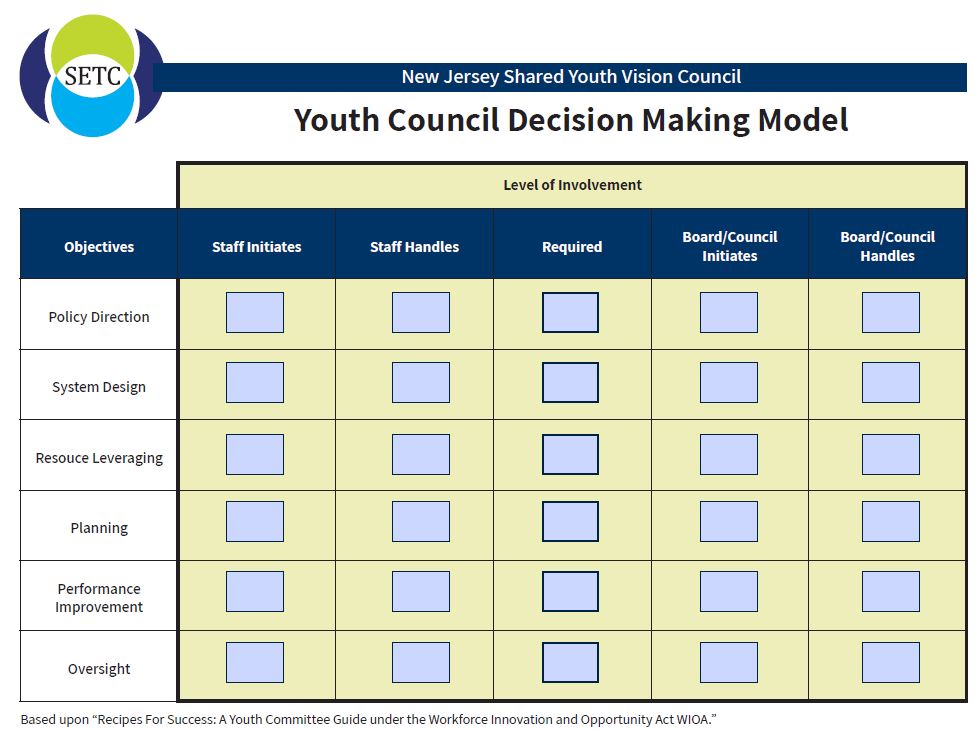
Attachment 3: Based Upon, “Recipes For Success: A Youth Committee Guide under the Workforce Innovation and Opportunity Act WIOA”
Glossary:
Policy Direction – Policy-related pieces that aim to inform and improve policy over a wide range of subjects by providing a broader policy context for the topic and relating it to the wider issues around constrained decision making. Moving board and system towards desired goal which should include a board collaborated mission and vision statement(s).
System Design – System design is the defining of the elements in a system including its structure, modules, and components; the different interfaces of those components, and the data that goes through that system. It is meant to satisfy the needs and requirements of a business or organization through the engineering of a coherent and well-running system. WIOA specifically includes the directives in youth procurement which is the act of obtaining or buying goods and services. The process includes preparation and processing of a demand as well as the end receipt and approval of payment.
Resource Leveraging - Propose the design of a comprehensive workforce development system to ensure a full range of services and opportunities for all youth, including disconnected youth: suggest ways to leverage resources and coordinate services among schools, public programs, and community-based organizations (CBOs) serving youth. This should also include employers who effectively employ or provide appropriate services to youth.
Planning - Youth Committees can provide a comprehensive program for youth development as well as determining the workforce needs of the area. The Committee can coordinate youth policy, ensure quality services, and leverage financial and programmatic resources. The committee can also recommend policy direction to the Local WDB for the design, development, and implementation of programs that benefit all youth.
Performance Improvement - Under the provisions of WIOA; Youth Committees can provide a mechanism for leadership, advocacy for youth issues, and an enhanced focus on youth workforce development. The committee shall help to identify weaknesses and gaps in services to develop strategies to use in competitive selections or community partnerships to address the unmet needs of youth as well as provide ongoing leadership and support for continuous quality improvement for local youth programs. Youth councils also have responsibilities centered on the basis of making continuous modifications to enhance the daily operations of the programs; respectively.
Oversight – Oversee eligible youth providers, as well as other youth program oversight responsibilities. Youth councils are generally the leading bodies in the area and they are accountable for preparing strategic and restorative oversight plans and structures tailored to the needs of their board, and local workforce system. (Oversight and monitoring are not synonymous.)
Staff Initiates- The staff may compile youth data and present it to the Youth Committee. After discussion, the Committee may decide to have the program targeted towards certain industries or trends that the staff initiated research provided. (staff comes up with ideas)
Staff Handles- Refers to matters or information that related Youth staff may undertake/resolve on their own. An example may be the compilation of youth labor market information. A staff member may compile the data on their own and present it to the Board. (implementation)
Required- A federal or state requirement may ask that all services be tied to demand in the local/regional economy. The Youth staff and Board would need to discuss valid related data to document its program design.
Board/Council Initiates- At a meeting, a Youth Council member is made aware of demand in a certain industry. At the next Youth Council meeting, that member leads a discussion which resolves with the Council asking the staff to pursue the field as an area of opportunity in their service structure for youth. Youth Councils and WDB staff should also constantly find ways to reach and engage the business community and employers.
Board/Council Handles- On a voluntary basis, the Youth Council may go to different employers in a specific industry. As a part of this effort they develop a set of needs/training areas that they deliver to the Youth Council and staff at its next meeting.
Considerations for Shared Youth Vision Visit to Local Workforce Areas
1. Resource Leveraging - Propose the design of a comprehensive workforce development system to ensure a full range of services and opportunities for all youth, including disconnected youth: Suggest ways to leverage resources and coordinate services among schools, public programs, and community-based organizations (CBOs) serving youth. This should also include employers who effectively employ or provide appropriate services to youth.
Resource Leveraging Question: What sort of resources (levels) do you dedicate to your youth services? How do you decide what to internalize versus procurement to other entities? Are your Youth programs integrated with other services provided in your area or are they stand-alone efforts? If integrated, who are the partners and how do you make certain costs are pro-rated appropriately? In a joint effort, how are assessments and results handled (e.g. information shared among partners)? (i.e. – weaving of services)
2. System Design – System design is the defining of the elements in a system including its structure, modules, and components; the different interfaces of those components and the data that goes through that system. It is meant to satisfy the needs and requirements of a business or organization through the engineering of a coherent and well-running system. WIOA specifically includes the directives in youth procurement which is the act of obtaining or buying goods and services. The process includes preparation and processing of a demand as well as the end receipt and approval of payment.
System Design Question: How did you and your board/council develop your youth system design? How has it changed over the years? How is the local workforce development board and youth council involved in the design and procurement of youth programs? Do they approve solicitations or recommendations? Are members involved in any facet of negotiation/contracting?
3. Policy Direction – Policy-related pieces that aim to inform and improve policy over a wide range of subjects by providing a broader policy context for the topic and relating it to the wider issues around constrained decision making. Moving Board and system towards desired goal which should include a board collaborated mission and vision statement(s).
Policy Direction Question: How do you consider the perspective and desires of young people in the design of youth services? Is there a Youth Council in the area? Does the committee aim to inform and improve youth related policies? Have these policies been approved/implemented? Who are the members of the youth board? Does it include community, faith-based or local service organizations? Are any service providers in the group? Businesses/Employers? How?
4. Performance Improvement - Under the provisions of WIOA; Youth Committees can provide a mechanism for leadership, advocacy for youth issues, and an enhanced focus on youth workforce development. The committee shall help to identify weaknesses and gaps in services to develop strategies to use in competitive selections or community partnerships to address the unmet needs of youth as well as provide ongoing leadership and support for continuous quality improvement for local youth programs. Youth councils also have responsibilities centered on the basis of making continuous modifications to enhance the daily operations of the programs; respectively.
Performance Improvement Question: Is there a specific group or population that is served in the local workforce board’s youth program? Is there a stakeholder group in place that advocates for youth issues and identifies gaps in services in order to develop methods to address the unmet needs of the population? What are the important client and system characteristics shared with the Board/Council in the design of youth services? How does success get reported to the Youth Council and Workforce Development Board?
5. Planning - Youth Committees can provide a comprehensive program for youth development as well as determining the workforce needs of the area. The Committee can coordinate youth policy, ensure quality services, and leverage financial and programmatic resources. The committee can also recommend policy direction to the Local WDB for the design, development, and implementation of programs that benefit all youth;
Planning Question: How are service trends/enrollment levels shared with the Board/Council? How do they react to increases/decreases in clients or funding? How is that shared with the Board/Council; what is done? What stakeholders are involved in the design and planning of youth programs? How does the area ensure that Youth Programs satisfy the required 14 program elements? Is there a plan of some sort in place that coordinates and ensures quality services and the leveraging of financial and programmatic resources? Are there specific targets for those services?
6. Oversight – Oversee eligible youth providers, as well as other youth program oversight responsibilities. Youth councils are generally the leading bodies in the area and they are accountable for preparing strategic and restorative oversight plans and structures tailored to the needs of their board, and local workforce system. (Oversight and monitoring are not synonymous.)
Oversight Question: What is reported to Youth Council and Workforce Development Staff and what is the frequency of reporting? Is there a feedback loop? Are Youth services tied to needs?
a. Those of the youth?
b. Those of area employers
c. Is someone overseeing these youth/youth providers and ensuring that these responsibilities are properly allocated and completed? Has program performance been reviewed?
Please review the questions. Are there any you would like to change or anything you wish to include? These visits should be concluded by the Summer and will include a written comparison of the different areas and what he found. This will help us move the Council forward and hopefully provide some positive perspective in what may be done to improve services for young people.
SYVC Vision: Providing and guiding youth to education, employment, retention of employment, and nationally
recognized credentials.
SYVC Mission: The Shared Youth Vision Council recommends service, policy and program components that serve youth at the local level in the workforce system. The council also recommends or assists in the programs and services that focus on youth workforce policy; with a focus on ensuring quality services for NJ’s youth. We will define success by the creation of a highly skilled, motivated, and conscientious workforce to help strengthen New Jersey’s economic future.
Purpose: The State Employment and Training Commission serves as an entity that provides policy guidance and strategic leadership on state and federal regulations, coordinates various aspects of the workforce board, and ultimately serves the public to ensure that resources are maximized and fair for all. The Shared Youth Vision Council adheres and works under this mission respectively. Under the new transition of leadership; there has been increased attention paid to the Youth of the State, as well as the staff that service them. Subsequently, a youth operations office was designed to better coordinate, align, and analyze the true issues and solutions that can impact youth. The SETC identifies and analyzes critical issues relating to workforce readiness and provides recommendations as a result. Subsequently, the SETC has found the endless value for effective youth programming; in the Spring 2017 edition of “Recipes For Success: A Youth Committee Guide under the Workforce Innovation and Opportunity Act (WIOA).” This gives youth and the staff that serves them all the information that they need to run a successful youth council that is proactive, equipped, and dedicated to serving the youth of the state of New Jersey.
Why: While the SYVC is not the operating body of the state, it is still imperative to have someone behind the scenes analyzing the fundamental services that are needed. Furthermore, the SETC has researched, collected, and promulgated the aims and ideals of the Spring 2017 “Recipes For Success: A Youth Committee Guide under the Workforce Innovation and Opportunity Act (WIOA)” article and summarized the information into a graph reflective of the key elements in establishing and maintaining a dynamic and proactive youth committee.
POLICY RESOLUTION: SETC #2020-01
SUBJECT: NJ Combined State Plan for the Workforce Innovation and Opportunity Act, 2020
Collaborative Process to Develop the NJ Combined State Plan: The SETC partnered with the NJ Department of Labor and Workforce Development (NJDOL), and other key stakeholders, to create the NJ Combined State Plan for WIOA, 2020. The foundation of this Combined Plan commenced with Governor Murphy’s vision for a stronger and fairer New Jersey. Over the last two years, NJDOL and SETC have established more intentional and regular input and feedback mechanisms with the wide range of stakeholder groups and, where applicable, the associations and organizations that represent them. In building a foundation for this plan, NJDOL and SETC also collaborated with and received input from the Governor’s Jobs and Economic Opportunity Council and the NJ Future of Work Task Force, and engaged with partner agencies and groups to inform their plans, such as the NJ Department of Education (NJDOE) Perkins V Plan for Career and Technical Education and the NJ Department of Human Services.
The primary foundation of this Combined State Plan is Governor Murphy’s Jobs NJ: Developing Talent to Grow Business in the Garden State, which was published in January 2020. Coinciding with its release, the John J. Heldrich Center for Workforce Development, under the auspices of the SETC, conducted eight stakeholder sessions with the purpose to gain insight and input to inform this Combined Plan from across five major stakeholder groups:
- Practitioners of literacy, youth, social services and supports, and disability services
- Local Workforce Development Boards
- Employers and Business Associations
- Education Partners, including state government agencies, community colleges, vocational/technical council, school boards and education associations
- State Partners, including state government agencies, planning authorities, labor and industry organizations and community and faith-based groups
The sessions were focused broadly on the ways in which New Jersey’s workforce development ecosystem – including but not limited to the programs included in this Combined Plan – could be aligned and advanced to provide equal access to opportunity for all while supporting the growth of the State’s economy. They were anchored in the three strategies outlined in Jobs NJ: expand access to opportunity, train individuals for in-demand jobs, and match talent to jobs.
Public Comment Period and Submission: The draft New Jersey Combined State Plan for WIOA, 2020 will be released for Public Comment in March 2020. The Combined State Plan will be submitted to USDOL/USDOE prior to April 1, 2020, with the public comment period completed. Any comments received will be included in the State Plan and updates will be made to the Plan as appropriate. The final State Plan will be posted on the SETC website at www.njsetc.net.
RESOLUTION: The State Employment and Training Commission hereby resolves to approve the release of the draft NJ Combined State Plan for WIOA, 2020 for public comment, and the subsequent submission of the State Plan 2020, with associated public comments, to the US Departments of Labor and Education by March 31, 2020, as required.
Commission Approval: February 26, 2020
WD-PY19-6.1: WIOA Eligibility and Self-Attestation Policy
New Jersey Workforce Innovation Notice
Issued By: Workforce Development Division of Career Services
Approved By: Hugh Bailey, Assistant Commissioner, Workforce Development
Issued Date: Revised January 13, 2020
1. SUBJECT: Workforce Innovation and Opportunity Act (WIOA) Eligibility and Self-Attestation Policy
2. PURPOSE: This policy is intended to outline the baseline criteria that local areas, one-stop operators, vendors and providers should apply to determine eligibility for WIOA career services.
3. EFFECTIVE DATE: This NJWIN is effective immediately.
4. BACKGROUND: Registration is the process of collecting information to support a determination of eligibility. This information may be collected through methods that include electronic data transfer, personal interview, and/or an individual's application. Participation occurs after the registration process and begins when the individual receives a staff-assisted WIOA service, which does not include self-service or informational activities.
5. PROGRAM ELIGIBILTY:
I. Title I Adult: To be eligible to participate in the WIOA Title I Adult program, that is, to
receive career services, and to meet the eligibility requirements for training services, the individual must be:
• Age 18 or older;
• A citizen or noncitizen authorized to work in the United States; and
• Meet selective service registration requirements, if a male 18 or older, born on or after January 1, 1960.
II. Title I Dislocated Worker: To be eligible for participation in the WIOA Title I Dislocated
Worker program, that is to receive career services, and to meet the eligibility requirements
for training services, the individual must meet of the WIOA adult eligibility requirements
and at least one of the following five categories:
1. Terminated/Laid off:
1.1 Has been terminated or laid off or has received a notice of termination or layoff from employment;
1.2 Is eligible for or has exhausted entitlement to unemployment compensation;
or:
a) Has been employed for a duration sufficient to demonstrate attachment to the workforce, but is not eligible for unemployment
compensation due to insufficient earnings or having performed services for an employer that were not covered under State unemployment compensation law; and b) Is unlikely to return to a previous industry or occupation.
2. Permanent Closure/ Substantial Layoff:
2.1 Has been terminated or laid off, or has received a notice of termination or layoff, from employment as a result of any permanent closure of, or any substantial layoff at, a plant, facility, or enterprise;
2.2 Is employed at a facility at which the employer has made a general announcement that such facility will close within 180 days; or
2.3 Is employed at a facility at which the employer has made a general announcement that such facility will close.
3. Formerly Self-Employed: Was self-employed (including employment as a farmer, a rancher, or a fisherman) but is unemployed as a result of general economic conditions in the community in which the individual resides or because of natural disasters.
4. Displaced Homemaker:
4.1 Has been dependent on the income of another family member, but is no longer supported by that income; or
4.2 Is the dependent spouse of a member of the Armed Forces on active duty and whose family income is significantly reduced because of a deployment, a call or order to active duty, a permanent change of station or the service-connected
death or disability of the member; and
4.3 Is unemployed or underemployed and is experiencing difficulty in obtaining or upgrading employment.
5. Spouse of a member of the Armed Forces:
5.1 Is a spouse of a member of the Armed Forces on active duty and who has experienced a loss of employment as a direct result of relocation to accommodate a permanent change in duty station of such member; or
5.2 Is the spouse of a member of the Armed Forces on active duty who is unemployed or underemployed and is experiencing difficulty in obtaining or upgrading employment.
Ill. Title I Youth: To receive WIOA youth services, an individual must be enrolled as a youth participant. Enrollment requires the collection of information to support an eligibility determination. A youth applicant's eligibility is determined at registration. Accordingly, a youth remains eligible to receive youth services within their originally designated category until exited from the program. Both in-school (ISY) and out-of-school youth (OSY) must meet the following basic eligibility requirements: 1) Be a citizen or non-citizen authorized to work in the United States, and 2) Meet selective service registration requirements, if
applicable.
1. To be eligible as a WIOA ISY, an individual must be:
1.1 Attending school, including secondary and post-secondary school;
1.2 Between 14 years of age or 21 at time of enrollment2 (unless the youth is an individual with a disability who is attending school under state law);
1.3 A low-income individual; and
1.4 One or more of the following:
a) Basic skills deficient;
b) An English language learner;
c) An offender;
d) A homeless individual (as defined in sec. 41403(6) of the Violence Act of 1994, a homeless child or youth (as defined in sec. 725(2) of the McKinney-Vento Homelessness Act, or a runaway:
e) An individual in foster care or who has aged out of the foster care system or who has attained 16 years of aged and left foster care for kinship guardianship or adoption, a child eligible for assistance under Sec. 477 of the Social Security Act, or in an out-of-home placement;
f) An individual who is pregnant or parenting;
g) An individual with a disability; or
h) An individual who requires additional assistance to enter or complete
an educational program or to secure or hold employment.
2. To be eligible as a WIOA OSY, an individual must be:
2.1 Not attending any school
2.2 Between 16 years of age or 24 at time of enrollment; and
2.3 One or more of the following:
a) A school dropout;
b) A youth who is within the age of compulsory school attendance, but has not attended school for at least the most recent complete school year calendar quarter, based on the definition of the local school district of school year quarters. In cases where schools do not use quarters, local programs must use calendar year quarters;
c) A recipient of a secondary school diploma or its recognized equivalent who is a low-income individual and is either basic skills deficient or an English language learner;
d) An offender;
e) A homeless individual (as defined in sec. 41403{6) of the Violence Act of 1994, a homeless child or youth (as defined in sec. 725{2} of the McKinney-Vento Homelessness Act, or a runaway:
f) An individual in foster care or who has aged out of the foster care system or who has attained 16 years of aged and left foster care for kinship guardianship or adoption, a child eligible for assistance under Sec. 477 of the Social Security Act, or in an out-of-home placement;
g) An individual who is pregnant or parenting;
h) An individual with a disability; or
i) A low-income individual who requires additional assistance to enter or complete an educational program or to secure or hold employment.
6. ELIGIBILITY VERIFICATION GUIDELINES: Workforce system staff must verify eligibility prior to the provision of services. Individuals whose eligibility is not yet determined may receive interim support from Wagner-Peyser, WIOA Title Ill services as they are universally available without eligibility requirements.
7. SELF-ATTESTATION: Self-attestation should be an option of "last resort" for documenting Title I program eligibility with an exception for OSY.
7.1 Eligible Categories:
a) Adult: Homeless
b) Dislocated Worker:
• Date of actual dislocation
• Displaced homemaker
• Reemployment opportunity is poor/Unlikely to return to work
• Permanently or temporarily laid off as a consequence of a disaster
c) Youth:
• English language learner
• Homeless
• Offender
• Pregnant or parenting
• Requires additional assistance
• In/aged out of foster care
• Runaway
• School status at time of registration
d) Income: Proof of income for individuals with little or no income (statement should indicate means of support).
e) Dependent Status: Used if a person would normally be included in the definition of a family, but is claiming to no longer be dependent (statement should be from made by the head of household, not the applicant).
7.2 Permissible Circumstances:
• Acceptable Use: To ease burdens on both applicants and providers who serve OSY who are most in need, self-attestation for OSY for WIOA eligibility determination will be permitted.
• Undue Hardship: Self-attestation is permissible in rare instances in which it may cause undue hardship for applicants to verify eligibility, particularly those with barriers to employment.
• Lost Documentation: Self-attestation may be accepted from an individual who has experienced a loss of documentation due to natural or man-made disasters (fire, flood, tornado, etc.); eviction from residence resulting in a loss of supporting documentation; or individual is fleeing or has fled an abusive or untenable home situation. Staff may utilize supportive services to assist
participants recover their legal documents. Once recovered, their file must be updated to contain required documentation.
7.3 Types of Self-Attestation:
• Applicant Statement: A Self-Attestation form (Attachment A) is the least preferred method of documenting and verifying eligibility. If an applicant statement is used, a rationale must be provided via case notes in America's One-Stop Operating System (AOSOS) describing other attempts at verifying eligibility prior to allowing self-attestation.
•Telephone Verification and Document Inspection: Preferred over self-attestation, providers/vendors are encouraged to use telephone verification with recognized governmental or social service agencies and/or by documentation inspection verification to verify eligibility, especially in consideration of individuals with barriers to employment. The information obtained must be verified and recorded on a Telephone/Document Inspection Verification form (Attachment B}. Information recorded must be adequate to
enable a monitor or auditor to report back to the cognizant agency or the document used.
8. SELF-ATTESTATION VERIFICATION: To ensure optimum compliance with this policy and the guidelines set forth by the New Jersey Department of Labor and Workforce Development (NJDOL}, all Youth and Adult and Dislocated Workers who use self-attestation will be randomly verified.
9. KEY DEFINITIONS:
"Attending School" - Youth are considered to be "attending school" if they receive services from any one of the public or non-public institutions listed in the table below. Those being home-schooled or privately tutored would be considered attending school for the purpose of WIOA Title 1-B youth eligibility determination. A youth enrolled at a post-secondary institution would also be considered attending school. (See related "Enrolled in School.")
| Public Schools | Non-Public Schools |
|---|---|
| School Districts Charter Schools Cyber Charter Schools Area Vocational Technical Schools | Sectarian Schools Private Schools |
"Age of Compulsory School Attendance" - The period in a child's life when he/ she is required to enter and attend school. In general, all children must continue education through high school. According to New Jersey education law, the timeframe for compulsory school attendance is no later than age 8 up to the age of 17 or graduation from a high school, whichever occurs first (except as otherwise provided by law). Students of compulsory school age are not required to enroll in public school if they:
• Have already graduated from high school;
• Are employed consistent with the applicable provisions of Section 1330;
Are enrolled in a private tutoring program;
• Are participating in a home education program; or
• Are enrolled in a non-public school.
"Basic Skills Deficient" - A youth, who has English reading, writing, or computing skills at or below the 8th grade level on a generally accepted standardized test;5 or is unable to compute or solve problems, or read, write or speak English at a level necessary to function on the job, in the individual's family, or in society.
"Displaced Homemaker" - An individual who has been providing unpaid services to family members in the home, and has been dependent on the income of another family member but is no longer supported by that income; is the dependent spouse of a member of the Armed Forces on active duty and whose family income is significantly reduced because of a deployment, a call or order to active duty, a permanent change of station or the service-connected death or disability of the member; and is unemployed or underemployed and is experiencing difficulty in obtaining or upgrading employment.
"Eligible Spouse" - A spouse:
• Of any veteran who died of a service-connected disability;
• Of any member of the Armed Forces serving on active duty who, at the time of application for the priority, is listed in one or more of the following categories and has been so listed for a total of more than 90 days: missing in action, captured in the line
of duty by a hostile force, or forcibly detained or interned in the line of duty by a foreign government or power;
• Of any veteran who has a total disability resulting from a service-connected disability, as evaluated by the Department of Veterans Affairs; or a spouse of any veteran who died while a disability was in existence;
• Who is a dependent spouse of a member of the Armed Forces on active duty whose family income is significantly reduced because of a deployment, a call or order to active duty, a permanent change of station, or the service-connected death or disability of the service member; and/or
• Who is unemployed or underemployed and is experiencing difficulty in obtaining or upgrading employment.
"English Language Learner" - Individual who has limited ability in reading, writing, speaking or comprehending the English language, and his/her native language is a language other than English, or lives in a family or community environment where a language other than English is the dominant language.
"Enrolled in School" - A student on the attendance rolls whether or not the student is physically present on any given day.
"Not Attending School" - For the purpose of WIOA Title I-B, a youth is determined to not be attending school if the youth is not receiving services from any one of the public or non-public institutions listed in Table 1 (See page 6). Individuals who are enrolled in adult basic education/GED preparation under Title II of WIOA, skills training, or other remedial education programs, including those offered through publicly and privately funded adult basic education programs, YouthBuild or Job Corps programs, or drop-out re-engagement programs are categorized as not attending school. Eligibility for these services is to be based on the educational status of a youth, not on the location or funding source of the entity providing the service(s). Therefore, such youth must be categorized as OSY for the purposes of registration in New Jersey's system of record, America's One-Stop Operating System (AOSOS). Youth attending high school equivalency programs funded by the public K-12 school system who are
classified by the school system as still enrolled in the school are an exception, they are considered in-school youth. (20 CFR 681.220)
"Homeless Individual" - An individual who lacks a fixed, regular, and adequate nighttime residence and includes an individual who is: sharing the housing of other persons due to loss of housing, economic hardship or a similar reason; is living in a motel, htel, trailer park or campground due to the lack of alternative adequate accommodations; is living in an emergency or transitional shelter; is abandoned in a hospital; is awaiting foster care placement; and/or has a primary nighttime residence that is a public or private place not designed for or ordinarily used as a regular sleeping accommodation for human beings.
"Low-Income Individual" -A recipient of public assistance; is underemployed; is in a family with a total family income that does not exceed the higher of the poverty line or 70% of the lower level standard income level; has a disability whose own. income meets the income requirements outlined above but who is a member of a family whose income does not meet this requirement; is homeless; a foster child; and/or receives or is eligible to receive a free or reduced priced lunch.
"Participant" -A reportable individual who has received services, except individuals in an Adult Education and Family Literacy Act (AEFLA) program who have not completed at least 12 contact hours or individuals who only use the self-service system, after satisfying all applicable programmatic requirements for the provision of services, such as eligibility determination. For WIOA Title I youth programs, a participant is a reportable individual who has satisfied all applicable program requirements for the provision of services, including eligibility determination, an objective assessment and development of an Individual Service Strategy, and received 1 of the 14 WIOA youth program elements.
"Recipient of Public Assistance" - An individual who receives, or in the past six months has received, or is a member of a family that is receiving or in the past six months has received assistance through one or more of the following: The Supplemental Nutrition Assistance Program (SNAP), the program of block grants to States for Temporary Assistance for Needy Families (TANF) program, the Supplemental Security Income (SSI) program, or State or local income-based public assistance.
"Reportable Individual" - An individual who has taken action that demonstrates an intent to use program services and who meets specific reporting criteria of the program, including: individuals who provide identifying information, individuals who only use the self-service system, or individuals who only receive information-only services or activities.
"School Dropout" - An individual who is no longer 'attending any school' and who has not received a secondary school diploma or its recognized equivalent.
"Self-Attestation" - When an individual states his/her status for a particular data element and then signs and dates a form acknowledging this status. The key elements for self-attestation are: the individual identifying his/her status for permitted elements and signing and dating a form attesting that the information provided to demonstrate eligibility for a program under Title I of WIOA is true and accurate.
10. REFERENCES
• Violence Against Women Act of 1994 (VAWA), Public Law 103-322, enacted September 13, 1994
• Workforce Innovation and Opportunity Act (WIOA), Public Law 113-128, enacted July 22, 2014
• Workforce Innovation and Opportunity Act Regulations, 20 CFR Parts 675, 677, 680, 681
11. ATTACHMENTS:
• Self-Attestation form
• Telephone/Document Inspection Verification form
New Jersey Workforce Innovation Notice 4-15, Change 1(F)
TO: Workforce Development Boards, One-Stop Operators, Employment Service Managers
FROM: John Bicica, Chief
Office of WIOA Technical Assistance and Capacity Building
SUBJECT: WIOA Adult and Dislocated Worker Transfer Authority
DATE: January 4, 2017
Purpose: To provide the revised procedures for the transfer of funds between the Workforce Innovation and Opportunity Act (WIOA) Adult and Dislocated Worker programs based on additional requirements in the WIOA Final Rules at 683.130(c). The Final Rules require the State to establish the criteria for the approval of transfer requests; these criteria are provided in this guidance.
Background: Local workforce development boards, with the approval of the Governor, have the authority to transfer up to 100 percent of the Adult Activities funds to Dislocated Worker Activities, and up to 100 percent of the Dislocated Worker Activities funds to Adult Activities. There is no authority to transfer funds to or from the Youth Activities Program.
Requests:
Each request must include the following. Incomplete requests will be returned for additional information:
1. Signature of the local board chair
2. The transfer fund source
3. The dollar amount of the transfer request, including the percentage share of the base allocation (the initial allocation received by the local area at the beginning of the program year) represented by the dollar amount
4. Justification for the transfer that includes the following:
- The reasons for the request for the transfer
- An assurance that the transfer will not adversely impact services to participants.
- All relevant data, including level of service reports and expenditures.
The following criteria will be used in evaluating the request for the transfer of funds:
Dislocated Worker transfer to Adult (Both criteria must be met):
1. The local board must certify that it lacks sufficient funds from other sources to adequately serve the WIOA Adult priority population:
- Public Assistance Recipients
- Other Low-Income Individuals
- Basic Skills Deficient Individuals
2. The local board must certify that it has determined that there are no pending layoffs within their local area that will impact the dislocated worker program.
Adult transfer to Dislocated Worker: The local board must certify that they have sufficient adult funds (i.e. TANF, GA, WIOA Adult) to serve the WIOA Adult priority population (public assistance recipients, other low-income individuals and basic skills deficient individuals) in the local area.
Procedure
The following procedure must be followed when requesting to transfer Adult Activity funds to Dislocated Worker, and Dislocated Worker to Adult Activity:
1) Prior to requesting a transfer of funds, the local area’s current program year’s signed contract reflecting initial program allocations must have been received and accepted by the Department of Labor and Workforce Development.
2) A letter requesting a transfer of funds must be sent to Patricia Moran, Ph.D., Assistant Commissioner
Workforce Development, P.O. Box 055, Trenton, New Jersey 08625-0055
Please include an electronic copy to John Bicica, Chief, Office of WIOA Technical Assistance and Capacity Building, at john.bicica@dol.state.nj.us.
The New Jersey Department of Labor and Workforce Development will examine relevant fiscal and program data upon receipt of the transfer request as part of the review of the request. For requests to transfer funds from the Dislocated Worker Program, the State will consider any impact on potential eligibility for National Dislocated Worker Grants. Additional information may be required for any requests to transfers of greater than 50 percent.
Reference and Links: WIOA Se. 133(b) (4); 20 CFR 683.130(b)
Rescissions: NJWIN 4-15
Authority: NJ Department of Labor and Workforce Development
For any questions regarding this guidance, please contact John Bicica, Chief, WIOA Technical Assistance and Capacity Building at john.bicica@dol.nj.gov.