



Located in:
- III. Operational Planning ElementsThe Unified or Combined State Plan must include an Operational Planning Elements section that support the State’s strategy and the system-wide vision described in Section II.(c) above. Unless otherwise noted, all Operational Planning Elements apply to Combined State Plan partner programs included in the plan as well as to core programs. This section must include—
- a. State Strategy ImplementationThe Unified or Combined State Plan must include—
- 2. Implementation of State StrategyDescribe how the lead State agency with responsibility for the administration of each core program or a Combined Plan partner program included in this plan will implement the State’s Strategies identified in Section II(c). above. This must include a description of—
- 2. Implementation of State Strategy
- a. State Strategy Implementation
III. a. 2. F. Partner Engagement with Other Education and Training Providers.
Current Narrative:
Partner Engagement with Other Education and Training Providers
Michigan Advanced Technician Training Program (MAT2) is an innovative and industry-defined approach to post-secondary education. Manufacturing and technology companies are experiencing a shortage of employees with the knowledge, skills, and competencies necessary to operate and maintain new systems-based equipment and technologies. The Michigan Advanced Technician Training Program is an educational model developed in conjunction with global technology leaders that combines theory, practice, and work to train a globally competitive workforce by:
- Allowing companies to “grow their own” employees and ensure a future pipeline of qualified talent;
- Direct employer involvement in the development and execution of a hands-on, competency-based education and training program, creating highly-skilled, capable and readily employable graduates;
- Offering an economically feasible option to training, ultimately reducing recruitment, retention and training costs;
- Establishing Michigan as an education innovator and global competitor; and
- Creating a nationally accredited program, in which students receive an Associate degree along with other accreditations where applicable.
Modeled after Germany’s dual-education system, the Michigan Advanced Technician Training Program connects employers with graduating high school seniors who will learn and earn how to become skilled in a high-demand trade. Training programs include Mechatronics Technician, Information Technology Technician, Technical Product Design, and Computer Numeric Control Manufacturing Technician.
To date, there have been more than 90 program participants with future cohorts planned. Eighteen employers have committed to the program with a total of nine participating community colleges. The State of Michigan will continue to support the Michigan Advanced Training Technician Program and its vision for change. Through collaboration with employers and academic providers, Michigan will continue to develop and implement additional Michigan Advanced Training Technician Program professions in order to meet industry needs with global standards.
Michigan Advanced Technician Program — Commitments and Benefits:
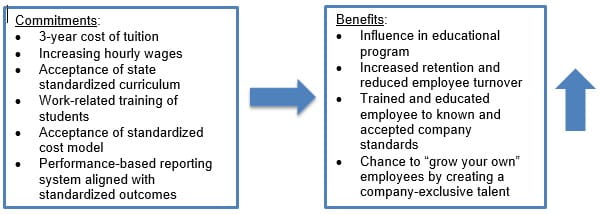
Career and Technical Education Programs: All secondary career and technical education students must have a work-based learning experience. It is an integral part of the curriculum so that students learn work-behavior skills and gain first-hand knowledge of the workplace. The Michigan Department of Education works closely with the Michigan Career Placement Association and the Michigan School Counselors Association to communicate job openings. These activities support and enhance workforce development in our state. State funding for career and technical education programs supports workforce development by prioritizing funding to the instructional programs where there are job openings, successful placement of students in those jobs, and wages that are self-sustaining. Vocational Rehabilitation collaborates with, and participates in, strategic partnerships with the Michigan Chamber of Commerce and external (national) resources, such as the National Employment Team to identify labor market areas where skill shortages occur. In some instances, training is provided or training programs are developed. For example, the Michigan Career and Technical Institute is a facility operated by Michigan Rehabilitation Services that is a Department of Education approved, nationally accredited post-secondary school which provides state-of-the-art training for jobs needed in business and industry today. Programs offered include Automotive Technology, Cabinet Making/Millwork, Certified Nursing Assistant, Culinary Arts, Electronics/Manufacturing, Graphic Communications, Grounds Maintenance and Landscaping, Machine Technology, Pharmacy, Office Automation, Retail Marketing, and Weatherization. Strong industry involvement helps to ensure that all Michigan Career and Technical Institute students have marketable skills upon graduation. Flexible training options provide students with an opportunity to develop individual skills, depending upon interests and ability, with graduates being successfully hired upon graduation. The Michigan Career and Technical Institute Certified Nursing Assistant training program is licensed at both the state and national level, and an approved regional Certified Nursing Assistant testing site for Prometric. Over 500 Michigan Career and Technical Institute Certified Nursing Assistant licensed students are currently working in Michigan. The Michigan Department of Human Services and Michigan Rehabilitation Services, in collaboration with Michigan Works! has exported the Certified Nursing Assistant training program and an array of remedial training programs from the Michigan Career and Technical Institute to the Benton Harbor Michigan Works! Service Center to train individuals in the Certified Nursing Assistant field. These individuals were Temporary Assistance for Needy Families recipients with disabilities in the Partnership. Accountability. Training. Hope. (PATH) Program. The training program was highly successful and there are plans to replicate the program in Detroit, Harbor Springs, Lansing and other areas across the state based on labor market need. Vocational Rehabilitation will continue to be a resource for accommodations to help individuals with disabilities and employers to prepare for, secure, retain, advance in, and regain competitive integrated employment (accessibility).