


Located in:
- III. Operational Planning Elements
The Unified or Combined State Plan must include an Operational Planning Elements section that supports the State’s strategy and the system-wide vision described in Section II(c) above. Unless otherwise noted, all Operational Planning Elements apply to Combined State Plan partner programs included in the plan as well as to core programs. This section must include—
- b. State Operating Systems and Policies
The Unified or Combined State Plan must include a description of the State operating systems and policies that will support the implementation of the State strategy described in section II Strategic Elements. This includes—
- b. State Operating Systems and Policies
III. b. 3. A. State Agency Organization
Describe the organization and delivery systems at the State and local levels for the programs covered in the plan, including the organizational structure. Include an organizational chart.
Current Narrative:
State Agency Organization
CareerSource Florida
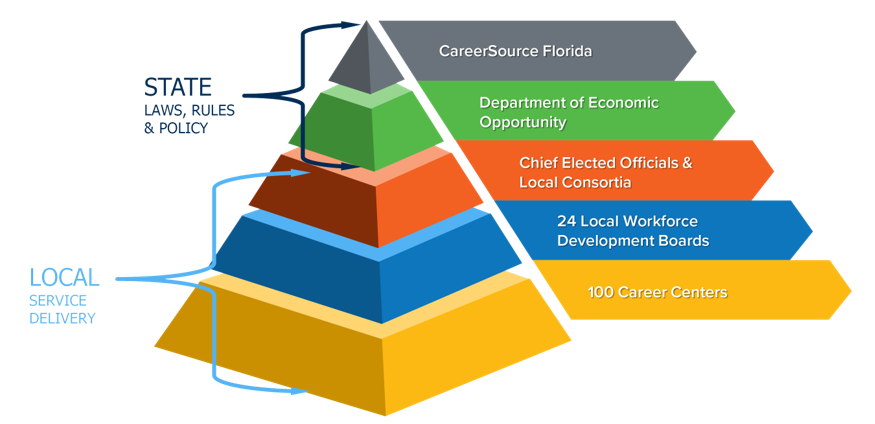
The state workforce development board, known as the CareerSource Florida Board of Directors, is established pursuant to the Workforce Innovation and Opportunity Act, Public Law 113-128, Title I, Section 101. Chaired by the Governor, the state workforce development board establishes and directs the vision for the state workforce system, known as the CareerSource Florida network, to align with strategic partners within workforce investment, education and economic development systems. The CareerSource Florida network’s strategic partners are those described within the federal Workforce Innovation and Opportunity Act (WIOA) and Florida Statutes. The CareerSource Florida network comprises the state workforce development board, the Florida Department of Economic Opportunity, the local workforce development boards, chief local elected officials, local boards of directors and local career centers.
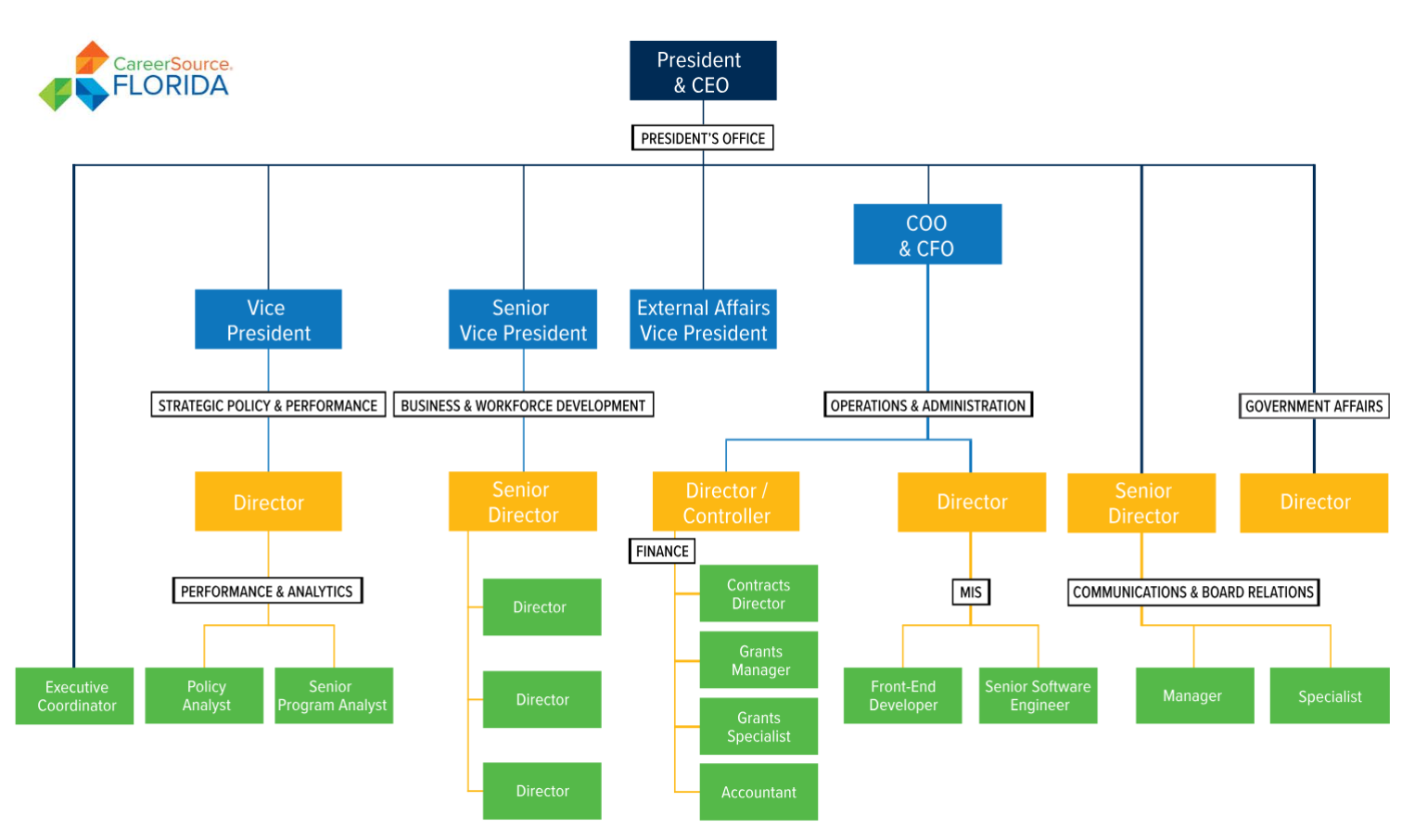
The state board hires the President and CEO of CareerSource Florida, Inc. and authorizes CareerSource Florida to develop and coordinate, under the consent and guidance of the board, the strategic, policy development, financial and programmatic direction of its vision for the state’s workforce system.
Figure 3.03
CareerSource Florida, Inc.
Organizational Chart
Department of Economic Opportunity
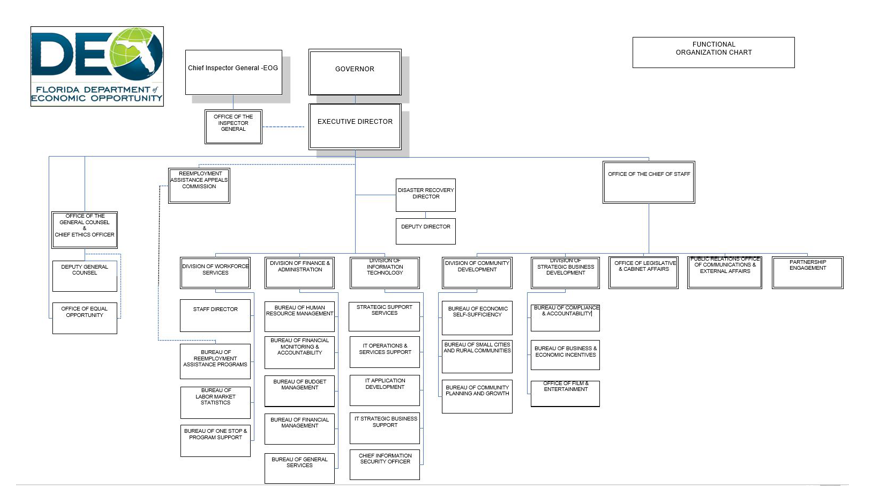
The Department of Economic Opportunity (DEO) is the Governor’s agency for workforce support and training, economic development and community development. DEO partners with CareerSource Florida and the state’s 24 local workforce development boards (LWDBs) to strengthen Florida’s business climate by supporting employers and helping Floridians gain employment, remain employed and advance in their careers. DEO oversees the administration of the state’s workforce system and receives and accounts for federal funds for the system. DEO reports financial and performance information to USDOL and other federal organizations. DEO distributes workforce guidance and policy initiatives and provides training, technical assistance and monitoring to LWDBs. DEO operates Florida’s Reemployment Assistance program, Labor Market Statistics program and many other programs and initiatives.
Figure 3.04
Florida Department of Economic Opportunity
Organizational Chart
Administration of the state’s workforce policy, programs and services is carried out by DEO and the business-led LWDBs. Services are delivered through approximately 100 career centers and service sites throughout Florida and through the state’s online job-matching system, Employ Florida, at www.employflorida.com. This includes 79 full-service sites and 29 satellite offices. Programmatic and administrative requirements are set forth in a Grantee-Sub-Grantee Agreement executed by DEO and each LWDB, requiring their compliance with all federal and state laws, regulations and any special state requirements.
Figure 3.05
Florida’s Workforce System Organization
Florida Department of Education
The mission of the Florida Department of Education (FDOE) is “to increase the proficiency of all students within one seamless, efficient system, by providing them with the opportunity to expand their knowledge and skills through learning opportunities and research valued by students, parents and communities and to maintain an accountability system that measures student progress.”
FDOE serves more than 2.8 million students, 4,300 public schools, 28 colleges, 171,000 teachers, 45,000 college professors and administrators and 325,000 full-time staff throughout the state; the department enhances the economic self-sufficiency of Floridians through programs and services geared toward college, workforce education, apprenticeships, job-specific skills and career development. The department manages programs that assist individuals who are blind, visually impaired, or have other disabilities succeed either in school settings or careers – encouraging independence and self-sufficiency. FDOE provides oversight to 28 locally governed public state colleges and 49 school district technical centers.
FDOE is currently appropriated 2,123.75 total full-time positions, including 884 positions in the Division of Vocational Rehabilitation, 290 positions in the Division of Blind Services and 73 positions in the Division of Career and Adult Education. The department’s annual operating budget for all entities in state fiscal year 2018-19 was approximately $17.7 billion.
The FDOE organizational and governance structure includes the State Board of Education which consists of seven members appointed by the Governor to staggered four-year terms, subject to confirmation by the Senate. Except for the State University System, the State Board of Education is the chief implementing and coordinating body of public education in Florida. The state board focuses on high-level policy decisions and has the authority to adopt rules to implement provisions of federal and state law. General duties include, but are not limited to, adopting education objectives and long-range plans for public education in Florida, exercising general supervision over the department, submitting an annual coordinated PreK-20 education budget and adopting uniform standards of student performance.
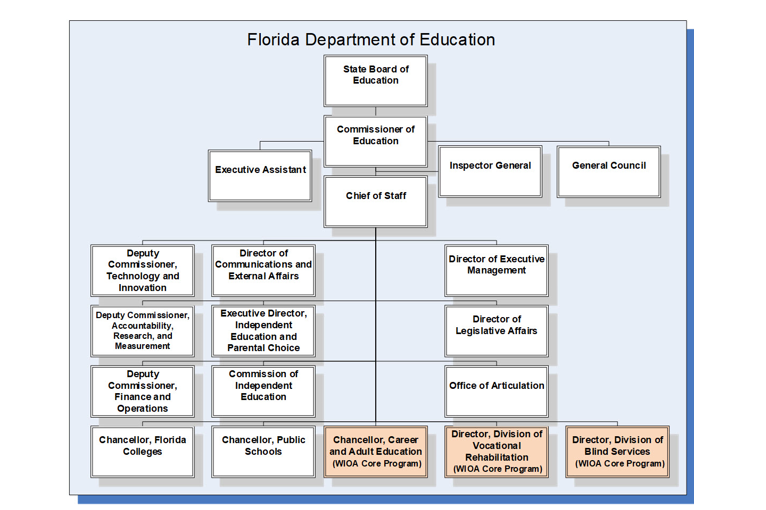
FDOE policies and operations are led by the department’s senior leadership team, consisting of the Commissioner of Education, chief of staff, division leaders and directors of support divisions (see organizational chart below). FDOE manages the core WIOA programs for adult and career education, vocational rehabilitation and blind services. The senior leadership team develops strategies, designs operational policies and manages the department’s business processes. Senior leader meetings are held weekly. Strategy development meetings are conducted quarterly. Strategies are tracked and adjusted as needed. FDOE financial and operational performance is reported on a regularly scheduled basis to the U.S. Department of Education, the Executive Office of the Governor and the Florida Legislature.
Figure 3.06
Florida Department of Education
Organizational Chart
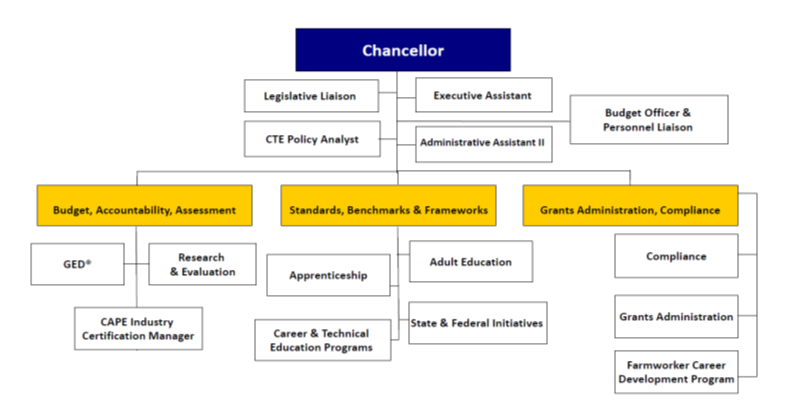
Adult Education
The Division of Career and Adult Education (DCAE) has oversight over the adult education system implemented in districts, colleges and community-based organizations. The division coordinates the distribution of federal adult education grants. DCAE works closely with local programs and provides guidance on state and federal guidelines, professional development and support in reporting data and technical assistance on program improvement plans.
Figure 3.07
Division of Career and Adult Education
Organizational Chart
Division of Vocational Rehabilitation
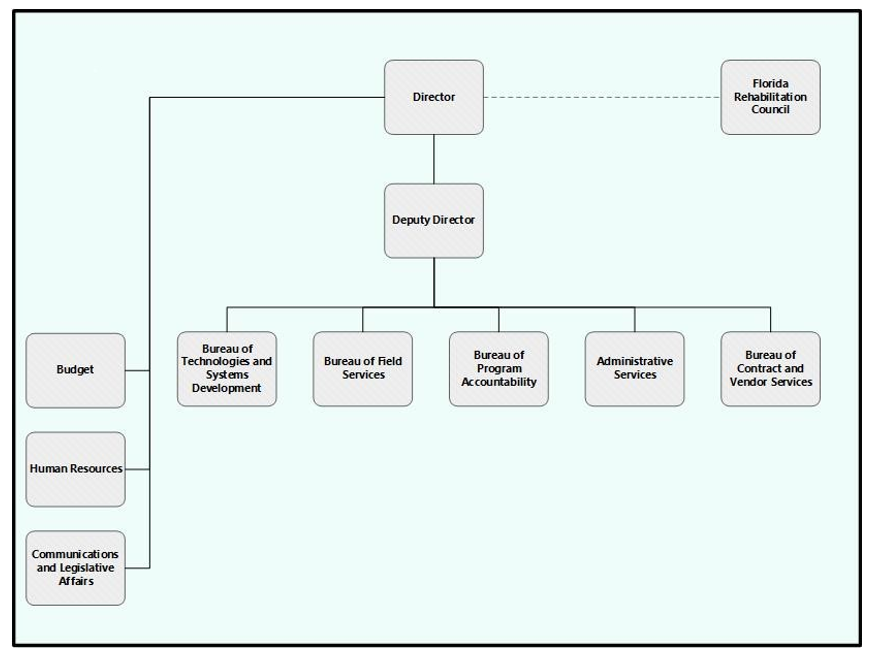
The Florida Division of Vocational Rehabilitation (VR) is federally established under the Rehabilitation Act, as Amended (1998) and reauthorized as a core program of WIOA (2014). In Florida, VR is a division of the Florida Department of Education. VR comprises a headquarters office, seven area offices and 96 unit offices located throughout Florida where customers receive direct services. The VR program is funded as a federal-state partnership, in which 21.3 percent of state general revenue matches a 78.7 percent federal grant. Most programmatic oversight and governance is established in the federal laws and code of federal regulations. Florida state laws for vocational rehabilitation are in Chapter 413, Florida Statutes. VR provides annual planning updates and annual/quarterly performance and financial reports to the federal Rehabilitation Services Administration (RSA) which conducts regulatory and programmatic monitoring and oversight activities approximately every four years.
WIOA retains the presence of a state rehabilitation council, known as the Florida Rehabilitation Council (FRC). Council members are volunteers appointed by the Governor and represent a variety of perspectives from the disability community. The council is not a governance board but is required by federal law to review, analyze and advise VR. Key collaborative activities with the council include input and recommendations for the VR services portion of the state plan, key programmatic policies, assessing VR customer satisfaction and the progress and outcomes of administrative hearings for VR customers. VR’s organizational structure is represented in Figure 3.07.
Figure 3.08
Division of Vocational Rehabilitation
Organizational Chart
Division of Blind Services
The Florida Division of Blind Services (FDBS) employment program is a federally established program under the Rehabilitation Act, as amended (1998), and reauthorized as a core program of WIOA (2014). The FDBS vocational rehabilitation program is funded as a federal-state partnership. FDBS is part of the Florida Department of Education and serves blind and visually impaired Floridians. Coordination of Services is administered through 15 FDBS office locations, and the Rehabilitation Center for the Blind. FDBS services are procured through a combination of state, federal and community funding. In partnership with community rehabilitation providers and other local partners, the division provides services to customers based on individual needs.
Figure 3.09
Division of Blind Services
Organizational Chart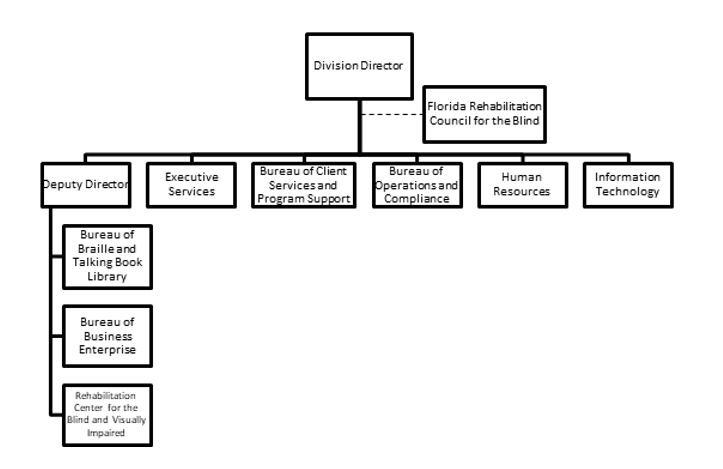
State Board
1. Membership Roster
Florida’s state workforce development board, known as the CareerSource Florida Board of Directors, is made up of 30 members. The state board is chaired by the Governor. When the Governor is unable to participate, a business representative, approved by Board, serves as Chair. Currently, Kevin Doyle serves as the Chair on behalf of Governor DeSantis. Board membership includes the Governor; 16 business representatives; six (6) workforce representatives; and eight (8) government officials, including core program state representatives, State Legislative representatives and chief elected officials.
Figure 3.10
CareerSource Florida Board of Directors Membership Roster
Government and Elected Officials
| Category | Business / Agency | First Name | Last Name | Title | |
|---|---|---|---|---|---|
| 1 | Governor | State of Florida | Ron | DeSantis | Governor |
| 2 | State Legislature Representative, Chief Elected Official | Florida Senate | Bill | Montford | Senator |
| 3 | State Legislature Representative, Chief Elected Official | Florida House of Representatives | Chris | Latvala | Representative |
| 4 | Chief Elected Official | Orange County Commissioner; Nelson Insurance Service - Mayor of Apopka | Bryan | Nelson | Mayor, Apopka |
| 5 | Core Program State Official | Department of Economic Opportunity | Ken | Lawson | Executive Director |
| 6 | Core Program State Official | Department of Education | Richard | Corcoran | Commissioner |
| 7 | Core Program State Official | Dept. of Education, Division of Blind Services (representing Vocational Rehabilitation) | Robert | Doyle | Director |
| 8 | Core Program State Official | Dept. of Education, Division of Adult & Career Education | Henry | Mack | Chancellor |
Business Representatives
| 9 | Business | Wexford Strategies | Kevin | Doyle | Partner |
|---|---|---|---|---|---|
| 10 | Business | StaffTime | Rose | Conry | CEO |
| 11 | Business | Indian River Lagoon Council & Indian River Lagoon National Estuary Program | Duane E. | De Freese | Executive Director |
| 12 | Business | New Horizons South Florida | Arnie | Girnun | President |
| 13 | Business | FAIRWINDS Credit Union | Elisha | González | Vice President of Community Relations and Government Affairs |
| 14 | Business | IBM Global Services | Elli | Hurst | VP, Globally Integrated Cap. |
| 15 | Business | Coca-Cola Refreshments | Bill | Johnson | VP, Finance Shared Serv. |
| 16 | Business | Northrup Grumman | Rick | Matthews | Vice President |
| 17 | Business | HNM Global Logistics | Tony | McGee | CEO |
| 18 | Business | MoseSys Inc. | W. Alexander | Moseley | President/CEO |
| 19 | Business | Florida Small Business Development Center Network | Mike | Myhre | CEO |
| 20 | Business | Banks Engineering | Todd | Rebol | Vice President |
| 21 | Business | Uber | Stephanie | Smith | Senior Policy manager |
| 22 | Business | AT&T | Joe | York | President, Florida, PR and VI |
| 23 | Business | VACANT | |||
| 24 | Business | VACANT |
Workforce
| 25 | Workforce Representative | VACANT | |||
|---|---|---|---|---|---|
| 26 | Workforce Representative | VACANT | |||
| 27 | Labor Organization Representative | VACANT | |||
| 28 | Labor Organization / Apprenticeship Representative | VACANT | |||
| 29 | Community-Based Service Representative | Capital Area Community Action Agency, Inc. | Timothy | Center | Executive Director |
| 30 | Youth Service Representative | Federal Reserve Bank of Atlanta | Brittany | Birken | Principal Adviser |
Board Activities
CareerSource Florida’s Board of Directors is statutorily required to meet either in person or by teleconference four times a year. CareerSource Florida councils meet separately, in person or by teleconference, as scheduled and/or at the request of the Council Chairman.
These meetings provide opportunities for the Board of Directors to address issues impacting the state network, guide and create strategic policy, obtain information about performance and oversee funding initiatives.
By law, CareerSource Florida is the statewide Workforce Investment Board charged with policy setting and oversight of the workforce system. Section 445.004, Florida Statutes, defines CareerSource Florida’s purpose as designing and implementing strategies that help Floridians enter, remain in and advance in the workplace. Information about the role of each council and the executive committee is available, along with board and council meeting schedules and materials, on the CareerSource Florida website at https://careersourceflorida.com/boardroom/.