Located in:
- III. Operational Planning ElementsThe Unified or Combined State Plan must include an Operational Planning Elements section that support the State’s strategy and the system-wide vision described in Section II.(c) above. Unless otherwise noted, all Operational Planning Elements apply to Combined State Plan partner programs included in the plan as well as to core programs. This section must include—
- b. State Operating Systems and PoliciesThe Unified or Combined State Plan must include a description of the State operating systems and policies that will support the implementation of the State strategy described in Section II Strategic Elements . This includes—
- b. State Operating Systems and Policies
III. b. 3. A. State Agency Organization
Current Narrative:
New Mexico Department of Workforce Solutions
The New Mexico Department of Workforce Solutions is designated as the State Administrative Entity for the Workforce Innovation and Opportunity Act and supports the State Workforce Development Board, which provides leadership, vision and strategy for New Mexico’s workforce system, as discussed earlier. In this role, the Department strives to promote and support a workforce system that creates value and offers employers, individuals, and communities the opportunity to achieve and sustain economic prosperity. Specifically, NMDWS is the lead agency responsible for the fiscal and program administration of the following core programs as specified in the Workforce Innovation and Opportunity Act.
- Adult Program (WIOA, Title I),
- Dislocated Worker Program (WIOA, Title I),
- Youth Program (WIOA, Title I)
- Wagner-Peyser Act Program (Wagner-Peyser Act, as amended by title III)
The New Mexico Department of Workforce Solutions provides oversight of WIOA programs by contracting with four Local Workforce Development Boards to provide a variety of services, such as job training and employment services. The boards represent a wide variety of individuals, businesses, and organizations throughout the local area who work to:
- promote and broker effective relationships between the Chief Elected Officials, economic development, education, and workforce partners throughout the local area;
- develop a strategy to continuously improve and strengthen the workforce development system through innovation in, and alignment and improvement of, employment, training, and education programs to promote economic growth;
- participate and collaborate closely with the required and other partners of the workforce development system, including public and private organizations; and
- integrate and align a more effective, job-driven workforce development system.
The chief elected officials in each local area serve as the local grant recipients for WIOA funds allocated to the local area. The NMDWS, as the State Administrative Entity for the administration of WIOA, allocates WIOA funds for services to youth, adults, and dislocated workers based on the U.S. Department of Labor-mandated formulas. Availability of WIOA funds is predicated upon receipt of federal allocations, and subject to required formula disbursements and rescission. Funds the local boards do not expend within the specified period are subject to reversion to the State pursuant to applicable law. Upon receipt of a fully executed grant agreement and all required attachments, the funds are made available to the local boards. Allocation letters, notices of increases and/or decreases in funding, or reallocation must be incorporated as modifications to this agreement.
WIOA requires chief elected officials and Local Workforce Development Boards to constitute WIOA-compliant boards through the appropriate local board appointments. For each local area the members of local boards must be selected by the chief elected officials consistent with criteria established pursuant to WIOA section 107(b)(1) and must meet the composition requirements of WIOA section 107(b)(2). Local boards must comply with New Mexico Open Meetings Act and Inspection of Public Records Act. Additionally, local board must elect chairpersons from among the business representatives on the boards. NMDWS issued Technical Assistance Guidance Letter 16-003, entitled Local Governance, on February 10, 2017, providing guidance on appointment procedures, roles/responsibilities and authority of chief elected officials and local boards, membership requirements, by-laws and committee structure. A review is underway of all local boards for compliance with WIOA requirements. All four boards are experiencing challenges filling positions, particularly in the business category, but are working diligently to identify and confirm new members. Through this process, each local board has reviewed and updated membership nomination processes and required documentation used to support their membership.
The New Mexico Department of Workforce Solutions also administers Wagner-Peyser Employment Services, which it does from the state level through its Employment Services Division, along with the administration of Trade Adjustment Assistance, Work Opportunity Tax Credit, Rapid Response, and Veterans programs. NMDWS receives funding from USDOL to hire and oversee state merit staff responsible for direct delivery of the Wagner Peyser employment services and the other related services to jobseekers and employers. Merit staff is located throughout 18 field offices and the programs are co-located with the WIOA programs in every local board area. Employment Services are provided as part of the one-stop delivery system. Currently, each local workforce development area has at least one comprehensive workforce development center that includes, at a minimum, three partners: WIOA Adult and Dislocated Worker services, Wagner-Peyser Employment Services, and access to Unemployment Insurance services.
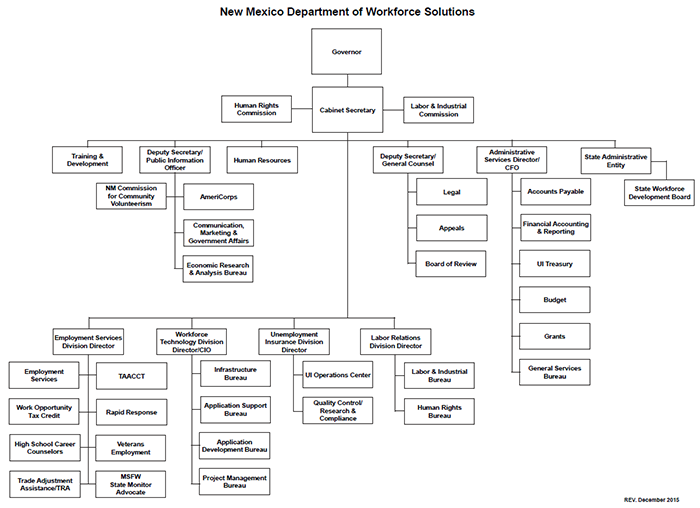
Each Employment Services field office is assigned a site manager who ensures the workforce centers are universally accessible, customer centered, and training is job-driven. This includes providing easy access to and assistance with workforce related activities, such as looking for a job, exploring work preparation and career development services, as well as seamless referral to WIOA employment, on-the-job-training, and occupational training programs. Employment Services staff work cooperatively and collaboratively with the Local Workforce Development Boards, site managers and operators, and other workforce partners, to effectively serve both employers and jobseekers. A key role of this program is to identify potential matches between employers and jobseekers. The program’s service delivery approach includes self-service, facilitated self-help, and staff-assisted services, and involves a number of other tools and resources. The organizational chart for New Mexico Department of Workforce Solutions, in which the WIOA and Wagner-Peyser programs are situated, follows.
New Mexico Higher Education Department, Adult Education Division
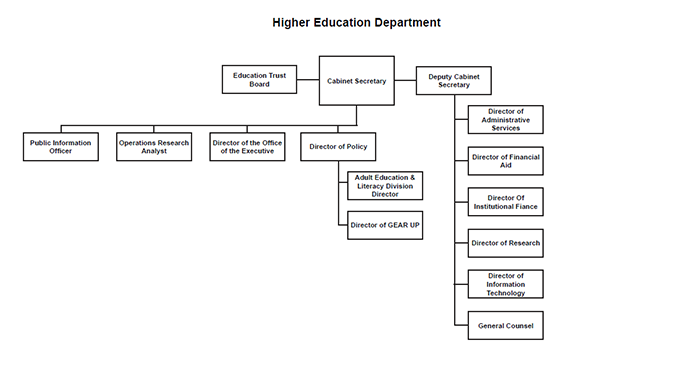
Adult Education in New Mexico is administered by the New Mexico Higher Education Department, which provides leadership, services, support, and technical expertise to Adult Education program personnel, students, partners and communities. At the State level, the Director of the Adult Education Division reports to the Secretary of New Mexico Higher Education Department. The Division oversees a Fiscal Office, a Program Improvement Office, and Operations Research for Adult Education, High School Equivalency Testing, and a Volunteer Literacy Tutoring program. The last two functions are funded by state legislative appropriation and are not governed by WIOA. The remainder of the Adult Education Division is funded through WIOA and a state legislative appropriation to the Higher Education Department to fulfill WIOA Maintenance of Effort requirements.
The program has 24 education providers. At the local level, each provider is attached to a fiscal agent. Four of the 24 providers are attached to a community based non-profit organization; one is attached to the Alamo Navajo School Board; and the remainders are attached to public postsecondary institutions. Each local provider has a program manager and a data technician, as well as instructional and administrative staff. Each local program provides instructional services using a curriculum aligned with the U.S. Department of Education, Office of Career, Technical, and Adult Education’s College and Career Readiness Standards, including literacy, high school equivalency preparation, workplace readiness training, basic technology skills, and English Language acquisition. Six programs have English Language/Civics grants through WIOA. In addition, eleven programs work in collaboration with college career and technical education departments to teach integrated basic education and skills training leading to an industry-recognized certification. In addition to instructional services, each program provides student assessment services, transition advising, and a variety of student support services, including referral to other entities for needed non-educational services. The organizational chart for the New Mexico Higher Education Department, in which Adult Education is situated, follows.
Vocational Rehabilitation
New Mexico has two vocational rehabilitation programs. The Commission for the Blind (Commission), an independent state agency, is the lead vocational rehabilitation entity serving individuals who are blind or visually impaired, while the New Mexico Division of Vocational Rehabilitation (NMDVR), situated within the Public Education Department, is the lead vocational rehabilitation entity serving individuals with all other disabilities. Both programs focus on preparing their respective participants for suitable work. A memorandum of understanding between NMDVR and the Commission has existed for many years to coordinate the provision of vocational rehabilitation services, processing of referrals, transitioning of cases, handling of joint cases, sharing of office space, sharing of confidential information, and representation on the State Workforce Board. The State funding allotment is distributed by the U.S. Department of Education, Rehabilitative Services Administration (RSA) between the two agencies. When the VR agencies receive funding from RSA for caseloads, they each distribute this money by operational region, which is further distributed down to individual employee caseloads. Vocational rehabilitation counselors manage caseload budgets to provide services for the individuals assigned to their caseload.
New Mexico Public Education Department, Division of Vocational Rehabilitation
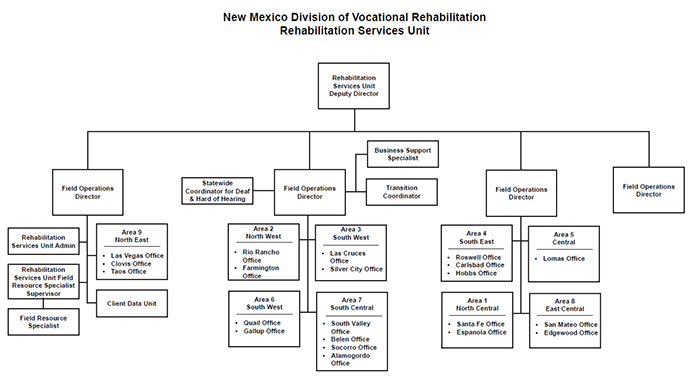
NMDVR helps individuals with disabilities find or retain suitable employment by providing vocational guidance, assistance, and services on an individualized basis. NMDVR is broken up into nine regions across the state, with each region having two to four field offices. Each region is managed by an area Program Manager and three Field Operation directors currently oversee each area. Also, one Administrative Field Operations Director oversees the administrative needs, i.e. facilities and fleet, of all the areas. The organizational chart for the New Mexico Department of Public Education, in which NMDVR is situated, follows.
Commission for the Blind
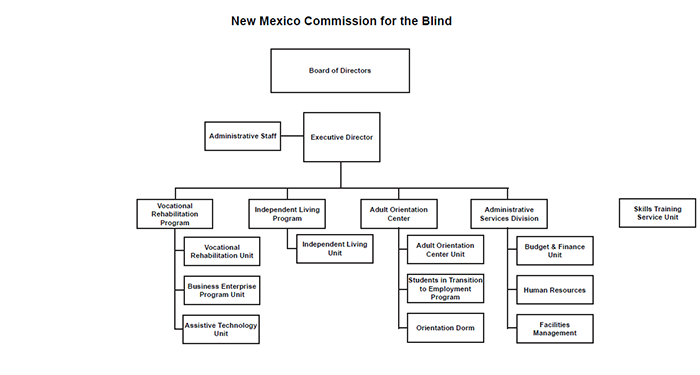
The Commission for the Blind provides vocational rehabilitation services to individuals who are blind or visually impaired, who need and can benefit from these services as it relates to an employment outcome. The Commission has eight vocational rehabilitation counselors located throughout the state, including four in Albuquerque, one in Las Vegas, one in Farmington, one in Roswell, and one in Las Cruces. The Commission typically opens a vocational rehabilitation case starting at age 14, and provides services through an Individualized Plan for Employment. As discussed earlier, examples of the types of services provided include guidance and counseling; transition services that can include participation in a summer youth training program or STEP; the provision of technological equipment, such as computers equipped with screen readers or screen enlargement software, specialized Braille computers, video magnifiers, or other rehabilitative technology; support attending college or graduate school; job placement services; support in starting a self-employment business; or provision of needed assistive technology to become or remain employed in a specific job. The Commission also operates a residential training program in Alamogordo, New Mexico where individuals who are blind can receive six to nine months of intensive training in Braille, orientation and mobility, assistive technology, personal management, home management, and industrial arts. The training is provided by eight highly qualified teachers. The Orientation Center is accredited by the Commission on Accreditation of Rehabilitation Facilities and certified by the National Blindness Professional Certification Board. The organizational chart for the New Mexico Commission for the Blind, an independent agency, follows.