



Located in:
- Program-specific Requirements for Adult, Dislocated Worker, and Youth Activities under Title I-B
The Unified or Combined State Plan must include the following with respect to activities carried out under subtitle B—
e. Waiver Requests (optional) (e1-e6)
States wanting to request waivers as part of their title I-B Operational Plan must include a waiver plan that includes the following information for each waiver requested:
1. Identifies the statutory or regulatory requirements for which a waiver is requested and the goals that the State or local area, as appropriate, intends to achieve as a result of the waiver and how those goals relate to the Unified or Combined State Plan;
2. Describes the actions that the State or local area, as appropriate, has undertaken to remove State or local statutory or regulatory barriers;
3. Describes the goals of the waiver and the expected programmatic outcomes if the request is granted;
4. Describes how the waiver will align with the Department’s policy priorities, such as:
A. Supporting employer engagement;
B. Connecting education and training strategies;
C. Supporting work-based learning;
D. Improving job and career results, and
E. Other guidance issued by the department.
5. Describes the individuals affected by the waiver, including how the waiver will impact services for disadvantaged populations or individuals with multiple barriers to employment; and
6. Describes the processes used to:
A. Monitor the progress in implementing the waiver;
B. Provide notice to any local board affected by the waiver;
C. Provide any local board affected by the waiver an opportunity to comment on the request;
D. Ensure meaningful public comment, including comment by business and organized labor, on the waiver.
E. Collect and report information about waiver outcomes in the State’s WIOA Annual Report.
7. The Secretary may require that States provide the most recent data available about the outcomes of the existing waiver in cases where the State seeks renewal of a previously approved waiver.
Current Narrative:
Ohio is applying for four waivers as described below:
Waiver 1: Allow TANF funds to count toward the 75 percent expenditure requirement on out-of-school youth and to calculate the expenditure requirement on a statewide basis.
- Identify the statutory or regulatory requirements for which a waiver is requested and the goals that the State or local area, as appropriate, intends to achieve as a result of the waiver and how those goals relate to the Combined State Plan.
Section 129 (a)(4) and 20 CFR 681.41 requires that local workforce development areas must expend a minimum of 75 percent of WIOA youth funds on out-of-school youth. Ohio would like to waive the requirement to allow for the inclusion of a percentage of TANF funds as part of the 75 percent expenditure for out-of-school youth requirement. Additionally, as part of this waiver, Ohio would like to calculate this expenditure requirement on a statewide basis.
Under CCMEP, with its emphasis on co-funding to benefit more cost-effective service delivery, the number of disconnected youth that can be served will increase, particularly given the large infusion of TANF dollars. This will ultimately allow WIOA youth dollars to have a further reach and greater impact in local communities. Additionally, by allowing the calculation of the expenditure rate to be statewide, there would be more flexibility amongst all the local workforce development areas to serve the population of participants unique to that local area.
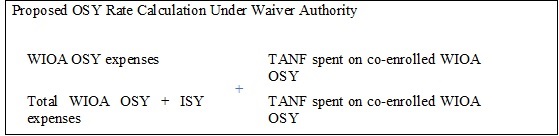
To recognize the influx of TANF dollars being invested in the WIOA out-of-school youth (OYS) population under CCMEP, ODJFS will include the amount of TANF dollars spent on co-enrolled WIOA OSY during a program year in both the numerator and denominator of the OSY rate calculation. The formula below defines the proposed alternative calculation to be used beginning with PY 20 funds:
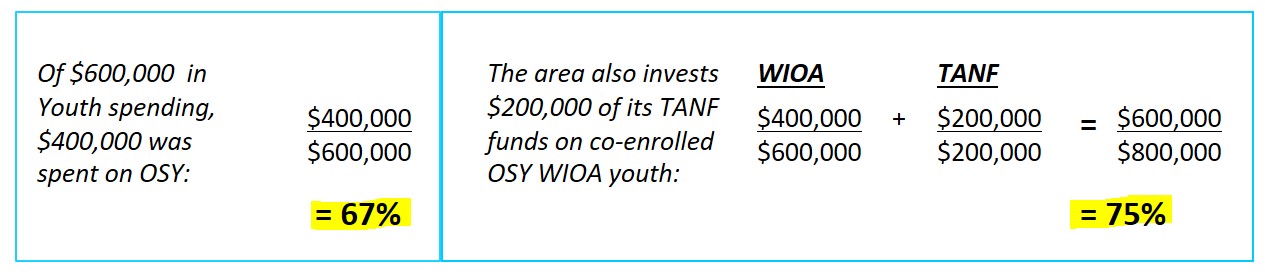
The example below compares the OSY rate calculation under current WIOA law to the proposed waiver flexibility for a local area that spent $400,000 of its $600,000 in PY18 WIOA Youth program funds during the two years of availability as well as $200,000 of its CCMEP TANF funds spent during the second year of the Youth grant on services for OSY who are co-enrolled:
The waiver supports the principles of streamlining services, increasing accountability and accessibility, State and local flexibility and ease of administration. Furthermore, this waiver supports the implementation of CCMEP by using both WIOA and TANF funding sources together to support the different needs of the same customer while easing administrative burden associated with managing two different Federal funding streams.
It should be noted that the LWDB still maintains the authority to determine how to fund the WIOA youth program, including how much funding should be dedicated to the WIOA in-school and out-of-school programs.
- Describe the actions that the State or local area, as appropriate, has undertaken to remove State or local statutory or regulatory barriers.
There are no State or local statutory or regulatory barriers to implementing the proposed waiver.
- Describe the goals of the waiver and the expected programmatic outcomes if the request is granted.
Ohio expects to achieve the following goals:
- Continuity and greater efficiency of service delivery;
- Flexibility in deciding the funding source for CCMEP participants who are eligible for these separate funding sources;
- Decrease in administrative costs to deliver services; and
- Integration of WIOA and TANF services as part of the CCMEP program.
- Describe how the waiver will align with the Department’s policy priorities, such as:
- Supporting employer engagement;
- Connecting education and training strategies;
- Supporting work-based learning;
- Improving job and career results, and
- Other guidance issued by the Department.
With the development of CCMEP, Ohio is pushing traditional program boundaries by integrating components of Ohio's TANF program with WIOA employment programs to create a better-coordinated, person-centered case management system. CCMEP takes a coordinated, holistic approach to stabilizing individuals and families by addressing the myriad of factors that may be contributing to poverty and unemployment, including health, housing, education, transportation, and child care. In conjunction with supportive services, the program will provide access to employment and training services, including career counseling, job placement, and the fourteen program elements to facilitate job retention.
This waiver supports co-funding and coordination of services and provides more flexibility on how funding is allocated. Furthermore, this waiver would extend WIOA funds and allow resources to go further. It will allow CCMEP to serve more youth by allowing both TANF and WIOA funds to be used when calculating the 75 percent expenditure requirement for out-of-school youth.
The population of youth and young adults fluctuates across Ohio. The population in some local areas is high density with a lot of resources to serve this population. In other local areas in the State, particularly the rural and Appalachian areas, the population is lower and resources are minimal. The waiver to calculate this expenditure requirement on a statewide basis would provide flexibility in serving CCMEP participants, allow the LWDB to focus on the populations who need services the most, and reflect the populations of participants who should be served.
- Describe the individuals affected by the waiver, including how the waiver will impact services for disadvantaged populations or individuals with multiple barriers to employment.
CCMEP serves TANF work-eligible recipients and WIOA in-school and out-of-school youth ages 14 to 24 years. By virtue of the program eligibility requirements, CCMEP is directly addressing service delivery for disadvantaged populations and individuals with multiple barriers to employment. This waiver will allow local areas to fund services in a manner which best meets the needs of the participant. The waiver to allow the use of TANF funds as part of the 75 percent expenditure requirement for out-of-school youth will allow additional funding flexibility so that both TANF and WIOA youth program funds can be used effectively and efficiently.
Furthermore, by allowing the 75 percent expenditure rate to be calculated on a statewide basis, the local areas may focus on serving the populations the LWDB has chosen to serve as well as the population of individuals who may benefit from the delivery of CCMEP services.
- Describe the processes used to:
- Monitor the progress in implementing the waiver;
- Provide notice to any local board affected by the waiver;
- Provide any local board affected by the waiver an opportunity to comment on the request;
- Ensure meaningful public comment, including comment by business and organized labor, on the waiver.
- Collect and report information about waiver outcomes in the State’s WIOA Annual Report.
ODJFS will monitor implementation and impact of this waiver through a combination of reporting from the local level using the Ohio Workforce Case Management System (OWCSM) and State monitoring, oversight, and evaluation functions. Monitoring of the waiver may be conducted through a variety of approaches that may include routine desk reviews and on-site compliance monitoring. ODJFS may also monitor the implementation of this waiver through feedback from local workforce development areas and review of all fiscal data systems. Meetings between ODJFS staff and local board directors are held on a regular basis, which serves as a venue to address any issue with the implementation of this waiver.
In addition to monitoring, CCMEP is being formally evaluated by the Ohio State University (OSU) to assess the impact of CCMEP on youth employment, education, and training outcomes using an experimental study design. OSU is using a broad evaluation strategy to assess CCMEP on three levels:
- A random-assignment outcome evaluation
- An implementation study to assess the key indicators of successful TANF-WIOA integration; and
- A descriptive study of the overall program, including an analysis of participant demographic, participation, and outcome data and an assessment of administrative effectiveness.
Additionally, the WIOA annual report published each year and provided to USDOL will include a section related to the effects of this waiver showing a re-calculation of the statewide OSY rate to include the TANF funds spent on co-enrolled OSY during the program year being reported.
Workforce development stakeholders, including local boards, businesses, and organized labor organizations, were notified of the proposed waiver request through an e-mail alert. The e-mail alert contained instructions on how to submit comments. In addition, both the general public and stakeholders had access to the waiver request on the OWD website.
Waiver 2: Allow the use of individual training accounts (ITA) for in-school youth, ages 18-21 years.
- Identify the statutory or regulatory requirements for which a waiver is requested and the goals that the State or local area, as appropriate, intends to achieve as a result of the waiver and how those goals relate to the Combined State Plan.
20 CFR 681.550 allows ITAs funded by WIOA youth funds to be used by out-of-school youth. The final rule did not expand the use of ITAs to in-school youth. Instead, in-school youth wishing to access ITAs may only do so through the WIOA adult program. Ohio would like to waive the requirement to only allow ITAs for out-of-school youth and expand this flexibility to in-school youth.
The intent of using ITAs in the WIOA out-of-school youth program is to expand training options, increase program flexibility, enhance customer choice, and reduce paperwork. Ohio would like in-school youth to also have this option. This waiver encourages this youth population to seriously look at career pathways and in-demand occupations and empowers them to make their own decisions, thereby taking responsibility for their actions.
This waiver request supports the principle of accountability and ease of administration. Co-enrollment in the WIOA adult program would not be necessary under this waiver. The ITA could be issued from one funding source and will increase accountability.
- Describe the actions that the State or local area, as appropriate, has undertaken to remove State or local statutory or regulatory barriers.
There are no State or local statutory or regulatory barriers to implementing the proposed waiver.
- Describe the goals of the waiver and the expected programmatic outcomes if the request is granted.
Ohio expects to achieve the following goals and programmatic outcomes:
- Improve the ability of LWDBs, youth program providers, and CCMEP lead agencies to respond quickly to the needs of in-school youth;
- Increase the quality of learning opportunities;
- Increase employment and training opportunities;
- Improve coordination by reducing fragmentation of service delivery;
- Improve customer choice and increase empowerment for youth, making them capable and responsible for making thoughtful choices about their career;
- Reduce unnecessary paperwork;
- Develop the emerging workforce with prepared candidates ready for work; and
- Increase accountability.
- Describe how the waiver will align with the Department’s policy priorities, such as:
- Supporting employer engagement;
- Connecting education and training strategies;
- Supporting work-based learning;
- Improving job and career results, and
- Other guidance issued by the Department.
In the WIOA Final Rule, the intent of using ITAs in the WIOA out-of-school youth program is to expand training options, increase program flexibility, enhance customer choice, and reduce paperwork. Ohio would like in-school youth to also have this option. This waiver encourages this youth population to seriously look at career pathways and in-demand occupations and empowers them to make their own decisions, thereby taking responsibility for their actions. The waiver also assists in the preparation of an emerging workforce with candidates who are ready for work.
- Describe the individuals affected by the waiver, including how the waiver will impact services for disadvantaged populations or individuals with multiple barriers to employment.
WIOA in-school youth participants will benefit from this waiver. In Ohio, CCMEP serves TANF work-eligible recipients and WIOA in-school and out-of-school youth. By virtue of the program eligibility requirements, CCMEP is directly addressing service delivery for disadvantaged populations and individuals with multiple barriers to employment. This waiver will allow this youth population to seriously look at career pathways and in-demand occupations, increase training and employment opportunities for this population of youth, and empower youth to make their own decisions.
- Describe the processes used to:
- Monitor the progress in implementing the waiver;
- Provide notice to any local board affected by the waiver;
- Provide any local board affected by the waiver an opportunity to comment on the request;
- Ensure meaningful public comment, including comment by business and organized labor, on the waiver.
- Collect and report information about waiver outcomes in the State’s WIOA Annual Report.
ODJFS will monitor implementation and impact of this waiver through a combination of reporting from the local level using the Ohio Workforce Case Management System and State monitoring, oversight, and evaluation functions. Monitoring of the waiver may be conducted through a variety of approaches that may include routine desk reviews and on-site compliance monitoring. ODJFS may also monitor the implementation of this waiver through feedback from local workforce development areas and review of all fiscal data systems. Meetings between ODJFS staff and local board directors are held on a regular basis, which serves as a venue to address any issue with the implementation of this waiver.
Workforce development stakeholders, including local boards, businesses, and organized labor organizations, were notified of the proposed waiver request through an e-mail alert. The e-mail alert contained instructions on how to submit comments. In addition, both the general public and stakeholders had access to the waiver request on the OWD website.
Waiver 3: Allow State to not collect and report performance data for all individuals engaged in programs of study listed on the State Eligible Training Provider List (ETPL).
- Identify the statutory or regulatory requirements for which a waiver is requested and the goals that the State or local area, as appropriate, intends to achieve as a result of the waiver and how those goals relate to the Combined State Plan.
As the State workforce agency, ODJFS is seeking a statewide waiver of the requirement to collect and report the number of individuals engaging in and exiting from the programs of study listed on the State ETPL, and the outcome data for the primary indicators of performance for all individuals in such programs, as mandated in WIOA §§ 116 and 122, and at 20 CFR 677.230 and 20 CFR 680.400 - 680.530.
Specifically, ODJFS requests waiver authority to report a “0” in the ETP Performance Report for the nine data elements related to all individuals in training (i.e.,data elements 120 through 128 on form ETA 9171) for programs of study where the data is not currently available.
The passage of WIOA resulted in new standards for tracking the quality of ETP s and informing consumers of performance outcomes associated with each training program. Pursuant to the WIOA requirements, ODJFS implemented numerous changes, including:
- Replacement of the State’s legacy ETPL database with a new portal known as the WIET system;
- Creation of new data fields for providers to input their levels of performance achieved on the primary indicators of performance for all trainees engaging in each program;
- Implementation of new policy guidance explaining the WIOA criteria and process for ETP s to become listed and renew their programs in WIET; and
- Issuance of frequent communications with training providers regarding the new requirements including a guidebook to help them navigate WIET.
ODJFS is implementing additional WIET system enhancements to collect the number of individuals enrolling in and completing each program of study. Despite these efforts to streamline and modernize the ETPL system and to achieve the WIOA vision of informed customer choice, some training providers have reported that they are struggling to provide the performance data required for all students in all programs. Their challenges fall within several categories:
- Excessive administrative costs associated with tracking former students, surveying their employment outcomes, and reporting the data for each training program, especially for programs where the percentage of WIOA participants is minute;
- Concerns with the protection of sensitive information (i.e., Social Security numbers) that would need to be gathered on all students to conduct wage record matches, leaving the students vulnerable to identity theft and privacy breaches; and
- Questionable accuracy of performance data if it is based on self-reported student surveys, anecdotal data, and potentially low response rates.
- Describe the actions that the State or local area, as appropriate, has undertaken to remove State or local statutory or regulatory barriers.
There are no known State or local barriers delaying implementation of this waiver. For purposes of selecting programs of training services, a LWDB may supplement the State’s criteria and information requirements for the ETP s it will utilize. This local authority will not be diminished by the waiver, enabling a local board to continue requiring its ETP s to report performance outcomes for all individuals if the local board deems this information to be necessary for informed customer choice and the achievement of local performance indicators.
- Describe the goals of the waiver and the expected programmatic outcomes if the request is granted.
The programmatic outcomes expected to result from waiver implementation include:
- Maintaining or increasing the number and diversity of training programs available on the ETPL;
- Reporting primary performance data for all programs for which it is available;
- Increasing the capacity to gather and report student counts and training program performance data where it is currently unavailable pursuant to WIOA mandates; and
- Strengthening relationships between training providers and the public workforce system through compromise and collaboration.
- Describe how the waiver will align with the Department’s policy priorities, such as:
- Supporting employer engagement;
- Connecting education and training strategies;
- Supporting work-based learning;
- Improving job and career results, and
- Other guidance issued by the Department.
The Combined State Plan identifies the alignment of training to business needs as a primary strategic goal for accomplishing WIOA’s primary purposes. Approval of the waiver would enhance this goal by ensuring that numerous and varied training programs remain available for participant selection, resulting in a well-prepared workforce possessing the widest possible array of technical skills that employers need to compete globally.
The USDOL priority of ensuring customer choice in the selection of training programs and providers is also supported by this waiver. If the list of available programs is diminished by removing many that are unable to provide data on all individuals, then the participants’ choices of potential training options would be diminished as well.
Finally, the State and Federal goal of serving disadvantaged populations and individuals with multiple barriers is supported by the waiver by ensuring that training providers with limited resources to track former student outcomes will focus their time and resources on ensuring successful outcomes for WIOA-funded participants rather than data collection tasks.
- Describe the individuals affected by the waiver, including how the waiver will impact services for disadvantaged populations or individuals with multiple barriers to employment.
Ohio provides training services to about 5,000 Adults, 3,000 Dislocated Workers, and 7,000 Youth annually. Most participants in training receive occupational skills training from an ETP on the State’s ETPL and would therefore benefit from this waiver by having access to a wide variety of in-demand training programs, which might otherwise be reduced if the providers who are unable to comply with all-individual reporting mandates must be removed from the ETPL.
- Describe the processes used to:
- Monitor the progress in implementing the waiver;
- Provide notice to any local board affected by the waiver;
- Provide any local board affected by the waiver an opportunity to comment on the request;
- Ensure meaningful public comment, including comment by business and organized labor, on the waiver.
- Collect and report information about waiver outcomes in the State’s WIOA Annual Report.
If the waiver is granted, ODJFS will monitor the entries in the WIET system and the program performance measures to evaluate the following outcomes:
- The number and diversity of training programs available on the ETPL, which should not decrease after the waiver is granted;
- The percentage of WIOA participants in training who receive a recognized postsecondary credential and retain employment in the second and fourth quarters after exit, which should not decrease due to this waiver (or else the waiver flexibility may have compromised the quality of the training services); and
- The percentage of providers that are unable to provide program performance data for all students, which should decrease as performance tracking methods improve.
Annually, ODJFS will evaluate the appropriateness and effectiveness of the waiver based on these measures and provide updates in each WIOA annual report while the waiver is in effect.
Workforce development stakeholders, including local boards, businesses, and organized labor organizations, were notified of the proposed waiver request through an e-mail alert. The e-mail alert contained instructions on how to submit comments. In addition, both the general public and stakeholders had access to the waiver request on the OWD website.
Waiver 4: Allow local areas to conduct non-participating career services for all youth as a WIOA youth-funded outreach activity.
- Identify the statutory or regulatory requirements for which a waiver is requested and the goals that the State or local area, as appropriate, intends to achieve as a result of the waiver and how those goals relate to the Combined State Plan.
Ohio is committed to providing high-quality services for youth, beginning with career exploration and guidance. As such, a partnership is developing between the Ohio Department of Education (ODE) and ODJFS to assist with the provision of career preparation activities for students in secondary education. These activities may include providing workshops, self-directed job search assistance, provision of information on in-demand sectors and occupations, information on postsecondary opportunities, and provision of workforce and labor market statistics information.
20 CFR 677.150 (a)(2) states that a participant for the WIOA youth program is an individual who has satisfied all applicable program requirements for the provision of services, including eligibility determination, an objective assessment, and development of an individual service strategy, and received one of the 14 WIOA youth program elements identified in section 129 (c)(2) of WIOA. Furthermore, Training and Employment Guidance Letter WIOA No. 21-16 Operating Guidance for the Workforce Innovation and Opportunity Act outlines the limited instances where WIOA youth funds may be expended on costs related to individuals who are not yet participants in the WIOA program. These instances include outreach and recruitment or assessment for eligibility determination. Funds cannot be spent on delivery of program elements. One of these program elements is services that provide labor market and employment information about in-demand industry sectors or occupations available in the local area, such as career awareness, career counseling, and career exploration services.
Ohio would like to waive the requirement to enroll youth that receive only the previously listed WIOA-funded services. These labor exchange services, listed previously, are considered non-participating basic career services under the WIOA adult and dislocated worker programs. Ohio would provide these services to all students as an outreach activity for the WIOA youth program. If students appear appropriate for the CCMEP, a referral to the program will be made.
- Describe the actions that the State or local area, as appropriate, has undertaken to remove State or local statutory or regulatory barriers.
There are no State or local statutory or regulatory barriers to implementing the proposed waiver.
- Describe the goals of the waiver and the expected programmatic outcomes if the request is granted.
The programmatic outcomes expected to result from waiver implementation include:
- Flexibility within CCMEP to provide basic labor exchange activities to all students without enrolling these students in the program.
- Mechanism to provide outreach to potential CCMEP applicants.
- Building a strong relationship between the local area and the local school system to assist with the provision of career preparation activities for students in secondary education.
- Providing career preparation prior to graduation from high school to students and developing a pipeline of employees to local businesses.
- Describe how the waiver will align with the Department’s policy priorities, such as:
- Supporting employer engagement;
- Connecting education and training strategies;
- Supporting work-based learning;
- Improving job and career results, and
- Other guidance issued by the Department.
Career awareness begins the process of developing a knowledge of the variety of careers and occupations available, their skill requirements, working conditions and training prerequisites, and job opportunities across a wide range of industry sectors. Providing career preparation activities to secondary school students supports the individual prepare for a potential career prior to graduation from high school. By providing these services as an outreach activity, the local area is then able to identify students who may need and/or benefit from CCMEP services. Under CCMEP, these students may then be connected to education and training, have an opportunity to obtain work experiences, and obtain not just a job, but a career.
- Describe the individuals affected by the waiver, including how the waiver will impact services for disadvantaged populations or individuals with multiple barriers to employment.
This waiver will allow the local area to provide labor exchange services to all high school students, not just those who seek CCMEP services. As such, the local areas will have another method of outreach to individuals who are low income, have disabilities, or have barriers to education and employment. Additionally, this waiver will allow the local areas to provide minimal career services to these individuals, which they may not have received otherwise.
- Describe the processes used to:
- Monitor the progress in implementing the waiver;
- Provide notice to any local board affected by the waiver;
- Provide any local board affected by the waiver an opportunity to comment on the request;
- Ensure meaningful public comment, including comment by business and organized labor, on the waiver.
- Collect and report information about waiver outcomes in the State’s WIOA Annual Report.
ODJFS will monitor implementation and impact of this waiver through a combination of reporting from the local level using the State monitoring, oversight, and evaluation functions. ODJFS will solicit feedback from local areas on the effectiveness of this waiver and the impact on participation in CCMEP. A review of all fiscal data systems will ensure that youth program funding spent on this outreach activity is appropriate with the allocation received by the local area. ODJFS will also communicate with ODE to ensure the goal of establishing a partnership between the local area and the local school system to provide career preparation prior to graduation from high school is met.
Workforce development stakeholders, including local boards, businesses, and organized labor organizations, were notified of the proposed waiver request through an e-mail alert. The e-mail alert contained instructions on how to submit comments. In addition, both the general public and stakeholders had access to the waiver request on the OWD website.