



Located in:
- II. Strategic Elements
The Unified or Combined State Plan must include a Strategic Planning Elements section that analyzes the State’s current economic environment and identifies the State’s overall vision for its workforce development system. The required elements in this section allow the State to develop data-driven goals for preparing an educated and skilled workforce and to identify successful strategies for aligning workforce development programs to support economic growth. Unless otherwise noted, all Strategic Planning Elements apply to Combined State Plan partner programs included in the plan as well as to core programs.
- a. Economic, Workforce, and Workforce Development Activities Analysis
The Unified or Combined State Plan must include an analysis of the economic conditions, economic development strategies, and labor market in which the State’s workforce system and programs will operate.
- a. Economic, Workforce, and Workforce Development Activities Analysis
II. a. 1. B. Workforce Analysis
The Unified or Combined State Plan must include an analysis of the current workforce, including individuals with barriers to employment, as defined in section 3 of WIOA4. This population must include individuals with disabilities among other groups5 in the State and across regions identified by the State. This includes—
[4] Individuals with barriers to employment include displaced homemakers; low-income individuals; Indians, Alaska Natives, and Native Hawaiians; individuals with disabilities, including youth who are individuals with disabilities; older individuals; ex-offenders; homeless individuals, or homeless children and youths; youth who are in or have aged out of the foster care system; individuals who are English language learners, individuals who have low levels of literacy, and individuals facing substantial cultural barriers; farmworkers (as defined at section 167(i) of WIOA and Training and Employment Guidance Letter No. 35-14); individuals within 2 years of exhausting lifetime eligibility under the Temporary Assistance for Needy Families program; single parents (including single pregnant women); and long-term unemployed individuals.
[5] Veterans, unemployed workers, and youth, and others that the State may identify.
i. Employment and Unemployment
Provide an analysis of current employment and unemployment data, including labor force participation rates, and trends in the State.
ii. Labor Market Trends
Provide an analysis of key labor market trends, including across existing industries and occupations.
iii. Education and Skill Levels of the Workforce
Provide an analysis of the educational and skill levels of the workforce.
iv. Skill Gaps
Describe apparent ‘skill gaps’.
Current Narrative:
Employment in the state and nation plunged with the onset of COVID-19. Per seasonally adjusted Local Area Unemployment Statistics (LAUS) figures, persons employed in Wisconsin dropped from 2,974,233 in February 2020 to 2,607,992 in April 2020, a 12.3% decline. As of June 2021, LAUS employment has nearly recovered to pre-pandemic levels. Wisconsin's employment-to-population ratio and labor force participation rate (LFPR) continue to exceed the national rate. After bottoming across several months at 65.5% in 2020 and 2021, the state's LFPR has increased to a seasonally adjusted rate of 66.3% (June 2021), which is 4.7 percentage points higher than the national rate of 61.6%. After peaking at 14.8% in April 2020, Wisconsin's June 2021 unemployment rate sits at 3.9%.
Discussion of Wisconsin's workforce quantity challenge makes clear the need to tap into all human resources available.
Individuals with Barriers
WIOA defines a number of populations which may experience barriers to employment. Wisconsin recognizes that many of its residents may experience difficulty gaining and maintaining employment.
- There are 591,486 individuals who are considered low-income, as defined by earning less than 125% of the federal poverty level wage (2019 American Community Survey, Table S1701).
- There are 54,577 American Indians or Alaska Natives (and an additional 37,669 residents that claim some Native American heritage) in the state and an additional 4,220 Native Hawaiians or Other Pacific Islanders (2019 American Community Survey, Table DP05).
- There are 50,222 youth (those under age 18) in the civilian non-institutionalized population that have significant disabilities (2019 American Community Survey, Table S1810).
- According to Cornell University's 2018 Disability Status Report the overall percentage (prevalence rate) of working age people (ages 21 to 64) with a disability in Wisconsin was 9.2%.
- According to the same report, the overall percentage for people with a disability ages 16 to 20 in Wisconsin was 7.2%.
- On the average night, there are 4,538 homeless individuals, with roughly half (43.9%) a part of families with minor children (State of Homelessness: 2020 Edition).
- As of July 20, 2021, 1,135 youth 15 years of age and older were in out-of-home care (WI DCF).
- 160,240 individuals in the state speak English less than "very well" (2019 American Community Survey, Table S1601).
- During the calendar year of 2020, Wisconsin averaged 32,191 Temporary Assistance for Needy Families (TANF)/Wisconsin Works (W-2) participants (Administration for Children & Families).
- According to the 2020 Migrant Labor Report, there are 6,023 migrant and seasonal farmworkers (includes dependents) in Wisconsin, as defined at section 167(i) of WIOA and Training and Employment Guidance Letter (TEGL) No. 35-14. (WI DWD).
- In FFY 2019, the Refugee Services Program served 448 refugees in Employment and Training activities. In FFY 2020, 345 refugees were served.
Unemployment
In annual average 2020 data, there were 196,100 unemployed people in Wisconsin. Of that total, 65,400 people were unemployed less than five weeks, 70,400 people were unemployed between 5-14 weeks, 31,900 people were unemployed between 15-26 weeks, and 28,400 people were unemployed 27 weeks or more.
Per the chart below, the average duration of unemployment peaked in 2011 at 36.6 weeks and decreased every year since until 2019. The share of long-term unemployed also has trended downward. Because the pandemic's impact largely began in March 2020, the first month an individual potentially would be considered long-term unemployed (27+ weeks) due to COVID-19 is September. This explains the unexpected low figures in the 2020 data, which averages figures from January through December 2020. Typically Current Population Survey (CPS) data at the state level is pooled over 12 months.
Chart 1: Annual Average Share of Long-Term Unemployed

Source: Office of Economic Advisors, Wisconsin Department of Workforce Development
Characteristics of Those Not in the Labor Force
According to the Current Population Survey, in 2020 (annual average), 1.58 million or 34.0% of the Wisconsin civilian, non-institutionalized population aged 16 and over did not participate in the labor market. Of this population, the large majority (94.9%) indicated that they did not want a job, though barriers may exist that if addressed could decrease the "not want a job" share. This cohort includes 229,400 residents between the ages of 16 and 24, many likely not participating due to educational commitments. Additionally, there are 1,053,400 residents over the age of 55 who likely have largely entered into retirement. This demonstrates two key facts of labor force non-participation, namely that large numbers of age-eligible individuals have either not yet entered the active workforce or have aged out of it.
Status of Labor Force Subgroups
There are a number of groups within this larger population who face more Significant Barriers to Employment (SBE) and therefore require special services such as those provided under WIOA. Among these groups are individuals with disabilities, veterans, the incarcerated population, and low income individuals.
Individuals with Disabilities
There are 677,250 individuals in the civilian, non-institutionalized population in Wisconsin that self-identify as having a significant disability, according to the 2019 American Community Survey. Almost half of these individuals (328,444) are of working age, generally defined as between the ages of 18 and 64. This constitutes almost 10% of the state's total working age population. Of this number, 144,156 individuals are employed and an additional 12,961 reported being unemployed (are actively seeking work). This results in an 8.3% unemployment rate within this group – a rate that is more than 2.5 times the state average over the same time period. That leaves 171,327 individuals unattached to the labor force. The most common disabilities for those not in the labor force are ambulatory (99,283), cognitive (88,771), and those that lead to independent living difficulties (80,485) . These figures result in a 47.8% labor force participation rate for the disabled population, significantly smaller than Wisconsin's rate of 81.9% for the 18 to 64 age group.
Veterans
Wisconsin's veteran population is a recognized priority in the provision of workforce development services. There are more than 148,000 veterans of working age (between 18 and 64) in Wisconsin, representing another vital potential workforce resource.
Although the unemployment rate of the state's age 18 to 64 veteran population is slightly lower than that of the overall population (3.4% compared to 3.5% - 2019 American Community Survey), its labor force participation rate is slightly lower than the state as a whole (2.4 percentage points). Twenty-eight percent of veterans experience some type of disability, a rate that is nearly twice that of the nonveteran population.
Incarcerated Population
A third notable group that faces barriers to employment in Wisconsin is its incarcerated population. Over 23,500 inmates were under the custody of the DOC as of December 31, 2019. Ninety-four percent of this population is male. Sixty-six percent of this population currently has less than five years of prison time remaining. Seventy-one percent of the male population and 66% of the female population have only a high school education.
Low Income Individuals
Another group that is a priority in Wisconsin consists of individuals who are between the ages of 18 and 64 living in poverty. In 2019, about 591,000 people in Wisconsin lived in poverty, compared to about 731,000 in 2010 – a decrease of about 140,000 people living in poverty. In Wisconsin, the share of people ages 18 to 64 who live in poverty is 10.4%. This means there are up to 350,000 low income job seekers and workers who may benefit from the programs and services provided by the public workforce system.
The four groups discussed represent populations that can help combat Wisconsin's workforce quantity challenge. Programs discussed in this report are needed to give these groups' individuals the training and support required to allow them to productively enter the state's labor force pipeline. The state added the DCF, DHS, and DOC to the PY20-23 State Plan to increase the opportunity for economic mobility and work participation among these populations by promoting further collaboration between workforce, re-entry, and human service programs.
Table 4: Civilians not in the labor force by sex and age, January 2020-December 2020 (based on CPS) (Numbers in thousands)
| Total | Age 16 to 24 years | Age 25 to 54 years | Age 55 years and over | Men | Women | |
|---|---|---|---|---|---|---|
| Total not in the labor force | 1,581.2 | 229.4 | 298.4 | 1,053.4 | 671.9 | 909.4 |
| Do not want a job now | 1,499.9 | 201.5 | 266.5 | 1,031.9 | 626.0 | 873.8 |
| Want a job | 81.4 | 27.9 | 32.0 | 21.5 | 45.8 | 35.5 |
| Did not search for work in previous year | 50.9 | 15.8 | 19.3 | 15.9 | 26.3 | 24.6 |
| Searched for work in previous year | 30.4 | 12.1 | 12.7 | 5.7 | 19.6 | 10.9 |
| Not available to work now | 5.7 | 3.9 | 1.5 | 0.3 | 1.6 | 4.1 |
| Available to work now | 24.8 | 8.2 | 11.1 | 5.4 | 18.0 | 6.8 |
| Reason not currently looking: | ||||||
| Discouragement over job prospects | 6.1 | 1.9 | 3.9 | 0.4 | 5.4 | 0.7 |
| Reasons other than discouragement | 18.7 | 6.3 | 7.3 | 5.1 | 12.6 | 6.0 |
Source: Office of Economic Advisors, Wisconsin Department of Workforce Development
The key labor market trend in Wisconsin is about workforce quantity. The fundamental challenge is finding enough workers to fill jobs across all industries and all geographies. As baby boomers continue their exodus out of the workforce, the need to "find every body available and get everybody trained up to the person's fullest potential" is crucial. See 'Workforce constraints limit growth' discussion below.
Table 5: Typical Education for Entry Totals and Percent by Education Type 2018-2028
| Typical Education for Entry | # Jobs - 2018 | % of Total Job Base -2018 | # Jobs - 2028 | % of Total Job Base - 2028 | 2018-2028 Numeric Change | 2018-2028 Percent Change |
|---|---|---|---|---|---|---|
| No formal education | 710,067 | 22.6% | 732,720 | 22.5% | 22,653 | 3.2% |
| High school diploma or equivalent | 1,320,690 | 42.0% | 1,343,555 | 41.3% | 22,865 | 1.7% |
| Some college, no degree | 89,233 | 2.8% | 89,464 | 2.7% | 231 | 0.3% |
| Postsecondary non-degree award | 207,675 | 6.6% | 216,326 | 6.6% | 8,651 | 4.2% |
| Associate degree | 70,873 | 2.3% | 74,609 | 2.3% | 3,736 | 5.3% |
| Bachelor's degree | 639,358 | 20.3% | 683,129 | 21.0% | 43,771 | 6.8% |
| Master's degree | 44,231 | 1.4% | 48,678 | 1.5% | 4,447 | 10.1% |
| Doctoral or professional degree | 62,959 | 2.0% | 66,642 | 2.0% | 3,683 | 5.8% |
| Total Job Base* | 3,145,086 | 100% | 3,255,123 | 100% | 110,037 | 3.5% |
The Long-Term 2018-2028 projections are estimates based on historic data and do not include any impact COVID-19 may have on industry employment in the future.
*Includes only published/non-confidential data.
Source: Office of Economic Advisors, Wisconsin Department of Workforce Development
Chart 2: Education Needed for Entry: Projected Employment in 2028 - Percent of Total
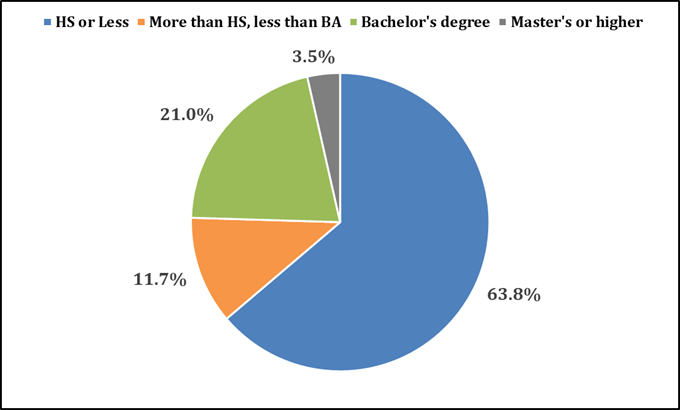
Source: Office of Economic Advisors, Wisconsin Department of Workforce Development
Chart 3: Education Needed for Entry: Annual Growth Openings 2018-2028 – Percent of Total

The Long-Term 2018-2028 projections are estimates based on historic data and do not include any impact COVID-19 may have on industry employment in the future.
Source: Office of Economic Advisors, Wisconsin Department of Workforce Development
The apparent 'skill gaps' is a two-part challenge for the state. Firstly, Wisconsin is facing a quantity challenge. Secondly, the quantity challenge foretells the 'skills gap' challenge; without enough workers, all industries and occupations will have too few appropriately skilled job candidates.
Workforce Constraints Limit Growth
Wisconsin's employment growth is constrained by difficulty finding workers to fill openings. Employers statewide have expressed concerns about the lack of qualified workforce to fill open positions. Employers in most industries and occupations voiced concerns about the lack of workforce available.
Opportunities in health care, IT, skilled trades, and skilled manufacturing occupations have increased, but job growth has been constricted by employers' inability to find adequately trained personnel. While specific technical skills are lacking, such as welding, CNC operators, IT engineers and technicians, and health care practitioners and technicians, there is a shortage of available workers across many additional occupations and skill sets, such as retail, customer service, and warehousing. Employers complain about the deficiency in Science, Technology, Engineering and Math (STEM) skills but also about the lack of "employability" skills: attendance, teamwork, communication, etc. Most employers today are willing to train new employees if only they could find and retain them.
Quantity Challenge
From 2011 to 2020, US Census Population Estimate Program figures show net migration had a negligible impact on Wisconsin's population. The Wisconsin general fertility rate per 1,000 women age 15-44 declined from 61.8 in 2014 to 58.1 in 2019, and Wisconsin's population growth from natural increase is predicted to slow over the next two decades. The percentage of Wisconsin's population 65 years and older was 18.0% in 2020, and that percentage is expected to increase to 23.7% in 2040. Meanwhile, the percentage of the working age population (18 -64) goes from 60.4% in 2020 to a projected 55.1% in 2040.
Nationally using February 2020 as a base point, the labor force participation rate (LFPR) for age 55+ workers has decreased a higher percentage than the overall LFPR. If the trend continues, it does not bode well for Wisconsin's labor force as an older state. Changes in LFPR, the unemployment rate, and the jobs-to-worker ratio affect the state's labor supply and demand balance.
What changes with a quantity gap, versus a skills gap, is that most occupations see shortages. Traditionally, target training and/or other incentives were instituted to satisfy spot gaps in one or a few occupations, such as IT, or in the cycles across engineering disciplines. Worker skills could be shifted from a sector with ample workers to one with too few.
A general quantity gap, however, shifts worker skills from one sector to another, increasing the shortage in the former sector. Using wage incentives to attract workers is a proven tool but is a less viable solution for export industries that face global competition.