


Located in:
- II. Strategic Elements
The Unified or Combined State Plan must include a Strategic Planning Elements section that analyzes the State’s current economic environment and identifies the State’s overall vision for its workforce development system. The required elements in this section allow the State to develop data-driven goals for preparing an educated and skilled workforce and to identify successful strategies for aligning workforce development programs to support economic growth. Unless otherwise noted, all Strategic Planning Elements apply to Combined State Plan partner programs included in the plan as well as to core programs.
II. c. State Strategy
The Unified or Combined State Plan must include the State's strategies to achieve its strategic vision and goals. These strategies must take into account the State’s economic, workforce, and workforce development, education and training activities and analysis provided in Section (a) above. Include discussion of specific strategies to address the needs of populations provided in Section (a).
1. Describe the strategies the State will implement, including industry or sector partnerships related to in-demand industry sectors and occupations and career pathways, as required by WIOA section 101(d)(3)(B), (D). “Career pathway” is defined at WIOA section 3(7) and includes registered apprenticeship. “In-demand industry sector or occupation” is defined at WIOA section 3(23)
2. Describe the strategies the State will use to align the core programs, any Combined State Plan partner programs included in this Plan, required and optional one-stop partner programs, and any other resources available to the State to achieve fully integrated customer services consistent with the strategic vision and goals described above. Also describe strategies to strengthen workforce development activities in regard to weaknesses identified in section II(a)(2)
Current Narrative:
The State of Alabama workforce system has set many ambitious goals including establishing a statewide longitudinal database, strengthening career pathways, expanding apprenticeship programs, producing 500,000 new credential holders within the next five years, and many others. Each of the agencies in the workforce system are aligned to support these goals. Workforce system partners include the Alabama Department of Commerce (Title I), Alabama Department of Postsecondary Education – (Title II, Perkins V), Alabama Department of Labor (Title III, Trade Act, JVSG), Alabama Department of Rehabilitation Services (Title IV), Alabama Department of Human Resources (TANF, SNAP E&T), Alabama Department of Senior Services (SCSEP), and the Alabama Department of Education (Perkins V).
There is a high level of cooperation among the agencies to serve their common client base. This includes communication and planning activities through various State Workforce Board and Local Area Workforce Board committees. The level of communication and data sharing will be strengthened as the longitudinal database is implemented. Currently Title I, Title III, Trade Act, and JVSG is operating together in a new shared case management and data tracking system, which started in April 2020. There are plans for other programs such as apprenticeship to be added. Each partner agency will have the opportunity to join in this data sharing system as it progresses. Agreements for data sharing of the common elements have been put in place with the Alabama Department of Rehabilitation Service (Title IV) and the Alabama Department of Postsecondary Education - Adult Education (Title II). The Alabama Department of Human Resources (TANF and SNAP E&T) historically has had an existing data sharing agreement with the Alabama Department of Commerce and Alabama Department of Labor to share data and coordinate shared client services. Details are now being worked out on how to transfer this to the new data system.
The Alabama Department of Human Resources' TANF program is an especially important partner in the workforce system. The JOBS Program, which is DHR’s welfare to work program, is operational in all 67 Alabama counties. The Program provides services and work supports to parents receiving cash assistance to help them find and retain employment. These services and supports seek to address barriers such as lack of adequate childcare, poor access to transportation, domestic violence and substance abuse, all which greatly limit the ability to obtain and retain employment. Services also include employability assessments, job readiness and job skills training, disability assessments and adult education. Following an initial interview which involves individual and family assessments, JOBS case managers provide services directly or by referral to other agencies. This program continues to operate its own separate physical locations, but there is close coordination between it, the Alabama Career Centers, and other workforce partners to serve common clients and ensure that current and potential clients have access to all of the workforce programs available through initial screenings for eligibility and referrals.
Alignment of these programs will support the following state workforce strategies and goals:
State Strategy: State Strategies to Achieve Goals
Alabama’s current strategies for achieving its strategic workforce development goals evolved from a two-year task force study conducted by the Alabama Workforce Council appointed by the Governor on July 2, 2014. The study by Alabama’s leaders of industry, business, education and government, recommended the following strategies in their report to the Governor on January 31, 2015:
⦁ Develop and implement a robust longitudinal data system (P-20W) for use by all stakeholders to inform decision-making and planning to meet changing workforce training and education needs. The P-20W data system will collect data from state education agencies, the Department of Labor, industries, and other parties to evaluate education and workforce trends. The system will serve as the centerpiece of the education and industry “feedback loop.”
⦁ Create and launch an awareness campaign to change generational misperceptions about long-term careers in the skilled trades and raise awareness about long-term career opportunities in Alabama. The campaign will serve as the marketing centerpiece for the state’s workforce development efforts to educate students and adults about career pathways and opportunities, and to direct them to a one-stop-shop online resource for more information about educational programs, industry websites, and other workforce development programs.
⦁ Develop and implement a “One Stop Shop” online workforce information resource -- a single online resource for all information about state workforce development efforts and career opportunities. Separate portals within the main site will deliver content relevant to each of the identified target demographic groups - (1) students, (2) adults seeking to re-enter the workforce, (3) parents, and (4) educators.
Since 2015, Alabama has accelerated efforts toward strengthening the state’s education and workforce development systems. This work has incorporated and aligned the efforts of many partners in the public, private, and nonprofit sectors, as well as citizens and stakeholders across the state. The State of Alabama’s 2020 Combined Plan for WIOArepresents a moment of opportunity to not only record and build on the success and collective impact of these efforts to date, but also to articulate a vision and priorities for collaborative work over the next four years. Alabama’s 2020 WIOA Combined Plan was designed to braid federal and state workforce and education funding streams to produce an education-to-workforce pipeline that provides a seamless transition from secondary to postsecondary education, alignment between secondary and postsecondary CTE, and co-enrollment between adult education and postsecondary CTE. The Governor’s Office and the partner agencies to the combined state WIOA plan participated in 14 joint state planning meetings beginning in June 2019. The plan was developed after the 14 public meetings were conducted in each of the seven workforce areas (regions). Two meetings were held in each region between July and October 2019. The 2020 Combined Plan includes Perkins CTE for the first time and provides a vision to align Alabama’s public workforce system to provide in-demand career pathways and supportive services for individuals with barriers to employment.
The Governor’s Office achieved consensus on needs assessments, plans to reach special and disconnected populations, stakeholder input, local and state performance targets, program quality and performance indicators, and alignment of programs in the combined state plan to achieve a unified workforce development system for the State of Alabama. The WIOA and CTE needs assessments were aligned. The process for collecting stakeholder input and stakeholder review between CTE and WIOA were aligned through the combined state plan. The WIOA and CTE public hearings were aligned. The combined state plan took advantage of aligned definitions in WIOA and CTE, including “career pathways,” “sector strategies,” and “programs of study” to develop fully articulated career pathways in all 16 career clusters that begin with career exploration, transition to pre-apprenticeship, and culminate in a registered or industry-recognized apprenticeship, which allow secondary CTE concentrators to earn a high school diploma, an associate’s degree mapped to industry recognized credentials, and work-based learning experience in an aligned occupation. The combined state plan explicates how career coaches, dual enrollment, and work-based learning, and simulated workplaces will be the lynchpins of ensuring that secondary and postsecondary CTE students have access to align career pathways and placement opportunities.
The 2020 WIOA combined state plan aligned the core indicators of performance for the six core WIOA programs, the four secondary CTE indicators, and the postsecondary CTE indicators. Under section 113, accountability, for the core secondary CTE indicators of performance, for the fourth indicator (program quality), Alabama selected recognized postsecondary credential attainment for federal accountability and will monitor all three as the basis for career pathways at the state level, since all three of these activities are critical to the develop of the education-to-workforce pipeline. Across all titles, WIOA and Perkins focus on serving “individuals with barriers to employment.” Each special population category listed in Perkins V and WIOA overlap except three (out-of-workforce individuals is a Perkins definition with three subcategories [one of the three subcategories contains a WIOA special population [displaced homemakers]). Individuals preparing for non-traditional fields and youth with parents on active duty are both exclusive to Perkins but were added to WIOA by the Governor to make all special populations aligned. The Alabama Success Plus postsecondary education attainment goal and the goal of reaching the national labor force participation rate by 2025 are focused on reaching each special population’s share of the attainment and labor force goals annually by each of the states seven workforce regions, by each county, and for each of the 16 career clusters. Alabama submitted the 2020 WIOA Combined Plan on February 3rd, 2020. The plan was approved by the U.S. Departments of Education and Labor on June 7, 2020.
(a.) The Career Cluster Strategy
The Alabama Committee on Credentials and Career Pathways (ACCCP) was created by Alabama Act 2019-506 to identify credentials of value associated with in-demand occupations within the 16 career clusters. The ACCCP is tasked with promulgating regional and statewide list of in-demand occupations and credentials of value associated with those occupations. The ACCCP also is tasked with identifying career pathways by connecting occupations in a sector from entry-level to advanced level. The career pathway approach connects levels of education, training, counseling, support services, and credentials for specific occupations in a way that optimizes continuous progress towards the education, employment, and career goals of individuals of all ages, abilities, and needs. Career pathways fully engage businesses to help meet their workforce needs. In turn, customers are encouraged to choose among a full range of education and work-based learning opportunities that allows them to earn marketable credentials. Ultimately, the goal is to connect the customer to a career pathway that taps their talents and leads to long-term economic security. Career pathways are most effective when they are highly informed by businesses in a regional economy and when they are supported by system partners. These pathways can offer a mechanism for those with barriers to employment to move more efficiently into jobs. The workforce development partners can identify potential participants and provide the support services for these job seekers to succeed in their education and training. Business input can help the education system better tailor and update curriculum based on regional industry needs and trends.
(b.) Secondary to Postsecondary Transition & Alignment
Alabama offers dual enrollment and statewide articulation to ease the transition from secondary to postsecondary through the Accelerated High School program, the Early College Enrollment Program, and general dual enrollment opportunities.
Alabama has statewide articulation agreements in the following Career Clusters:
⦁ Agriculture, Food & Natural Resources Career Cluster
⦁ Architecture & Construction Career Cluster
⦁ Arts, AV Technology & Communications Career Cluster
⦁ Business Management & Administration Career Cluster
⦁ Education & Training Career Cluster
⦁ Human Services Career Cluster
⦁ Information Technology Career Cluster
⦁ Manufacturing Career Cluster
⦁ STEM Career Cluster
⦁ Transportation, Distribution & Logistics Career Cluster
Recognizing a major shortage of craft professionals within Alabama and a need for better career pathways for students, Alabama’s legislature signed into law a requirement for all of ALSDE’s CTE programs to have industry-supported advisory programs to ensure students are career ready upon graduation.
(c.) Industry Collaboration
In 2013, ALSDE created industry committees in response to new legislation requiring Alabama CTE programs to have advisory programs to ensure industry has influence on the training process. Feedback from all industry advisory committees indicated a strong demand for industry-recognized credentials, so the committees established Career Readiness Indicators, which equate to credentials or certifications that demonstrate a student is ready for career placement.
(d.) Career Preparedness
To better facilitate career-based decision making among its students, ALSDE requires every student to take a one-credit career preparedness course in ninth grade that focuses on academic and career planning prior to graduation. The career preparedness course has three integrated areas of instruction: academic planning and career development, financial literacy, and technology. Students define their career goals and plan their coursework through grade 12. This four-year plan is a dynamic document that can be updated, but it serves as a compass for students’ career paths. The course allows students to spend a year looking at careers and what it takes to get there. In addition, ALSDE employs career coaches to better educate students on the options available to them. Career Coaches in Alabama high schools act as liaisons between industry, students, and parents in each of ALSDE’s schools. More students are earning in-demand industry credentials than ever before. The ACT WorkKeys assessment is administered to all high school seniors in Alabama public schools.
As baseline data for Alabama’s CTE programs the following information for the 2014-15 school year is presented in the table below.
| Item/Feature of CTE in Alabama | Number, Amount or Percentage |
|---|---|
| Number of public high schools | 376 |
| Number of public high school offering CTE courses | 72 |
| Students enrolled in public high schools | 262,062 |
| Students enrolled in CTE courses | 170,448 |
| Students identified as high school CTE concentrators | 81,341 |
| Number of public community colleges | 26 |
| Number of full and part-time students enrolled in public community colleges | 125,477 |
| Number of post-secondary CTE concentrators | 39,932 |
| Total Perkins funds received | $19,175,065 |
| Percentage of Perkins funds distributed to secondary schools | 70% |
| Percentage of Perkins funds distributed to post-secondary | 30% |
The Department of Commerce’s Workforce Development Division (WDD) is dedicated to assisting the growth of Alabama businesses and the workers that sustain their operations. By directing individuals toward job skills improvement programs, education, and training, the Workforce Development Division equips workers with the tools and talents that employers demand. The Workforce Development Division has two prongs to serve businesses and industry, job seekers, and employees. The Alabama Industrial Development Training agency (AIDT), one of the nation’s top state workforce training agencies, offers comprehensive pre-employment selection and training, leadership development, on-the-job training, and assessments — all specific to each company’s needs. AIDT has worked with thousands of businesses and trained more than 600,000 workers. The second prong of the Workforce Development Division is the Workforce Innovation and Opportunity Act (WIOA) and are responsible for several workforce programs, including the Alabama Career Centers (Which are jointly funded by the Alabama Department of Commerce and managed by the Alabama Department of Labor) and various training programs.
WDD also oversees five (5) of the seven (7) Local Workforce Development Areas (LWDAs). The five Local Workforce Development Areas that are administered by the Workforce Development Division currently contain some of the same membership as the Regional Workforce Councils, which provides the integration and consistency desired at the local level. Each of the LWDAs works with their corresponding Regional Council to share information and seek information from local businesses and industry to ensure WIOA training programs are targeting the skills and gaps identified in each local area. Career Centers, Local Workforce Development Boards (LWDBs), employers, and other partners will collaborate to develop pathways for populations that may have barriers to entering the workforce. The Alabama Department of Labor manages the Alabama Career Center System that is funded by WIOA in Alabama. The respective staffs of these agencies are fully engaged and integrated as we serve the citizens.
ACCS Adult Education Office is Alabama’s eligible agency for adult education and is responsible for the administrative and programmatic oversight of the Title II AEFLA funds distributed to eligible, competitively selected providers. Under WIOA, ACCS Adult Education eligible providers’ services may include all of the following:
⦁ adult education and literacy;
⦁ workplace adult education and literacy;
⦁ family literacy;
⦁ English language acquisition;
⦁ Integrated English literacy and civics education;
⦁ workforce preparation;
⦁ integrated education and training (IET).
ACCS Adult Education will focus on expanding low-skilled individuals’ access to career pathways in high-demand occupations. With this focus, the integrated education and training (IET) activities and the contextualized curriculum and materials used for IET will be aligned to Alabama’s College and Career Readiness standards for ELA/Literacy, science, and math. In addition, workforce preparation activities will align to OCTAE’s Employability Skills Framework, and any occupational training components provided will be based on business and industry standards. All low-skilled job seekers will have access to these Pathways through a “no wrong door” approach to career center services.
(e.) The Strong Start, Strong Finish Initiative
Governor Ivey launched the Strong, Start Strong Finish education initiative in July 2017 to integrate Alabama’s early childhood education, K-12 education, and workforce development efforts into a seamless educational journey for all Alabamians. Strong Start, Strong Finish is composed of three major strategies: Pre through Three (P-3); Computer Science for Alabama (CS4AL); and Success Plus. Pre to Three is focused on securing state-wide saturation for the Alabama First-Class Pre-K Program and ensuring that all of Alabama’s third-graders are proficient readers by 2022. CS4AL will ensure that a rigorous computer science course is offered at all of Alabama’s middle and high schools by 2022. Success Plus will prepare 500,000 more Alabamians to enter the workforce with high-quality postsecondary degrees, certificates, and credentials by 2025. With the passage of the Strong Start, Strong Finish legislative agenda (Act 2019-523, Act 2019-389, and Act 2019-506), Governor Ivey has delivered on the most sweeping and transformative education agenda in over 50 years.
Governor Ivey’s strategic vision Alabama’s education and workforce system includes five benchmarks to ensure that all Alabamians are prepared for a strong start and a strong finish to their education journey—no matter what phase of life they may find themselves. The five Strong Start, Strong Finish benchmarks are:
⦁ pre-k readiness to ensure that all of Alabama’s four-year-old children are prepared for an excellent early childhood education experience;
⦁ school readiness to ensure that all of Alabama’s five- and six-year-old students enter kindergarten and/or first grade with advanced skills;
⦁ literacy and numeracy by age eight to ensure that all of Alabama’s students are prepared to persist through difficult coursework;
⦁ career exploration and discovery so that all students understand how to connect their interests and aptitudes with academic skills they learn in the classroom; and
⦁ college and/or career readiness so that all students graduate high school prepared to enter into postsecondary education or into an in-demand occupation.
The three Strong Start, Strong Finish strategies—P-3, CS4AL, and Success Plus—are composed of initiatives designed to make progress against two or more of the five benchmarks. P-3 is composed of strategies that address the first three benchmarks—pre-k readiness, school readiness, and literacy and numeracy. CS4AL is focused on benchmarks three through five (literacy and numeracy, college and career exploration, and college and/or career readiness). Success Plus highlights fourth and fifth benchmarks of career exploration and discovery and college and career exploration.
(f.) Governor’s Office of Education and Workforce Transformation (GOEWT)
Governor Ivey established the Governor’s Office of Education and Workforce Transformation (GOEWT) to coordinate Alabama’s education and workforce systems in 2018. The GOEWT was charged with three goals: (1) to increase the labor force participation and to decrease the unemployment and underemployment rates; (2) to surpass the Alabama post-secondary attainment goal; and (3) to create career pathways in all 16 career clusters for in-school youth, out-of-school youth, adults, and disconnected populations. The GOEWT was assigned three objectives to achieve its three goals: (1) to braid Alabama’s federal education and workforce development funding streams to support an education-to-workforce pipeline; (2) to create and manage the Alabama Terminal for Linking and Analyzing Statistics (ATLAS) on Career Pathways as Alabama’s state longitudinal database system; and (3) to create the Alabama Office of Apprenticeship.
The GOEWT is led by the Director of the GOEWT, who also concurrently serves as the Governor’s Education Policy Advisor. The Director of the GOEWT is charged with nine tasks for achieving the goals and objectives of the GOEWT. The Director of the GOEWT is charged with (1) braiding Alabama’s federal education and workforce funding streams; (2) leading the Governor’s P-20W Council that governs the ATLAS on Career Pathways; (3) managing the development of the ATLAS on Career Pathways; (4) developing the Alabama College and Career Exploration Tool (ACCET); (5) identifying valuable credentials and career pathways aligned to secondary, post-secondary, and adult education programs of study; (6) coordinating the development of the combined WIOA 2020 State Plan; (7) coordinating the establishment of the Alabama Office of Apprenticeship as Alabama’s state apprenticeship agency; (8) creating a unified workforce marketing, outreach, and incentive strategy; and (9) coordinating Alabama’s federal education and workforce development grant applications.
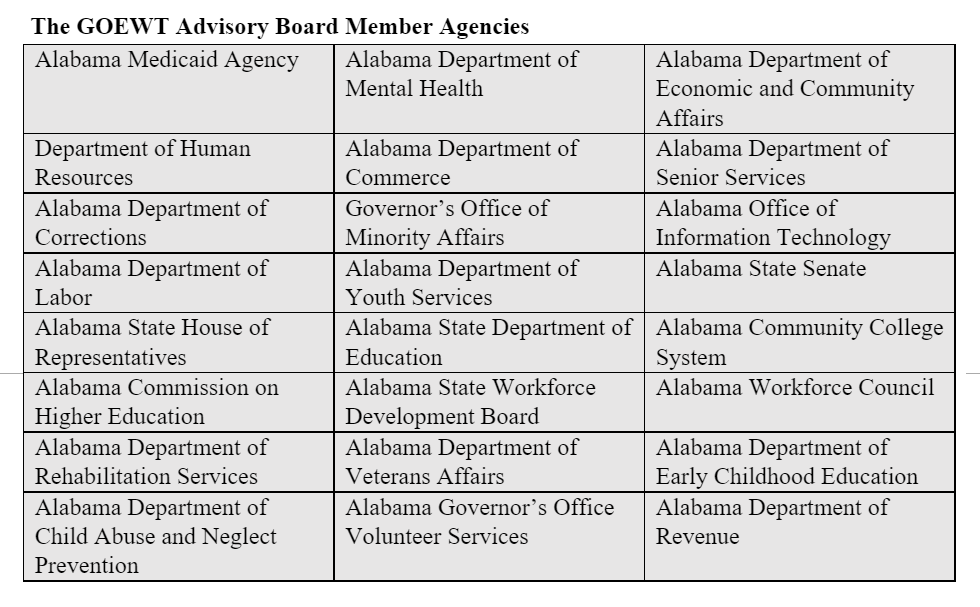
The GOEWT Advisory Board consists of the 24 state agencies involved in education, workforce development, and human services in Alabama. The GOEWT Advisory Board provides advice and consent on the recommendations of the Director of the GOEWT. The Director of the GOEWT presents recommendations to implement the goals and objectives of the GOEWT to the GOEWT Advisory Board. The GOEWT Advisory Board is chaired by the Chief Advisor to the GOEWT. During each called meeting of the GOEWT Advisory Board, there is an official meeting followed by a work session. During the official meeting, the Council may vote to confirm or disapprove of recommendations presented by the Director of the GOEWT at the previous called work session. The Chief Advisor on Workforce Development presides over the GOEWT Advisory Board business meetings, and the Director of the GOEWT holds the floor during the work sessions.
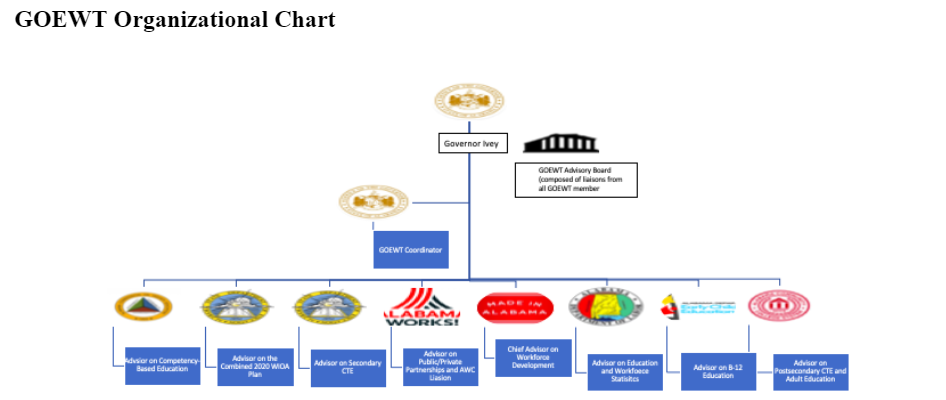
The GOEWT Director is supported by a team of advisors who represent key partner state agencies. The advisors include: (1) a chief advisor on workforce development, who is the director of the Alabama Office of Apprenticeship; (2) an advisor on outreach and workforce statistics, who is the director of the Office of Education and Workforce Statistics; (3) an advisor on pre-k-12 education, who is an employee of the Alabama Department of Early Childhood Education; (4) an advisor on secondary career and technical education, who is an employee of the Alabama State Department of Education; (5) an advisor on public/private partnerships, who is recommended for appointment by the chairperson of the Alabama Workforce Council; (6) an advisor on competency-based education, who is the state higher education executive officer; (7) an advisor on the combined 2020 WIOA plan, who is an employee of either the Alabama State Department of Education, the Alabama Department of Commerce, or the Alabama Community College System; and (8) an advisor on postsecondary career and technical education, who is an employee of the Alabama Community College System. The GOEWT is funded by braiding funds through memorandum of agreement between the Governor’s Office and the Alabama Department of Commerce, the Alabama Community College System, and the Alabama State Department of Education to transfer state leadership and administration funds to the GOEWT.
(g.) Alabama’s Education and Workforce Transformation
To achieve the Alabama attainment goal and to ensure that participants in Alabama’s workforce development programs have access to in-demand career pathways that lead to valuable, portable, post-secondary degrees, certificates, and credentials, Governor Ivey is committed to meeting the Alabama postsecondary attainment goal of adding 500,000 credential holders to the workforce and raising Alabama’s labor force to the national average by 2025 through human capital development, shifting more federal resources to directly support job training, and a new social compact between the workforce and Alabama’s employers. Stackable, trackable, portable, and transferable industry-recognized credentials that are linked to fast-growing, high-wage, and high-demand career pathways. This will create career pathways for in-school youth based on work-based learning and credential attainment and will provide multiple points of entry and exit from the workforce for adults who need to earn competency-based credentials to reenter the workforce or upskill. A currency of credentials of value will create a reciprocal feedback loop between employers and the workforce by signaling progressive wage increases, upward mobility within a firm, and the potential for lateral transfers within and between industry sectors. A credential currency will also signal to many people who are disengaged from the workforce, who are also economically disadvantaged and socially at-risk, that entry into a skill- and competency-based career pathway is also a path into economic security.
(h.) The Alabama Attainment Goal
Governor Ivey has set a postsecondary education attainment goal of adding 500,000 credential holders to Alabama’s workforce by 2025. Alabama is committed to meeting the Alabama postsecondary attainment goal through human capital development, shifting more federal resources to directly benefit job training, and a renewed social compact for Alabamians. Using the combined 2020 WIOA plan and the Alabama Career Pathways Model, Alabama is working to establish a wage premium for individuals who presently are unable to enter the labor force due to barriers such as a lack of childcare or transportation or disillusionment regarding the prospects of upward mobility. The career pathway model will provide a feedback loop between employers and employees that will signal to individuals who currently are not betting on work to take a chance on a competency-based career pathway. A currency of credentials of value will also signal progressive wage increases, upward mobility within a firm, and within and between industry sectors. The 2020 WIOA Combined Plan will ensure that Alabama’s workforce system is driven by data and by the needs of industry and special populations to serve two customers: employers and job seekers.
The global economy is changing rapidly, and there is an increasing need for workers who possess skills and training beyond a high school diploma. Workers with a post-secondary credential have taken 8.4 million jobs since 2011 in the United States, but workers with a high school diploma or less took only 80,000 jobs, after losing 5.6 million jobs in the last recession. The Lumina Foundation, a non-profit organization committed to increasing the number of Americans who hold quality post-secondary credentials, has set the goal that 60 percent of Americans will hold a high-quality degree, certificate, or credential by 2025. Between now and 2025, assuming current rates of degree and certificate production continue, about 24.2 million Americans will earn postsecondary credentials. To reach the 2025 goal, 16.4 million more high-skilled workers need to be added to that total. Alabama’s attainment gap is similar to the national numbers. Alabama’s 2017 attainment rate was 43 percent, while the experts project that Alabama’s demand for post-secondary education attainment in 2025 will be 51 percent.
Based on recommendations from the Success Plus plan, Governor Ivey has set five absolute priorities for reaching the post-secondary educational attainment goal: 1) All Alabama residents will understand the importance of earning certificates, credentials, and degrees and will know how to find information and resources to start or continue their education and training; 2) all Alabama residents will have access to education and will receive the continuous support they need to complete certificates, credentials, and degrees; 3) career pathways from education and training to high-demand jobs will be defined; 4) partners at the state, regional, and local levels will work together to increase post-secondary educational attainment in Alabama; 5) progress toward Alabama’s goal for post-secondary educational attainment will be tracked and shared regularly using data and evidence-based practices. To measure progress against each of the Success Plus absolute priorities, five key metrics have been identified, which will be tracked and shared regularly: 1) post-secondary educational attainment rate; 2) college and career readiness; 3) participation in work-based learning; 4) enrollment and completions for all levels of education and training by population, race/ethnicity, gender, and workforce region; and 5) the employment and workforce participation rate. Alabama’s attainment efforts will focus on high school students (Grades 9–12); out-of-school youth; post-secondary students (18-24 years old); adult learners; veterans; individuals in the corrections system; and populations with significant barriers to post-secondary educational attainment opportunities in Alabama, including disabled and special needs individuals, English language learners, first-generation college students, low-income individuals, minorities, rural residents, and women. Governor Ivey’s Consolidated State Workforce Development Strategic plan will help achieve each of the Success Plus absolute priorities by aligning federal workforce development funding streams, increasing the amount of federal funding workforce regions must use to directly support job training opportunities, enabling data-driven workforce development decisions, and by scaling access to valuable credentials and work-based learning.
| Success Plus Metrics | Purpose | Data Source | |
|---|---|---|---|
| 1 | Post-secondary Educational Attainment Rate | Measures progress toward overall post-secondary educational attainment goal | Educational Attainment Data Dashboard |
| 2 | College and Career Readiness | Indicates readiness of high school graduates to continue along pathways to continuing education opportunities and high-demand jobs | ALSDE College and Career Ready Dashboard |
| 3 | Participation in Work-Based Learning | Serves as an indicator for career success | Alabama Community College System, Alabama Department of Commerce, and Alabama State Department of Education |
| 4 | Enrollment and Completions for All Levels of Education and Training by Population, Race/Ethnicity, Gender, and Workforce Region | Measures progress toward closing attainment gaps for particular populations and regions | Alabama Commission on Higher Education |
| 5 | Employment and Workforce Participation Rate | Demonstrates alignment between workforce preparedness and business/industry demand | Alabama Department of Labor |
(i.) Braiding Federal Workforce Development Funding Streams
Governor Ivey braided federal funding streams to fund the Governor’s Office of Education and Workforce Transformation (GOEWT). The GOEWT is tasked specifically with braiding Alabama’s federal education and workforce development funding streams to support an education-to-workforce pipeline, which involves modifying ESSA, Perkins, and WIOA state plans to support the Alabama Career Pathways Model. The GOEWT also lists a significant number of local supports to be provided as part of this system, funded in large part by braiding WIOA and Perkins State Leadership and Administration dollars. These local supports include development of staff, providing technical assistance in carrying out activities described in the Perkins state plan, and supporting local development of industry and sector partnerships.
(j.) The Workforce Innovation and Opportunity Act (WIOA)
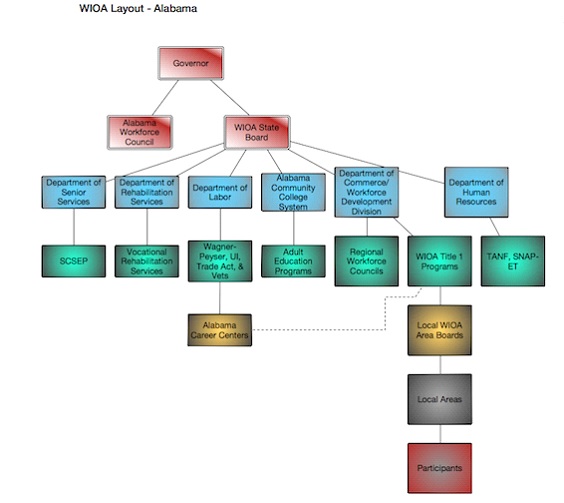
The Workforce Innovation and Opportunity Act (WIOA), which succeeded the Workforce Investment Act of 1998 (WIA), is the primary federal legislation that supports workforce development. The five titles of WIOA include six core programs—adult, dislocated worker, and youth programs (Title I of WIOA), adult education (Title II), the employment service program (Title III), and the vocational rehabilitation program (Title IV). The six core programs are administered by multiple agencies. The Department of Commerce is responsible for implementing the Title I programs, the Alabama Community College System (ACCS) manages Title II, the Alabama Department of Labor oversees Title III, and the Alabama Department of Rehabilitation Services (ADRS) oversees Title IV.
WIOA Core Agencies
⦁ Alabama Department of Commerce (Title I youth, adult, dislocated worker)
⦁ The Alabama Community College System (Title II adult education)
⦁ The Alabama Department of Labor (Title III Wagner-Peyser and the Employment Service)
⦁ The Alabama Department of Rehabilitation Services (Title IV Rehabilitation Services)
WIOA Partner Agencies
⦁ The Alabama State Department of Education (Perkins CTE)
⦁ The Alabama Department of Human Resources (SNAP and TANF)
⦁ The Alabama Department of Veterans Affairs
⦁ The Alabama Department of Senior Services
WIOA Priorities
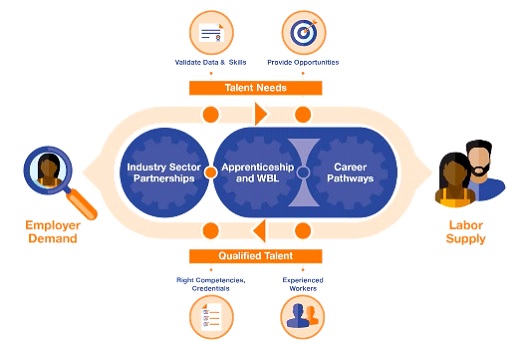
More strategic local boards, creation of career pathways and sector strategies that allow the business community to engage with all education and workforce agencies to create aligned opportunities for special populations across all agencies; data-driven decision making; validate data and provide work-based learning opportunities aligned to labor market data; allowing the employer community to tell their story once throughout the entire system rather than having to go to each agency.
Planning
State and local boards must be composed of at least 51 percent business and industry and at least 20 percent worker organizations, which means 71 percent of the board is composed of customers. WIOA also creates planning regions. Each state determines whether the planning regions and local areas are concurrent.
WIOA includes five titles:
● Title I—Workforce Development Activities—authorizes job training and related services to unemployed or underemployed individuals and establishes the governance and performance accountability system for WIOA;
● Title II—Adult Education and Literacy—authorizes education services to assist adults in improving their basic skills, completing secondary education, and transitioning to postsecondary education;
● Title III—Amendments to the Wagner-Peyser Act—amends the Wagner-Peyser Act of 1933 to integrate the U.S. Employment Service (ES) into the One-Stop system authorized by WIOA;
● Title IV—Amendments to the Rehabilitation Act of 1973—authorizes employment-related vocational rehabilitation services to individuals with disabilities, to integrate vocational rehabilitation into the One-Stop system; and
● Title V—General Provisions—specifies transition provisions from WIA to WIOA.
The five titles of WIOA include six core programs—adult, dislocated worker, and youth programs (Title I of WIOA), adult education (Title II), the employment service program (Title III), and the vocational rehabilitation program (Title IV). In Alabama, the Department of Commerce is the fiscal agent for WIOA. The Department of Commerce Workforce Development oversees the data collection and performance indicators for all six core programs. WIOA adopted six uniform performance indicators for all of the WIOA core programs. The six primary indicators of performance in WIOA are:
A. the percentage of program participants who are in unsubsidized employment during the second quarter after exit from the program;
B. the percentage of program participants who are in unsubsidized employment during the fourth quarter after exit from the program;
C. the median earnings of program participants who are in unsubsidized employment during the second quarter after exit from the program;
D. the percentage of program participants who obtain a recognized postsecondary credential (or secondary school diploma or equivalent) during participation or within one year after program exit;
E. the percentage of program participants who are in an education or training program that leads to a recognized postsecondary credential or employment and who are achieving measurable skill gains toward such a credential or employment; and
F. the indicators of effectiveness in serving employers established by the Secretaries of Labor and Education.
| Service or Program | Programs and Activities |
|---|---|
| Alabama Career Center System | Operated as a partnership between the Alabama Department of Commerce ((WIOA Adult, Dislocated Worker, and Youth) and the Alabama Department of Labor (Wagner-Peyser, UI, TAA and Veterans). The Career Center System also collaborates with Adult Education, Rehabilitative Services, TANF, SNAP and Title IV of the Older Americans Act (SCESP). Statewide there are 7 Comprehensive Career Centers and 46 Affiliate Career Centers in the system. In PY 2020 Alabama Career Center System provided 8130 individuals with WIOA training services, serving low-income adults, youth, and dislocated workers. PY 2020 Workforce Innovation and Opportunity Act funds totaled $40,432,623. |
| Adult Education | The WIOA Title II Adult Education array of educational and training services are administered through the Alabama Community College System (ACCS) network of twenty-five eligible, competitively selected providers. The overarching goals focus on attainment of a high school credential or it’s recognized equivalent, college and career readiness to promote successful transition to postsecondary education, training, and/or employment. Adult Education services, includes integration of basic literacy and numeracy skills, employability skills, integrated English literacy civics education and career pathway skills leading to industry-recognized and in-demand credentials. Adults are afforded opportunities for apprenticeship and pre-apprenticeship programs. The myriad of adult education services are also extended to the incarcerated or institutionalized population in a limited, yet targeted format. Adult Education is a central core partner within the local workforce board areas and an active member of the Alabama Career Center system. |
| Alabama Department of Labor - Wagner-Peyser, Unemployment Insurance, Trade Act, and Veterans Services | The Alabama Department of Labor (ADOL) houses the Wagner-Peyser program (Employment Service), Unemployment Insurance, Trade Act, and Veterans Services programs. ADOL Wagner-Peyser and WIOA Title I programs have been co-located as part of the Alabama Career Centers since 2001. AlabamaWorks! (AW!) is the online case management data system that provides job seeker skills, abilities and work history with employers posting job openings in the system. ADOL provides Trade Act services and Veteran's employment representatives in the Career Centers. In PY2020 alone, approximately 145,500 job seekers were registered into the AW! system. |
| Alabama Department of Rehabilitation Services (ADRS) | The Department of Rehabilitation Services Vocational Rehabilitation Services (VRS) provides specialized employment and education related services and training to assist teens and adults with disabilities to become employable. Services include skill assessments, counseling, training programs, job placement, assistive technology and transportation. For Program Year 2014 funding for the VRS totaled approximately $25,000,000; and for the same period 31,244 job seekers with disabilities were provided services. Since 2001 the VRS has been an active partner in the Alabama Career Center System. |
(k.) The Carl D. Perkins Act
The Carl D. Perkins Act (Perkins V) is the preeminent source of federal funding for secondary and post-secondary career and technical education. The Perkins Act provides nearly $1.3 billion annually to CTE programs across the nation. Perkins Basic State Grants provide formula funding to states. The basic grant awards are divided between high schools and community colleges. States are given discretion on how to split the funds between secondary and postsecondary education, but a minimum of 85 percent of these grants must be distributed based on a formula to local secondary and postsecondary institutions that target disadvantaged students. The Division of Career and Technical Education and Workforce Development at the ALSDE is responsible for overseeing secondary Career and Technical Education (CTE) programs in Alabama’s middle and high schools. Secondary CTE standards are designed for specific “career clusters,” which organize CTE programs of study to prepare students for further education or employment in pathways such as health care, business, and manufacturing. Alabama has adopted the National Career Clusters Model and is implementing standards and programs across all 16 career clusters. At the postsecondary level, CTE is delivered through Alabama's community colleges. With 24 colleges and 76 locations, the Alabama Community College System (ACCS) reaches almost every corner of the state. The Alabama Community College System offers dual enrollment and statewide articulation agreements to ease the transition from secondary to postsecondary CTE programs. The Alabama Commission on Higher Education coordinates transfer agreements between Alabama’s community and technical colleges and the four-year public institutions for advanced CTE programs.
(l.) The Combined 2020 State WIOA Plan
Under WIOA, the Governor of each state must submit a Unified or Combined State Plan to the U.S. Secretary of Labor that outlines a four-year strategy for the state’s workforce development system. At a minimum, a state must submit a Unified State Plan that includes a plan for the six core WIOA programs. However, a state may also submit a Combined State Plan that includes other workforce development programs, such as secondary and postsecondary CTE programs funded under the Carl D. Perkins Act. Alabama submitted a combined state plan for 2016-2019; however, CTE programs were not included in the plan.
The Strengthening Career and Technical Education for the 21st Century Act (H.R. 2353), the fifth reauthorization of the Carl D. Perkins Career and Technical Education Act (Perkins V), reduced the length covered by a state’s CTE plan from six years to four years to encourage alignment between the core WIOA programs and the optional partner programs, such as CTE. Prior to the recent reauthorization, the divergent number of years covered by the WIOA and CTE state plans created a barrier to including CTE in a combined state plan. Although all States have approved WIOA Unified or Combined State Plans for Program Years (PYs 2016- 2019), WIOA requires that states review their plans every two years and update state plan strategies based on changes in the labor market, economic conditions, or other factors affecting the implementation of the state plan. Alabama will include Perkins CTE programs in the 2020 Combined Plan, which will produce the alignment necessary for apprenticeships for in-school youth to flourish in Alabama. Furthermore, Alabama recently requested and received a waiver from the U.S. DOL to allow in-school youth to receive ITAs. Allowing at-risk, in-school youth who are participating in an apprenticeship program to access WIOA funding will enhance the viability of pre-registered youth and industry-recognized apprenticeships that are aligned to credentials of value and in-demand career pathways. Including CTE in the consolidated state WIOA and expanding apprenticeships by allowing in-school youth to receive ITAs will align Alabama’s workforce development programs around in-demand career pathways linked to credentials of value.
(m.) The Alabama College and Career Exploration Tool (ACCET)
Reemployment
Governor Ivey’s focus on aligning competency-based career pathways with work-based learning and academic course work has resulted in an intentional development of the Alabama Office of Apprenticeship, a process for validating the quality of non-degree credentials, and a system for developing profiles for Alabama’s in-demand occupations. These advancements have provided the foundation for economic upward mobility by permitting an individual to progress from an entry-level position, then to a middle-skills job, and finally to an advanced-level career. Over the next year, Governor Ivey will launch a series of technology solutions to operationalize Alabama’s Talent Development Strategic Plan. The Alabama Talent Triad consists of the Alabama Credential Registry, which will be used to provide full transparency for each credential awarded to Alabamians and will tag credentials to the competencies that compose Alabama’s in-demand jobs. The Credential Registry launched in September 2021. The Alabama Skills-Based Job Description Generator will allow employers to create customized job descriptions based on the “DNA” of the jobs in their firms. The ACCET learning and employment record will allow job seekers to develop verified resumes and to link directly to skills-based job descriptions generated by employers. The Alabama will develop an add-on to the ACCET for virtual career coaching. The GOEWT is developing a virtual coaching platform will triage jobseekers and students through the ACCET using artificial intelligence (AI) and chat bots. Individuals will be referred to a cadre of Career Pathways Navigators recruited from Alabama’s public workforce system, who will be trained to respond to referrals from the AI to provide human assistance.
The Alabama College and Career Exploration Tool (ACCET) will be an interactive online dashboard available to students, employees, and employers. Jobseekers will be able to seek training and open positions using the ACCET, and employers will also use the tool to find potential employees. The ACCET will be designed to serve as a one-stop digital dashboard, which will enable Alabamians to compare all college and career options before choosing a career pathway. The ACCET will guide students through a digitally-delivered exploration and survey all 79 pathways within the 16 CTE industry clusters, an interest and career profile, and a graduation plan. The ACCET will allow CTE concentrators to map career pathways that will lead to graduation with industry-recognized credentials, postsecondary credit, and work-based learning experience. The ACCET will include a Free Application for Federal Student Aid (FAFSA) completion and college application tool. Students will be able to access the WIOA eligible training provider list (ETPL) through the ACCET in order to receive WIOA funding for postsecondary education and training. Employers will begin including recognized non-degree credentials in job descriptions and providing pay increases for attaining those credentials, which will reduce employee turnover and increase the productivity and skill level of the workforce. The ACCET will also serve as a verified, digital resume to display industry-recognized credentials and progress against established competency models. Credential information displayed through the ACCET will signal to employers that a worker or student possesses the requisite skills for either an entry-level job or progressive wage increases as a result of mastering the next competency within a stackable sequence. The ACCET will allow employers to auto-populate a list of the individuals who possess the credentials and competencies best suited for each job posting, which will reduce hiring costs and will incent employers to add credentials to job descriptions. The ACCET will also serve as an integrated case-management and intake system for the public workforce system that will faciltate the cross training of employees and a no-wrong-door approach to the public workforce system.
(n.) Expanding Competency-Based Career Pathways in Alabama
(i) Developing Pathways to the Middle Class by Developing a Currency of Quality Non-Degree Credentials
Non-degree credentials (NDCs), such as certificates, industry certifications, apprenticeship certificates, and occupational licenses are a key component of meeting the Success Plus postsecondary education attainment goal of adding 500,000 credential workers to Alabama’s workforce by 2025. In 2016, the Adult Training and Education Survey (ATES) found that 27 percent of adults held an NDC, with 18 percent holding licenses, 8 percent holding postsecondary certificates, and 6 percent holding certifications. The number of workers nationally participating in registered apprenticeship programs increased by 56 percent between 2013 and 2018. Postsecondary certificate holders earn 30 percent more than individuals with a high school diploma alone, on average, but not all NCSs are created equal. Making the value of NDCs in the labor market transparent is key to ensuring NDC quality assurance. There are four types of NCDs:
⦁ Certificates are credentials awarded by an educational institution based on completion of all requirements for a program of study, including coursework and tests. They are not time-limited and do not need to be renewed.
⦁ Apprenticeship certificates are credentials earned through work-based learning and postsecondary learn-and-earn models. They are applicable to industry trades and professions. Registered apprenticeship certificates meet national standards.
⦁ Industry certifications are credentials awarded by a certification body (not a school or government agency) based on an individual demonstrating, through an examination process, that he or she has acquired the designated knowledge, skills, and abilities to perform a specific occupation or skill. It is time-limited and may be renewed through a re-certification process.
⦁ Licenses are credentials that permit the holder to practice in a specified field. An occupational license is awarded by a government licensing agency based on pre-determined criteria. The criteria may include some combination of degree attainment, certifications, assessment, apprenticeship programs, or work experience. Licenses are time-limited and must be renewed periodically.
Developing an aligned definition of an NDC of value can help provide for a common accountability framework for knowing whether a credential meets the definition of a “recognized postsecondary credential” under the Workforce Innovation and Opportunity Act, the Carl D. Perkins Act, or the Trade Adjustment Assistance (TAA) Program. Alabama participated, along with Iowa, New Jersey, Tennessee, Virginia, and Washington, as a round one state in the National Skills Coalitions NDC quality assurance project. The National Skills Coalition’s NDC Quality Assurance Project led to the acceptance of several general principles for the definition of a NDC of quality, including the need for the definition to be student-focused, to support equitable credential attainment, to be flexible while safeguarding quality, and should include a public process for determining which credentials are quality credentials.
The National Skills Coalition has developed the following consensus definition for a quality NDC. A quality non-degree credential is one that provides individuals with the means to equitably achieve their informed employment and educational goals. There must be valid, reliable, and transparent evidence that the credential satisfies the criteria that constitute quality. The criteria that constitute quality include three required and one that is strongly preferred but need not always be in place. The three required criteria include (1) substantial job opportunities, (2) transparent evidence of the competencies mastered by credential holders, and (3) evidence of the employment earning outcomes of individuals after obtaining employment. The strongly preferred criterion is stackability to additional education or training. Some quality credentials required to obtain employment in an in-demand occupation are stand-alone credentials, such as a registered apprenticeship completion certificate, which is not stackable but is also quality. Setting earnings thresholds is an important tool for maintaining quality as well. Often, earnings thresholds are based on a wage premium above the average earned by someone with a high school diploma alone. According to the U.S. Department of Education, the average annual earnings of an individual in the United States with a high school diploma alone between the ages of 25 and 34 is $28,000. The Lumina Foundation recommends at least a 20 percent wage premium over a high school diploma, or $33,600 nationally.
Alabama has focused on non-degree quality assurance and transparency to develop a credential currency that enables Alabamians to progress through a career pathway and earn wage increases by earning a sequence of stackable credentials that denote mastery of workplace competencies aligned to occupations that are part of a career pathway. By identifying credentials of value that are portable, trackable, stackable, provide a wage premium, are recognized by employers, and are integrated into a career pathway progression, Alabama has developed a competency-based approach to human capital development that helps Alabamians with weak labor force attachment due to benefits cliffs or others barriers to entering the workforce use credentials of value as a means of attaining economic mobility by progressing from an entry-level position, to middle-skills jobs, to advanced-level occupations.
(ii) Using Data to Establish Employer Signals and Career Pathways Based on Stackable Credentials
Alabama is collaborating with the Lumina Foundation, the National Skills Coalition, and the Workforce Data Quality to establish a standardized protocol to inventory and publish credentials. The ATLAS on Career Pathways, the state’s longitudinal database system, will serve as Alabama’s credential registry. Alabama won a grant from Credential Engine in June 2019 to establish a standardized protocol to inventory and publish credentials. As part of the process of vetting a credential for inclusion on the state’s list of credentials of value (the Alabama compendium of valuable credentials), relevant credential data will be published to the ATLAS on Career Pathways. Each credential application submitted to the ACCCP for review will be referred to a Technical Advisory Committee (TAC). The TACs will publish information on each credential, whether or not it is selected for inclusion on the Alabama compendium of valuable credentials. Each industry sector is represented by a TAC, and each TAC has developed an industry-endorsed competency model for each occupation within its purview. The competency models developed by each TAC will establish credential attainment as the “common denominator” between progression from secondary to postsecondary education and training programs. Alabama will reach the “tipping point” goal of publishing over half of the credentials in the state to the ATLAS on Career Pathways by 2022. Enhancing credential transparency is key to Governor Ivey’s workforce development strategic plan. By providing a standardized process for vetting and publishing data on credentials of value and mapping credentials to workforce competencies, stackable sequences mapped to competencies, and traditional degrees will make non-degree credential attainment an indelible component of Alabama’s workforce system and labor market. Vetting credentials through the ACCCP, publishing data on credentials submitted to the ACCCP to the ATLAS on Career Pathways, and then enabling students and workers to display credentials of value they have earned through their profile on the ACCET will provide for a credential currency in Alabama that could result in a paradigm shift in relations between individuals and the education and workforce training system and between the workforce and employers by signaling to employers that they should reward employees with progressive wage increases and increased responsibility for mastering advanced competencies. Creating a market language for credentials through credential transparency will produce a more intentional pathway for Alabamians determined to pursue a competency-based education as a pathway into the middle class.
(iii) The Five-Star Rubric Test for In-Demand Occupations
The state list of in-demand occupations will be compiled by first assigning each occupation regionally, and then statewide, with one to five stars, based on a rubric that awards one star for occupations that include one or more of the five criteria included on the rubric for evaluating the regional lists of in-demand occupations. Occupations that are awarded three or more stars will be included on a regional list. The state list will include all career pathways that appear on at least two of the regional lists. The TAC for each career cluster shall evaluate each occupation within each of the career pathways under its purview with the rubric below. The rubric contains five categories. Occupations that possess the characteristic in the category are awarded a star for that category. An occupation will receive one to five stars based on how many of the five characteristics the occupations possess on the rubric. The five criteria are whether an occupation: (1) pays at least 70 percent of the mean regional wage; (2) the occupations to career cluster with an annual regional Success Plus attainment goal that is ranked in the top eight out of the 16 clusters; (3) the occupation is projected to have positive annual growth and positive growth over the next decade (2016 to 2026); (4) the occupation is on the regional “Top 40 In-Demand Jobs List” or the occupation is in at least the 75th percentile of the average regional wage; and (5) the occupation requires a postsecondary degree, certificate, or credential for initial employment. Earning a star for three of the criteria is mandatory. For the first two required criteria, earning a star for criteria (1) and criteria (3) is mandatory, and an occupation must possess one or both of criteria (4) or (5) to pass the five-star rubric test. Passing the five-star rubric test with three, four, or five stars does not imply value. Whether an occupation receives three, four, or five stars only provides the TAC with additional information needed to make decisions regarding the final list on in-demand occupations. Furthermore, a TAC may determine not to include an occupation that has passed the five-star rubric test on the final list of in-demand occupations if the occupation is deemed to not provide adequate economic mobility or progression across a career pathway.
| Characteristic | Criteria I Occupation Must be at Least 70 percent of Mean Regional Wage | Criteria II The Occupation Belongs within a Career Cluster that is ranked in the top eight for the annual regional Success Plus attainment goal | Criteria III Positive Annual Growth Over Decade | Criteria IV Occupation is on the Regional To Forty In-Demand Jobs List or occupation is at least in the 75th Percentile of the Average Regional Wage | Criteria V The Occupation Requires a Post-Secondary Degree, Certificate, or Credential for Initial Employment |
|---|---|---|---|---|---|
| Earning a star for three of the criteria is mandatory. For the first two required criteria, earning a start for criteria (1) and criteria (3) is mandatory, and an occupation must possess one or both of criteria (4) or (5) to be included on a regional or statewide compendium of valuable credentials. |
(iv) Developing Competency Models and Career Lattices
Once the TACs have reviewed the list of occupations for each region that have passed the five-star rubric test, then each TAC will determine how the occupations in each cluster fit into a career pathway that progresses from an entry-level occupation, to middle-skills occupations, and then onto advanced level occupations. In the process of developing career pathways, the TACs may choose to include an occupation that forms part of a career pathway sequence but did not pass the five-star rubric test on the final list of regional or statewide in-demand occupations.
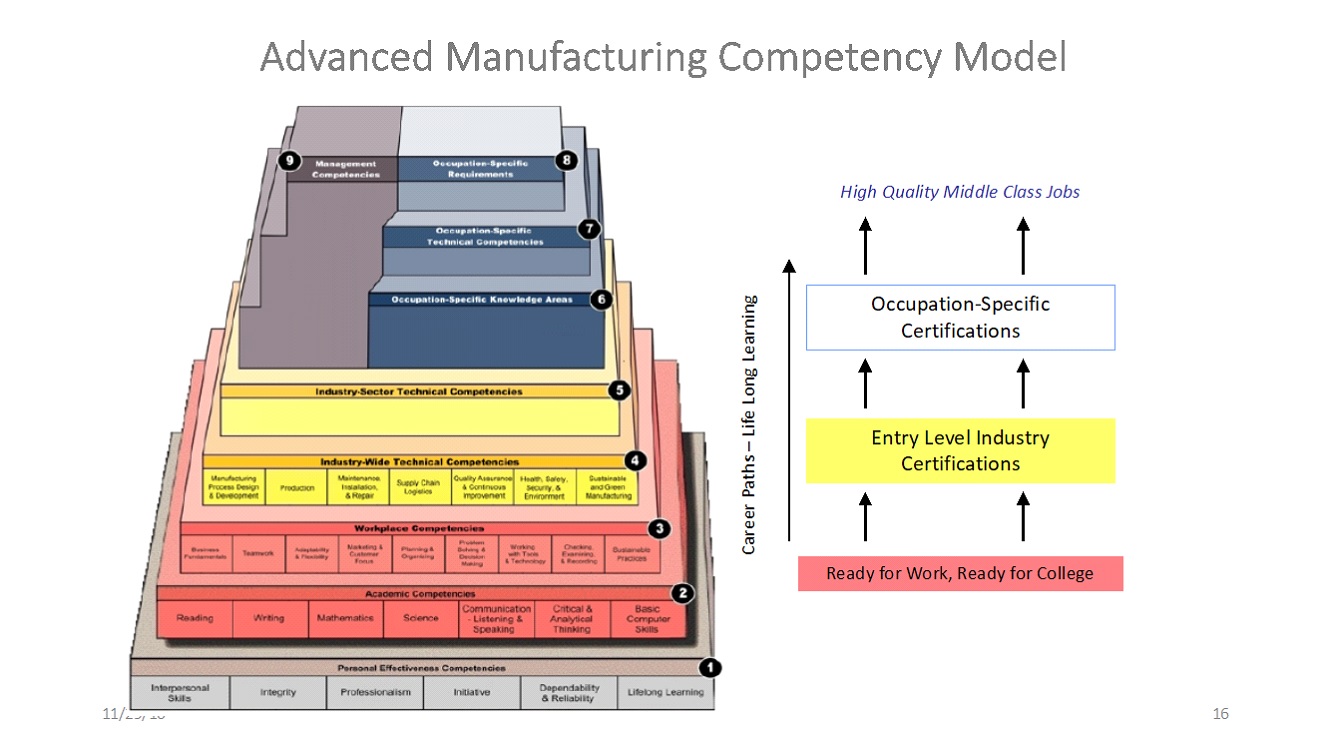
Each TAC will develop a regional and statewide list of in-demand occupations. The statewide list will be composed of occupations that have been included on two or more regional lists. After identifying the regional and statewide in-demand occupations, the TACs must create an industry competency model and a competency-based career lattice for each of the occupations among the 79 career pathways within the 16 career clusters on a regional or statewide list of in-demand occupations. Each TAC shall commission a statistically-significant survey to determine which workplace and academic competencies are required by employers for each occupation within its purview no later than March 30, 2020. The survey shall also determine whether there are industry-recognized credentials associated with each of the occupations under the TACs purview.
Each TAC shall recognize an industry-recognized credential of value, which shall be submitted to the ACCCP for approval, for each occupation with three or more stars on a regional or the statewide list of in-demand occupations no later than December 31, 2020. No later than 30 June 2020, each of the sixteen (16) Technical Advisory Committees shall create an industry competency model and competency-based career lattice for each occupation on its regional and statewide lists of in-demand occupations. Each of the industry competency models and competency-based career lattices must include:
⦁ A description of the progression of coursework and industry-recognized credentials needed to ascend from entry-level to higher-level jobs within the occupation;
⦁ The sequence of personal effectiveness competencies, workplace competencies, industry-recognized technical competencies, sector-specific competencies, occupation-specific competencies, and management-level competencies in that occupation;
⦁ The curricula, skills assessments, and certifications needed to develop incremental training modules as a sequence of courses leading to industry-recognized credentials or certifications that also progressively lead to a traditional postsecondary degree to provide participants with multiple points to enter and exit the training and education programs over the course of a career to earn progressively advanced certificates and credentials that lead to positions of increased responsibility and higher wages.
(v) The Alabama Competency Taxonomy
The ACCCP will develop a five-tier credential taxonomy that will include the following information: Career Cluster (each of the 16 career clusters will be given a numeric code); Career Pathway (each of the career pathways will be given a numeric code); Division (Secondary of Postsecondary); Category (Basic or Advanced); and Classification (Complementary, Regional, or Statewide). The TACs will also map all related competencies to the credential during stage two review.
| 2342- | KNO- | 06- | 08 | 20190817 | E | 094161258 |
|---|---|---|---|---|---|---|
| Career Cluster-Career Pathway-Occupation-Competency | KNO- Knowledge SPE- Specialized Skill PER - Personal Skill SOC - Social Skill COM - Competency | Rate of Decay (in months) | Level of Proficiency | Date of Current Assessment | Summative Assessment Format A - Artifact E - Exam P - Performance | D-U-N-S Number |
Alabama has developed the Alabama Competency Taxonomy, which is a seven-tiered system for coding each individual skill, or competency, that composes an occupation. There are personal effectiveness competencies, academic competencies, workplace competencies, industry-wide competencies, sector-specific competencies, occupation-specific competencies, and management competencies. Through the Alabama Competency Taxonomy, each of them can be coded, organized, and mapped onto a credential of value so that the credential of value can be recognized as certifying the mastery of that competency. The first tier of the competency taxonomy details the career cluster, career pathway, and specific occupation in which the knowledge, skill, attitude, or competency exists. The competency identifier consists of four alphanumeric digits that are specific to the assigned competency. The code will be assigned as follows: career cluster—career pathway—occupation and occupation-specific competency model—occupation-specific competency (0-0-0-0). The second tier of the competency taxonomy consists of three alphanumeric characters that reflect the knowledge, specialized skills, personal skills, and social skills as articulated in the Lumina Beta Credential Framework. They include: (1) KNO – Knowledge – What a learner knows, understands and can demonstrate in terms of the body of facts, principles, theories, and practices related to broad general or specialized fields of study or work; (3) SPE – Specialized Skill – Skills that are occupational and discipline-specific; (2) PER – Personal Skill – Competencies required to act in an independent and responsible manner in various situations, to exercise judgment, demonstrate critical thinking and problem solving, reflect on one’s own actions and on the actions of others, and to continue to develop his/her own competencies; (4) SOC – Social Skill – An individual’s ability to be aware of the behavior of others and of differing viewpoints, to communicate with others effectively, and to work effectively with people from diverse backgrounds and points of view; and (5) COM – Competency – A learnable, measurable, role-relevant, and behavior-based characteristic or capability. The third tier of the competency taxonomy includes a two-digit rate-of-decay code will be reflective of the number of months between the time of initial certification or recertification of the competency and the time that the individual earning the competency will need to be recertified. The fourth tier of the competency taxonomy is the proficiency indicator, which is based on an eight-level proficiency system identified in the Beta Credential Framework. The scale of proficiency from one to eight does not reflect the level of individual mastery, but, rather, it reflects the level of proficiency needed to adequately perform the underlying occupation. The fifth tier of the competency taxonomy reflects the last date on which proficiency for the competency was assessed, if applicable. These eight characters represent the date, using Gregorian calendar notation, on which the proficiency was assessed by the validating agency, credential provider, or TAC, as determined by each TAC. The data format follows a yyyymmdd date schema. The sixth tier of the competency taxonomy details the type of assessment used to determine the proficiency achieved by the learner. There are three assessment types identified: artifact, exam, or performance. These three methods represent the majority of assessments that would measure and validate proficiency of a knowledge, skill, or competency. The seventh tier of the competency taxonomy includes a nine-digit Dun & Bradstreet (D-U-N-S Numbers.) Because there is no central repository for all institutions, organizations, and employers, this portion of the code is difficult to detail. For this reason, the Dun & Bradstreet (D-U-N-S Numbers) system will be used, as these are both international and non-sector specific. This nine-digit number is required of all entities that do business with the federal government. Because these numbers are assigned without a fee, it would appear to be a strong solution for many of the institutions and employers likely to verify knowledge, skills, and competencies.
(vi) The Alabama Compendium of Valuable Credentials
Based on the regional and state in-demand career pathways, labor market information, and program completion and employment data, the ACCCP will also create annual Compendia of Valuable Credentials. The Alabama Compendium of Valuable Credentials will be composed of the regional and state lists of credentials that are mapped onto the regional and state in-demand career occupations with three or more stars. The ACCCP will adopt the procedures by which the TACs shall review and vote to recommend credentials to the regional and statewide compendia of valuable credentials in accordance with the procedures as follows:
⦁ An industry or trade association group, the Alabama Workforce Council, the Alabama State Workforce Investment Board, the Alabama State Department of Education, the Alabama Community College System, the Alabama Office of Apprenticeship, and the Alabama Commission on Higher Education may apply to the Alabama Committee on Credentialing and Career Pathways to include a credential possessing one or more of the ten characteristics of a valuable credential, described in tier-one review, on a regional or statewide Compendium of Valuable Credentials.
⦁ The ACCCP will refer each application, by career cluster and pathway, to a TAC for stage one review.
| 02 | 43 | S | B | R | 2342-KNO-06-08-20190717-E-094161258 |
|---|---|---|---|---|---|
| Career Cluster (01-16) | Career Pathway (01-79) | Division (Secondary or Postsecondary) | Category (Advanced or Basic) | Complementary (C), Regional (R), or Statewide (S) | Competencies Mapped to the Credential (Not included as part of the five-digit taxonomy for the compendia of valuable credentials.) |
Each credential undergoes a two-tier review process by the TAC. Tier one review includes reviewing the credential application against the following criteria:
⦁ The TAC shall classify the underlying credential referenced in the application as either required by law, including any credential mandated by the laws or regulations of the State of Alabama or the United States of America; mandated by industry, which shall include any credential mandated by two (2) or more firms within an industry sector; or preferred by industry, which shall include any credential endorsed, but not required, by two or more firms within an industry sector.
⦁ The TAC shall determine whether the credential is required to obtain a job (counts toward attainment goal and is an advanced credential on the compendium of valuable credentials); part of stackable sequence leading to a credential that is required for employment (included on the compendium of valuable credentials as a basic credential, but these credentials do not count towards the attainment goal); complementary credentials with skills that are affiliated with the career pathway but are not directly aligned to the credential sequence (can be included on the compendium of valuable credentials as a complementary credential but are not included in credential sequences and do not count towards the attainment goal);
⦁ Accredited or recognized by a statewide or national industry-recognized accrediting bodies, such as a sector or industry association;
⦁ Aligned to an occupation on a regional or statewide list of in-demand occupations;
⦁ Achievable by students in a secondary and/or the postsecondary level of study;
⦁ Earned after a minimum number of hours of instruction time, as determined by the Alabama Committee on Credentialing and Career Pathways, and awarded after achieving a passing score, as determined by the sponsoring industry sector, on a proctored examination;
⦁ Stackable in a sequence of aligned competencies that progress along with the rigor of advanced training programs;
⦁ Valuable as determined by leading to at least a twenty (20)-percent wage premium over a high school diploma;
⦁ Traceable and trackable by the ATLAS on Career Pathways; and
⦁ Portable across or within an industry sector to establish the qualifications of individuals in multiple geographic areas, among multiple education and training institutions, and by diverse employers.
Credentials that possess one or more of the characteristics reviewed during tier one review and that are vetted and receive a majority vote of approval by the TAC proceed to stage two review. Each TAC should make the following considerations when moving a credential forward for two-tier review if the credential is not complementary, if the credential does not possess the following tier-one criteria:
⦁ If a credential is not mandated by industry, required by law, or preferred by industry, the credential must be complementary.
⦁ Only credentials that are required to obtain a job can be counted towards the attainment goal and to be counted as an advanced credential for tier-two review. Stackable credentials that are not required to obtain a job are counted as basic credentials for tier-two review.
⦁ A credential is complementary if it does not denote mastery of one or more competencies required for one or more occupations on one or more regional or the statewide list of in-demand occupations.
⦁ A credential is complementary if it is not nationally, regionally, or locally recognized by business or industry.
⦁ A credential that is not achievable at the secondary or postsecondary level is complementary and a credential only achievable at the secondary level is basic for tier-two review.
⦁ A credential that is not achievable through 130 hours of coursework or through a proctored examination should include an artifact or performance-based examination to move forward for tier-two review. A TAC may, on a case-by-case basis and with the recommendation of relevant members of industry, lower the required number of hours for a time-based credential.
⦁ A credential is either complementary or a stand-alone credential of value, such as an apprenticeship completion credential or a long-term certificate, if it is not stackable.
⦁ A credential is either complementary or basic if it does not provide at least a 20-percent wage premium over a high school diploma.
⦁ A credential is trackable by the ATLAS on Career Pathways if it has been registered into the Alabama Credential Registry, which is required before Tier One review may begin. Credential providers who refuse, or who cannot provide the information necessary to register credentials onto the Alabama Credential Registry, will not be able to process an application for inclusion on the Compendium of Valuable Credentials.
⦁ A non-portable credential is either regional or complementary. A non-portable credential may be basic or advanced.
During stage two review, credentials are placed in the five-level credential taxonomy:
⦁ credentials are categorized by career cluster;
⦁ credentials are categorized by career pathway;
⦁ credentials are categorized into either the secondary or postsecondary division of the Alabama Compendium of Valuable Credentials. Secondary are high school credentials and below, and postsecondary credentials are at the college level;
⦁ credentials in both the secondary and the postsecondary divisions will be classified as either basic or advanced. Basic certifications are the first level or industry certification, or a relevant stand-alone certification. Advanced credentials are part of a stackable sequence of credentials that are linked to an occupation on the ACCCP’s list of regional and state in-demand career pathways;
⦁ basic and advanced credentials will be categorized as either a statewide, regional, or complementary credential. Statewide credentials must be linked to an in-demand career pathway on the ACCCP’s state list of in-demand career pathways. A regional credential must be linked to a career pathway on the ACCCP’s regional list of in-demand career pathways. Complementary credentials, such as first aid or digital literacy, have value across industry sectors.
A subgroup of credentials on statewide or regional compendia of valuable credentials classified in the secondary, basic and complementary divisions may be endorsed by the relevant Technical Advisory Committee as a “Success Credential” that may be designed to provide basic, foundational, or essential skills. Credentials deemed as “Success Credentials” shall be duly noted. A subgroup of credentials on statewide or regional compendia of valuable credentials classified in the secondary or postsecondary, advanced, and the regional or statewide divisions of the compendia of valuable credentials, that also lead to no fewer than 12 postsecondary credit hours towards a postsecondary degree aligned to a career pathway on a regional or statewide list of in-demand career pathways, may be designated by the relevant Technical Advisory Committee as a “Success Plus” credential. Credentials deemed “Success Plus” credentials shall be duly noted.
For each year, except the first year after the organizational meeting of the ACCCP, each of the 16 Technical Advisory Committees shall complete the stage one and two review of all credential applications referred by the Alabama Committee on Credentialing and Career Pathways for review and shall compile a final list of credentials for recommendation for the regional and statewide compendia of valuable credentials no later than the 30th day of September in each year. No later than the 31st day of the month of October in each year, except the first year after the organizational meeting of the ACCCP, the Alabama Committee on Credentialing and Career Pathways shall vote to adopt or reject, in whole, the final list of recommended credentials for submission to the regional and statewide compendia of valuable credentials from each Technical Advisory Committee. A Technical Advisory Committee may resubmit a revised list of recommended credentials to add to the regional and statewide compendia of valuable credentials within 30 days of notice from the Alabama Committee on Credentialing and Career Pathways that the Technical Advisory Committee’s initial recommendations were rejected. Credentials included on a Regional or Statewide Compendium of Valuable Credentials do not require an initial application or stage one review but must undergo stage two review for inclusion on the next iteration of the same Regional or Statewide Compendium of Valuable Credentials. Furthermore, credential providers must report annually, at the time of annual review for inclusion on a regional or statewide compendia of Valuable Credentials, data on the number of individuals who earned the credential in the previous year, the number of people who were employed in an occupation that requires the credential in the previous year, and the percentage of successful completers who attempted a written or competency-based assessment required for the attainment of the credential in the previous year. Credentials shall be removed from a regional or statewide compendium of Valuable Credentials when the provider of credential fails to provide a report to the ACCCP, under the provisions of this subsection, within sixty (60) days of the annual deadline established by the ACCCP. The aggregated approved lists of Technical Advisory Committees shall be promulgated by the Alabama Committee on Credentialing and Career Pathways as the Regional and Statewide Compendia of Valuable Credentials no later than the 1st day of January in each year. The Regional and Statewide Compendia of Valuable Credentials promulgated on the 1st day of each year shall become effective on the first day of July in each calendar year, except the first year after the organizational meeting of the ACCCP. The final Regional and Statewide Compendia of Valuable Credentials shall be available for access to the general public at no cost and shall include a unique code, based on the five-tier credential taxonomy to provide for common identification for each credential included on the Regional and Statewide Compendia of Valuable Credentials, which shall also include the codes for each competency (based on the Alabama Competency Taxonomy) for which the credential denotes mastery.
(vii) The Alabama Integrated Career Pathways Model
The Governor’s Office of Education and Workforce Transformation (GOEWT) is working to establish the two-pronged Alabama Career Pathways Model. Post-secondary credential attainment, dual enrollment, and work-based learning will be used as strategies to establish the two-pronged Alabama Career Pathways Model. Under the first prong, in-school youth may participate in a registered- or industry-recognized apprenticeship program, earn their associate degree, and earn stackable credentials at the time of high school graduation. Under the second prong, adults who are disconnected from the workforce or those who are underemployed may upskill or become basic skills proficient through multiple on and off ramps from workforce training and employment through stackable credentials mapped to a traditional associate degree. Shortened career pathways for in-school youth will hasten their ability to enter the workforce and lengthened career pathways, with multiple points of entry and exit, for adults will enable a flexible progression and persistence through a competency model and career pathway.
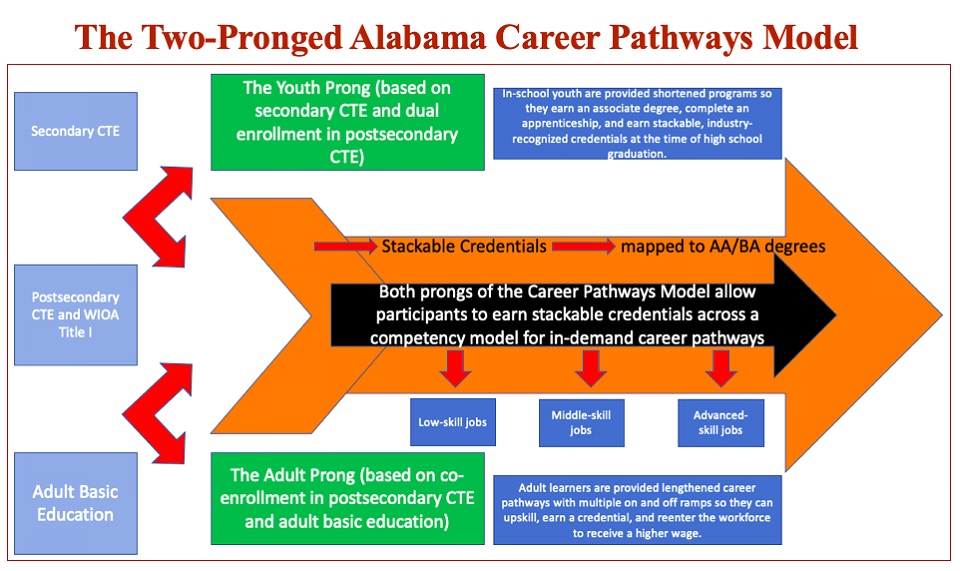
The purpose of the Alabama Committee on Credentialing and Career Pathways (ACCCP) is to develop career pathways that lead students to employment in the in-demand occupation. That is the “why.” The “how” component is met with the process of identifying the occupations that are in-demand at the regional and statewide levels through the five-star occupational taxonomy. Identifying the in-demand occupations is necessary, yet not sufficient to developing career pathways, however. Once the in-demand occupations have been identified, they must be “stacked” in a series of occupations within the same occupational pathway that increase in the level of skill and knowledge required to perform the occupation as one advances from the entry-level occupation within a pathway, to middle-skills occupations, and then onto to occupations that required advanced postsecondary education and training. Once the progression of occupations for a career pathway has been identified, the underlying competencies related to each occupation must be identified and coded, using the Alabama Competency Taxonomy, and developed into a competency model for each occupation within the pathway.
(o.) Alabama’s Apprenticeship Expansion Efforts
(i) The Alabama Industry-Recognized and Registered Apprenticeship (AIRRAP) Act (Act 2019-506)
To enable Alabama to meet the post-secondary attainment goal and to surpass the national average labor force participation rate, the Alabama Industry-Recognized and Registered Apprenticeship Program, or “AIRRAP,” Act established the Alabama Office of Apprenticeship to serve as Alabama’s state apprenticeship agency, established the Alabama Registered and Industry-Recognized Apprenticeship Program to expand access to apprenticeships for in-school youth and adult learners, and enhanced the Apprenticeship Alabama Tax Credit to incent employers to hire in-school youth apprentices. The Alabama Industry Recognized and Registered Apprenticeship Program Act (Act 2019-506) passed the Senate 32-0. It passed the House 97-0-4. Act 2019-506 was sponsored by Sen. Orr. Governor Ivey signed Act 2019-506 into law on May 30, 2019.
(ii) Provisions of the Alabama Industry-Recognized and Registered Apprenticeship (AIRRAP) Act (Act 2019-506)
Act 2019-506 provides for the establishment of the Alabama Office of Apprenticeship (AOA) to register Alabama’s registered apprenticeships. On March 12, 2020, the AOA was granted status as the State’s Apprenticeship Agency and thus took over responsibilities for registered apprenticeships in Alabama. Act 2019-506 established the Alabama Committee on Credentialing and Career Pathways is established as a subcommittee of the Alabama Workforce Council, which includes 16 technical advisory councils (one for each career cluster) that will create annual lists of regional and statewide in-demand career pathways and regional and statewide lists of valuable credentials. Act 2019-506 increased the per capita Apprenticeship Alabama Tax Credit from $1,000 to $1,250; increased the cap on the number of eligible apprentices for each employer from 5 to ten apprentices; provided for a $500 tax credit enhancement for hiring in-school youth apprentices; increased the aggregate Apprenticeship Alabama Tax Credit from $3,000,000 to $7,500,000; and extended the Apprenticeship Alabama Tax Credit through 2025.
(iii) The Apprenticeship Alabama Tax Credit Act 2016-314
In 2016, Senator Orr sponsored the precursor to the AIRRAP Act—the Apprenticeship Alabama Tax Credit Act 2016-314. The Apprenticeship Alabama Tax Credit Act, which was signed into law by Governor Robert Bentley on May 10, 2016, provides for tax credits for employers who employ apprentices and also established the Apprenticeship Alabama Office within the Alabama Department of Commerce, Workforce Development Division. Act 2016-314 provided for a $1,000 tax credit for up to five apprentices per employer. Act 2016-314 provided for a rapid expansion of apprenticeship throughout Alabama. Apprenticeship Alabama increased Alabama’s 2015 talent pool of 3,995 apprentices to more than 5,030 apprentices in 2018. Prior to this act and the creation of Apprenticeship Alabama, the USDOL Office of Apprenticeship averaged less than 9 newly registered programs per year. However, with the partnership with Apprenticeship Alabama 20 programs were created in 2017 and 15 were added in 2018.
(iv) Act 2019-527, the Eliminating Legal Barrier to Apprenticeship (ELBA) Act
Act 2019-527, the Eliminating Legal Barrier to Apprenticeship (ELBA) Act, sponsored by Rep. Terri Collins, provides that if a licensing authority requires an examination for a license, the authority may not impose higher testing standards for apprenticeship completers than it does for any other applicant. Act 2019-527 removes existing legal barriers that currently are preventing 14- and 15-year-olds from participating in pre-apprenticeship programs, and the law lifts existing restrictions on apprenticeable occupations for 14- and 15-year-olds who are participating in pre-apprenticeship programs. Act 2019-527 removes existing legal barriers that prevent 16- and 17-year-olds from completing registered- and industry-recognized apprenticeship programs in apprenticeable occupations currently barred to them by law.
(v) The Alabama Office of Apprenticeship (AOA)
Under the provisions of the National Apprenticeship Act (50 Stat. 664; 29 U.S.C. 50) and 29 CFR Part 29 § 29.1-14, a state may use the National Office of Apprenticeship governed by the U.S. Department of Labor or may seek permission from the U.S. Department of Labor to establish a state apprenticeship agency (SAA) to register registered-apprenticeship programs operating within the state. Twenty-five states and territories currently operate an SAA.
(vi) Approving the AOA as Alabama’s State Apprenticeship Agency (SAA)
Since taking office, Governor Ivey has collaborated with the legislature to expand access to quality work-based learning programs for all Alabamians, which is helping us to reach our Success Plus absolute priorities. Act 2019-506 established the Alabama Office of Apprenticeship established the Alabama Office of Apprenticeship as Alabama’s State Apprenticeship Agency.
In March 2020, the Alabama Office of Apprenticeship was approved by the U.S. Department of Labor as the first new State Apprenticeship Agency in over 20 years.
Upon Governor Ivey’s request, Alabama was granted a waiver from the U.S. Department of Labor to allow to allow in-school youth, aged 16-24, who are participating in a pre-apprenticeship or a youth apprenticeship program to access Workforce Innovation Opportunity Act Individual Training Accounts to support the required technical instruction component of youth apprenticeship.On September 18, 2019, Alabama adopted a formal definition for work-based learning, which was modeled from the definition for work-based learning in Perkins V.
As of December 2021, there are 418 registered apprenticeship employer sponsors who are employing 3,033 active registered apprentices in Alabama.
(p.) The Alabama Terminal on Linking and Analyzing Statistics (ATLAS) on Career Pathways and the Alabama College and Career Exploration Tool (ACCET)
Governor Ivey has charged the Governor’s Office of Education and Workforce Transformation (GOEWT) to finish the work of developing Alabama’s SLDS. As part of her Strong Start, Strong Finish education-to-workforce strategic plan, Governor Ivey directed the establishment of the Alabama Terminal on Linking and Analyzing Statistics (ATLAS) on Career Pathways ATLAS as Alabama’s SLDS to enable education and workforce data to be analyzed to develop data-informed adjustments to the workforce development strategic plan to provide aligned expectations from the earliest years of a child's development, through the K-12 system, through postsecondary education, and into the workforce. The ATLAS on Career Pathways is a is an inter-agency data-sharing system that will permit education and workforce agencies to share data for the purposes of creating reports for internal use. The system will be governed by the P20-W Council (a body composed of each agency head that is a partner to the ATLAS on Career Pathways data-sharing agreement) and will be managed by the Office of Education and Workforce Statistics (OEWS). Tonya Lee is the Director of OEWS. The “P” represents preschool, the “20” represents grade 1 through graduate school, and the “W” represents the workforce. On December 21, 2021, the final ATLAS on Career Pathways data-sharing memorandum of agreement was signed by all members of the P-20W Council. On February 8, 2021, the P-20W Council held its first meeting. On April 12, 2021, the P-20W Council adopted bylaws. On May 10, 2021, the P-20W Council formed committees and selected committee chairs and members. On June 1, 2021, the Office of Education and Workforce Statistics (OEWS) was officially formed under the leadership of Tonya Lee.
State Longitudinal Database System (SLDS) Grant
The U.S. Department of Education has stimulated state SLDS efforts through the SLDS Grant Program. As authorized by the Educational Technical Assistance Act of 2002, the SLDS Grant Program has awarded competitive grants to states since 2005. The grants extend for three to five years for up to twenty million dollars per grantee.[1] In 2015, the Alabama Workforce Council recommended that Alabama should establish a P20W longitudinal database system, and the ALSDE applied for the U.S. Department of Education’s SLDS Grant Program. However, Alabama was not awarded the grant in 2015.[2] Alabama applied for a four-year U.S. Department of Education statewide longitudinal database system (SLDS) grant on September 17, 2019, and Alabama received official notification on March 4, 2020 of an award in the amount of $3.25 million.[3] The SLDS grant will be used to support the expansion of the infrastructure for the ATLAS on Career Pathways.
Development of the ATLAS on Career Pathways
The OEWS developed an agreed statement of work with the Alabama Supercomputer Authority (ASA) to develop the infrastructure and data-sharing, security, and deidentification process needed for the ATLAS on Career Pathways. OEWS met first met with ASA on August 13,2020 to discuss the ATLAS on career pathways statement of work and memorandum of agreement.[4] On August 26, 2019, ASA presented OEWS with a proposed memorandum of agreement (MOA).[5] On September 18, 2019, OEWS determined that ASA would develop the ATLAS on Career Pathways and that a vendor would be procured to develop the ACCET.[6] On September 27, 2019, the ASA presented OEWS with a revised MOA that only included the ATLAS on Career Pathways.[7] On October 7, 2019, a meeting was held between OEWS; ASA; and the Alabama Office of Information Technology (OIT) regarding ATLAS on Career Pathways project governance.[8] An ATLAS on Career Pathways project charter for OIT was signed by Governor Ivey on October 30, 2020.[9] On October 29, 2019, an agreement was signed between ASA and ADOL for the work on the ATLAS on Career Pathways.[10] On December 26, 2019, the ASA completed the ATLAS on Career Pathways security plan.[11] Alabama Supercomputer Authority (ASA) was selected in October 2019 to develop the ATLAS, due to its vast experience working with partner agencies on data systems and other projects. ASA has experience matching data from various agencies, and already works with both Adult Education and the Alabama Community College System. To date, ASA has developed a version of a Security Document, to outline security measures for file transfer, data processing, server configurations, test procedures, training, and employee authorization to confidential PII data. The ATLAS on Career Pathways is being developed by incorporating the Common Education Data Standards (CEDS), which is a national collaborative effort to develop common data standards for a key set of education data elements to streamline the exchange, comparison, and understanding of data within and across P20W agencies and sectors. ASA is currently building the infrastructure for database processing. They are using test data to convert from the typical source data to a CEDS format. In addition, they are addressing data security by removing personal identifying information from data and creating a two-factor authentication procedure for staff. The ATLAS version of CEDS will allow ASA to process all data imported into ATLAS from partner agencies, even if the agencies’ data does not have a direct CEDS equivalent. ASA and the OEWS Director are coordinating with the CEDS Stakeholder Group to take advantage of CEDS tools, such as CEDS Align and CEDS Connect, to develop a data dictionary with elements and definitions common to other agencies and partners. Aligning to CEDS will allow Alabama to have the resources to duplicate research being conducted in other states and compare results.
Using the ATLAS on Career Pathways
Agencies will submit a request to the P20-W Council to generate a report. Once a report is generated by OEWS, the P20-W council must vote unanimously to approve a report before it may be released. All partner agencies in this federated system will warehouse their own data. Partner agencies will not have access to data maintained by other agencies, even if that data is shareable. During the data-matching process for the purposes of producing longitudinal reports, encrypted data sets will be transferred via a secure site in a password protected file. Once data is downloaded, it will be run through a vigorous automated matching procedure, as the quality of the data is dependent on the match rate success for producing accurate and informative longitudinal analysis. The P-20W Council’s policies and procedures will strictly comply with FERPA regulations in every use of education data. After data is matched, and the system creates a unique ID, files transferred from the agencies will be destroyed.
[1]About the SLDS Program, National Center for Education Statistics, accessed on 4 August 2018 <https:// nces.ed.gov/programs/slds/about_SLDS.asp>.
[2] Powell, Trisha Crain, “Alabama Moving Forward on P-20W Database Without Federal Grant Money,” 28 September 2015, accessed on 4 August 2018 <http://alabamaschoolconnection.org/2015/09/28/alabama-moving-forward-on-p-20w-database-without-federal-grant-money/>.
[3] National Center for Education Statistics, Statewide Longitudinal Data System Grant Program, 2019 Alabama Grant Application, accessed on 11 April 2020 <https://nces.ed.gov/programs/slds/state.asp?stateabbr=AL>.
[4]Ibid.
[5]Ibid.
[6]Ibid.
[7]Ibid.
[8]Ibid.
[9] Alabama Office of Information Technology, Alabama Terminal on Linking and Analyzing Statistics (ATLAS) on Career Pathway, Project Charter, 30 October 2019.
[10] Alabama Department of Labor, Memorandum of Agreement Between Alabama Department of Labor and Alabama Supercomputer Authority, 29 October 2019.
[11] Alabama Supercomputer Authority, ATLAS Security Plan, Version 1.0, 26 December 2019.
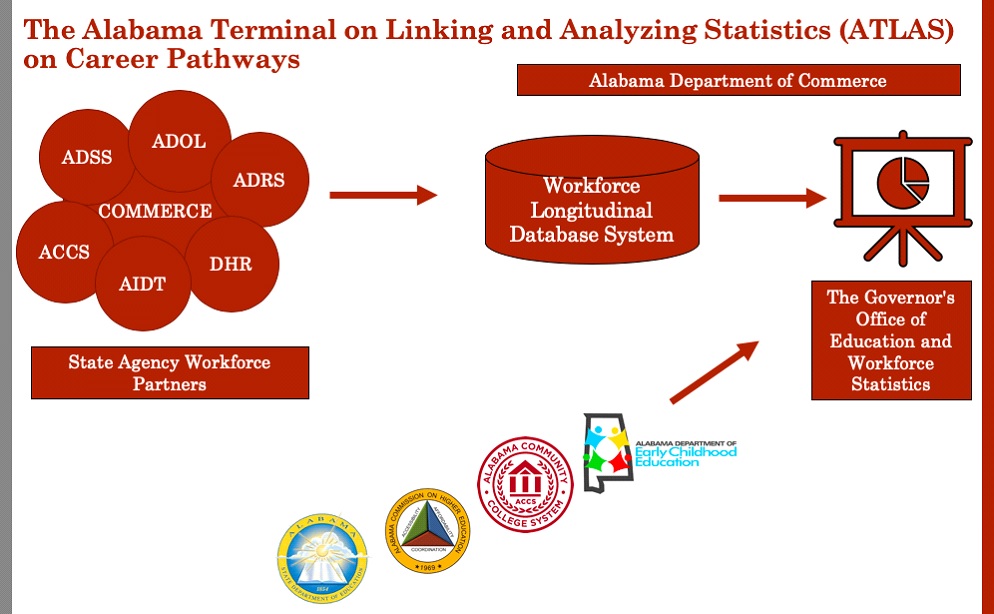
(q.) WIOA Supportive Services
One area the State of Alabama has increased emphasis on is supportive services. In April 2021 the state developed a concept and conducted a pilot for providing supportive services for WIOA participants such as reimbursement of exam and licensing fees and training materials not covered by ITAs or OJTs. This program was fully implemented in PY2021. The initial annual budget is $40,000, and we expect to serve 140 participants by the end of the program year at an average cost of $285 per participant. For PY2022 and PY2023 the expected budget will be approximately $40,000 per year to provide these services to WIOA participants.
(r.) Project Strengthen Alabama: Strengthening Alabama's Workforce Through Training, Recovery, and Employment
The Alabama Department of Commerce is utilizing funds made available from the U.S. Department of Labor-Employment and Training Administration to implement a National Dislocated Worker/Workforce Innovation and Opportunity Act (WIOA) National Emergency Grant to address the Opioid Crisis impacting Alabama’s Workforce Delivery System. The Alabama Department of Commerce (ADC) selected Local Workforce Development Areas 2,3,4 and 5 because these thirty-five (35) counties include the state's capital city of Montgomery, the economically progressive Jefferson County, and several promising counties slated for industry expansion. These areas are primed and ready for economic growth and are part of Alabama's top priority in economic and workforce development, yet opioid abuse is threatening this progress. Because of the numerous economic opportunities, in addition to ample state and federal training facilities in these areas, they should benefit the most from this funding. Intervention is necessary to help people recover from opioid addiction and become trained, skilled workers who are ready to return to the workforce as engaged, productive members of their communities. Affordable basic medical care such as dental check-ups, physical examinations, and mental health programs are sometimes difficult to obtain in a vast majority of these communities, exacerbating the effects of opioid abuse. Most of the larger counties have only one public health facility available, some of the smaller counties have none, which means most people needing assistance must travel long distances to get help, which results in them only seeking help when their condition worsens. Therein lies another problem transportation. Local health and mental health officials maintain that transportation, following the lack of formal recovery facilities, are the top two concerns for residents seeking assistance with opioid addictions.
Project Strengthen Alabama seeks to address the humanitarian needs caused by the steady presence of opioid misuse. In keeping with the Governor's Success Plus plan to add 500,00 highly-skilled Alabamians to the State’s workforce by 2025, Project Strengthen Alabama seeks to expand jobs throughout the state, especially within these targeted regions, by creating employment and training opportunities and supportive recovery services which are essential in preparing this segment of the workforce for obtainable job opportunities provided through current workforce development efforts. The supportive services that opioid sufferers need to ascend out of opioid misuse need to be established at the community level. Communities also need to create a robust basic social services network so that others will not fall prey to opioid addiction in the future.
Recovery, support, and education are essential to successful workforce relevance for this special population prior to training and employment. Grant partners will assist program participants with employment and training referrals while offering wraparound services that includes needs assessment, group and individual counseling, peer recovery support, and drug intervention support, all designed to help participants and their families eliminate barriers and achieve success. Local Workforce Development Areas 2,3,4 & 5 will maximize workforce efforts throughout twenty-nine (29) of the thirty-five (35) counties within the project area and ensure the alignment of necessary resources to address project priorities. Local Workforce Development Boards (LWDBs) will deliver a pool of project participants to the grant program by coordinating with area partners to access and enroll eligible grant participants. The LWDBs will administer all resources for services rendered through the Opioid Grant. This collaborative and multifaceted strategy will provide for a successful project to mitigate the numerous and varied obstacles generated by opioid misuse.
(s.) Reemployment
Individuals who were employed in retail or hospitality jobs prior to the COVID-19 pandemic were often unable to contemplate enrolling in training or upskilling into a new position. Many of these individuals are now unemployed, or underemployed, which presents an opportunity for them to upskill or retool into a resilient, in-demand occupation. In February 2020, Alabama’s unemployment rate was 2.4 percent and a skills gap caused thousands of jobs to remain unfilled. Many of Alabama’s industries have proven resilient during the COVID-19 pandemic, including manufacturing, health care, information technology, construction, and transportation. In February 2021, many of the jobs that were open in February 2020 remain open and unfilled in Alabama. Alabama is focused on retraining and supporting Alabamians with transitioning into resilient occupations through rapid reskilling and wrap-around supportive services.
The GOEWT is partnering with the Treasurer’s Office to develop a Financial Literacy Course for Alabama that will be six asynchronous, online modules. The program will be used by WIOA participants who are reentering the workforce. The program will launch in late 2022.
The Alabama Skills-Based Recovery Initiative will aim to adopt the concepts piloted through the AWSP into the workflow of Alabama’s public workforce system.
(t.) Alabama Workforce Stabilization Program (AWSP)
The Alabama Workforce Development Board was awarded a three-year, $17.8 million Reimagine Workforce Preparation (RWP) grant from the U.S. Department of Education on September 25, 2020, to scale the Alabama Workforce Stabilization Program (AWSP). The AWSP is a first-of-its-kind, non-traditional, short-term educational program, which is potentially significant for gathering data on the quality and efficacy of short-term, competency-based education programs that articulate to traditional postsecondary programs. The AWSP provides funding for short-term programs that are not currently eligible for Federal Pell Grant and student loans under Title IV of the Higher Education Act. The AWSP focuses on connecting short-term programs for rapid entry or reentry into the workforce, coupled with a focus on the Ability to Benefit Program for AWSP participants to continue their post-secondary education and articulate AWSP credits towards a long-term certificate or associate degree. The AWSP is bolstered by the Alabama Human Capital Development Fund, which extends the individual training accounts funded by Title I of the Workforce Innovation and Opportunity Act (WIOA) for AWSP participants to offset costs associated with transportation, childcare, housing, and equipment costs.
The Alabama Workforce Stabilization Program (AWSP) is a needs-based workforce training program that awarded $17,827,178.11 through a grant from the U.S. Department of Education’s Re-Imagine Workforce Program (RWP) provided through the Coronavirus Aid, Relief and Economic Security (CARES) Act.
The purpose of the AWSP program is to provide opportunities for 7,080 Alabama workers that have been displaced by COVID-19, to develop new skills in high demand industries: Healthcare, Advanced Manufacturing, Information Technology, Transportation, distribution/logistics and Construction. The method for participation in AWSP is employer driven, but the ultimate goal is to assist the individual worker. The program also seeks to help 200 Alabama Businesses avoid lay-offs, up-skill current employees, and to develop talent pipelines.
The Alabama Workforce Stabilization Program (AWSP) seeks to offsets the costs to participants for short-term education programs. It is designed to provide integrated education for participants who co-enroll in adult education and CTE courses. AWSP also awards college credit through the Alabama Community College System (ACCS) to students who need assistance in meeting requirements for the Ability to Benefit (ATB) program, which allows low-skilled individuals to access necessary workforce training and education that can help lift them out of poverty. This program allows adults who have not yet earned a HS Diploma or GED to access Pell Grants by either passing an ability to benefit assessment of basic skills or by completing at least two, 3-hour credit college courses.
The competitive preference of the grant award is to prioritize programs serving individuals who reside/work in rural communities or Opportunity Zones. Participants will work with Career Center representatives to determine level of services and the best career advancement path. All participants will be provided integrated Case Management by Alabama Career Center Staff; including Individual Employment Plan, Comprehensive Needs Assessment, and Personal training equipment. The Alabama Department of Human Resources (DHR) will assist in identifying state and local organizations to provide personalized support for the AWSP Participants successful transition into education and training courses. The AWSP program is a joint effort being coordinated between nine of Alabama’s departments and agencies.