



Located in:
- III. Operational Planning Elements
The Unified or Combined State Plan must include an Operational Planning Elements section that supports the State’s strategy and the system-wide vision described in Section II(c) above. Unless otherwise noted, all Operational Planning Elements apply to Combined State Plan partner programs included in the plan as well as to core programs. This section must include—
- b. State Operating Systems and Policies
The Unified or Combined State Plan must include a description of the State operating systems and policies that will support the implementation of the State strategy described in section II Strategic Elements. This includes—
- b. State Operating Systems and Policies
III. b. 4. C. Previous Assessment Results
Beginning with the state plan modification in 2018 and for subsequent state plans and state plan modifications, provide the results of assessments of the effectiveness of the core programs and other one-stop partner programs and Combined State Plan partner programs included in the Unified or Combined State plan during the preceding 2-year period (i.e. the 2-year period of the plan modification cycle). Describe how the State is adapting its strategies based on these assessments.
Current Narrative:
New Jersey, as all states, formally began the transition to the Workforce Innovation and Opportunity Act (WIOA) on July 1, 2016. In preparation for the transition, the NJDOL sought to determine performance measures and sustainability issues relevant to local areas, NJDOL, USDOL, the US Department of Education (USED) and other stakeholders. This process presented several challenges for the state’s performance accountability system, but also provided several opportunities for our workforce development system overall. The challenges include the necessity to incorporate new and revised performance measures and to update systems of record to comply with WIOA. In addition, testing new systems requires time and effort and necessitates changes in how we work and related business requirements. The opportunities included the ability to set baseline targets for programs, enhance the functionality of data systems, clean up old data, and create better service models. The WIOA transition period, directly affected the accuracy and completeness of PY 2017 and PY 2018 outcome data. We are working diligently to bring America’s One Stop Operating System (AOSOS) into technical compliance with WIOA and USDOL continues to revise their reporting mechanisms on a regular basis which affects data integrity. Software errors are reported to our case management vendor and USDOL as needed for corrective action. These activities will continue into the foreseeable future.
| Common Measures | Goal | Actual | Percent of Goal Achieved | Measure Results |
|---|---|---|---|---|
| Adult Program | ||||
| Employment (Second Quarter after Exit) | 73.3% | 60.8% | 82.9% | Not Met |
| Employment (Fourth Quarter after Exit) | 66.3% | 62.4% | 94.1% | Met |
| Median Earnings | $5,250 | $4,935 | 94.0% | Met |
| Credential Attainment Rate | 57.3% | 48.3% | 84.3% | Not Met |
| Measurable Skill Gains | Baseline | 13.6% | ||
| Dislocated Worker Program | ||||
| Employment (Second Quarter after Exit) | 77.0% | 56.5% | 73.4% | Not Met |
| Employment (Fourth Quarter after Exit) | 74.0% | 59.5% | 80.4% | Not Met |
| Median Earnings | $6,876 | $6,612 | 96.2% | Met |
| Credential Attainment Rate | 56.4% | 51.9% | 92.0% | Met |
| Measurable Skill Gains | Baseline | 16.2% | ||
| Youth Program | ||||
| Employment (Second Quarter after Exit) | 69.0% | 62.3% | 90.3% | Met |
| Employment (Fourth Quarter after Exit) | 41.0% | 56.7% | 138.3% | Exceeded |
| Median Earnings | Baseline | $2,272 | ||
| Credential Attainment Rate | 73.5% | 23.8% | 32.4% | Not Met |
| Measurable Skill Gains | Baseline | 15.3% | ||
| Wagner-Peyser Program | ||||
| Employment (Second Quarter after Exit) | Baseline | 49.9% | ||
| Employment (Fourth Quarter after Exit) | Baseline | 50.7% | ||
| Median Earnings | Baseline | $5,142 |
| Common Measures | Goal | Actual | Percent of Goal Achieved | Measure Results |
|---|---|---|---|---|
| Adult Program | ||||
| Employment (Second Quarter after Exit) | 73.3% | 65.5% | 89.4% | Not Met |
| Employment (Fourth Quarter after Exit) | 71.2% | 67.3% | 94.6% | Met |
| Median Earnings | $5,300 | $5,449 | 102.8% | Exceeded |
| Credential Attainment Rate | 58.7% | 59.5% | 101.4% | Exceeded |
| Measurable Skill Gains | Baseline | 43.0% | ||
| Dislocated Worker Program | ||||
| Employment (Second Quarter after Exit) | 77.0% | 67.2% | 87.3% | Not Met |
| Employment (Fourth Quarter after Exit) | 74.1% | 63.4% | 85.5% | Not Met |
| Median Earnings | $6,900 | $7,857 | 113.9% | Exceeded |
| Credential Attainment Rate | 63.5% | 67.1% | 105.7% | Exceeded |
| Measurable Skill Gains | Baseline | 40.0% | ||
| Youth Program | ||||
| Employment (Second Quarter after Exit) | 65.0% | 61.1% | 94.0% | Met |
| Employment (Fourth Quarter after Exit) | 41.0% | 58.3% | 142.1% | Exceeded |
| Median Earnings | Baseline | $2,306 | ||
| Credential Attainment Rate | 64.0% | 53.7% | 83.9% | Not Met |
| Measurable Skill Gains | Baseline | 68.1% | ||
| Wagner-Peyser Program | ||||
| Employment (Second Quarter after Exit) | 50.0% | 53.5% | 107.0% | Exceeded |
| Employment (Fourth Quarter after Exit) | 55.0% | 54.3% | 98.7% | Met |
| Median Earnings | $5,200 | $5,518 | 106.1% | Exceeded |
| Adult Education and Literacy | ||||
| Employment (Second Quarter after Exit) | Baseline | 45.0% | ||
| Employment (Fourth Quarter after Exit) | Baseline | 43.2% | ||
| Median Earnings | Baseline | $4,783 | ||
| Credential Attainment Rate | Baseline | 27.9% | ||
| Measurable Skill Gains | 51.0% | 58.5% | 115.0% | Exceeded |
| Vocational Rehabilitation | ||||
| Employment (Second Quarter after Exit) | Baseline | 3.2% | ||
| Median Earnings | Baseline | $6,122 | ||
| Measurable Skill Gains | Baseline | 31.2% |

Chart details the 2019 Title I Adult Program Common Measures which show that New Jersey met the two measures related to employment retention (employment at second and fourth quarters) and exceeded median earning and credential rates.
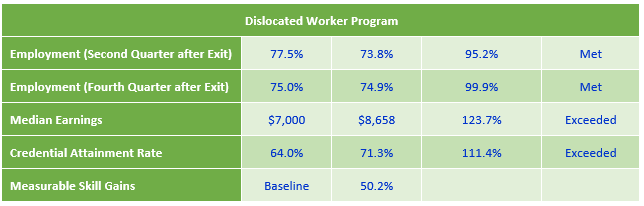
For 2019 Dislocated Workers programming, New Jersey met federally established targets for employment retention (employment in the second and fourth quarters) while exceeding targets for median earnings and credential attainment.

In 2019 there were three Youth measurements for assessment. New Jersey met the first employment retention measure for the second quarter while exceeding the fourth quarter target. New Jersey did not meet the credential target for 2019.
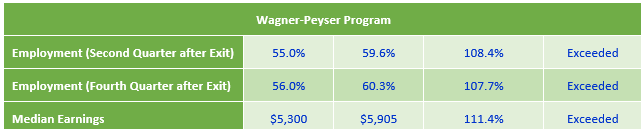
New Jersey exceeded all three Wagener-Peyser Employment Service targets for 2019 including both retentian targets (second and fourth quarter) and median earnings.
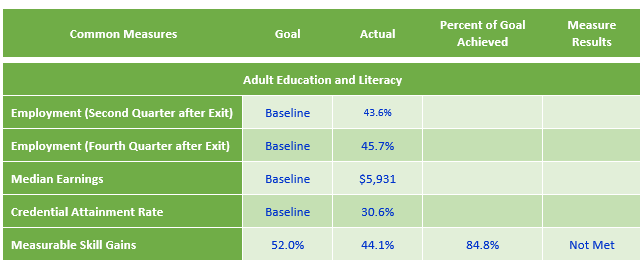
2019 marked beginning for the use of measurements for Title II Adult Education and Literacy. New Jersey did not meet the target for Measurable Skill Gains.
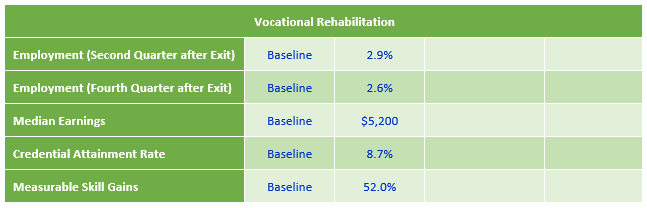
In 2019 measurements for Title IV Vocational Rehabilitation were still new and were provided only on a baseline basis with no measurements.

The 202 Title I Adult program met one of its measurements for retention (second quarter) and failed to meet its target for the fourth Quarter. It also met its target for median earnings and exceeded targets for credential attainment and measurable skills gains.
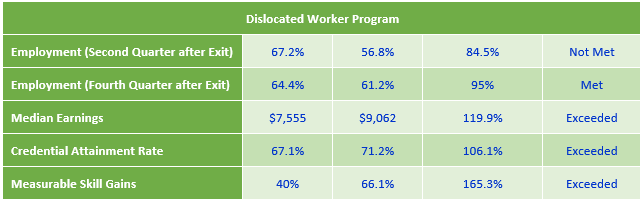
The 2020 Dislocated Worker programs did not meet its second quarter retention target but did meet its fourth quarter goals. It also exceeded targets for median earnings, credential attainment and measurable skills gain.

The 2020 Youth program exceeded three measurements, employment at the fourth quarter, median earnings and measurable skills gain. It met targets for second quarter retention and did not meet its credential attainment target.
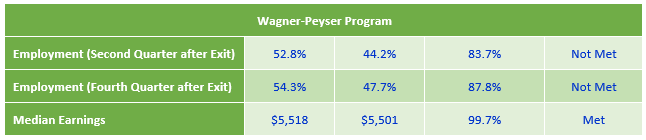
The Wagner-Peyser Employment Service program did not meet retention targets for the neither the second not fourth quarter for 2020. It did meet its median earnings target.
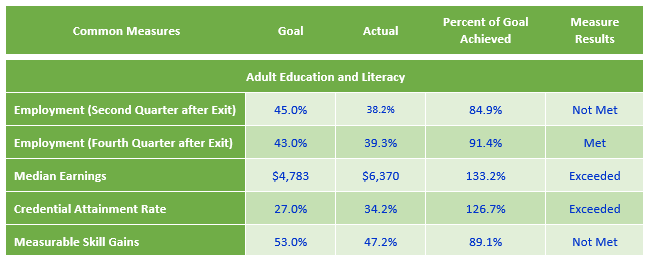
The 2020 Title II Adult Education and Literacy exceeded its median earnings and credential attainment rates and met the fourth quarter retention target. It did not meet second quarter retention targets not measurable skills gains.
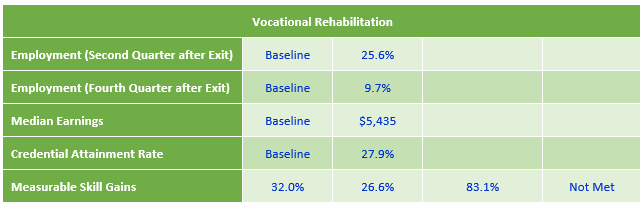
For 2020 Title IV Vocational Rehabilitation was still in a baseline focus. Its one measure for the year, measurable skills gain, was not met.
The State used the Workforce Innovation and Opportunity Act (WIOA) primary indicators performance measures to negotiate goals and report outcomes for the WIOA Title I Adult, Dislocated Worker, and Youth programs; Title III Wagner-Peyser programs; Title II Adult Education and Literacy programs; and Title IV Vocational Rehabilitation programs, for Program Years 2020 and 2021. This will continue for Program Years 2022 and 2023.
Performance outcomes for WIOA Titles I, II, III and IV are reported to USDOL and USED. These published reports are shared with the NJ State Employment and Training Commission, the state board, and NJDOL partners and stakeholders through the WIOA Dashboard. The WIOA Dashboard is published on the SETC website at http://njsetc.net/performance. Local program performance outcomes are provided by NJDOL to the 18 local workforce areas and to Title II providers in New Jersey. The Dashboard and the provision of local area reports support program analysis, identification of trends and consideration of potential program and delivery improvements by NJDOL, the SETC, local area program providers and other agency partners. Discussion and further exploration of program outcomes and needed improvements are held at regular SETC meetings and meetings hosted by NJDOL with core program staff and local providers.