



Located in:
- III. Operational Planning Elements
The Unified or Combined State Plan must include an Operational Planning Elements section that supports the State’s strategy and the system-wide vision described in Section II(c) above. Unless otherwise noted, all Operational Planning Elements apply to Combined State Plan partner programs included in the plan as well as to core programs. This section must include—
- b. State Operating Systems and Policies
The Unified or Combined State Plan must include a description of the State operating systems and policies that will support the implementation of the State strategy described in section II Strategic Elements. This includes—
- b. State Operating Systems and Policies
III. b. 4. C. Previous Assessment Results
Beginning with the state plan modification in 2018 and for subsequent state plans and state plan modifications, provide the results of assessments of the effectiveness of the core programs and other one-stop partner programs and Combined State Plan partner programs included in the Unified or Combined State plan during the preceding 2-year period (i.e. the 2-year period of the plan modification cycle). Describe how the State is adapting its strategies based on these assessments.
Current Narrative:
Previous Assessment Results
Beginning with the state plan modification in 2018 and for subsequent state plans and state plan modifications, provide the results of assessments of the effectiveness of the core programs and other one-stop partner programs and Combined State Plan partner programs included in the Unified or Combined State plan during the preceding 2-year period (i.e. the 2-year period of the plan modification cycle). Describe how the State is adapting its strategies based on these assessments.
Below are the results of assessments of the effectiveness of the core programs during the preceding two-year period for the core partners. Utah plans to utilize its workgroups and State Workforce Development Board committees to adapt its strategies based on assessment results. These activities will be particularly meaningful as comprehensive one-stop centers are certified throughout the state.
Utah State Board of Education, Adult Education Previous Assessment Results
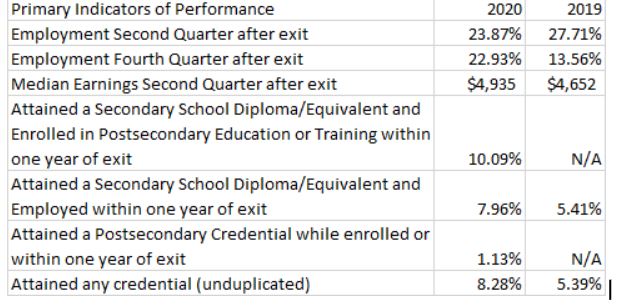
*Note that adult education programs were significantly impacted by COVID during both of these years.
Department of Workforce Services, Office of Rehabilitation Previous Assessment Results
The Utah State Office of Rehabilitation’s Vocational Rehabilitation Program remained in a baseline period for all performance measures outlined in WIOA section 116 and negotiated Measurable Skill Gain Targets for PY20 and PY21. However, the Utah State Office of Rehabilitation reviews current performance on a quarterly basis, analyzing performance on common performance measures, in addition to other relevant data points such as employment outcomes, wages at closure, timeliness of eligible and plan development and the rehabilitation rate. Performance reports are run on a statewide, regional, and district basis to provide a comprehensive picture of performance throughout the state. To help inform the overall quality of the services being delivered, customer satisfaction surveys are available and results are reviewed quarterly to guide work moving forward. Finally, a Comprehensive Statewide Needs Assessment is conducted every three years, which includes a survey of staff members, clients, and stakeholders to provide ongoing information and data points about service delivery.
| Program Year 2019 | Program Year 2020 | |
|---|---|---|
| Measurable Skills Gains | Negotiated: Baseline Actual: 42.9% | Negotiated: 41.8% Actual: 51.6% |
| Credential Attainment | Negotiated: Baseline Actual: 3.3% | Negotiated: Baseline Actual: 29.9% |
| Employment 2nd Quarter after Exit | Negotiated: Baseline Actual: 55.4% | Negotiated: Baseline Actual: 50.9% |
| Employment 4th Quarter after Exit | Negotiated: Baseline Actual: 51.9% | Negotiated: Baseline Actual: 48.6% |
| Median Wages | Baseline Actual: 3,713 | Baseline Actual: 3,989 |
Department of Workforce Services, Workforce Development Division Previous Assessment Results
Performance outcomes include the number of customers who complete an education program or who close as positive out of the total number of customers closed for that program year. Internal case reviews include the total case accuracy for cases reviewed in that program year.
| Performance Measure | Program Year 2019 | Program Year 2020 |
|---|---|---|
| Training Completion Outcomes: The percentage of customers who complete a training program for the indicated program year. | 60.4% | 60.8% |
| Positive Enrollment Closures: The percentage of customers who close as employed or, for youth, entered post-secondary education, obtained employment, or increased in literacy/numeracy skills for the indicated program year. | 85.1% | 81.1% |
| Case Review Accuracy: This is based on the accuracy of the total case when reviewed during the indicated program year. | 79.64% | 75.2% |
As the State Workforce Development Board and core partners move forward to accomplish the goals outlined in Utah’s Unified Plan, they will address the performance of required partners. All core partners are developing goals and priorities within the plan that meet objectives of common performance measures.
In addition, supporting the strategies outlined in this plan, Utah’s core partners will develop processes to continually provide technical assistance to operations, evaluate funding, identify areas of weakness and provide corrective intervention as needed. This is an ongoing activity and will include enhancing the system, guiding policy, establishing a system for continual improvement of activities, and exploring how to manage performance assessments with required partners.
Utah will use performance data as targets. The core partners will analyze the performance data, review the one-stop system annually, meet the State Workforce Development Board certification requirements, conduct customer satisfaction surveys, review accessibility and ensure continuous improvement efforts. The Operations Committee will oversee the presentation of analysis to the State Workforce Development Board as it becomes available. This is an ongoing activity.
As Utah implements new methods to evaluate customer satisfaction, existing customer feedback mechanisms will be used, and continuous improvement will take into consideration the indicators of performance. Accessibility for individuals with disabilities will be evaluated, and restraints will be addressed as they arise.