


Located in:
Other Appendices
Current Narrative:
B. Success Plus Goals by State and Workforce Council Region
| Career Cluster | 2016 | 2026 | Change | Annual Growth | Annual Growth Openings | Annual Exit Openings | Annual Total Openings | Goal 2019 - 2020 |
|---|---|---|---|---|---|---|---|---|
| Information Technology | 38,240 | 42,720 | 4,479 | 1.11% | 450 | 685 | 1,130 | 1,212 |
| Science, Technology, Engineer & Mathematics | 34,410 | 39,300 | 4,889 | 1.34% | 485 | 830 | 1,315 | 1,204 |
| Health Science | 190,320 | 216,030 | 25,736 | 1.28% | 2,575 | 7,345 | 9,920 | 6,977 |
| Manufacturing | 272,130 | 298,680 | 26,551 | 0.94% | 2,655 | 11,150 | 13.805 | 7,735 |
| Architecture & Construction | 144,630 | 155,680 | 10,747 | 0.72% | 1,075 | 5,260 | 6,330 | 3,536 |
| Finance | 68,440 | 72,100 | 3,655 | 0.52% | 365 | 2,340 | 2,705 | 1,452 |
| Transportation, Distribution & Logistics | 188,220 | 203,010 | 14,792 | 0.76% | 1,475 | 8,775 | 10,250 | 4,747 |
| Government & Public Administration | 16,500 | 17,430 | 926 | 0.55% | 90 | 605 | 695 | 308 |
| Human Services | 83,110 | 93,160 | 10,044 | 1.15% | 1,000 | 5,495 | 6,495 | 2,726 |
| Law, Public Safety, Corrections & Security | 67,070 | 69,580 | 2,511 | 0.37% | 250 | 2,750 | 3,000 | 1,185 |
| Education & Training | 140,630 | 148,830 | 8,201 | 0.57% | 815 | 6,345 | 7,160 | 2,688 |
| Hospitality & Tourism | 239,910 | 263,070 | 23,161 | 0.93% | 2,315 | 18,055 | 20,370 | 6,904 |
| Agriculture, Food & Natural Resources | 79,940 | 81,460 | 1,519 | 0.19% | 150 | 3,750 | 3,900 | 1,105 |
| Business Management & Administration | 311,200 | 315,180 | 3,981 | 0.13% | 400 | 14,630 | 15,030 | 4,158 |
| Marketing | 242,010 | 249,310 | 7,304 | 0.30% | 735 | 14,840 | 15,570 | 3,907 |
| Arts, Audio/Video Technology & Communications | 22,550 | 21,780 | -779 | -0.35% | 0 | 835 | 755 | 155 |
| Career Cluster | 2016 | 2026 | Change | Annual Growth | Annual Growth Openings | Annual Exit Openings | Annual Total Openings | Goal 2019 - 2020 |
|---|---|---|---|---|---|---|---|---|
| Information Technology | 14,080 | 16,300 | 2,225 | 1.48% | 225 | 250 | 470 | 515 |
| Science, Technology, Engineering & Mathematics | 20,460 | 23,340 | 2,885 | 1.33% | 285 | 490 | 780 | 689 |
| Health Science | 39,150 | 44,680 | 5,529 | 1.33% | 545 | 1,530 | 2,075 | 1,313 |
| Manufacturing | 80,530 | 90,790 | 10,254 | 1.21% | 1,020 | 3,345 | 4,365 | 2,536 |
| Architecture & Construction | 31,800 | 34,360 | 2,558 | 0.78% | 255 | 1,160 | 1,410 | 761 |
| Transportation, Distribution & Logistics | 44,710 | 47,800 | 3,083 | 0.67% | 305 | 2,060 | 2,365 | 989 |
| Business Management & Administration | 74,890 | 77,760 | 2,864 | 0.38% | 285 | 3,450 | 3,740 | 1,298 |
| Human Services | 17,470 | 19,700 | 2,230 | 1.21% | 225 | 1,175 | 1,395 | 553 |
| Finance | 13,380 | 14,230 | 855 | 0.62% | 85 | 470 | 550 | 283 |
| Law, Public Safety, Corrections & Security | 11,580 | 12,050 | 463 | 0.39% | 45 | 495 | 535 | 199 |
| Education & Training | 27,010 | 28,530 | 1,526 | 0.55% | 150 | 1,185 | 1,335 | 544 |
| Agriculture, Food & Natural Resources | 27,000 | 28,060 | 1,068 | 0.39% | 105 | 1,290 | 1,395 | 469 |
| Hospitality & Tourism | 53,930 | 58,760 | 4,835 | 0.86% | 485 | 4,100 | 4,580 | 1,377 |
| Arts, Audio/Video Technology & Communications | 5,150 | 5,100 | -51 | -0.10% | 0 | 190 | 185 | 50 |
| Marketing | 52,080 | 53,860 | 1,784 | 0.34% | 180 | 3,260 | 3,440 | 871 |
| Government & Public Administration | 2,810 | 2,950 | 139 | 0.48% | 15 | 105 | 120 | 54 |
Region 2 SUCCESS + Goal 33,000
| Career Cluster | 2016 | 2026 | Change | Annual Growth | Annual Growth Openings | Annual Exit Openings | Annual Total Openings | Goal 2019-2020 |
|---|---|---|---|---|---|---|---|---|
| Science, Technology, Engineering & Mathematics | 980 | 1,150 | 172 | 1.63% | 15 | 25 | 40 | 49 |
| Information Technology | 810 | 850 | 42 | 0.51% | 5 | 15 | 20 | 19 |
| Health Science | 13,120 | 14,770 | 1,647 | 1.19% | 155 | 525 | 685 | 544 |
| Manufacturing | 29,850 | 32,050 | 2,201 | 0.71% | 220 | 1,250 | 1,470 | 885 |
| Architecture & Construction | 7,490 | 7,860 | 367 | 0.48% | 35 | 270 | 305 | 172 |
| Business Management & Administration | 18,160 | 18,160 | -5 | 0.00% | 0 | 865 | 860 | 196 |
| Education & Training | 8,400 | 8,770 | 370 | 0.43% | 30 | 350 | 380 | 172 |
| Human Services | 6,300 | 6,900 | 596 | 0.91% | 55 | 405 | 460 | 210 |
| Law, Public Safety, Corrections & Security | 4,080 | 4,240 | 155 | 0.37% | 15 | 150 | 165 | 81 |
| Government & Public Administration | 940 | 970 | 35 | 0.37% | 0 | 35 | 35 | 16 |
| Transportation, Distribution & Logistics | 12,710 | 13,330 | 613 | 0.47% | 60 | 600 | 655 | 288 |
| Hospitality & Tourism | 15,500 | 16,280 | 779 | 0.49% | 80 | 1,135 | 1,215 | 369 |
| Arts, Audio/Video Technology & Communications | 1,460 | 1,320 | -146 | -1.05% | 0 | 55 | 55 | 15 |
| Finance | 2,700 | 2,790 | 96 | 0.35% | 10 | 100 | 110 | 55 |
| Agriculture, Food & Natural Resources | 6,460 | 6,450 | -15 | -0.02% | 0 | 300 | 300 | 66 |
| Marketing | 13,260 | 13,350 | 90 | 0.07% | 5 | 845 | 850 | 165 |
Region 3 SUCCESS+ Goal 32,000
| Career Cluster | 2016 | 2026 | Change | Annual Growth | Annual Growth Openings | Annual Exit Openings | Annual Total Openings | Goal 2019-2020 |
|---|---|---|---|---|---|---|---|---|
| Science, Technology, Engineering & Mathematics | 1,140 | 1,440 | 298 | 2.35% | 25 | 30 | 55 | 54 |
| Information Technology | 1,150 | 1,240 | 95 | 0.80% | 5 | 20 | 25 | 24 |
| Manufacturing | 21,080 | 25,320 | 4,244 | 1.85% | 420 | 925 | 1,340 | 897 |
| Health Science | 12,970 | 14,220 | 1,247 | 0.92% | 120 | 525 | 645 | 333 |
| Architecture & Construction | 11,190 | 11,850 | 662 | 0.58% | 60 | 405 | 465 | 217 |
| Education & Training | 10,110 | 10,860 | 746 | 0.71% | 70 | 435 | 510 | 224 |
| Business Management & Administration | 17,980 | 18,220 | 237 | 0.13% | 25 | 865 | 890 | 233 |
| Transportation, Distribution & Logistics | 11,620 | 12,440 | 824 | 0.69% | 80 | 550 | 630 | 253 |
| Finance | 3,020 | 3,210 | 193 | 0.62% | 20 | 105 | 120 | 61 |
| Human Services | 5,580 | 6,220 | 644 | 1.10% | 65 | 365 | 430 | 162 |
| Government & Public Administration | 780 | 820 | 36 | 0.45% | 0 | 30 | 30 | 10 |
| Hospitality & Tourism | 17,010 | 18,530 | 1,514 | 0.86% | 150 | 1,290 | 1,440 | 422 |
| Law, Public Safety, Corrections & Security | 3,670 | 3,830 | 159 | 0.43% | 15 | 145 | 160 | 65 |
| Agriculture, Food & Natural Resources | 6,330 | 6,400 | 61 | 0.10% | 5 | 290 | 295 | 75 |
| Marketing | 13,370 | 13,500 | 139 | 0.10% | 15 | 835 | 850 | 164 |
| Arts, Audio/Video Technology & Communications | 1,120 | 1,090 | -28 | -0.25% | 0 | 40 | 35 | 6 |
Region 4 SUCCESS+ Goal 132,000
| Career Cluster | 2016 | 2026 | Change | Annual Growth | Annual Growth Openings | Annual Exit Openings | Annual Total Openings | Goal 2019-2020 |
|---|---|---|---|---|---|---|---|---|
| Information Technology | 13,130 | 14,140 | 1,009 | 0.74% | 100 | 235 | 330 | 357 |
| Science, Technology, Engineering & Mathematics | 5,100 | 5,570 | 473 | 0.89% | 45 | 115 | 160 | 153 |
| Health Science | 58,520 | 66,940 | 8,417 | 1.35% | 840 | 2,195 | 3,035 | 2,436 |
| Architecture & Construction | 38,690 | 41,290 | 2,601 | 0.65% | 260 | 1,400 | 1,655 | 989 |
| Finance | 26,180 | 27,520 | 1,342 | 0.50% | 130 | 870 | 1,005 | 578 |
| Business Management & Administration | 89,370 | 89,300 | -71 | -0.01% | 0 | 4,180 | 4,170 | 1,006 |
| Manufacturing | 45,520 | 47,760 | 2,245 | 0.48% | 220 | 1,765 | 1,985 | 988 |
| Transportation, Distribution & Logistics | 49,550 | 53,330 | 3,778 | 0.74% | 380 | 2,330 | 2,705 | 1,364 |
| Government & Public Administration | 4,460 | 4,660 | 199 | 0.44% | 20 | 160 | 180 | 93 |
| Human Services | 20,630 | 23,290 | 2,652 | 1.22% | 260 | 1,380 | 1,640 | 789 |
| Law, Public Safety, Corrections & Security | 20,200 | 21,020 | 824 | 0.40% | 80 | 855 | 940 | 404 |
| Hospitality & Tourism | 57,750 | 63,360 | 5,613 | 0.93% | 560 | 4,335 | 4,900 | 1,845 |
| Agriculture, Food & Natural Resources | 8,310 | 8,580 | 268 | 0.32% | 30 | 385 | 415 | 154 |
| Marketing | 68,160 | 70,270 | 2,113 | 0.31% | 210 | 3,945 | 4,155 | 1,228 |
| Education & Training | 29,840 | 31,920 | 2,077 | 0.68% | 205 | 1,270 | 1,475 | 774 |
| Arts, Audio/Video Technology & Communications | 6,970 | 6,800 | -163 | -0.24% | 0 | 260 | 245 | 42 |
Region 5 SUCCESS+ Goal 65,000
| Career Cluster | 2016 | 2026 | Change | Annual Growth | Annual Growth Openings | Annual Exit Openings | Annual Total Openings | Goal 2019-2020 |
|---|---|---|---|---|---|---|---|---|
| Science, Technology, Engineering & Mathematics | 2,940 | 3,420 | 479 | 1.52% | 45 | 70 | 115 | 103 |
| Information Technology | 5,580 | 5,950 | 372 | 0.65% | 40 | 105 | 140 | 116 |
| Health Science | 25,480 | 28,990 | 3,506 | 1.30% | 350 | 1,020 | 1,370 | 816 |
| Manufacturing | 44,100 | 48,980 | 4,883 | 1.06% | 495 | 1,845 | 2,335 | 1,228 |
| Architecture & Construction | 19,130 | 20,610 | 1,482 | 0.75% | 145 | 695 | 840 | 421 |
| Business Management & Administration | 44,790 | 45,070 | 282 | 0.06% | 30 | 2,115 | 2,140 | 481 |
| Transportation, Distribution & Logistics | 24,860 | 26,920 | 2,052 | 0.80% | 200 | 1,200 | 1,400 | 569 |
| Education & Training | 23,070 | 24,350 | 1,276 | 0.54% | 120 | 990 | 1,105 | 416 |
| Human Services | 13,050 | 14,290 | 1,243 | 0.91% | 120 | 840 | 960 | 325 |
| Law, Public Safety, Corrections & Security | 12,420 | 12,740 | 327 | 0.26% | 30 | 485 | 515 | 169 |
| Hospitality & Tourism | 37,950 | 41,870 | 3,912 | 0.99% | 395 | 2,855 | 3,245 | 1,006 |
| Finance | 10,200 | 10,690 | 489 | 0.47% | 50 | 350 | 395 | 177 |
| Marketing | 34,000 | 35,070 | 1,070 | 0.31% | 105 | 2,150 | 2,255 | 502 |
| Agriculture, Food & Natural Resources | 9,850 | 9,870 | 19 | 0.02% | 0 | 450 | 450 | 94 |
| Arts, Audio/Video Technology & Communications | 3,410 | 3,320 | -88 | -0.26% | 0 | 135 | 125 | 17 |
| Government & Public Administration | 3,180 | 3,360 | 180 | 0.55% | 20 | 115 | 135 | 60 |
Region 6 SUCCESS+ Goal 32,000
| Career Cluster | 2016 | 2026 | Change | Annual Growth | Annual Growth Openings | Annual Exit Openings | Annual Total Openings | Goal 2019-2020 |
|---|---|---|---|---|---|---|---|---|
| Information Technology | 1,220 | 1,360 | 139 | 1.09% | 15 | 20 | 35 | 44 |
| Science, Technology, Engineering & Mathematics | 1,190 | 1,340 | 153 | 1.22% | 15 | 25 | 40 | 44 |
| Health Science | 13,880 | 15,410 | 1,527 | 1.05% | 150 | 545 | 695 | 509 |
| Manufacturing | 19,540 | 21,170 | 1,628 | 0.80% | 165 | 825 | 990 | 595 |
| Architecture & Construction | 8,450 | 8,950 | 499 | 0.58% | 45 | 300 | 345 | 196 |
| Transportation, Distribution & Logistics | 17,870 | 18,920 | 1,050 | 0.57% | 105 | 770 | 875 | 432 |
| Human Services | 5,370 | 5,980 | 608 | 1.08% | 60 | 355 | 410 | 196 |
| Business Management & Administration | 20,540 | 20,320 | -216 | -0.11% | 0 | 960 | 935 | 148 |
| Education & Training | 9,460 | 9,920 | 456 | 0.47% | 40 | 410 | 450 | 194 |
| Law, Public Safety, Corrections & Security | 4,850 | 4,960 | 107 | 0.22% | 10 | 185 | 195 | 71 |
| Hospitality & Tourism | 16,510 | 17,380 | 872 | 0.52% | 85 | 1,220 | 1,305 | 374 |
| Arts, Audio/Video Technology & Communications | 1,180 | 1,110 | -75 | -0.65% | 0 | 40 | 40 | 11 |
| Marketing | 16,850 | 17,080 | 224 | 0.13% | 20 | 1,060 | 1,080 | 221 |
| Agriculture, Food & Natural Resources | 9,870 | 9,770 | -98 | -0.10% | 0 | 455 | 445 | 73 |
| Finance | 3,650 | 3,770 | 118 | 0.32% | 10 | 130 | 140 | 64 |
| Government & Public Administration | 1,570 | 1,630 | 63 | 0.39% | 5 | 60 | 65 | 28 |
Region 7 SUCCESS+ Goal 81,000
| Career Cluster | 2016 | 2026 | Change | Annual Growth | Annual Growth Openings | Annual Exit Openings | Annual Total Openings | Goal 2019-2020 |
|---|---|---|---|---|---|---|---|---|
| Information Technology | 3,390 | 3,940 | 553 | 1.52% | 55 | 65 | 120 | 137 |
| Science, Technology, Engineering & Mathematics | 2,990 | 3,430 | 436 | 1.37% | 45 | 70 | 110 | 111 |
| Health Science | 27,000 | 31,040 | 4,039 | 1.40% | 400 | 1,035 | 1,435 | 1,026 |
| Education & Training | 17,880 | 18,760 | 886 | 0.48% | 85 | 765 | 855 | 363 |
| Architecture & Construction | 28,820 | 31,350 | 2,534 | 0.85% | 250 | 1,050 | 1,300 | 781 |
| Transportation, Distribution & Logistics | 28,440 | 31,370 | 2,928 | 0.98% | 290 | 1,335 | 1,625 | 852 |
| Manufacturing | 30,180 | 31,550 | 1,365 | 0.44% | 140 | 1,135 | 1,280 | 607 |
| Human Services | 13,240 | 15,150 | 1,908 | 1.36% | 190 | 855 | 1,045 | 492 |
| Law, Public Safety, Corrections & Security | 9,980 | 10,470 | 486 | 0.48% | 45 | 415 | 460 | 196 |
| Finance | 9,020 | 9,770 | 748 | 0.80% | 70 | 315 | 385 | 234 |
| Hospitality & Tourism | 42,100 | 47,850 | 5,752 | 1.29% | 575 | 3,255 | 3,830 | 1,511 |
| Business Management & Administration | 46,950 | 48,350 | 1,404 | 0.30% | 135 | 2,275 | 2,415 | 797 |
| Agriculture, Food & Natural Resources | 12,180 | 12,360 | 180 | 0.15% | 15 | 565 | 585 | 174 |
| Marketing | 40,720 | 42,290 | 1,577 | 0.38% | 155 | 2,525 | 2,680 | 757 |
| Arts, Audio/Video Technology & Communications | 2,770 | 2,650 | -116 | -0.43% | 0 | 100 | 90 | 15 |
| Government & Public Administration | 2,310 | 2,440 | 133 | 0.56% | 10 | 85 | 95 | 47 |
SUCCESS+ Goal = 500,000
Alabama
Annual LFP Goal = 40,000
| Special Population Groups | Population Estimates | Share of Aggregate of Attainment Goal | 2019-2020 Annual Attainment Goal | 2019-2020 Annual Labor Force Participation Goal |
|---|---|---|---|---|
| Displaced Home maker | 280,438 | 24,026 | 2,403 | 2,303 |
| Caregiver | 154,574 | 25,651 | 2,565 | 2,465 |
| Adults with Aging Dependents | 134,990 | 10,038 | 1,004 | 1,004 |
| Unemployed | 83,565 | 66,240 | 6,624 | 0 |
| Low-Income | 849,699 | 114,508 | 11,451 | 10,807 |
| Indians, Alaskan Natives, Native Hawaiians | 27,311 | 789 | 79 | 69 |
| People with Disabilities | 291,771 | 82,688 | 8,270 | 8,230 |
| Older Individuals | 516,713 | 29,907 | 2,993 | 2,893 |
| Ex-Offenders | 15,224 | 10,691 | 1,069 | 1,069 |
| Homeless Individuals | 17,546 | 3,845 | 382 | 372 |
| Youth Who Aged Out of Foster System | 572 | 208 | 23 | 23 |
| English Language Learners | 20,725 | 7,023 | 702 | 580 |
| Individuals with Low Levels of Literacy | 48,998 | 28,664 | 2,860 | 2,436 |
| Individuals with Substantial Cultural Barriers | 106,217 | 22,076 | 2,209 | 2,209 |
| Migrant & Seasonal Farmworkers | 18,266 | 3,796 | 380 | 380 |
| Individuals Nearing TANF Exhaustion | 8,565 | 3,429 | 343 | 343 |
| Single Parents | 178,243 | 46,216 | 4,622 | 3,990 |
| Long-Term Unemployed | 15,960 | 11,939 | 1,195 | 0 |
| Individuals Preparing for Nontraditional Fields | N/A | 3,708 | 370 | 370 |
| Youth with Parents in Active Duty Military | 8,750 | 4,558 | 4,566 | 456 |
Sources for population estimates include US Census Bureau (ACS), AL Dept. of Public Health (ADPH),
AL Dept. of Human Resources (DHR), AL Dept. of Corrections (DOC), The Annie E Casey Foundation, and AL Dept. of Labor (ADOL).
SUCCESS+ Goal = 125,000
Region 1
Annual LFP Goal = 10,000
| Special Population Groups | Population Estimates | Share of Aggregate of Attainment Goal | 2019-2020 Annual Attainment Goal | 2019-2020 Annual Labor Force Participation Goal |
|---|---|---|---|---|
| Displaced Home maker | 44,866 | 7,448 | 745 | 745 |
| Caregiver | 36,679 | 8,441 | 844 | 844 |
| Adults with Aging Dependents | 13,025 | 1,853 | 185 | 185 |
| Unemployed | 16,824 | 14,330 | 1,433 | 0 |
| Low-Income | 104,860 | 28,609 | 2,861 | 2,261 |
| Indians, Alaskan Natives, Native Hawaiians | 819 | 211 | 21 | 11 |
| People with Disabilities | 62,902 | 14,190 | 1,419 | 1,419 |
| Older Individuals | 122,848 | 8,498 | 850 | 850 |
| Ex-Offenders | 3,470 | 2,893 | 289 | 289 |
| Homeless Individuals | 3,969 | 1,022 | 102 | 102 |
| Youth Who Aged Out of Foster System | 71 | 51 | 5 | 5 |
| English Language Learners | 14,505 | 3,733 | 373 | 261 |
| Individuals with Low Levels of Literacy | 59,361 | 7,279 | 728 | 623 |
| Individuals with Substantial Cultural Barriers | 32,504 | 8,366 | 837 | 837 |
| Migrant & Seasonal Farmworkers | 7,672 | 1,975 | 197 | 197 |
| Individuals Nearing TANF Exhaustion | 1,089 | 780 | 78 | 78 |
| Single Parents | 40,087 | 10,318 | 1,032 | 967 |
| Long-Term Unemployed | 2,902 | 1,747 | 175 | 0 |
| Individuals Preparing for Nontraditional Fields | N/A | 2,000 | 200 | 200 |
| Youth with Parents in Active Duty Military | 1,772 | 1,256 | 126 | 126 |
Sources for population estimates include US Census Bureau (ACS), AL Dept. of Public Health (ADPH),
AL Dept. of Human Resources (DHR), AL Dept. of Corrections (DOC), The Annie E Casey Foundation, and AL Dept. of Labor (ADOL).
SUCCESS+ Goal = 33,000
Region 2
Annual LFP Goal = 2,600
| Special Population Groups | Population Estimates | Share of Aggregate of Attainment Goal | 2019-2020 Annual Attainment Goal | 2019-2020 Annual Labor Force Participation Goal |
|---|---|---|---|---|
| Displaced Home maker | 11,731 | 797 | 79 | 79 |
| Caregiver | 13,699 | 1,150 | 115 | 115 |
| Adults with Aging Dependents | 4,246 | 659 | 66 | 66 |
| Unemployed | 5,935 | 5,061 | 506 | 0 |
| Low-Income | 38,704 | 7,921 | 792 | 748 |
| Indians, Alaskan Natives, Native Hawaiians | 259 | 46 | 5 | 5 |
| People with Disabilities | 27,963 | 6,581 | 658 | 658 |
| Older Individuals | 47,358 | 2,727 | 273 | 273 |
| Ex-Offenders | 1,916 | 1,143 | 114 | 114 |
| Homeless Individuals | 1,897 | 339 | 34 | 24 |
| Youth Who Aged Out of Foster System | 34 | 30 | 3 | 3 |
| English Language Learners | 2,480 | 443 | 44 | 34 |
| Individuals with Low Levels of Literacy | 22,630 | 723 | 72 | 52 |
| Individuals with Substantial Cultural Barriers | 5,350 | 757 | 76 | 76 |
| Migrant & Seasonal Farmworkers | 1,096 | 146 | 15 | 15 |
| Individuals Nearing TANF Exhaustion | 524 | 94 | 9 | 9 |
| Single Parents | 16,323 | 1,769 | 177 | 167 |
| Long-Term Unemployed | 1,101 | 997 | 100 | 0 |
| Individuals Preparing for Nontraditional Fields | N/A | 800 | 80 | 80 |
| Youth with Parents in Active Duty Military | 1,772 | 817 | 82 | 82 |
Sources for population estimates include US Census Bureau (ACS), AL Dept. of Public Health (ADPH),
AL Dept. of Human Resources (DHR), AL Dept. of Corrections (DOC), The Annie E Casey Foundation, and AL Dept. of Labor (ADOL).
SUCCESS+ Goal = 32,000
Region 3
Annual LFP Goal = 2,600
| Special Population Groups | Population Estimates | Share of Aggregate of Attainment Goal | 2019-2020 Annual Attainment Goal | 2019-2020 Annual Labor Force Participation Goal |
|---|---|---|---|---|
| Displaced Home maker | 6,240 | 1,006 | 101 | 101 |
| Caregiver | 9,707 | 1,554 | 155 | 155 |
| Adults with Aging Dependents | 4,029 | 743 | 74 | 74 |
| Unemployed | 5,113 | 4,480 | 448 | 0 |
| Low-Income | 39,320 | 8,227 | 823 | 823 |
| Indians, Alaskan Natives, Native Hawaiians | 261 | 55 | 5 | 5 |
| People with Disabilities | 19,992 | 6,036 | 604 | 564 |
| Older Individuals | 33,516 | 1,407 | 141 | 141 |
| Ex-Offenders | 795 | 466 | 47 | 47 |
| Homeless Individuals | 773 | 162 | 16 | 16 |
| Youth Who Aged Out of Foster System | 14 | 3 | 3 | 3 |
| English Language Learners | 1,931 | 203 | 20 | 20 |
| Individuals with Low Levels of Literacy | 20,115 | 2,208 | 218 | 218 |
| Individuals with Substantial Cultural Barriers | 6,620 | 1,085 | 109 | 109 |
| Migrant & Seasonal Farmworkers | 1,096 | 179 | 18 | 18 |
| Individuals Nearing TANF Exhaustion | 731 | 153 | 15 | 15 |
| Single Parents | 14,581 | 2,901 | 290 | 242 |
| Long-Term Unemployed | 826 | 640 | 64 | 0 |
| Individuals Preparing for Nontraditional Fields | N/A | 300 | 30 | 30 |
| Youth with Parents in Active Duty Military | 438 | 192 | 19 | 19 |
Sources for population estimates include US Census Bureau (ACS), AL Dept. of Public Health (ADPH),
AL Dept. of Human Resources (DHR), AL Dept. of Corrections (DOC), The Annie E Casey Foundation, and AL Dept. of Labor (ADOL).
SUCCESS+ Goal = 132,000
Region 4
Annual LFP Goal = 10,500
| Special Population Groups | Population Estimates | Share of Aggregate of Attainment Goal | 2019-2020 Annual Attainment Goal | 2019-2020 Annual Labor Force Participation Goal |
|---|---|---|---|---|
| Displaced Home maker | 37,548 | 7,759 | 776 | 676 |
| Caregiver | 34,956 | 7,051 | 705 | 605 |
| Adults with Aging Dependents | 13,137 | 3,589 | 359 | 359 |
| Unemployed | 16,492 | 14,506 | 1,451 | 0 |
| Low-Income | 99,958 | 27,311 | 2,731 | 2,731 |
| Indians, Alaskan Natives, Native Hawaiians | 811 | 222 | 22 | 22 |
| People with Disabilities | 59,726 | 25,709 | 2,571 | 2,571 |
| Older Individuals | 111,313 | 8,956 | 896 | 796 |
| Ex-Offenders | 2,791 | 2,263 | 226 | 226 |
| Homeless Individuals | 3,340 | 913 | 91 | 91 |
| Youth Who Aged Out of Foster System | 75 | 20 | 2 | 2 |
| English Language Learners | 11,592 | 1,567 | 157 | 157 |
| Individuals with Low Levels of Literacy | 46,557 | 7,721 | 771 | 472 |
| Individuals with Substantial Cultural Barriers | 29,856 | 7,157 | 716 | 716 |
| Migrant & Seasonal Farmworkers | 1,096 | 249 | 25 | 25 |
| Individuals Nearing TANF Exhaustion | 2,121 | 580 | 58 | 58 |
| Single Parents | 48,048 | 13,128 | 1,313 | 947 |
| Long-Term Unemployed | 3,068 | 2,838 | 284 | 0 |
| Individuals Preparing for Nontraditional Fields | N/A | 191 | 19 | 19 |
| Youth with Parents in Active Duty Military | 438 | 270 | 27 | 27 |
Sources for population estimates include US Census Bureau (ACS), AL Dept. of Public Health (ADPH),
AL Dept. of Human Resources (DHR), AL Dept. of Corrections (DOC), The Annie E Casey Foundation, and AL Dept. of Labor (ADOL).
SUCCESS+ Goal = 65,000
Region 5
Annual LFP Goal = 5,200
| Special Population Groups | Population Estimates | Share of Aggregate of Attainment Goal | 2019-2020 Annual Attainment Goal | 2019-2020 Annual Labor Force Participation Goal |
|---|---|---|---|---|
| Displaced Home maker | 15,402 | 1,831 | 183 | 183 |
| Caregiver | 23,547 | 2,829 | 283 | 283 |
| Adults with Aging Dependents | 7,119 | 809 | 81 | 81 |
| Unemployed | 11,812 | 10,671 | 1,067 | 0 |
| Low-Income | 89,462 | 16,447 | 1,645 | 1,645 |
| Indians, Alaskan Natives, Native Hawaiians | 711 | 131 | 13 | 13 |
| People with Disabilities | 44,563 | 10,558 | 1,056 | 1,056 |
| Older Individuals | 72,247 | 3,137 | 314 | 314 |
| Ex-Offenders | 2,000 | 1,568 | 157 | 157 |
| Homeless Individuals | 2,570 | 472 | 47 | 47 |
| Youth Who Aged Out of Foster System | 37 | 17 | 2 | 2 |
| English Language Learners | 5,443 | 501 | 50 | 50 |
| Individuals with Low Levels of Literacy | 42,371 | 3,789 | 378 | 378 |
| Individuals with Substantial Cultural Barriers | 16,764 | 2,082 | 208 | 208 |
| Migrant & Seasonal Farmworkers | 1,096 | 201 | 20 | 20 |
| Individuals Nearing TANF Exhaustion | 1,999 | 367 | 37 | 37 |
| Single Parents | 39,433 | 7,250 | 724 | 683 |
| Long-Term Unemployed | 2,299 | 1,923 | 192 | 0 |
| Individuals Preparing for Nontraditional Fields | N/A | 92 | 9 | 9 |
| Youth with Parents in Active Duty Military | 1,772 | 326 | 33 | 33 |
Sources for population estimates include US Census Bureau (ACS), AL Dept. of Public Health (ADPH),
AL Dept. of Human Resources (DHR), AL Dept. of Corrections (DOC), The Annie E Casey Foundation, and AL Dept. of Labor (ADOL).
SUCCESS+ Goal = 32,000
Region 6
Annual LFP Goal = 2,600
| Special Population Groups | Population Estimates | Share of Aggregate of Attainment Goal | 2019-2020 Annual Attainment Goal | 2019-2020 Annual Labor Force Participation Goal |
|---|---|---|---|---|
| Displaced Home maker | 4,986 | 756 | 76 | 76 |
| Caregiver | 13,336 | 790 | 79 | 79 |
| Adults with Aging Dependents | 5,511 | 746 | 75 | 75 |
| Unemployed | 5,837 | 4,900 | 490 | 0 |
| Low-Income | 41,052 | 7,152 | 715 | 715 |
| Indians, Alaskan Natives, Native Hawaiians | 226 | 39 | 4 | 4 |
| People with Disabilities | 24,806 | 5,408 | 541 | 541 |
| Older Individuals | 42,147 | 1,166 | 117 | 117 |
| Ex-Offenders | 1,488 | 756 | 76 | 76 |
| Homeless Individuals | 1,758 | 192 | 19 | 19 |
| Youth Who Aged Out of Foster System | 87 | 25 | 2 | 2 |
| English Language Learners | 2,375 | 208 | 21 | 21 |
| Individuals with Low Levels of Literacy | 21,612 | 1,712 | 170 | 170 |
| Individuals with Substantial Cultural Barriers | 5,062 | 769 | 77 | 77 |
| Migrant & Seasonal Farmworkers | 5,114 | 778 | 78 | 78 |
| Individuals Nearing TANF Exhaustion | 7,799 | 1,139 | 114 | 114 |
| Single Parents | 16,948 | 2,910 | 291 | 291 |
| Long-Term Unemployed | 1,152 | 1,098 | 110 | 0 |
| Individuals Preparing for Nontraditional Fields | N/A | 252 | 25 | 25 |
| Youth with Parents in Active Duty Military | 1,772 | 1,204 | 120 | 120 |
Sources for population estimates include US Census Bureau (ACS), AL Dept. of Public Health (ADPH),
AL Dept. of Human Resources (DHR), AL Dept. of Corrections (DOC), The Annie E Casey Foundation, and AL Dept. of Labor (ADOL).
SUCCESS+ Goal = 81,000
Region 7
Annual LFP Goal = 6,500
| Special Population Groups | Population Estimates | Share of Aggregate of Attainment Goal | 2019-2020 Annual Attainment Goal | 2019-2020 Annual Labor Force Participation Goal |
|---|---|---|---|---|
| Displaced Home maker | 25,069 | 4,429 | 443 | 443 |
| Caregiver | 22,650 | 3,837 | 384 | 384 |
| Adults with Aging Dependents | 10,796 | 1,639 | 164 | 164 |
| Unemployed | 13,465 | 12,292 | 1,229 | 0 |
| Low-Income | 77,071 | 18,841 | 1,884 | 1,884 |
| Indians, Alaskan Natives, Native Hawaiians | 349 | 85 | 9 | 9 |
| People with Disabilities | 40,465 | 14,206 | 1,421 | 1,421 |
| Older Individuals | 87,205 | 4,016 | 402 | 402 |
| Ex-Offenders | 2,464 | 1,602 | 160 | 160 |
| Homeless Individuals | 5,090 | 745 | 73 | 73 |
| Youth Who Aged Out of Foster System | 253 | 62 | 6 | 6 |
| English Language Learners | 2,731 | 368 | 37 | 37 |
| Individuals with Low Levels of Literacy | 41,854 | 5,232 | 523 | 523 |
| Individuals with Substantial Cultural Barriers | 10,061 | 1,860 | 186 | 186 |
| Migrant & Seasonal Farmworkers | 1,096 | 268 | 27 | 27 |
| Individuals Nearing TANF Exhaustion | 1,294 | 316 | 32 | 32 |
| Single Parents | 32,480 | 7,940 | 794 | 693 |
| Long-Term Unemployed | 2,849 | 2,696 | 270 | 0 |
| Individuals Preparing for Nontraditional Fields | N/A | 73 | 7 | 7 |
| Youth with Parents in Active Duty Military | 788 | 493 | 49 | 49 |
Sources for population estimates include US Census Bureau (ACS), AL Dept. of Public Health (ADPH),
AL Dept. of Human Resources (DHR), AL Dept. of Corrections (DOC), The Annie E Casey Foundation, and AL Dept. of Labor (ADOL)
Carl D. Perkins Act
U.S. Department of Education
Office of Career, Technical, and Adult Education
Strengthening Career and Technical Education for the 21st Century Act (Perkins V) State Plan
I. COVER PAGE
A. State Name: Alabama
B. Eligible Agency (State Board) Submitting Plan on Behalf of State:
Alabama State Board of Education
C. Person at, or officially designated by, the eligible agency, identified in Item B above, who is responsible for answering questions regarding this plan. This is also the person designated as the “authorized representative” for the agency.
- Name: Jennifer J. Burt
- Official Position Title: Administrator of Standards and Accountability
- Agency: Alabama State Board of Education
- Telephone: (334) 694-4763 6. Email: jburt@alsde.edu D.Individual serving as the State Director for Career and Technical Education:
□ Check here if this individual is the same person identified in Item C above and then proceed to Item E below.
- Name: Daniel Boyd
- Official Position Title: Deputy State Superintendent of Education
- Agency: Alabama State Board of Education
- Telephone: (334) 694-4907 5. Email: dboyd@alsde.edu E. Type of Perkins V State Plan Submission - FY 2019 (Check one):
- 1-Year Transition Plan (FY2019 only) – if an eligible agency selects this option, it will then complete Items G and J
F. Type of Perkins V State Plan Submission - Subsequent Years (Check one):4
X State Plan (FY 2020-23) - if an eligible agency selects this option, it will then complete Items H, I, and J
- State Plan Revisions (Please indicate year of submission: ______________) - if an eligible agency selects this option, it will then complete Items H and J
G. Submitting Perkins V State Plan as Part of a Workforce Innovation and Opportunities Act (WIOA) Combined State Plan – FY 2019 (Check one):
- Yes
X No
H. Submitting Perkins V State Plan as Part of a Workforce Innovation and Opportunities Act (WIOA) Combined State Plan – Subsequent Years (Check one):5
X Yes (If yes, please indicate year of submission: FY2020-2023 )
- No
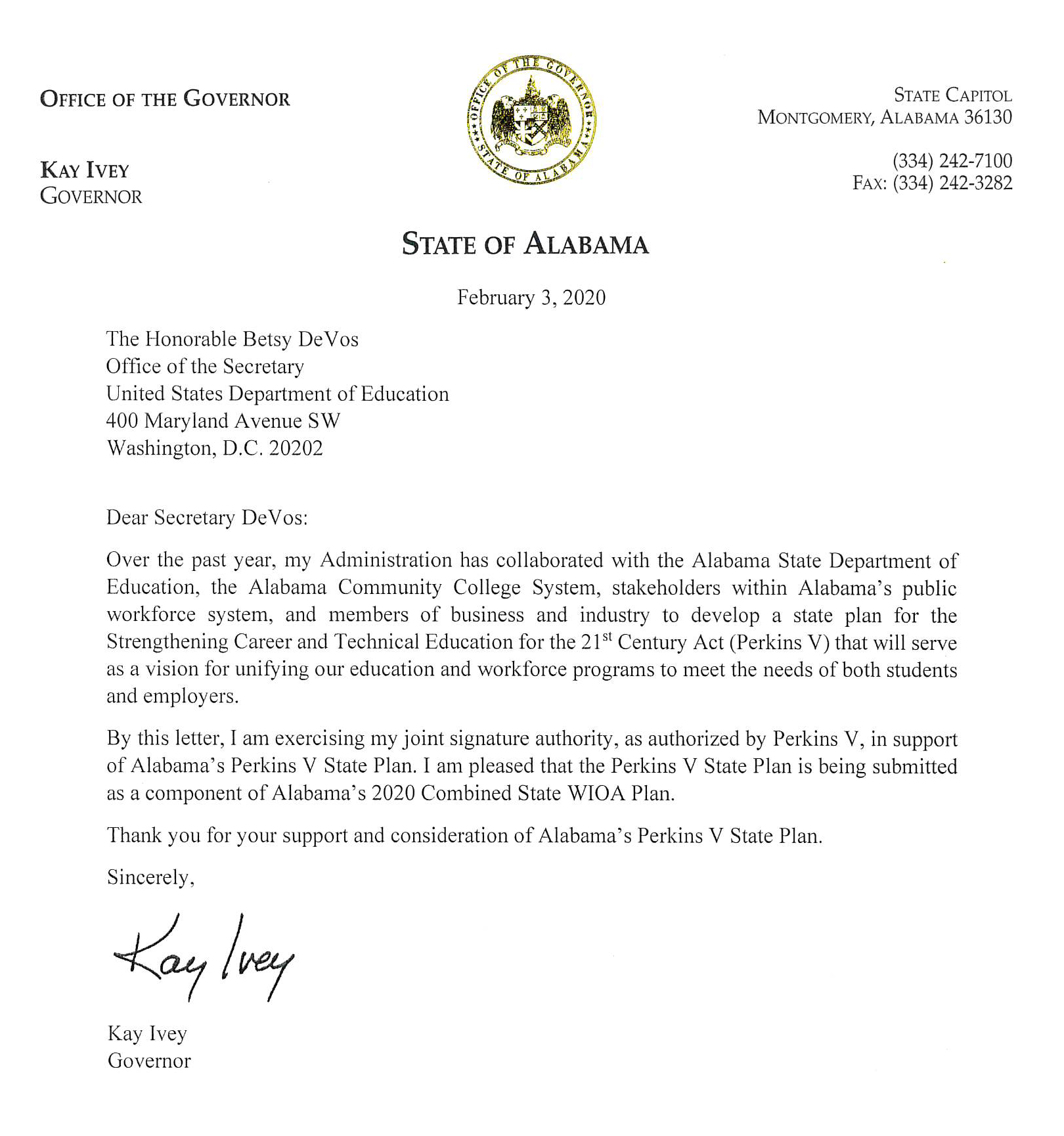
I. Governor’s Joint Signatory Authority of the Perkins V State Plan (Fill in text box and then check one box below):6
| Date Governor was sent State Plan for signature: February 3, 2020 |
X The Governor has provided a letter that he or she is jointly signing the State plan for submission to the Department.
- The Governor has not provided a letter that he or she is jointly signing the State plan for submission to the Department.
4 Item F will only appear to the user in the Perkins V State Plan Portal in subsequent years (FY 2020-23).
5 Item H will only appear to the user in the Perkins V State Plan Portal in subsequent years (FY 2020-23).
6 Item I is required in FY 2019 only for States that choose to submit a full Perkins V State plan, covering FY 2019-23.
Governor's Workforce Innovation Directives
ALABAMA WORKFORCE INVESTMENT SYSTEM
April 24, 2015 Department of Economic and Community Affairs Workforce Development Division 401Adams Avenue Post Office 5690 Montgomery,Alabama 36103-5690 GOVERNOR’ S WORKFORCE INNOVATION DIRECTIVE NO. PY2014-10
SUBJECT:
1. Purpose. Training and Employment Guidance Letter (TEGL) - Workforce Innovation and Opportunity Act (WIOA) Youth Program Transition This transmits the following TEGL:
Number Date 23-14 03/26/15 Subject Workforce Innovation and Opportunity Act (WIOA) Youth Program Transition
2. Discussion. The purpose of TEGL No. 23-14 is to provide guidance and planning information to states, local workforce areas, and other recipients of Workforce Investment Act (WIA) Title I youth formula funds on the activities associated with the implementation of WIOA.
In order to continue implementation prior to the final rule, a series of WIOA Operational Guidance documents that provide the needed implementation information will be issued in the form of Training and Employment Guidance Letters (TEGLs). These Operational Guidance TEGLs will inform the system about how to begin the important planning and reorganization necessary to comply with new WIOA statutory requirements for the upcoming Program Year (PY) 2015 (beginning July 1, 2015). The Operating Guidance TEGLs will provide a framework for program activities until the regulations are finalized. TEGL 23-14 is one in the ongoing series of Guidance.
Regarding the implementation of youth programs, TEGL 23-14 states that while previously issued TEGL No. 19-14 (discussed in GWID PY2014-07) says "States will receive their first WIOA allotment for the youth programs in April 2015 and will begin full implementation of WIOA for the Youth Program at that time," this was imprecise. Operational implementation of the WIOA youth program begins on July 1, 2015, with all provisions taking effect July 1,2016. The PY 2015 WIOA youth allotment that is distributed in April 2015 is for preparation and programmatic activities for WIOA youth program implementation on July 1, 2015. In addition, states and local workforce areas are encouraged to use allowable transition funds to prepare for implementation of the WIOA Youth program. Page 2 Directive No. PY2014-10
TEGL 23-14 further discusses youth program planning and provides operational guidance for WIOA. This includes discussion on the transition from the required minimum thirty (30) percent expenditure rate for youth formula-funded programs on out-of-school youth under WIA to the new required minimum seventy-five (75) percent expenditure rate for youth formula-funded programs on out-of-school youth under WIOA and how the percentage is calculated. Other topics include Youth Standing Committees, transitioning in-school youth programs, changes to the youth program elements, the new eligibility criteria, and many other programmatic changes. Examples of successful out-of-school youth programs currently meeting the seventy-five (75) percent expenditure rate are provided for research as well as a list of resources to help states and local areas successfully transition.
3. Action. This Directive should be distributed accordingly to local areas, workforce staff, and partners. Local area staff should review TEGL 23-14, and use presented strategies and resources to transition their youth programs to the WIOA.
-------------- ALABAMA WORKFORCE INVESTMENT SYSTEM Department of Commerce Workforce Development Division 401 Adams Avenue Post Office Box 5690 Montgomery, Alabama 36103-5690 September 11, 2015 GOVERNOR’S WORKFORCE INNOVATION DIRECTIVE NO. PY2015-03
SUBJECT: Workforce Innovation and Opportunity Act Eligible Training Providers Policy
1. Purpose. This directive transmits the State’s policy regarding the Workforce Innovation and Opportunity Act (WIOA) Eligible Training Providers List in order to continue eligibility and to provide the procedures for potentially new training providers.
2. Discussion. Under WIOA, States shall establish initial eligibility for WIOA eligible training provider and certified training programs in order to continue to be eligible to provide training services until December 31, 2015. WIOA initial eligibility (for all current training providers on the ETPL) expires on December 31,2015. All current training providers and their current programs are grandfathered in as eligible training providers. Procedures are included in this policy for current training providers to seek continued eligibility. Under WIOA, the State shall also establish a procedure to determine the eligibility of new training providers. The criteria and procedures for new training providers are included in the attached policy. It is the responsibility of the Workforce Development Division to collect the required information from all Eligible Training Providers, who provide services to WIOA participants in Alabama . This Directive supersedes all previous directives regarding policies, collection of performance, costs and other information on the ETPL including GWDD No. PY2002-03 through PY2011-23, change 2.
3. Action. It is the responsibility of the local workforce development areas and the training providers to review the attached policy and instructions and adhere to the established procedures.
Attached are the policy and forms to use in the continued eligibility process and/or the application process for new training providers. The required information is to be submitted to the Workforce Development Division and information updated on the website, www.ETPL.alabama.gov, for each current program by December 31, 2015. Training providers are required to enter the information on the Eligible Training Provider List website. Training providers are strongly encouraged to keep the performance information listed on the ETPL website up to date. Training providers’ information will be reviewed at least every 24 months for renewal purposes. Training providers, who fail to follow the continued eligibility instructions by December 31, 2015, will be removed from the ETPL without exception.
----------------------------------------ALABAMA WORKFORCE DEVELOPMENT SYSTEM
Department of Commerce Workforce Development Division 401 Adams Avenue
Post Office Box 304103 Montgomery, Alabama 36130-4103
November 30, 2018
GOVERNOR'S WORKFORCE INNOVATION DIRECTIVE NO. PY2015-03, Change 3
SUBJECT: Workforce Innovation and Opportunity Act Eligible Training Providers
1. Purpose. This directive transmits the State's revised policy for the Workforce Innovation and Opportunity Act (WIOA) Eligible Training Providers. This removed outdated information regarding the transition from Workforce Investment Act (WIA) to WIOA and updates program performance information.
2. Discussion. Under WIOA, States are to establish a procedure to determine eligibility for new training providers and one for continued eligibility of current training providers. It also states that submission of the performance, program costs, and any additional information required for each individual WIOA-certified program must be submitted every two years to the Workforce Development Division. The revisions to this policy include removing outdated information regarding the transition from WIA to WIOA; simplifies the performance information for initial and continued eligibility; clarifies the dropout rate pertains to the training provider and not an individual program. The policy also encourages training providers to include soft or employability skills for students in the programs and to award any certificates/certifications or credentials to the students when attained and to refrain from holding those until the end of the program. The policy reduces the minimum completion and employment rates to 50% for WIOA participants for the continued eligibility for current providers. The current standard of 70% was not being met by programs due to current economic conditions and other factors. After reviewing the current performance and minimum standards, it was determined that it is in the best interest to reduce the minimum standards. Another major change to the policy is the addition of required information on all students being served in the ETPL approved programs. This information is required by the U.S. Department of Labor for the ETA-9171 Eligible Training Provider performance report. Please note that this information must be reported for the approved programs even if WIOA participants were not served during the reporting period.
3. Action. It is the responsibility of the local workforce development areas and the training providers to review the attached policy. This revised policy will also be posted on the website, www.madeinalabama.com, under the Governor's Workforce Innovation Directives.
Training providers are required to enter performance information on the Eligible Training Provider List website. Training providers are strongly encouraged to keep the performance information listed on the ETPL website up-to-date. Training providers' information will be reviewed at least every 24 months to ensure that it remains current and meets establish performance goals for continued eligibility. The minimum 50% completion and employment rate for WIOA participants is required for continued eligibility.
4. Contact. Any questions regarding this Directive should be addressed to Jessica Dent, Workforce Development Division, at (334) 353-3256 or at Jessica.Dent@commerce.alabama.gov.
-------------------- Alabama Workforce Investment System
Department of Economic and Community Affairs
Workforce Development Division
401 Adams Avenue
Post Office 5690
Montgomery, Alabama 36103-5690
February 26, 2015
GOVERNOR’S WORKFORCE INNOVATION DIRECTIVE NO. PY2014-05
SUBJECT: Local Area Designation Policy
1. Purpose. To transmit the State’s local area designation request form.
2. Discussion. The Workforce Innovation and Opportunity Act (WIOA) requires the Governor to designate local workforce development areas within the state through consultation with the State Workforce Development Board and after consultation with the chief elected officials and comments from the general public. Factors impacting these designations are listed in Section 106(b) of the WIOA. It is anticipated that supplemental instructions may be issued at a later date to address the requirements of Section 106(a) Regions, which must be addressed before the second full year program, e.g. prior to July 1, 2016. If there are any inconsistencies with the issuance of the final WIOA Implementing Regulations in calendar year 2016, this policy will be revised to comply with the Implementing Regulations.
3. Action.All local area designation requests must be submitted using the attached form. The effective date of this policy is the date of issuance of this Directive. The local Chief Elected Official (CEO) must submit the completed application to the Workforce Development Division no later than 5:00 p.m., March 31, 2015 for consideration of initial designation.
4. Contact. Questions regarding this information should be directed to Bill Hornsby, Supervisor, State Programs, Planning, and Divisional Budget Management Section at (334) 242-5847 or bill.hornsby@adeca.alabama.gov.
----------------- Alabama Workforce Investment System
Alabama Department of Commerce
Workforce Development Division
401 Adams Avenue
Post Office 304106
Montgomery, Alabama 36130-4106
December 9, 2015
GOVERNOR’S WORKFORCE INNOVATION DIRECTIVE NO. PY2014-05, Change 01
SUBJECT: Local Area Designation Policy
1. Purpose. To transmit a revision to the State’s Local Area Designation Policy pursuant to correspondence of September 22, 2015 from the Assistant Secretary of Labor for Employment and Training as well as update information relative to the transfer of the Workforce Development Division of the Alabama Department of Economic and Community Affairs to the Alabama Department of Commerce per Act 2015-450.
2. Discussion. Subsequent to the issuance of the initial Local Area Designation Policy on February 26, 2015, the U.S Department of Labor (USDOL), Employment and Training Administration (ETA) issued Training and Employment Guidance Letter (TEGL) Number 27-14 on April 15, 2015. Among other requirements, this TEGL required the states to include not only a definition of “Performed Successfully,” which was in the initially issued state policy, but also definitions for the terms “met or exceeded” and “failure” consistent with how those terms were defined at the time the performance levels were negotiated. TEGL Number 25-13, dated May 15, 2014, is the relevant guidance in regard to the guidance used for the definition of the Workforce Investment Act performance measure parameters to define exceeds, met, or failed to meet. Per the Secretary of Labor’s correspondence, as well as the guidance provided in TEGL Number 27-14, the applicable attachments to the State’s Local Area Designation Policy have been revised to include the required additional definitions as stated in TEGL Number 25-13.
3. Action. Local area designation requests were received from three (3) entities pursuant to the initially-issued (February 26, 2015) Local Area Designation Policy. Two of the applications were approved by the Governor subsequent to recommendation by the State Workforce Development Board, so no action is required for those two entities (Mobile Works, Inc. and the Alabama Workforce Investment Area). However, the application for the Jefferson County Commission was not recommended by the State Workforce Development Board for approval by the Governor nor was it approved by the Governor.
Per the Assistant Secretary of Labor’s requirement stated in her September 22, 2015 correspondence, the State is required to “allow the Jefferson County Commission to request initial designation under WIOA Section 106(b)(2) and review such request if submitted, and afford the local area the right to a State-level appeal under WIOA Section 106(b)(5) if the State rejects the local area’s request for initial designation.”
In compliance with this requirement, the local Chief Elected Official (CEO) for the Jefferson County Commission may submit the completed application to the Workforce Development Division no later than 5:00 p.m., December 31, 2015 for consideration of initial designation per Section 106(b)(2) of the WIOA.
4. Contact. Questions regarding this information should be directed to Kivondra Rivers, Supervisor, State Programs, Planning, and Divisional Budget Management Section at (334) 242-5847 or kivondra.rivers@commerce.alabama.gov.
-------------------------- ALABAMA WORKFORCE INVESTMENT SYSTEM
Alabama Department of Commerce Workforce Development Division 401 Adams Avenue
Post Office 304106 Montgomery, Alabama 36130-4106
GOVERNOR'S WORKFORCE INNOVATION DIRECTIVE NO. PY2015-09
SUBJECT: Workforce Innovation and Opportunity Act (WIOA) Youth Program Requirements and Procurement of Youth Workforce Investment Activities
1. Purpose.
This Directive identifies the State-developed criteria to be used by local boards in awarding grants (contracts) for youth workforce investment activities.
2. Discussion.
The State Workforce Development Board supports cost-efficient, collaborative efforts that result in comprehensive and innovative services that lead youth to academic improvement, high school graduation or High School Equivalency attainment, employment, military services, advanced or apprenticeship training, paid and unpaid internships, and/or post-secondary education. Local programs must link academic and occupational learning and develop measures of successful outcomes. Effective programs require the involvement of local groups providing input on the proposed program design, and coordinating the delivery of the youth services with local employers, One-Stop Career Centers and other youth services already available in the community.
Local programs have the discretion to determine what specific program services will be provided to a youth participant, based on each participant's objective assessment and individual service strategy. Critical to the success is integrating a youth development strategy that focuses on a young person's assets, provides a variety of interventions and supports allowing the youth to grow, learn and mature-successfully transitioning to careers and productive adulthood. Youth development activities include leadership development opportunities that encourage responsibility, employability, and other positive social behaviors. It is expected that each youth will participate in more than one of the fourteen program elements required as part of any local youth program. The overall goal of the youth program is to help youth complete a high school diploma or equivalent and to prepare for a career pathway that will transition into skilled employment and/or postsecondary education.
Youth program outcomes should prepare youth for post-secondary educational opportunities, provide better linkages between academic and occupational learning, prepare youth for employment; and offer effective connections to intermediary organizations that provide strong links to the job market and employers. All youth must receive some form of follow-up services for a minimum period of 12 months, following the completion of participation in the program.
Local Workforce Development Areas (LWDAs) will follow the procurement procedures established by each local area to ensure proper competition and transparency. Procurement of WIOA funded Youth Services requires the selection of youth providers through a competitive selection process (Section 123(a)). Each LWDA, is afforded the opportunity to identify providers of youth services that effectively address the needs of local youth.
Per WIOA Section 123(b), a local board may award grants or contracts on a sole-source basis if such board determines there is an insufficient number of eligible providers of youth workforce investment activities in the local area involved (such as a rural area) for grants and contracts to be awarded on a competitive basis under Section 123(a). Failed competitive competition would be necessary to make such determination for sole-source procurement.
The local boards will fund youth providers based on performance and program cost data provided by potential providers and based on criteria that may include those youth activities and providers that:
• Develop relationships between youth and caring adults
• Involve family members
• Build youth responsibility
• Develop youth citizenship and leadership skills
• Place high expectations on youth and staff
• Provide appropriate services based on age and needs of each youth
• Demonstrate involvement of the business/employer community
• Provide accessible facilities and provide accommodations for special needs populations, including individuals with disabilities
• Demonstrate prior successes in providing employment and training services to youth
• Prepare youth for success in employment
• Advocate for the youth perspective
• Demonstrate the connection between work and learning
• Provide comprehensive guidance and counseling
The criteria to solicit competitive proposals (per WIOA Section 123(a)) for the operation of Workforce Innovation and Opportunity Act (WIOA) Title I, Public Law 113-128 youth purposes and activities, will ensure that Youth Programs are competitively procured and solicited for comprehensive year-round Youth Programs for out-of-school youth between the ages 16-24, and in-school youth between the ages of 14 and 21. Local Areas' youth program design must offer a unique opportunity to provide a creative and innovative mix of services designed to address the academic, vocational, and employment needs of at-risk youth.
Targeted activities include:
1. Tutoring, study skills training, instruction, and evidence-based dropout prevention and recovery strategies that lead to completion of the requirements for a secondary school diploma or its recognized equivalent (including a recognized certificate of attendance or similar document for individuals with disabilities) or for a recognized postsecondary credential;
2. Alternative secondary school services, or dropout recovery services, as appropriate;
3. Paid and unpaid work experiences that have as a component, academic and occupational education, which may include:
a. summer employment opportunities and other employment opportunities available throughout the school year;
b. pre-apprenticeship programs;
c. internships and job shadowing; and
d. on-the-job training opportunities;
4. Occupational skill training, which shall include priority consideration for training programs that lead to recognized postsecondary credentials that are aligned with in demand industry sectors or occupations in the local area involved, if the local board determines that the programs meet the quality criteria described in WIOA Section 123;
5. Education offered concurrently with and in the same context as workforce preparation activities and training for a specific occupation or occupational cluster;
6. Leadership development opportunities, which may include community service and peer-centered activities encouraging responsibility and other positive social and civic behaviors, as appropriate;
7. Supportive services;
8. Adult mentoring for the period of participation and a subsequent period, for a total of not less than 12 months;
9. Follow-up services for not less than 12 months after the completion of participation, as appropriate;
10. Comprehensive guidance and counseling, which may include drug and alcohol abuse counseling and referral, as appropriate;
11. Financial literacy education;
12. Entrepreneurial skills training;
13. Services that provide labor market and employment information about in-demand industry sectors or occupations available in the local area, such as career awareness, career counseling, and career exploration services; and
14. Activities that help youth prepare for and transition to postsecondary education and training.
State policy for "requires additional assistance to complete an educational program or to secure and hold employment" is a low income individual who has at least one of the following criteria:
Indian, Alaska Native, or Hawaiian Native. Individuals who are English language learners. Individuals with low levels of literacy.
Individuals facing substantial cultural barriers. Eligible migrant and seasonal farm workers.
Low academic performance (a grade point C or below or basic academic skills in the bottom quartile of the class).
A past record of excessive absences as verified by school officials.
Has been suspended, expelled, or put on probation during high school.
Has dropped out of school previously.
Limited English proficiency.
Family environment is not conducive to education or career goals.
Has documented alcohol and/or substance abuse. Has a record of violent behavior.
Lacks motivation or maturity to pursue education or career goals.
Emotional disorder which impairs education or career goals. Health problems which impair education or career goals.
Eligible for free lunch under the National School Lunch Programs.
Has inadequate or no work experience.
Lacks marketable, occupational skills that are in demand in the local labor market.
The State understands and provides guidance that in each local area, not more than five percent (5%) of the in-school youth assisted may be made eligible using WIOA Section 129(a)(1)(C)(iv)(VII) as follows:
(VII) An individual who requires additional assistance to complete an educational program or to secure or hold employment.
The five percent (5%) "Limitation" is calculated based on all in-school youth served in the WIOA local youth program in a given program year. For example, if you serve a total of 40 in-school youth, only 2 may be eligible using clause (VII) "requires additional assistance" (40 X .05 = 2).
Local Areas/ Local Boards must follow a procurement process that ensures compliance with the prescribed rules and regulations. At a minimum, the procurement process must ensure:
1. Solicitation methods that promote fair and open competition;
2. A written code of conduct that includes specific conflict of interest provisions to ensure that those who develop or issue a proposal are separate and distinct from those who are involved in the selection process;
3. A clear and accurate description of the services being procured; and
4. A specific contract time frame with the option to extend the contract for a specified period based on a provider's compliance with the terms of the contract. (Note: This option (to be valid) must be included in the Request for Proposals (RFPs) as well as in the subsequent contracts resulting from the RFPs).
In addition, each Local Area/LWDB must use the following criteria in awarding contracts for youth services:
1. Ability to measure and attain youth-related core performance levels; participant and employer (customer) satisfaction levels (Note: the State calculates and tracks official standards and performance.)
2. Coordination with local secondary and post-secondary institutions;
3. Prior experience working with disadvantaged, special populations, and in operating education, training, and employment programs;
4. Leveraging funds with other funding sources;
5. Fiscal accountability; and
6. Program design that includes the following components:
a. An objective assessment for each participant;
b. Individual Service Strategies (155); and
c. Services that prepare youth for post-secondary education opportunities, link academic and occupational learning, prepare youth for employment, and provide connections to intermediary organizations linked to the job market and employers.
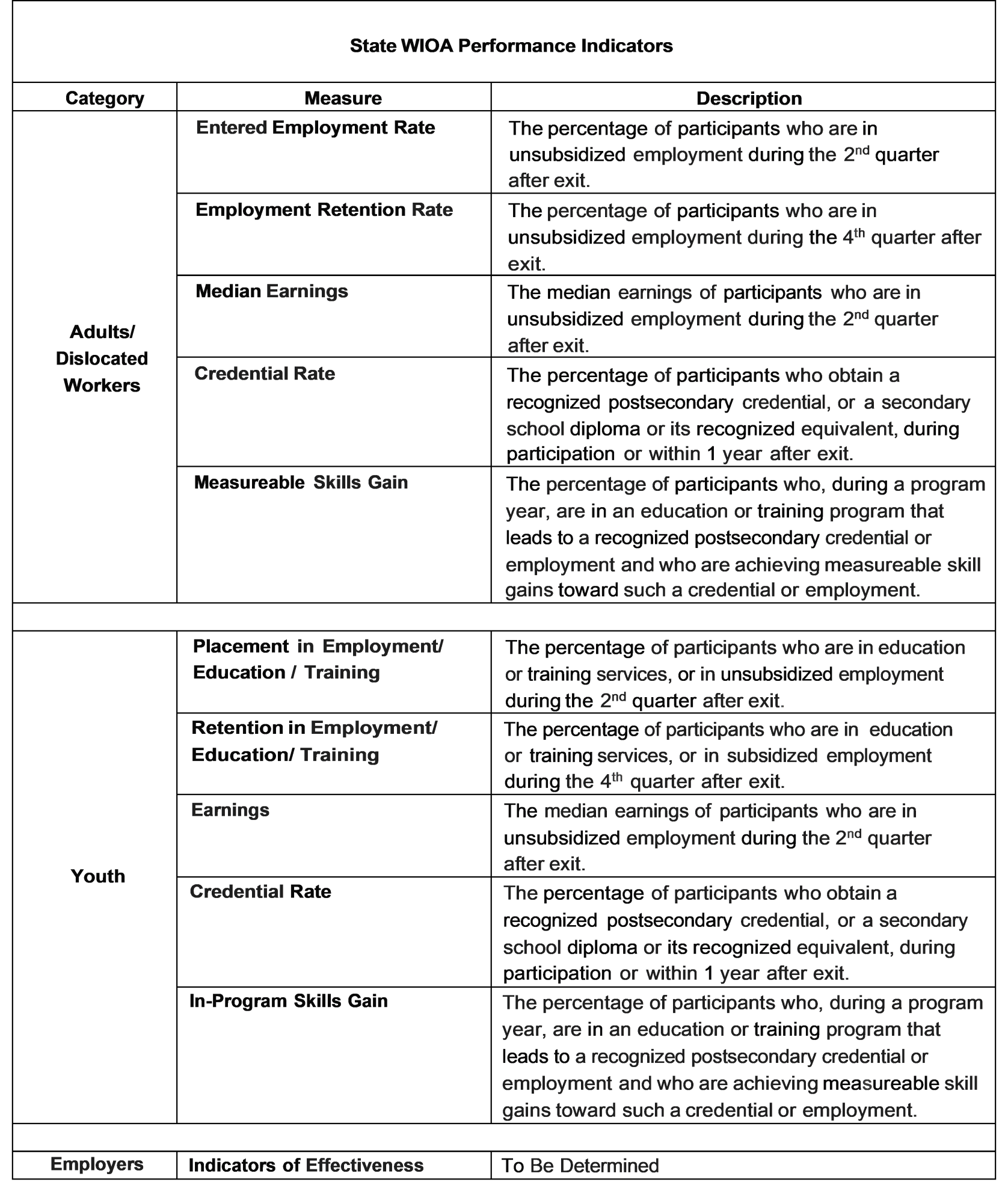
WIOA has established core performance indicators (See Table 1 on Next Page) to ensure that Federal investments in employment and training programs are accountable to job seekers, employers, customers, and taxpayers. This is a renewed system, which will ensure access for all individuals, of every skill level, the opportunity to pursue the skills, training, and education they need to obtain employment that will lead to financial stability and economic security for themselves and their families. Employers will also have the assurance that trained and qualified workers will be available to fill their current and future openings. Specifically related to this Youth Policy are the Youth Measures and Descriptions.
3. Action.
Local Workforce Development Areas/ Local Workforce Development Boards will follow this policy in regard to the selection of Youth Program Service Providers beginning with the procurement of Youth Services and Activities for WIOA programs beginning on or after April 1, 2016.
4. Contact.
Questions regarding this Directive should be referred to Bill Hornsby, Supervisor, Workforce Development Division, State Programs, Planning and Divisional Budget Management Section at (334) 242- 5847 or bill.hornsby@commerce.alabama.gov.
ALABAMA WORKFORCE INVESTMENT SYSTEM
Department of Commerce Workforce Development Division 401 Adams Avenue
Post Office Box 304103 Montgomery, Alabama 36103-4103
--------------------------------- GOVERNOR'S WORKFORCE INNOVATION DIRECTIVE NO. PY 2016-01
SUBJECT: Priority of Service for Basic Skills Deficient, Recipient of Public Assistance, Other Low-Income
1. Purpose.
To establish a policy for determining priority of services for adults receiving direct monetary services such as support services or training under the Workforce Innovation and Opportunity Act (WIOA).
2. Discussion.
WIOA section 134(c)(3)(E) establishes the need for the local Workforce Development Areas to have a system of priority for services to adults:
"With respect to funds allocated to a local area for adult employment and training activities... priority shall be given to recipients of public assistance, other low income individuals, and individuals who are basic skills deficient for receipt of career services...and training services. The appropriate local board and the Governor shall direct the one-stop operators in the local area with regard to making determinations related to such priority."
WIOA Implementing Regulations 680.600(b) requires States and local areas to establish criteria for providing priority to individualized career services and training with WIOA adult funds under Title I. The criteria may include other resources and funds for providing career and training-related services in the local workforce development area (LWDA), as well as other factors the LWDA determines appropriate.
WIOA 680.600(c) clarifies that while priority must be given under WIOA adult funds to low-income individuals, public assistance recipients, or individuals, who are basic skills deficient for individualized career services and training services, the Local Board and Governor my establish a process that also gives priority to other individuals.
A. Background
The Adult Program under Title I of WIOA provides workforce development services to adults to increase their employment, retention in employment and earnings and also support their occupational skill attainment and career advancement. Local workforce development boards are charged with strategic planning and oversight activities in support of workforce and economic development.
WIOA specifies that services for adults will be provided through One-Stop Career Centers. Service such as career guidance and workforce information may also be provided virtually. WIOA authorizes two types of service that are potentially available to job seekers:
- Career Services - includes outreach, job search and placement assistance, provision of labor market information, comprehensive assessments, development of individual employment plans, counseling and career planning, and other services specified in Section 134(c)(2)(A).
- Training Services - includes Occupational Skills Training, One-the-Job Training activities, Customized, Training, Individual Training Accounts, and other training services specified in Section 134(c)(3)(D).
Priority for both career and training services must be given recipients of public assistance, other low-income individuals, and individuals who are basic skills deficient in accordance with the federal requirement specified above.
Funds allocated for WIOA Dislocated Worker eligible individuals are not subject to this Policy.
B. Compliance with the Jobs for Veterans Act
The Alabama Workforce Development System will provide priority of services to veterans and eligible spouses, as specified in the Jobs for Veterans Act and its implementing regulations at 20CFR Part
101. When Veterans Priority is applied in conjunction with Priority of Services for WIOA Adult Program Participants, veterans and eligible spouses who are also recipients of public assistance, other low-income individuals, and individuals who are basic skill deficient will receive first priority. The second priority would be recipients of public assistance, other low-income individuals and individuals who are basic skills deficient who are not veterans or eligible spouses.
C. Local Board Requirements
Local Workforce Development Boards are required to develop and include in their local plan, policies that implement Priority of Services for WIOA Adult Program Participants for the One Stop Center and service delivery plan for the local training providers.
3. Action.
Each LWDA should take the appropriate measures to ensure compliance with the above-stated policy and amend local area plans to address the Priority of Services policy. The State Program Integrity Section is tasked with monitoring the LWDAs to ensure that Priority of Services policies are established and approved by local boards, as well as sample testing participant files for adherence to stated policies.
4. Contact.
Any questions should be referred to Melody Koorangi, Supervisor, Program Integrity Section, at (334) 242-5175 or by email at melody.koorangi@commerce.alabama.gov.
-----------------------------------ALABAMA WORKFORCE INVESTMENT SYSTEM
Alabama Department of Commerce Workforce Development Division 401 Adams Avenue
Post Office 304106 Montgomery, Alabama 36130-4106
GOVERNOR'S WORKFORCE INNOVATION DIRECTIVE NO. PY2015-08
SUBJECT: One-Stop Career Center Systems and One-Stop Delivery System Certification
1. Purpose.
To provide guidance, process and deadlines for the certification of One-Stop Career Centers and the One-Stop delivery system that is to be conducted by local workforce development boards, and to set criteria for the development of a local policy for one-stop certification.
2. Discussion.
The Workforce Innovation and Opportunity Act (WIOA) Section 121(e)(2)(A) states that each area must operate at least one comprehensive One-Stop Career Center. WIOA Section 134(c)(1)(i), states the State is responsible "to establish a One-Stop deliver system."
For Alabama to remain competitive in today's knowledge-based economy, its workforce system is critical. Workforce development and training systems must offer current workers and the emerging workforce opportunities to acquire world-class skills that meet employer demands, while increasing productivity. The workforce system must be comprehensive, flexible, innovative, employer-driven, customer-focused and performance-based. The workforce system must also respond to customer needs, and be adaptable to the rapid changes in the global economy. Technology will be used in the delivery of services to the extent it is feasible.
In an effort to ensure that the One-Stop system meets minimum quality standards, including the effective integration of services, pursuant to the Workforce Innovation and Opportunity act (WIOA) Section 121(b)(1)(A) and
(B) each entity that carries out a program or activities described at WIOA Section 121(b)(1)(B) (programs authorized under WIOA Title I-B; programs authorized under the Wagner-Peyser Act (29 U.S.C. 49 et seq.); adult education and literacy activities authorized under title 11; programs authorized under title I of the Rehabilitation Act of 1973 (29 U.S.C. 720 et seq.) (other than section 112 or part C of title I of such Act (29 U.S.C. 732, 741); activities authorized under title V of the Older Americans Act of 1965 (42 U.S.C. 3056 et seq.); career and technical education programs at the postsecondary level authorized under the Carl D. Perkins Career and Technical Education Act of 2006 (20 U.S.C. 2301 et seq.); activities authorized under chapter 2 of title II of the Trade Act of 1974 (19 U.S.C. 2271 et seq.); activities authorized under chapter 41 of title 38, United States Code; employment and training activities carried out under the Community Services Block Grant Act (42 U.S.C. 9901 et seq.); employment and training activities carried out by the Department of Housing and Urban Development; programs authorized under State unemployment compensation laws (in accordance with applicable Federal law); programs authorized under section 212 of the Second Chance Act of 2007 (42 U.S.C. 17532 et seq.); and (unless the
Governor notifies the Secretary of Labor) programs authorized under part A of title IV of the Social Security Act (42 U.S.C. 601 et seq.)), shall provide access through the One-Stop delivery system to such program or activities carried out by the entity.
Also as required at WIOA Section 121(e)(3) and consistent with Section 3(d) of the Wagner-Peyser Act and in order to improve service delivery, avoid duplication of services, and enhance coordination of services, including location of staff to ensure access to services in underserved areas, the Employment Service Offices in each state shall be co-located with One-Stop Career Centers established under the WIOA.
The Workforce Innovation and Opportunity Act (WIOA) specifies in Section 101(d)(6) and 121(g)(l) that the Governor (with assistance from the State WIOA Board) shall establish the minimum criteria for certification of One Stop Career Centers and the One-Stop delivery system. Certification is required to be done by local boards at least once every three (3) years in order for One-Stop Career Centers and the One-Stop delivery system to receive infrastructure funding pursuant to WIOA Section 121(h).
Certification Criteria - In order to be certified, One-Stop Career Centers and the One-Stop delivery system must meet or exceed the standards established for each of the following areas:
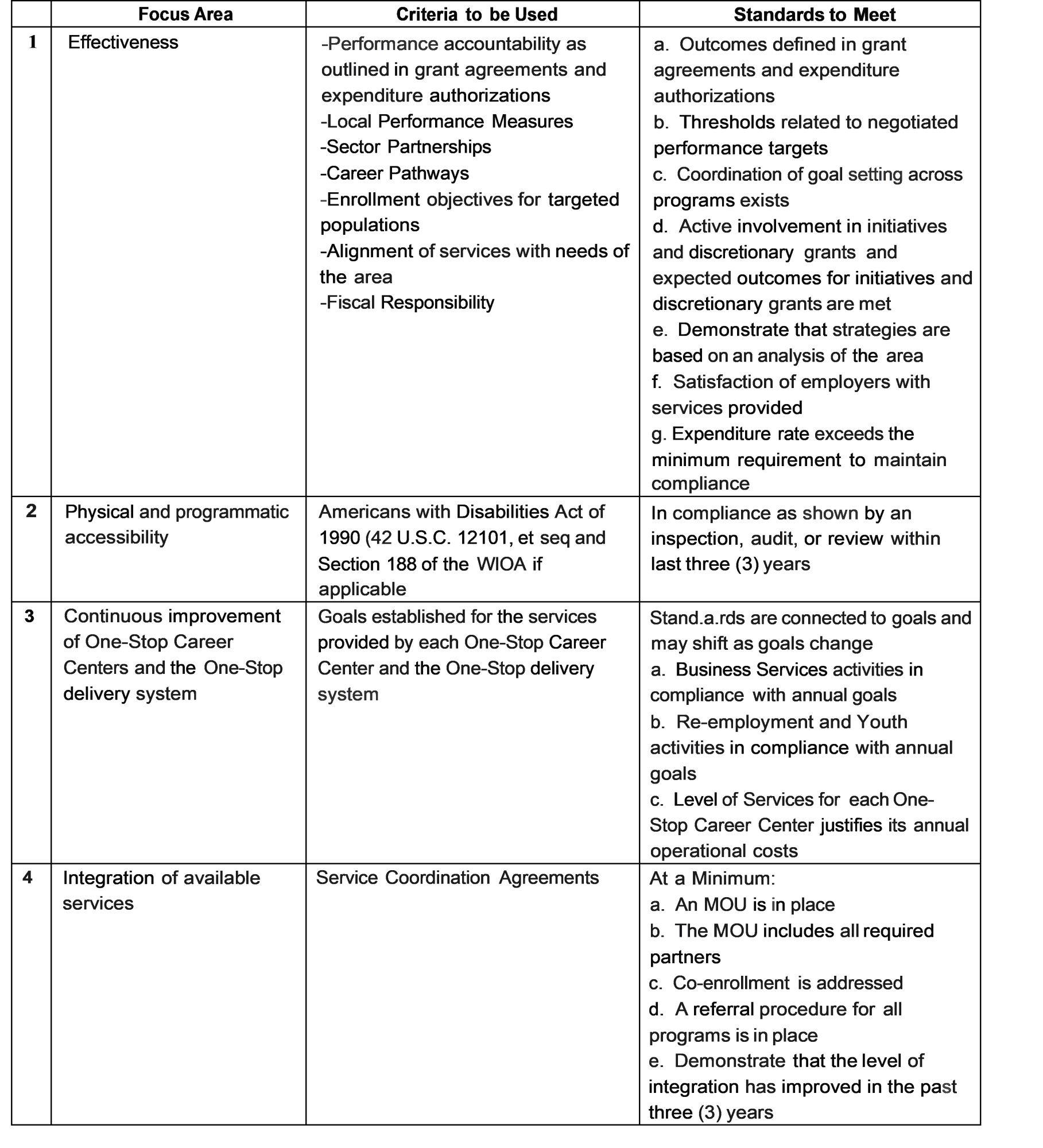
On an annual basis, the required partners in each local workforce area will work with the Commerce - Workforce Development Division to reach agreed upon levels of performance that apply to Focus Area 1 and with the Commerce - Workforce Development Division to reach agreed upon continuous improvement goals that apply to Focus Area 3.
The chair of the local board shall be copied on all local plan quarterly and annual reports provided to Commerce - Workforce Development Division so that the Commerce - Workforce Development Division can maintain data on an ongoing basis. At the request of a local board, when it engages in the certification process for the One-Stop Career Centers and the One-Stop delivery system, the Commerce -Workforce Development Division will provide to the local board a summary of the performance data that has been provided to the Commerce - Workforce Development Division on the above criteria. The state agencies of required partners shall forward quarterly or annual reports to the Commerce - Workforce Development Division so that data on partner programs can be maintained and shared with local boards during the assessment process. Local boards should contact Commerce - Workforce Development Division to obtain information on WIOA performance measurements.
Local boards are responsible for assessing the One-Stop Career Centers and the One-Stop delivery system with these criteria and submitting a record of the assessment and certification determination to Commerce - Workforce Development Division within 10 days of completing the certification determination.
Local boards are required to have policies and procedures in place for assessing the One-Stop Career Centers and the One-Stop delivery system. This Directive requires local workforce boards to develop policies and procedures by May 1, 2016. The policies and procedures:
Must include the criteria outlined within this Directive;
May include additional criteria beyond the items outlined in this policy;
Must be submitted to the Commerce - Workforce Development Division for review prior to approval by the local board;
Will be incorporated into the compliance review procedures conducted by the State Program Integrity Unit.
3. Action.
Certification should be completed by the local board prior to the beginning of the second program year under WIOA, which is July 1, 2016, and at least every three (3) years thereafter.
A statement of certification must be submitted as a component of the local plan. If certification is not completed within the required timeframes, the One-Stop Career Centers and the One-Stop delivery system become ineligible to receive infrastructure funding from partners or the state funds for those areas that utilize the state infrastructure funding mechanism. When the Commerce - Workforce Development Division receives the record of the certification determination, it will be reviewed and a statement will be issued that acknowledges that a local board has certified the One-Stop operator and that the operator is eligible to receive infrastructure funding.
4. Contact.
Questions regarding this Directive should be referred to Bill Hornsby, Supervisor, Workforce Development Division, State Programs, Planning and Divisional Budget Management Section at (334} 242-5847 or bill.hornsby@commerce.alabama.gov.
------------------------------------ALABAMA WORKFORCE INVESTMENT SYSTEM
Alabama Department of Commerce Workforce Development Division 401 Adams Avenue
Post Office 304106
Montgomery, Alabama 36130-4106
April 2, 2020
GOVERNOR'S WORKFORCE INNOVATION DIRECTIVE NO. PY2015-08, Change 01
SUBJECT: One-Stop Career Center Systems and One-Stop Delivery System Certification
1. Purpose.
To provide guidance and the deadline for the certification of One-Stop Career Centers and the One-Stop delivery system that is to be conducted by local workforce development boards for the Program Year 2019 through Program Year 2021three-year period.
2. Discussion.
The Workforce Innovation and Opportunity Act (WIOA) Section 121(e)(2)(A) states that each area must operate at least one comprehensive One-Stop Career Center. Additional comprehensive One-Stop Career Centers and affiliate Career Centers are also allowed. WIOA Section 134(c)(l)(i), states the State is responsible "to establish a One-Stop delivery system." Certification of One-Stop Career Centers and the One-Stop Delivery System is required to be done by local boards at least once every three (3) years in order for them to receive infrastructure funding pursuant to WIOA Section 12l(h).
During Program Year (PY) 2016, each local workforce development board developed certification standards based on the Certification Criteria issued in Governor's Workforce Innovation Directive (GWID) PY2015-08 and received approval from the Alabama Department of Commerce Workforce Development Division, to use the standards they developed. Local areas certified One-Stop Career Centers and their One-Stop Delivery Systems for the PY 2016 through PY 2018 three-year period. Each local workforce development area must recertify its respective One-Stop Career Centers and One-Stop Delivery System for the PY 2019 through PY 2021three-year period.
Local Workforce Development Areas should use their current Certification Processes and Procedures previously approved by the Alabama Department of Commerce Workforce Development Division to certify their One-Stop Career Centers and One-Stop Delivery System. If certain criteria on the certification form does not apply to an affiliate site, include a notation (N/A) on the form. Please note that every Career Center location, including both comprehensive and affiliate (satellite and itinerant) sites, must be certified in accordance with TEGL NO. 16-16.
3. Action.
Due to the ongoing COVID-19 cr1s1s, the time period to complete certifications is being extended past the ending date of PY19 (June 30, 2020), which is when they currently are due. Certifications should now be completed by the local board and submitted to the State Program Integrity Section no later than October 30, 2020.
Statements of certification must be submitted as a component of the local area plan in PY 2021. If the certifications are not completed within the required timeframes, the local area becomes ineligible to receive infrastructure funding from partners or state set-aside funds for those areas that utilize the state infrastructure funding mechanism. When the State Program Integrity Section receives statements of certification, they will be reviewed, and a letter will be issued that acknowledges a local board has certified its Career Centers and is eligible to receive infrastructure funding.
4. Contact.
Questions regarding this Directive should be referred to Jan Dame, Workforce Development Division, State Program Integrity Section at (334) 242-5175 or jan.dame@commerce.alabama.gov.
5. References.
• Governor's Workforce Innovation Directive No. PY 2015-08, January 21, 2016.
• Training and Employment Guidance Letter One-Stop Operating Guidance for WIOA No. 16-16, January 18, 2017.