


Located in:
- Program-specific Requirements for Adult, Dislocated Worker, and Youth Activities under Title I-B
The Unified or Combined State Plan must include the following with respect to activities carried out under subtitle B—
e. Waiver Requests (optional) (e1-e6)
States wanting to request waivers as part of their title I-B Operational Plan must include a waiver plan that includes the following information for each waiver requested:
1. Identifies the statutory or regulatory requirements for which a waiver is requested and the goals that the State or local area, as appropriate, intends to achieve as a result of the waiver and how those goals relate to the Unified or Combined State Plan;
2. Describes the actions that the State or local area, as appropriate, has undertaken to remove State or local statutory or regulatory barriers;
3. Describes the goals of the waiver and the expected programmatic outcomes if the request is granted;
4. Describes how the waiver will align with the Department’s policy priorities, such as:
A. Supporting employer engagement;
B. Connecting education and training strategies;
C. Supporting work-based learning;
D. Improving job and career results, and
E. Other guidance issued by the department.
5. Describes the individuals affected by the waiver, including how the waiver will impact services for disadvantaged populations or individuals with multiple barriers to employment; and
6. Describes the processes used to:
A. Monitor the progress in implementing the waiver;
B. Provide notice to any local board affected by the waiver;
C. Provide any local board affected by the waiver an opportunity to comment on the request;
D. Ensure meaningful public comment, including comment by business and organized labor, on the waiver.
E. Collect and report information about waiver outcomes in the State’s WIOA Annual Report.
7. The Secretary may require that States provide the most recent data available about the outcomes of the existing waiver in cases where the State seeks renewal of a previously approved waiver.
Current Narrative:
Waiver Request #1
Waiver Request
1. The statutory and/or regulatory requirements the State would like to waive:
WIOA Section 129(a)(4)(A) and 20 CFR 681.410; Missouri is requesting to waive the requirement that states and local areas expend 75 percent of all Governor’s reserve and local formula youth funds on out-of-school youth based on school status. Missouri is requesting that this percentage be lowered to 50 percent for both local and statewide funded activities for PY’22 & PY ‘23 funds.
2. Actions the State has undertaken to remove State or local barriers:
There are currently no state or local statutory or regulatory barriers to implementing the requested waiver. The state of Missouri regulations, policy guidance and issuances are in compliance with federal law.
3. A discussion of how the waiver complements Department of Labor priorities (i.e. expansion of apprenticeship, improved employer engagement, etc.);
The State of Missouri is a lead state in the nation for its apprenticeship programs. Missouri supports the registered apprenticeship program and continues to expand the program with statewide funds and other grants. The Department of Higher Education and Workforce Development has pledged to support opportunities for students and workers in high growth industries in the state including the healthcare, information technology, and advanced manufacturing sectors by engaging youth and providing opportunities in work-based learning, training, and other workforce services.
The Office of Workforce Development (OWD) and the Missouri Department of Elementary and Secondary Education (DESE) continue to develop apprenticeship opportunities for youth and young adults aged sixteen and older. Both pre-apprenticeships and registered apprenticeships allow high school junior and seniors to simultaneously further education options and earn wages. Youth apprentices face a lower risk of dropping out of high school, and are engaged in a transition to post-secondary education. The Missouri Research and Information Center (MERIC) has found that job openings that require education and skill level beyond high school are in high growth occupational fields and pay higher salaries.
With the approval of this waiver, the State of Missouri and Local Workforce Development Boards will have the flexibility to utilize federal funding to increase the number of youth and young adults enrolled in services such as pre-apprenticeship and apprenticeship activities. Local Boards and youth staff will also have the ability to provide the comprehensive services needed and personal contact required to ensure student success.
4. Quantifiable projected programmatic outcomes resulting from implementation of the waiver;
The goals and outcomes previously set for this waiver were:
- Establish pre-apprenticeship with Missouri High Schools and Career and Technical Education (CTE) programs: Average 2 pre-apprenticeship programs per school year. We currently are working with the CTE’s to establish pre-apprenticeships through the Missouri Apprentice Ready program which is funded with WIOA Statewide funds. The programs are being developed and enrollments are planned to start in the fall of 2022. Industries will include: welding, equipment operator (Associated General Contractors), etc.
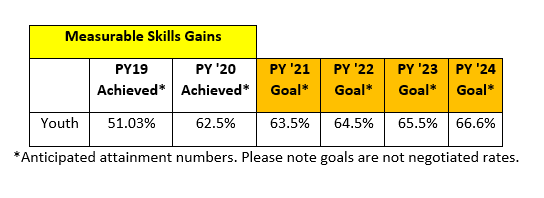
- Increase in measurable skills gains for the In-School (IS) students based off PY’20 achieved measures: Year 1-1%: Year 2-2%; Year 3 3%; & Year 4-4%;
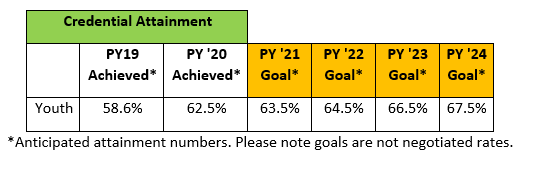
- Increase obtainment of industry recognized credentials for high school youth based off PY’20 achieved measures: Year 1-1%: Year 2-2%; Year 3 3%; & Year 4-4%;
This waiver request provides the Local Workforce Development Boards (LWDBs) the flexibility to serve more youth and young adults in work-based learning and the apprenticeship model regardless of school status. It facilitates the provision of the necessary funding and the ease of current regulations essential to designing programs that will aid youth and youth adults in the preparation for long-term participation in the Missouri labor force. Economic growth in Missouri and its high-growth industries will be sustained with the infusion of skilled workers ready to fill current job openings and adequately trained for future openings.
5. Individuals, groups or populations benefitting from the waiver or otherwise impacted by the waiver from the waiver;
This waiver request will provide Local Workforce Development Boards (LWDBs) the flexibility to serve more youth and young adults in work-based learning and the apprenticeship model regardless of school status. It will facilitate the provision of the necessary funding and the ease of current regulations essential to designing programs that will aid youth and youth adults in the preparation for long-term participation in the Missouri labor force. Economic growth in Missouri and its high-growth industries will be sustained with the infusion of skilled workers ready to fill current job openings and adequately trained for future openings.
Missouri students and eligible youth population, Missouri’s employers and high-growth industries will benefit from this waiver.
6. How the State plans to monitor waiver implementation, including collection of waiver outcome information:
Once the waiver is approved, OWD will issue guidance on the waiver which will include a mandatory reporting process for the Workforce Development Boards (WDBs) that request and utilize the specific waiver. The reporting at a minimum will require the WDBs monitor the waiver and the utilization and submit quarterly reports to the state regarding enrollments that impact the waiver; outcomes of the trainings received; and the impact it has had on enrollments and WIOA metrics. The implementation and progress of the waiver utilization will be reviewed at a minimum, quarterly by programmatic, compliance, and fiscal staff with technical assistance being providing if needed.
In addition to the quarterly reports submitted by the Workforce Development Boards, OWD units will utilize the state’s electronic case management system (MoJobs) to verify customer enrollments and outcomes. OWD’s financial monitoring will utilize the Financial Reporting System (FRS) to monitor expenditures and lines items applicable to the waiver.
Waiver Request #2
1. The statutory and/or regulatory requirements the State would like to waive:
20 CFR 681.550: Missouri is requesting a waiver to allow local areas and the state to provide in-school youth, ages 16-21 with Individual Training Accounts (ITAs). This will allow Missouri to collaborate with education to prepare students for employment or college post-graduation.
2. Actions the State has undertaken to remove State or local barriers:
There are currently no state or local statutory or regulatory barriers to implementing the requested waiver. The state of Missouri regulations, policy guidance and issuances are in compliance with federal law.
3. State strategic goal(s) and Department of Labor priorities (i.e. expansion of apprenticeship, improved employer engagement, etc.) supported by the waiver:
Missouri would like to waive this requirement in order to allow ITAs for out of school youth and expand the flexibility to in-school youth, ages 16-21. This will expand training options and allow these youth to explore career pathways and assist them with making good career decisions.
4. Projected programmatic outcomes resulting from implementation of the waiver:
The goals and outcomes for this waiver are to:
- Establish pre-apprenticeship with Missouri High Schools and Career and Technical Education (CTE) programs: Average 2 pre-apprenticeship programs per school year. We currently are working with the CTE’s to establish pre-apprenticeships through the Missouri Apprentice Ready program which is funded with WIOA Statewide funds. The programs are being developed and enrollments are planned to start in the fall. Industries will include: welding, equipment operator (Associated General Contractors), etc.
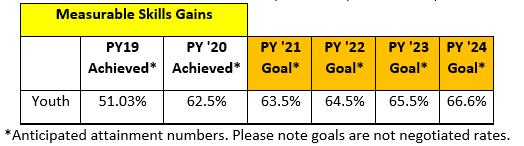
- Increase in measurable skills gains for the In-School (IS) students based off PY’20 achieved measures: Year 1-1%: Year 2-2%; Year 3 3%; & Year 4-4%;
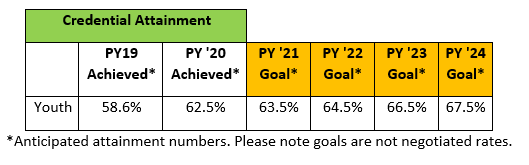
- Increase obtainment of industry recognized credentials for high school youth based off PY’20 achieved measures: Year 1-1%: Year 2-2%; Year 3 3%; & Year 4-4%;
5. Individuals, groups or populations benefitting from the waiver:
This waiver will benefit the WIOA in-school population, ages 16-21, which includes disadvantaged youth and youth with multiple barriers to employment.
6. How the State plans to monitor waiver implementation, including collection of waiver outcome information:
Once the waiver is approved, OWD will issue guidance on the waiver which will include a mandatory reporting process for the Workforce Development Boards (WDBs) that request and utilize the specific waiver. The reporting at a minimum will require the WDBs monitor the waiver and the utilization and submit quarterly reports to the state regarding enrollments that impact the waiver; outcomes of the trainings received; and the impact it has had on enrollments and WIOA metrics. The implementation and progress of the waiver utilization will be reviewed at a minimum, quarterly by programmatic, compliance, and fiscal staff with technical assistance being providing if needed.
In addition to the quarterly reports submitted by the Workforce Development Boards, OWD units will utilize the state’s electronic case management system (MoJobs) to verify customer enrollments and outcomes. OWD’s financial monitoring will utilize the Financial Reporting System (FRS) to monitor expenditures and lines items applicable to the waiver.
Waiver Request #3
1. The statutory and/or regulatory requirements the State would like to waive:
WIOA 134(c)(3)(H)(i) and 20 CFR 680.720(b) , Waiver to increase on-the-job training employer reimbursement up to 90 percent for businesses.
2. Actions the State has undertaken to remove State or local barriers:
There are currently no state or local statutory or regulatory barriers to implementing the requested waiver. The state of Missouri regulations, policy guidance and issuances are in compliance with federal law.
3. State strategic goal(s) and Department of Labor priorities (i.e. expansion of apprenticeship, improved employer engagement, etc.) supported by the waiver:
The State of Missouri will utilize this waiver to offer businesses with work-based learning opportunities to re-establish their workforce and provide job seekers the opportunity to re-connect with the workforce and learn skills to re-establish self-sufficiency after the COVID-19 pandemic.
4. Projected programmatic outcomes resulting from implementation of the waiver:
This waiver request will assist Missouri to further enhance its existing efforts designed to establish a talent pipeline that will address the labor market needs of local Missouri businesses.
Since July 2019, 124 OJT participants have been served so far under the OJT waivers duration. Staff continue to market OJT as WIOA programmatic support for apprenticeship. The availability of the OJT and IWT waivers has increased interest for work-based learning and sustained program development throughout the pandemic.
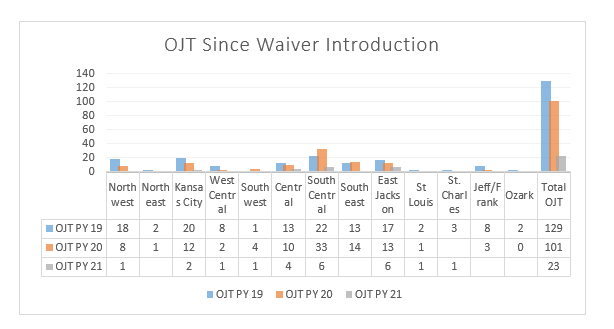
The goal is to increase the number of OJT’s being utilized by 10%, using PY’19 as the baseline.
5. Individuals, groups or populations benefitting from the waiver:
This waiver request will provide Local Workforce Development Boards (LWDBs) the flexibility to work with businesses in their community, and assist job seekers with barriers to employment including those that lost their jobs due to the COVID-19 pandemic.
6. How the State plans to monitor waiver implementation, including collection of waiver outcome information:
Once the waiver is approved, OWD will issue guidance on the waiver which will include a mandatory reporting process for the Workforce Development Boards (WDBs) that request and utilize the specific waiver. The reporting at a minimum will require the WDBs monitor the waiver and the utilization and submit quarterly reports to the state regarding enrollments that impact the waiver; outcomes of the trainings received; and the impact it has had on enrollments and WIOA metrics. The implementation and progress of the waiver utilization will be reviewed at a minimum, quarterly by programmatic, compliance, and fiscal staff with technical assistance being providing if needed.
In addition to the quarterly reports submitted by the Workforce Development Boards, OWD units will utilize the state’s electronic case management system (MoJobs) to verify customer enrollments and outcomes. OWD’s financial monitoring will utilize the Financial Reporting System (FRS) to monitor expenditures and lines items applicable to the waiver.
___________________________________________________________________________
Waiver Request #4
1. The statutory and/or regulatory requirements the State would like to waive:
WIOA 134(d)(4) and 20 CFR 680.800(a) We are requesting the ability of the local areas to reserve more than 20% of Adult and Dislocated Worker funds for incumbent worker training
2. Actions the State has undertaken to remove State or local barriers:
There are currently no state or local statutory or regulatory barriers to implementing the requested waiver. The state of Missouri regulations, policy guidance and issuances are in compliance with federal law.
3. State strategic goal(s) and Department of Labor priorities (i.e. expansion of apprenticeship, improved employer engagement, etc.) supported by the waiver:
In an effort to assist employers with recovering from the impact of the COVID-19 pandemic, the State of Missouri is requesting this waiver to allow the local areas the flexibility to work with businesses avert potential layoffs as a result of the effects of the pandemic and to allow the workers that remain with the business the opportunity to maintain employment and advance to higher-skilled positions that were vacated.
4. Projected programmatic outcomes resulting from implementation of the waiver:
The use of these strategies will increase skills for underemployed workers in an effort to advance these workers to more skilled positions with the same employer or industry sector leading to an increase in earnings through more work hours or an increase in pay.
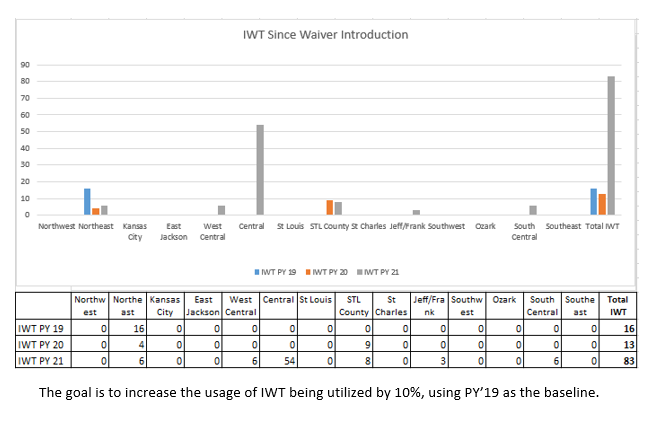
The availability of Incumbent Worker Training participation has increased over the past three years from one region to seven regions and 31 IWT projects. IWT training for this year (PY22) is now being delivered to an all-time high of 181 participants throughout Missouri and has been increasing regularly. Since the first quarter of FY21 OWD’s Work Based Learning Coordinator has ran a cohort of learning for Local Workforce Development Board (LWDB) Directors. They meet monthly and are provided with technical assistance on work-based learning and apprenticeship.
5. Individuals, groups or populations benefitting from the waiver:
This waiver request will provide Local Workforce Development Boards (LWDBs) the flexibility to work with businesses in their community to re-build their workforce and possibly alleviate business closures and lay-off. It will also provide an opportunity for incumbent workers to retain employment and upgrade skills.
6. How the State plans to monitor waiver implementation, including collection of waiver outcome information:
Once the waiver is approved, OWD will issue guidance on the waiver which will include a mandatory reporting process for the Workforce Development Boards (WDBs) that request and utilize the specific waiver. The reporting at a minimum will require the WDBs monitor the waiver and the utilization and submit quarterly reports to the state regarding enrollments that impact the waiver; outcomes of the trainings received; and the impact it has had on enrollments and WIOA metrics. The implementation and progress of the waiver utilization will be reviewed at a minimum, quarterly by programmatic, compliance, and fiscal staff with technical assistance being providing if needed.
In addition to the quarterly reports submitted by the Workforce Development Boards, OWD units will utilize the state’s electronic case management system (MoJobs) to verify customer enrollments and outcomes. OWD’s financial monitoring will utilize the Financial Reporting System (FRS) to monitor expenditures and lines items applicable to the waiver.