



Located in:
- Program-Specific Requirements for Wagner-Peyser Program (Employment Services)
All Program-Specific Requirements provided for the WIOA core programs in this section must be addressed for either a Unified or Combined State Plan.
e. 6. C. Data Assessment
Review the previous four years Wagner-Peyser data reports on performance. Note whether the State has been meeting its goals to provide MSFWs quantitatively proportionate services as compared to non-MSFWs. If it has not met these goals, explain why the State believes such goals were not met and how the State intends to improve its provision of services in order to meet such goals.
Current Narrative:
Ohio has taken steps to ensure that services to Migrant and Seasonal Farm Workers are qualitatively equivalent and quantitatively proportionate to those provided to non-Migrant and Seasonal Farm Workers.
The State Monitor Advocate (SMA) collects statewide participant information on a quarterly basis from an automated data collection system, BIC Cognos, to determine if the state’s MSFWs are referred to the full range of employment opportunities, training programs, testing, counseling and career guidance services. The automated reports are compared to the daily logs reported by the outreach specialists to ensure accuracy.
In addition, Ohio’s performance reporting process takes this a step further. Reports submitted to U.S. Department of Labor on program activity and performance outcomes provide a comparison of the service indicators of the MSFW and non-MSFW registrants. Ohio’s statewide performance reports are as follows:
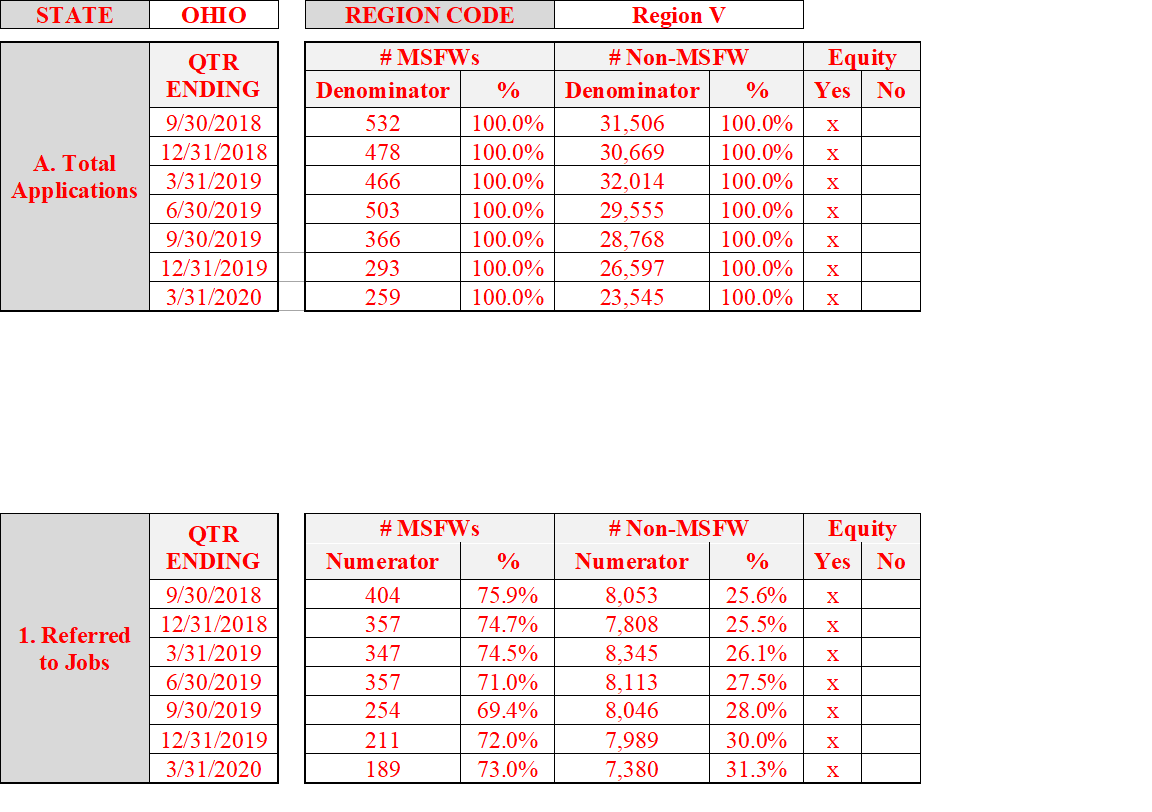
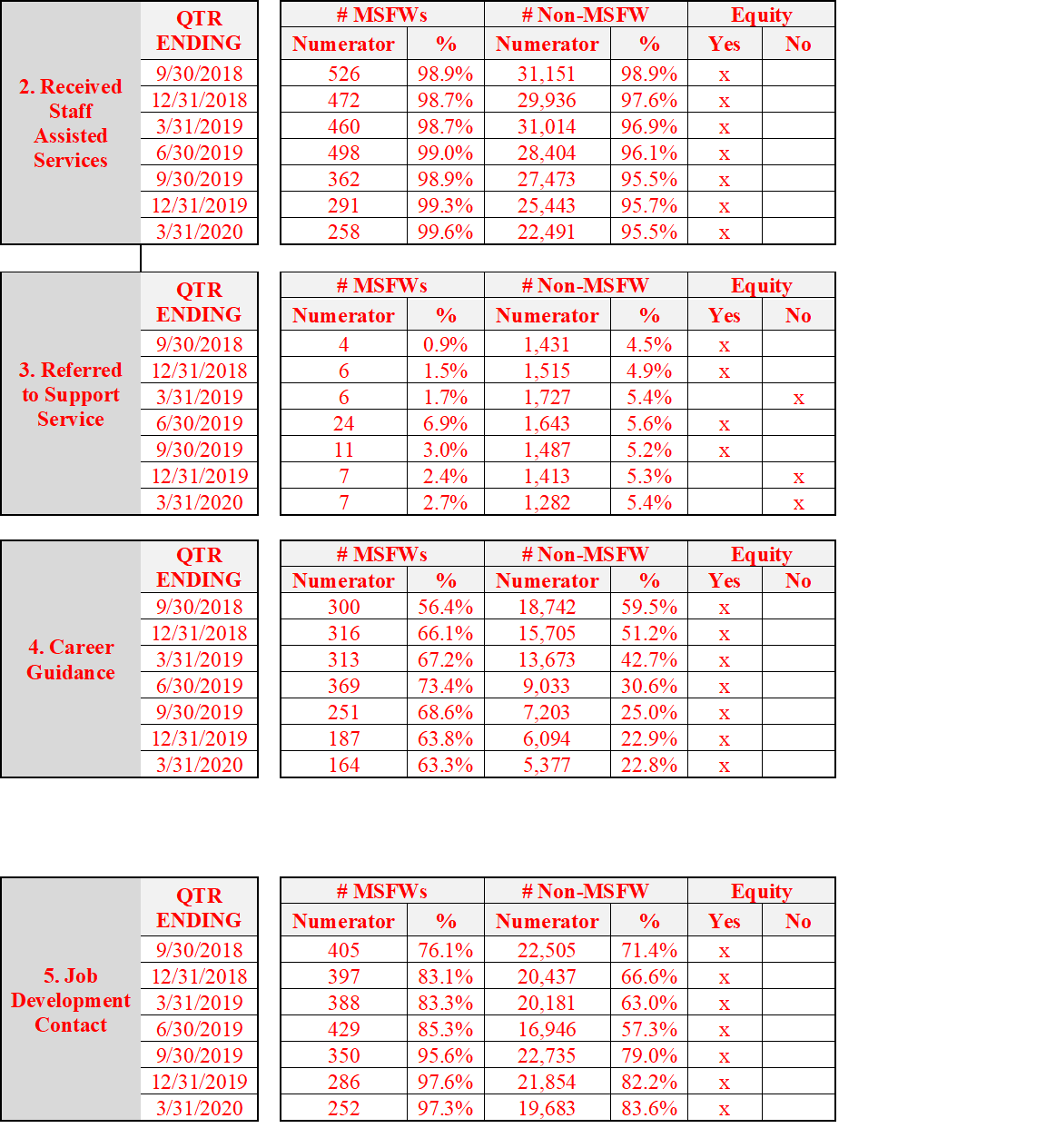
Ohio consistently meets 4 out of 5 equity indicators. Enhancements to the system of record, OWCMS and its successor, ARIES, have been deployed to easily identify, distinguish and annotate the migrant and seasonal farmworkers. This feature allows all staff working with this population to better record the services provided, giving a true depiction of the services landscape. Outreach specialists and local workforce development areas were provided training on how to capture special populations and a deployment document was distributed to all OWCMS users.
Technology has been added to the resources available for the outreach specialist. Surface Pros are used by staff in the field to aid in data collection. The staff can capitalize on the available technology to better track and report services occurring in remote locations away from state office facilities.
The SMA ensures all data captured and reported are accurate. In addition, physical monitoring of the four significant MSFW offices are conducted for deficiencies, problems, or improper practices.