



Located in:
- Senior Community Service Employment Program (SCSEP)
(OMB Control No. 1205-0040)
a. 3. Discuss current and projected employment opportunities in the State (such as by providing information available under §15 of the Wagner-Peyser Act (29 U.S.C. 491-2) by occupation), and the types of skills possessed by eligible individuals. (20 CFR 641.325(c))
Current Narrative:
SCSEP will continue to work with One-Stop Career Centers to ensure seniors have access to full portfolio of services available to them, as well as to the most current information about employment opportunities and related skill requirements.
The charts below reflect projected employment opportunities in New Jersey through 2026.
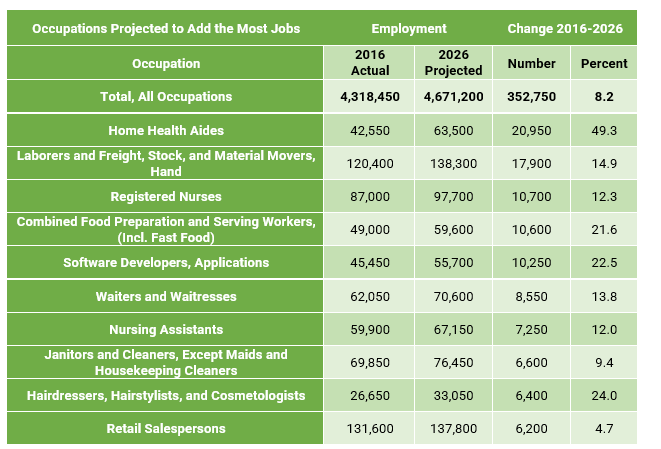
The above chart projects job top ten demand through 2026 and is used to indicate opportunities for the older workers. In pure numbers, Home Health Aides show the most potential growth with projected openings of over 20,000, a growth of almost half in that position. Other areas of growth include Laborers where close to 18,000 openings are projected .Also above 10,000 new opportunities during the period will be provided in areas including Registered Nurses, Food Preparation and Serving and Software Developers, Applications offering opportunities at different education/skill levels. Other projected jobs in demand include Table waiting, nursing assistants, janitors and cleaners, hair styling and retail sales.
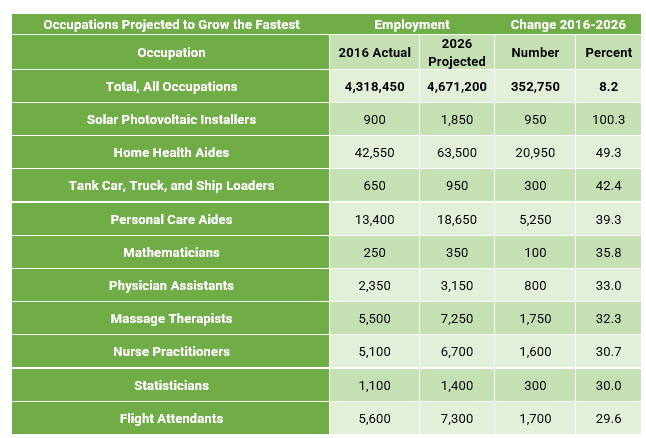
Similar to the above list for largest growth, the above chart details fastest growing opportunities through 2026. Similar to the prior chart, this one also sees Hone Health Aide at the top of the list with over 20,000 openings. Personal Care Aides see a need to fill over 5200 positions in the period while flight attendants, massage therapist and nurse practitioners are eat 1600 or higher. Other making this fastest growing list include solar photovoltaic installers; Tank Car, Tuck and Ship Loaders; mathematicians; physician attendants; and, statisticians.
SCSEP staff report the following skill profiles for SCSEP participants:
- Low levels of education: The majority of SCSEP participants have low levels of education. Of all the SCSEP participants, 48 percent have a high school diploma or equivalent and 16percent have a 9th grade -11th grade education, making it very difficult for them to obtain unsubsidized employment opportunities in New Jersey’s highly skilled job market. Additionally, 40 percent of participants enroll in the SCSEP program after using WIA Title 1 services and failing to find employment.
- Computer illiteracy: In addition to low levels of education and income below the poverty level, the majority of participants lack computer skills or have very low computer skill levels that were acquired prior to all the advancements made in technology. Increasing computer skills or updating computer skills is necessary to help participants obtain and retain employment.
- Poor employment history and skill gaps: Most participants have poor employment history and skill gaps from the time they were last employed to the time they seek help from SCSEP to re-enter the workforce. Thus, 96 percent of participants have low employment prospects.
- Homeless or At-Risk for Homelessness: Most participants do not have stable or suitable housing and are very transient. Thus, making it difficult for them to obtain and retain employment as their home situation is often unstable. Thus, 77 percent of all participants are homeless or at-risk for homelessness.
- Late-onset physical limitations: Many participants have physical or other health limitations that prohibit or impair their ability to perform physical duties.
- Cognitive, mental or behavioral health needs: Participants with more complex mental or behavioral health needs, cognitive impairment or trauma impacted have additional barriers to employment. Additionally, the number of participants impacted by opioids continues to increase.
In light of this and the above profile, NJ SCSEP will target employment opportunities for participants within the following occupations: Home Health Aide, Combined Food Preparation, Janitors/Cleaners, Retail Salespersons. Based on participant IEPs, staff will provide training and recruit host agencies that will enhance their education and computer literary skills. Additionally, program staff will continue to work to:
- Identify available jobs, training, or certifications adequate for seniors;
- Assess participant skills and interests and place them into relevant training;
- Target senior friendly host sites and employers; and
- Promote on-the-job experience (OJEs) with private industries.