



Located in:
- II. Strategic Elements
The Unified or Combined State Plan must include a Strategic Planning Elements section that analyzes the State’s current economic environment and identifies the State’s overall vision for its workforce development system. The required elements in this section allow the State to develop data-driven goals for preparing an educated and skilled workforce and to identify successful strategies for aligning workforce development programs to support economic growth. Unless otherwise noted, all Strategic Planning Elements apply to Combined State Plan partner programs included in the plan as well as to core programs. Where requirements identify the term “populations”, these must include individuals with barriers to employment as defined at WIOA Section 3. This includes displaced homemakers; low-income individuals; Indians, Alaska Natives, and Native Hawaiians; individuals with disabilities, including youth who are individuals with disabilities; older individuals; ex-offenders; homeless individuals, or homeless children and youths; youth who are in or have aged out of the foster care system; individuals who are English language learners, individuals who have low levels of literacy, and individuals facing substantial cultural barriers; farmworkers (as defined at section 167(i) of WIOA and Training and Employment Guidance Letter No. 35-14); individuals within 2 years of exhausting lifetime eligibility under the Temporary Assistance for Needy Families program; single parents (including single pregnant women); and long-term unemployed individuals. Additional populations include veterans, unemployed workers, and youth, and others that the State may identify.
- a. Economic, Workforce, and Workforce Development Activities Analysis
The Unified or Combined State Plan must include an analysis of the economic conditions, economic development strategies, and labor market in which the State’s workforce system and programs will operate.
- a. Economic, Workforce, and Workforce Development Activities Analysis
II. a. 1. A. Economic Analysis
The Unified or Combined State Plan must include an analysis of the economic conditions and trends in the State, including sub-State regions and any specific economic areas identified by the State. This must include—
i. Existing Demand Industry Sectors and Occupations
Provide an analysis of the industries and occupations for which there is existing demand.
ii. Emerging Demand Industry Sectors and Occupations
Provide an analysis of the industries and occupations for which demand is emerging.
iii. Employers’ Employment Needs
With regard to the industry sectors and occupations identified in (A)(i) and (ii), provide an assessment of the employment needs of employers, including a description of the knowledge, skills, and abilities required, including credentials and licenses.
Current Narrative:
i. Existing Demand Industry Sectors and Occupations
The Department of Workforce Solutions Economic Research and Analysis Bureau undertook the assessment of the state’s industry and occupational demand through an analysis of existing data, including current employment trends, industry, and occupational projections, worker credentialing, and feedback from the state’s employers. From the beginning of Governor Lujan Grisham’s Administration in January 2019 to June 2023, New Mexico added approximately 34,500 net jobs, with all gains occurring in the private sector (up 34,800 jobs, or 5.3 percent). Although the state’s rate of total job growth (4.1 percent) was less than that of the nation (6.1 percent), New Mexico’s rate of private sector job growth outpaced by the U.S. (7.1 percent vs. 5.3 percent, respectively).
The largest occupational group in New Mexico was office and administrative support, with a 14.2 percent share of total employment, for a total of 116,000 jobs. With 76,580 jobs, food preparation and serving related was the next largest occupational group, with an employment share of 9.4 percent. Other large occupational groups include sales and related (8.2 percent), transportation and material moving (7.5 percent), healthcare support (6.6 percent), construction and extraction (6.5 percent), and education, training, and library (6.0 percent).
ii. Emerging Demand Industry Sectors and Occupations.
At the outset, this Plan recognizes that traditional employment projections may not keep pace with the rapidly changing economy of New Mexico. By virtue of their methodology, the projections discussed in this section do not take into account massive investments in education, healthcare and infrastructure that began in 2020 and continue to the current time. They also do not consider the emergence of new industries, such as alternative energy and advanced manufacturing. That said, these projections do follow the historical methodology of the New Mexico WIOA State Plan and are helpful from that perspective.
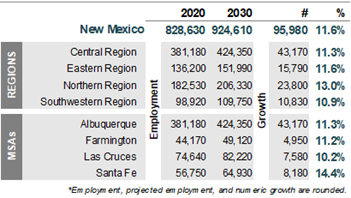
New Mexico’s 2020 employment of 828,630 is projected to grow to 924,610 by 2030. This increase represents an additional 95,980 jobs and 11.6 percent growth. (Estimates, projection, and numeric growth are rounded.) As shown in Exhibit 1, of the state’s four workforce regions, the Northern Region is projected to experience the highest percentage growth (13.0 percent). Growth in the Santa Fe Metropolitan Statistical Area (MSA, 14.4 percent) is anticipated to be the primary driver of that region’s growth. The MSA also has the highest projected percentage growth of the state’s four MSAs. The largest numeric growth is, unsurprisingly, anticipated to occur in the state’s most populated region (Central) and MSA (Albuquerque). Percentage growth in the Eastern region is equal to growth statewide. The Southwestern Region trails with growth of 10.9 percent.
As illustrated in Exhibit 2, about half of all projected employment growth is anticipated to occur in just three industry sectors—accommodation and food services (24,010 jobs, or 31.8 percent growth), health care and social assistance (22,400 jobs, or 16.8 percent growth), and arts, entertainment, and recreation (10,050 jobs, or 118.4 percent growth). The percentage growth of these three sectors exceeds the all-industry average of 11.6 percent. Four other sectors have percentage growth above the all-industry average, including professional, scientific, and technical services (7,200 jobs, or 12.0 percent), mining and oil and gas extraction (3,320 jobs, or 16.6 percent), other services (2,450 jobs, or 13.3 percent), and information (1,840 jobs, or 20.3 percent). Two sectors are projected to see a decline in employment, wholesale trade (50 jobs, or 0.2 percent) and utilities (80 jobs, or 1.9 percent).

The top three industry sectors projected to grow the most and the top three projected to grow the fastest are, for the most part, the same across all four regions and MSAs. Health care and social assistance and accommodation and food services are among the three sectors to grow the most in all substate areas (Exhibit 3). Accommodation and food services is joined by arts, entertainment, and recreation to be among the three fastest-growing industry sectors in all substate areas (Exhibit 4).

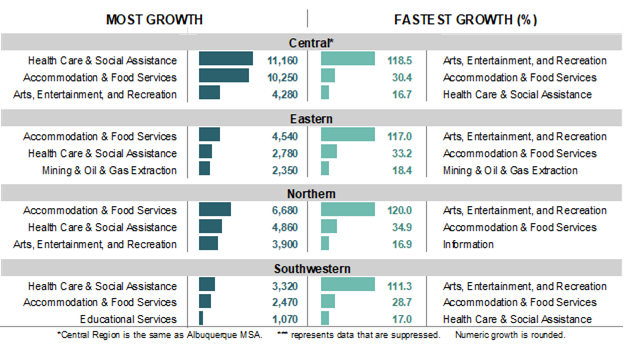
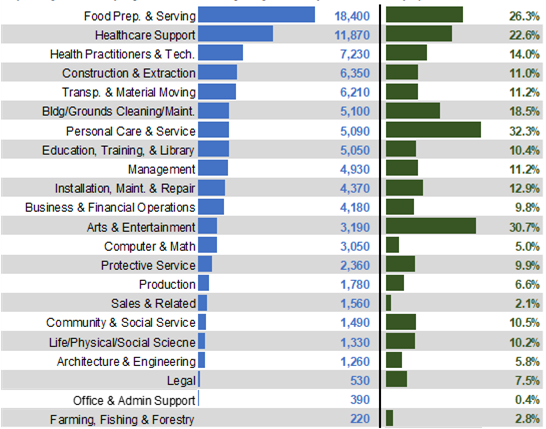
Exhibit 5 illustrates projected employment growth by major occupational group in New Mexico. Employment growth is defined as the number of positions that are completely new and have not been filled by a worker who previously left the occupation. Employment in food preparation and serving is projected to grow the most, by 18,400 jobs, making up over one-fifth of total statewide growth. Food preparation and serving also have the third fastest growth, at 26.3 percent, a rate over two times that of the statewide average of 11.6 percent. The occupational group with the fastest growth was personal care and service, at 32.3 percent, with jobs increasing by 5,090. Two other major occupational groups with large growth include healthcare support related (11,870 jobs) and healthcare practitioners and technical (7,230 jobs).
Employment in the occupational groups of farming, fishing, and forestry is projected to have the smallest increase of 220 jobs by 2030. Office and administrative support is expected to have minimal growth as well (390 jobs, or 0.4 percent), but with current employment, it is the second largest of any other occupational group in the state (about 111,320 in 2020).
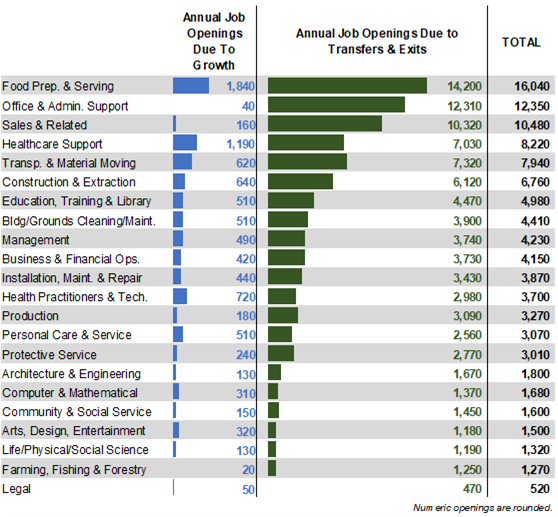
Not only are employment opportunities created by growth, but job openings also arise when workers need to be replaced because they leave the occupation to enter a different occupation (also called transfers) or because workers leave the occupation and exit the labor force (also called exits). The total annual number of job openings equals the sum of growth, transfers, and exits.
As seen in Exhibit 6, the food preparation and serving related major occupational group is projected to have the most annual job openings in the state due to transfers and exits (14,200 jobs). When this figure is combined with growth openings, the food preparation and serving related major occupational group will have the most annual job openings (16,040 jobs). Although minimal job growth is expected in office and administrative support, this occupational group will have the second-largest number of total annual job openings (12,350 jobs) because of the large number leaving the occupation (12,310). Other occupational groups expected to have minimal job growth are legal (50 jobs) and farming, fishing, and forestry (20 jobs). Legal is expected to have the least number of job openings due to transfers and exits (470 jobs).
iii. Employers’ Employment Needs
To determine employers’ needs, in addition to labor market information, we examined both quantitative and qualitative data. Stakeholder collaboration and comment were also critical inputs. We partnered with agencies across the State. This section incorporates data from the Early Childhood Education and Care Department, the New Mexico Health Care Workforce Committee Annual Report, the Department of Health, the Human Services Department, and the Economic Development Department.
Occupational and Industry projections also provide a critical component for assessing New Mexico employers’ needs, but they do not assess the current demand for workers. Information for current needs can be obtained through analyses of online job postings. Based on information available through the advertised jobs data from the Workforce Connection Online System, online advertised vacancies in New Mexico averaged 90,000 per month in the most recent 12-month period, or an average of 2.6 advertised job listings per unemployed worker.
To build a thriving and healthy economy for all New Mexicans, the WIOA State Plan identified the following employer needs:
- Growing the workforce that supports safe and healthy New Mexican families and communities
- Growing the workforce to modernize New Mexico’s infrastructure, and
- Developing a workforce system that anticipates and prepares the workforce for changes in the New Mexican economy.
Employers needs for a workforce that supports safe and healthy New Mexican families and communities entail focusing on the following sectors: healthcare providers, behavioral health providers, early childhood workforce, and first responders.
Healthcare Providers (Including Behavioral Health)
The Health Care and Social Assistance sector comprises establishments providing health care and social assistance for individuals. The sector includes both health care and social assistance, because it is sometimes difficult to distinguish between the boundaries of these two activities. The industries included here, and in the next section, provide a continuum of health care and social assistance. Establishments in these fields deliver services by trained professionals. All industries in the sector share this commonality of process, namely, labor inputs of health practitioners or social workers with the requisite expertise. Many of the industries in the sector are defined based on the educational degree held by the practitioners included in the industry.
The industry with the largest number of job openings was in healthcare (22.5 percent of the total), followed by professional, scientific, and technical services (17.0 percent) and educational services (14.5 percent).
The occupational group with the largest number of job openings by far was also healthcare practitioners and technical occupations (32.1 percent). Since 2012 the average number of advertised online job postings for registered nurses has consistently been over 2,000 a month (Exhibit 7). The most recent month of data shows there were over 6,500 advertised job postings for registered nurses. In calendar year 2022, the total number of advertised job postings was over 44,000, with nearly one in three of those online advertised job postings located in Bernalillo County.
Exhibit 7: Online Advertised Job Postings for Registered Nurses (2022)

According to the World Health Organization (WHO) there is “no health without mental health.” The Global Burden of Disease Study shows that mental disorders (like depression, schizophrenia, and bipolar disorder) make up the highest burden of disease both globally and in the US. Mental disorders are a concern for people of all ages (children to older adults) and are associated with age, gender, education, income level, race and ethnicity, geographical location and sexual orientation.
Mental disorders also have a serious impact on physical health and are associated with the prevalence, progression, and outcome of some of today's most pressing chronic diseases, including diabetes, heart disease, and cancer. They have long-lasting effects that not only include high psychosocial and economic costs for people living with the disorder, but also for their families, schools, workplaces, and communities.
The Department of Health conducts ongoing surveillance for indicators of mental health among students and adults in every county of New Mexico. Implementation of suicide prevention strategies statewide is a significant focus of the Department of Health’s Office of School and Adolescent Health. Youth suicide prevention and intervention activities were initially funded by the New Mexico Legislature in June 2005. The Human Services Department recently modernized the New Mexico Medicaid system by integrating physical and behavioral health services in the Centennial Care program, which will help treat an individual in a more holistic manner.
The New Mexico Health Care Workforce Committee’s 2021 Annual Report quantified the need for additional healthcare providers and behavioral healthcare providers. The Report indicated that the state as a whole has 151 fewer Primary Care Providers than the national benchmark, and assuming no redistribution of the current workforce, an additional 328 Primary Care Providers would be needed for all New Mexico counties to meet the national benchmark (8.3 per 10,000 population). The report also indicates that New Mexico has a shortage of Obstetrics and Gynecology Physicians, Registered Nurses and Clinical Nurse Specialists, Certified Nurse Practitioners, Physician Assistants, Physical Therapists, and Pharmacists. According to New Mexico’s Workforce Connection Online System (WCOS), there were 8,468 advertised job openings for healthcare providers across the state in July 2023.2
Early Childhood Care and Education
According to the New Mexico Economic Development Department, poorer academic performance among students of color and low income students often starts at lower grade levels and can largely be attributed to a lack of early childhood learning opportunities. This disinvestment can compound over a student’s life. The mission of the New Mexico Early Childhood Education & Care Department (ECECD) is to optimize the health, development, education, and well-being of babies, toddlers, and preschoolers through a family-driven, equitable, community-based system of high-quality prenatal and early childhood programs and services. Fulfilling this mission requires staffing classrooms with well qualified workers and expanding childcare access throughout the state. To facilitate this, Governor Michelle Lujan Grisham raised the wage floor for childcare providers.
ECECD accomplishments in State Fiscal Year 2023 that will affect demand for early childhood care workers include:
- Expanded access for 7,300 more children through the Child Care Assistance program from FY22 to FY23, largest increase of infants and toddlers
- Increased licensed childcare capacity by 3,000 from FY22 to FY23
- Grew the number of programs achieving the highest levels of quality by 8 percent from FY22 to FY23 (i.e., 4- and 5-star FOCUS programs)
- Awarded $11.5 million in grants to 38 childcare providers creating 2,200 new slots
By 2027, ECECD aims to impact families, children, communities, and early childhood professionals through the following goals that will affect demand for early childhood care workers:
- Enrolling 5,000 additional children in high-quality NM PreK
- Providing 20,000 more families with affordable high-quality early care and education
- Engaging all 33 counties in New Mexico in an active local early childhood coalition.
- Improving early childhood facilities supported by a dedicated funding source and technical assistance for 23 Tribes, Pueblos and Nations
- Supporting 80 percent of families and babies with Plans of Care
- Providing 2,000 additional infants and toddlers with access to high-quality, inclusive child care.
- Supporting 500 indigenous early childhood educators in achieving higher credentials
- Engaging 5,000 additional families in evidence-based home visiting
Exhibit 8 illustrates the increase in the number of children who will be served by Child Care Assistance from FY 22 to FY26. Exhibit 9 estimates the saturation is based on the number of children meeting CCDF requirements: (A) estimated number of children in each birth cohort, (B) number of children eligible, based on new eligibility levels; (C) number of children with all available parents in the workforce. By FY 2026, ECECD projects serving 100% of eligible children who need care. This includes an increase in the families needing care, based on the relationship between maternal labor force participation and affordability of childcare.
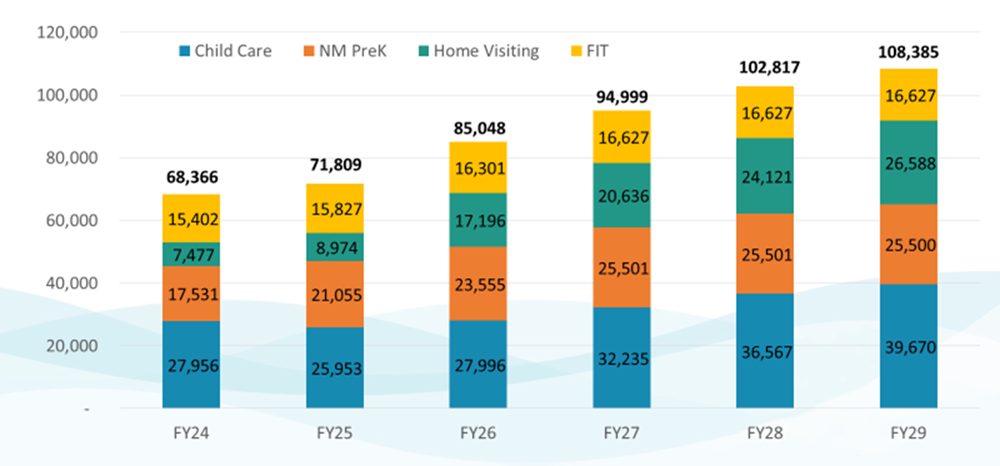

The New Mexico Early Childhood Education & Care Department (ECECD) has estimated the future early childhood educators’ workforce needs. ECECD anticipates an additional 200-225 workers in FY25, 50 in FY26, 120-150in FY27, 80-100 in FY28, and 60-100 in FY29. According to New Mexico’s WCOS, there were 224 advertised job openings for early childhood workers across the state in July 2023.
First Responders
First responders, such as fire fighters, paramedics, and police officers, provide essential services in every community in New Mexico. They are often the first to arrive on the scene of an emergency or disaster. They provide services essential to the response and the community, and they can be the difference between life and death for patients and community members.
Across New Mexico you will find plains, mountains, basins, mesas, desert lands, rivers, and lakes requiring first responders to prepare for a wide variety of environmental challenges. The state’s demographics also swing between large metropolitan areas and small, rural towns. Interoperability is needed for state and city agencies to work closely with the governments representing the state’s large Native American population, including part of the Navajo Nation, 19 federally recognized Pueblo communities of Puebloan peoples, and three different federally recognized Apache tribes.
In 2021, Governor Lujan Grisham and the New Mexico State Legislature set a goal of adding 1,000 new police officers across the State. Over $150 million has been appropriated to meet these goals, over the past two years. Similarly, the entire nation faces a shortage of paramedics. A 2021 survey conducted by the American Ambulance Association found that the turnover among paramedics and EMTs ranges from 20 to 30 percent annually, meaning there’s 100 percent turnover every four years. Firefighters are also in short supply. In connection with retention legislation in March 2023, the State Fire Marshal’s Office reported there were 126 vacancies in Albuquerque, Bernalillo County, Las Cruces City, Dona Ana County, Santa Fe City, and Santa Fe County fire departments. They also stated that there “are likely more vacancies among rural fire departments.”
The second part of the first goal of this statewide plan is to grow a workforce to modernize New Mexico’s infrastructure. Sectors helping to modernize New Mexico’s infrastructure are: vertical and horizontal construction and building, broadband expansion, water infrastructure, and natural resource management.
Vertical and Horizontal Construction and Building
The construction industries are central to modernizing New Mexico’s infrastructure. The construction sector comprises establishments primarily engaged in the construction of buildings or engineering projects (e.g., highways and utility systems). Establishments primarily engaged in the preparation of sites for new construction and establishments primarily engaged in subdividing land for sale as building sites also are included in this sector. Construction work done may include new work, additions, alterations, or maintenance and repairs. Activities of these establishments generally are managed at a fixed place of business, but they usually perform construction activities at multiple project sites. Production responsibilities for establishments in this sector are usually specified in (1) contracts with the owners of construction projects (prime contracts) or (2) contracts with other construction establishments (subcontracts). Establishments primarily engaged in contracts that include responsibility for all aspects of individual construction projects are commonly known as general contractors, but also may be known as design-builders, construction managers, turnkey contractors, or (in cases where two or more establishments jointly secure a general contract) joint-venture contractors. Construction managers that provide oversight and scheduling only (i.e., agency) as well as construction managers that are responsible for the entire project (i.e., at risk) are included as general contractor type establishments. The data above clearly set forth the projected demand for employees in the construction industries.
According to New Mexico’s WCOS, there were 857 advertised job openings for construction workers across the state in July 2023. DWS anticipates a marked increase in this number in the coming years, as a result of Build Back Better and state infrastructure funding.
Broadband Expansion
To better coordinate broadband deployment efforts among different state entities, in 2021 New Mexico Legislature passed, and Governor Lujan Grisham signed, Legislation establishing the Office of Broadband Access and Expansion and Connect New Mexico Council. The NM Legislative Finance Committee (LFC), in their analysis of House Bill 10, the Connect New Mexico Act, introduced in the 55th Legislature - State of New Mexico- First Session, 2021, signed by Governor Michelle Lujan Grisham, stated that New Mexico lags behind the rest of the nation in broadband connectivity. State and federal investments and oversight have succeeded in connecting schools, hospitals, and other institutions, but the costs of “last-mile” infrastructure are high, and residents and businesses in many rural areas remain unserved. New Mexico created the NM Office of Broadband Access and Expansion (OBAE) to facilitate the deployment of a “Statewide Open Access Middle Mile Network”. Funding for Connect New Mexico, totaling $100 million (Senate Bill 377) was approved by the New Mexico Legislature, and signed by Governor Lujan Grisham. In addition, the State received $675 million from the White House High-Speed Broadband Internet Initiative. According to New Mexico’s WCOS, there were 435 advertised job openings for broadband expansion workers across the state in July 2023. DWS anticipates a marked increase in this number in the coming years, as a result of the massive investment and numerous initiatives coming online in the next four years.
Water Infrastructure and Natural Resource Management
As a mostly desert state prone to droughts, New Mexico depends heavily on responsible water management and conservation. In New Mexico, water serves many purposes: it supplies drinking water, contributes to New Mexico’s recreation economy, supports crops and livestock, assists in the drilling of oil, natural gas, and more. The state relies on a mix of surface water, primarily from major rivers, and groundwater, primarily from aquifers. Both sources have challenges; surface water levels fluctuate greatly depending on precipitation, while aquifer levels have been diminishing over previous decades. New Mexico’s Office of the State Engineer, together with 16 water planning regions, regularly monitor water levels across the state to ensure appropriate conservation measures are taken so that New Mexico can sustain a robust water source for generations to come.
Since 2011, New Mexico has experienced several large-scale and long-lasting severe droughts, with more than a third of the last 10 years spent in emergency and exceptional drought conditions. New Mexico is not alone though, as the western half of the United States has been gripped by a “megadrought” that has lasted since 2000. Megadroughts last decades to centuries, drawing on a combination of high temperatures and low precipitation in the form of reduced rain and snowfall. Increasing average temperatures due to global climate change have resulted in stronger than expected drought conditions throughout the western states. Water management and conservation in New Mexico are critical regional challenges as they require the cooperation of many different stakeholders both public and private and are governed by a series of laws and compacts sometimes over a hundred years old.
Governor Lujan Grisham’s Administration strives to make our state a leader in developing reliable supplies of energy, and energy-efficient technologies and practices, with a balanced approach toward conserving our renewable and non-renewable resources; to protect the environment and ensure responsible reclamation of land and resources affected by mineral extraction; to be effective in leading our state in growing healthy, sustainable forests and managing them for a variety of users and ecologically sound uses; and to improve the state park system into a nationwide leader that contributes to a sustainable economy statewide while protecting New Mexico’s natural, cultural, and recreational resources for posterity. According to New Mexico’s WCOS, there were 718 advertised job openings for natural resources management workers across the state in July 2023. DWS anticipates a marked increase in this number in the coming years, as a result of the ambitious goals and initiatives set forth above.
Anticipating and Preparing the Workforce for Changes in the New Mexico Economy
The COVID-19 pandemic exemplifies one of the many disruptive changes that will have a profound impact on the employment landscape over the coming years. Many of the major drivers of transformation currently affecting global industries are expected to have a significant impact on jobs, ranging from significant job creation to job displacement, and from heightened labor productivity to widening skills gaps. The World Economic Forum has suggested that 65 percent of children entering primary school in 2016 will end up working in completely new job types that don’t yet exist. Governor Lujan Grisham’s Administration is focused on preparing New Mexico to meet these challenges. To that end, her Administration is focusing on enhancing the state’s workforce in areas such as energy transition, climate resilience, aerospace, intelligent manufacturing, biosciences, and sustainable and value-added agriculture.
Energy Transition
In 2019, the New Mexico Legislature passed, and Governor Lujan Grisham signed, Senate Bill 489, the Energy Transition Act (ETA). This landmark legislation sets bold statewide renewable energy standards and establishes a pathway for a low-carbon energy transition away from coal while providing workforce training and transition assistance to affected communities.
Developed over the course of a year with collaboration by community organizations, unions, energy groups and advocates, the ETA establishes New Mexico as a national leader in clean energy. The ETA sets a statewide renewable energy standard of 50 percent by 2030 for New Mexico investor-owned utilities and rural electric cooperatives and a goal of 80 percent by 2040, in addition to setting zero-carbon resources standards for investor-owned utilities by 2045 and rural electric cooperatives by 2050. The law transitions New Mexico away from coal and toward clean energy, ensuring greater renewable energy production and reducing costs for consumers, and provides tens of millions of dollars of economic and workforce support for communities impacted by coal plant closures, as well as the development of renewable replacement power in San Juan County. According to New Mexico’s WCOS, there were 109 advertised job openings for energy transition workers across the state in July 2023. DWS anticipates a marked increase in this number in the coming years, as a result of the ambitious goals and initiatives set forth above.
Climate resilience
In January 2019, Governor Lujan Grisham issued Executive Order 2019-003 on Climate Change and Energy Waste Prevention, which created the state Interagency Climate Change Task Force and included directives for agencies to incorporate climate mitigation and adaptation practices into their policies and operations. The Energy Conservation and Management Division (ECMD) of the Energy, Minerals and Natural Resources Department supports the Task Force through coordination, technical assistance, planning, and policy development and supports interagency work to reduce greenhouse gas emissions from electricity generation, transportation, industry, the built environment, and natural and working lands.
Early in 2022, the Task Force convened a Technical Advisory Group (TAG) to assess draft climate goals and implementing actions and offer input on gaps or challenges to implementation. The TAG was brought together to provide a diverse perspective on the draft climate goals and implementing actions. This group included representatives from industry, environment, tribal and environmental justice organizations, and represented different geographic regions of the state, differing areas of expertise and experience in different sectors that contribute to the state’s greenhouse gas emissions. The resulting input from this process is being used to inform the final goals of the 2023-2028 Climate Action Plan, which is under development and expected to be released in early 2023.
In 2022, Federal Emergency Management Agency Building Infrastructure & Resilient Communities (BRIC) funding was awarded to ECMD through two subgrants from the New Mexico Department of Homeland Security and Emergency Management. The two grants support climate change adaptation planning and climate awareness outreach respectively. The planning grant will be used to convene state agencies in a planning process to develop a climate mitigation and adaptation annex to the state Hazard Mitigation Plan. The climate change awareness grant will be used to develop partnerships with stakeholders, local governments and Indian Tribes and Pueblos to build their respective capacities to plan for natural hazards exacerbated by climate change.
According to New Mexico’s WCOS, there were 187 advertised job openings for climate resilience workers across the state in July 2023. DWS anticipates a marked increase in this number in the coming years, as a result of the ambitious goals and initiatives set forth above.
Aerospace
Leaders across the state from industry, government, and academia, work together to make New Mexico a center of innovation for space. New Mexico has an early advantage in specialization areas that support the aerospace industry, including microelectronics, optics, directed energy, computer software, satellite manufacturers and operators, and data analytics. These sub-industries of aerospace are strengths in New Mexico and many colleges and universities have programs that support them. As home to the world’s first commercial spaceport, three national research laboratories, three Air Force bases and three testing facilities with the most experienced FAA approved UAS test center with access to over 15,000 square miles of restricted air space, New Mexico is the place to be to grow aerospace businesses, jobs, and educational opportunities. This is a priority sector in the State’s economic development strategy. According to New Mexico’s WCOS, there were 3,720 advertised job openings for aerospace workers across the state in July 2023.
Intelligent Manufacturing
New Mexico has a strong and versatile manufacturing ecosystem that is comprised of a diverse range of firms, from large corporations such as Intel to small, family-owned businesses. In addition to its three national research facilities, New Mexico is home to three nationally recognized research universities. The state is ranked first in non-industry investment in research and development, second in high-tech jobs, and seventh in patents, providing unparalleled capacity for research collaboration and technology commercialization in many areas that contribute to advanced manufacturing. New Mexico has many companies utilizing technologies spun out of these institutions. Education and research opportunities at these facilities contribute graduates in many fields including engineering, optics, nanotechnologies, physics, and manufacturing hardware and software development. This is a priority sector in the State’s economic development strategy. According to New Mexico’s WCOS, there were 2,281 advertised job openings for manufacturing workers across the state in July 2023.
Biosciences
New Mexico’s bioscience industry is growing, and New Mexico seeks to capitalize on the momentum and opportunities in the industry. New Mexico’s bioscience industry garnered about $1.2 billion in revenue in 2015. There are 700 biotech companies now working in human health, agricultural and environmental issues around the state. These businesses directly employ about 9,300 people, and up to 41,000 if related support jobs are included. This is a priority sector in the State’s economic development strategy. According to New Mexico’s WCOS, there were 1,836 advertised job openings for bioscience workers across the state in July 2023.
Sustainable and Value-Added Agriculture
New Mexico’s economy has been based in cattle ranching and farming for two centuries, and still has a significant presence with 24,700 farms in operation. On a large scale, New Mexico’s agricultural producers lead the United States in the production of chiles and pecans, alongside the state’s strong dairy industry. On a more local scale, the value-added agriculture industry serves as a vital source of income and employment for many located in New Mexico’s rural communities, including the state’s large Native American population. Supporting employees and employers in New Mexico’s value-added agriculture strengthens rural communities and is a foundational industry that provides employment to a significant component of NM workforce. This is a priority sector in the State’s economic development strategy. According to New Mexico’s WCOS, there were 372 advertised job openings for sustainable and value-added agriculture workers across the state in July 2023.
Employer Needs Survey
Governor Michelle Lujan Grisham’s Administration is committed to providing the state’s employers with a highly skilled workforce. Part of this commitment includes working with employers to assess their workforce needs. As part of this effort, in 2023 the New Mexico Department of Workforce Solutions (NMDWS) piloted a biennial Employer Needs Survey. The current survey is designed to gauge employer’s hiring and retention challenges, how they responded to these difficulties, and their awareness and use of employer services available from NMDWS.
Results from the survey revealed employers were experiencing hiring difficulties, with more than three-quarters of all responding employers reporting difficulty in filling at least one position in 2022 (Exhibit 10). When asked about reasons for hiring difficulties, almost half (49.4 percent) indicated that too few applicants applied for open positions. This may, in part be due to ratio of unemployed New Mexican to the number of open positions in the state. In July 2023 there were 0.6 unemployed New Mexicans for every advertised job in the state, or about 33,500 more jobs available than there are unemployed New Mexicans available to fill them. Just under a quarter of employers (23.0 percent) reported not having any challenges finding any qualified candidates for their open positions.
| Challenge | % Employers citing challenge |
|---|---|
| Too few applicants | 49.4% |
| Candidates lack technical skills required for success | 32.4% |
| Candidates lack required experience | 30.0% |
| Candidates lacked soft skills required for success | 26.9% |
| New employees quit soon after hire without giving notice (stop showing up) | 25.9% |
| Candidates accept offer but never report to work | 24.5% |
| We require employees to work on-site, no telework or hybrid schedules available | 18.7% |
| Other businesses offer higher wages than we can | 17.3% |
| New employees give notice and quit soon after hire | 16.1% |
| Candidates lack educational qualifications | 13.7% |
| We require employees to have a clean driving record | 8.9% |
| The business is located in a remote area and there are very few local candidates | 8.9% |
| All of our positions are part-time | 8.6% |
| We drug test all employees (and marijuana is included in the list of disqualifying drugs) | 7.9% |
| The work is physically demanding | 7.4% |
| We only offer the minimum benefits legally permitted | 6.5% |
| Candidates cite lack of childcare | 6.2% |
| Commuting distances are too great | 4.1% |
| The work requires employees to travel and be away from home several nights a week | 2.4% |
Some employers have proactively responded to challenges they have encountered in hiring staff by increasing pay and benefits, cross training staff, turned away business, or working with outside organizations (Exhibit 11). Just under half of employers (47.2 percent) indicated they increased employee pay, 13.9 percent have increased employee benefits, while 5.8 percent of employers indicated they started providing employee benefits. Employers are also examining their internal processes to reduce their need to hire externally; 15.1 percent of employers have cross-trained employees to promote from within and 11.5 percent of employers reported they cross trained employees to increase scheduling flexibility.
A small percentage of employers (2.6 percent) indicated their response to hiring challenges has been to require current employees to work longer hours. Staffing shortages have resulted in 31.4 percent of employers turning away business because they did not have sufficient staff. Using a temporary hiring agency to meet their workforce needs has been a strategy employed by 7.9 percent of employers while 5.7 percent of employers have turned to the NMDWS for assistance in hiring new employees.
Just under a quarter of employers (23.5 percent) indicated they have not had any difficulties hiring employees and 18.2 percent of employers indicated they had not changed their hiring or business practices, or their employee compensation and benefits packages in response to any hiring challenges.
Exhibit 11: How Businesses Responded to Hiring Challenges (2022)
| Response | % Employers Giving Response |
|---|---|
| Increased employee pay | 47.2% |
| Turned away business because we do not have the staff available to meet demand | 31.4% |
| Cross-trained employees to promote from within | 15.1% |
| Increased employee benefits | 13.9% |
| Cross-trained employees to increase schedule flexibility | 11.5% |
| Worked with a temporary hiring agency | 7.9% |
| Contacted the NM Department of Workforce Solutions for hiring assistance | 5.8% |
| Started providing employee benefits | 5.8% |
| Required employees to work longer hours | 2.6% |
More than one-third (37.1 percent) of employers were unaware that the NMDWS provides services to employers. Although 41.6 percent of employers indicated they had used NMDWS services related to Information on Rules and Regulations for Businesses, such as the NM Paid Sick Leave Law, the Wage Pay Act, and the Minimum Wage Act, 21.9 percent of employers were not aware that the NMDWS provided information on rules and regulations for businesses. More than one in ten employers (10.2 percent) have used the Labor Market Information provided by the NMDWS, however 41.6 percent of employers were unaware that the NMDWS provided this information. Similarly, while 8.8 percent of employers had utilized the NMDWS to help them develop job descriptions, 48.2 percent of employers did not know the NMDWS could assist them with this task.
More than half of employers in New Mexico were not aware that the NMDWS could assist them in starting an apprenticeship program (50.4 percent), ensure they are compliant with the Rapid Response and & WARN Act (65.0 percent), provide skill assessments for potential hires (51.1 percent), or provide information about the Internal Revenue Services’ Work Opportunity Tax Credit (57.0 percent).