



Located in:
- II. Strategic Elements
The Unified or Combined State Plan must include a Strategic Planning Elements section that analyzes the State’s current economic environment and identifies the State’s overall vision for its workforce development system. The required elements in this section allow the State to develop data-driven goals for preparing an educated and skilled workforce and to identify successful strategies for aligning workforce development programs to support economic growth. Unless otherwise noted, all Strategic Planning Elements apply to Combined State Plan partner programs included in the plan as well as to core programs. Where requirements identify the term “populations”, these must include individuals with barriers to employment as defined at WIOA Section 3. This includes displaced homemakers; low-income individuals; Indians, Alaska Natives, and Native Hawaiians; individuals with disabilities, including youth who are individuals with disabilities; older individuals; ex-offenders; homeless individuals, or homeless children and youths; youth who are in or have aged out of the foster care system; individuals who are English language learners, individuals who have low levels of literacy, and individuals facing substantial cultural barriers; farmworkers (as defined at section 167(i) of WIOA and Training and Employment Guidance Letter No. 35-14); individuals within 2 years of exhausting lifetime eligibility under the Temporary Assistance for Needy Families program; single parents (including single pregnant women); and long-term unemployed individuals. Additional populations include veterans, unemployed workers, and youth, and others that the State may identify.
- a. Economic, Workforce, and Workforce Development Activities Analysis
The Unified or Combined State Plan must include an analysis of the economic conditions, economic development strategies, and labor market in which the State’s workforce system and programs will operate.
- a. Economic, Workforce, and Workforce Development Activities Analysis
II. a. 1. B. Workforce Analysis
The Unified or Combined State Plan must include an analysis of the current workforce in the State and within various state regions. Provide key analytical conclusions in aggregate as well as disaggregated among populations to identify potential disparities in employment and educational attainment and understand labor force conditions for items (i)-(iii) below. Populations analyzed must include individuals with barriers to employment described in the first paragraph of Section II. Analysis must include—
i. Employment and Unemployment
Provide an analysis of current employment and unemployment data, including labor force participation rates, and trends in the State.
ii. Labor Market Trends
Provide an analysis of key labor market trends, including across existing industries and occupations.
iii. Education and Skill Levels of the Workforce
Provide an analysis of the educational and skill levels of the workforce.
Current Narrative:
I. EMPLOYMENT AND UNEMPLOYMENT
As of the end of 2023, Georgia's unemployment rate has shown stability, maintaining a rate of 3.4% seasonally adjusted, reflecting continuous economic resilience since the pandemic-induced highs of April 2020. Despite fluctuations, the unemployment rate has consistently trended downward from the spike in 2020, underscoring the state's recovery. Correspondingly, the labor force participation rate (LFPR) has seen a gradual increase, reaching 61.6% by the end of 2023, indicating a rebound from the previous year's lows and a re-engagement of the workforce. However, this rate is still reflective of the broader national trends where certain demographics have seen varying levels of participation. For instance, there has been a noticeable increase in labor force participation among Asian and Black or African American communities nationally, while the LFPR for White persons has experienced a slight uptick.
The employment-population ratio, which is a measure of the proportion of the state's working-age population that is employed, has also seen a positive increment, aligning with the national trend of increasing labor force engagement among both men and women. This suggests that more individuals are finding employment and contributing to the economy. The consistency in the employment-population ratio across different demographics further highlights a recovering and diversifying job market in Georgia.
These statistics suggest that Georgia's job market is progressively stabilizing and expanding post-pandemic, with varying degrees of recovery and participation across different sectors and demographics. The detailed breakdown by industry and skill sought, as per the provided data, underscores the specific areas where job growth is most prominent, thereby offering insights for workforce development and policy-making to bolster employment opportunities in the state.
Labor Force Demographics
Georgia, the eighth largest state in the U.S. with a population of approximately 10.7 million, remains one of the nation's fastest-growing states. According to the 2022 ACS 5-year estimates, Georgia has experienced a population increase of approximately 12.6% since the 2010 ACS 5-year estimate, which recorded a population of 9,468,815. This growth outpaces the national average, reflecting Georgia's appeal as a residential and business destination.
In terms of economic well-being, the 2022 American Community Survey (ACS) five-year estimates reveal that Georgia’s Poverty Rate stands at 13.5%, which is an improvement from the 15.1% reported in 2019. This was a substantially greater decrease than what took place on the national where poverty rates fell from 13.4% in 2019 to 12.5% in 2022, a decrease of less than one percent. This is a strong indicator of robust growth and improved wellbeing in the state.
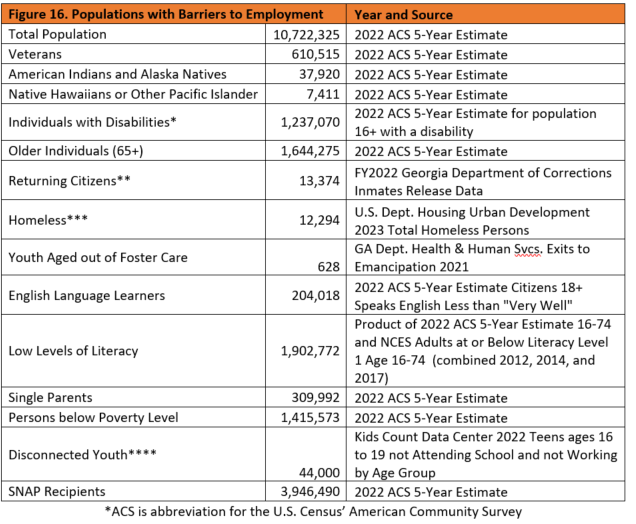
Figure 16 below indicates that individuals with barriers to employment comprise large segments of the population. Georgia has specifically developed service strategies to address barriers to employment for many of these population segments, which will be explored further within the State Strategy section of this pl
Figure 16. Populations with Barriers to Employment
As illustrated in Figures 17A and 17B below, each cohort of Georgia’s working-age population grew from 2010 to 2020. Projections indicate each will grow again from 2020 to 2030. These comprehensive growth trends are occurring while the available workforce is aging, which is consistent with national trends.
As a percentage of the total, the cohorts of 15 to 24, 24 to 44, and 45 to 64 each represented their respective highest percentage of the total in 2010 (of the time periods illustrated in Figures 17A and 17B), while the 65+ group is projected to grow to its highest share of 20.4% by 2030.
Figure 17A: Georgia Population by Age, Totals & Figure 17B: Georgia Population by Age, Percentage of Total

In 2000, the median age was 33.4. Today, the most recent median age estimate for Georgia is 36.7.[1] This upward trend is due to a proportional increase in the number of older individuals. The increase in the percentage of the population over 65 will have significant impacts on Georgia’s economy. First, there will be an increase in demand for healthcare professionals, particularly for the elderly and aging populations. Second, it signifies a high percentage of workers on the verge of exiting the labor force, creating a need for replacement workers in addition to filling openings from growth. And national estimates indicate many have already left the workforce in response to the COVID-19 pandemic, yet some may still return to the participating labor force (see Figure 23).
[1] Source: 2000 Decennial Census and 2019 ACS 5-year estimates.
Georgia’s population has limited language barriers, with only about 2.6% of households without a member over the age of 14 who speaks English. The overall state population is predominantly Caucasian (58.6% of the total population). The largest minority group is Black/African American (31.6% of the population). Asian and other minority groups make up about 9.8% of Georgia’s population. Of the total population, 9.5% are Hispanic (the racial demographics of non-Hispanics are 52.7% Caucasian, 31.2% African American, and 6.5% Asian and other minority groups).
One of Georgia’s most valuable labor resources is the military veteran population. Georgia has one of the largest active duty populations with around 70,000 personnel stationed in various corners of the state. As many military veterans and families remain in the community in which they are based, the state also has a large veteran population of 616,527. Many of these military veterans possess core competencies, which correlate directly to civilian occupations in Georgia’s high-demand industries. The attractiveness of veteran talent to employers is evident from the relatively low for 2019 unemployment rate of 4.9% for Georgia’s veterans.
Georgia's Economic Base
As the below Figure 18 job growth index illustrates, since 2012 Georgia’s job growth has outpaced that of the nation writ large.
Figure 18. Change Index for Total Non-Farm Employment, 2012 to 2022
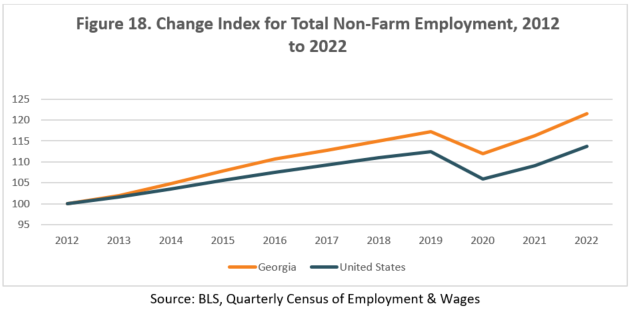
Figure 19. Change Index for Total Non-Farm Employment, January 2022 to November 2023
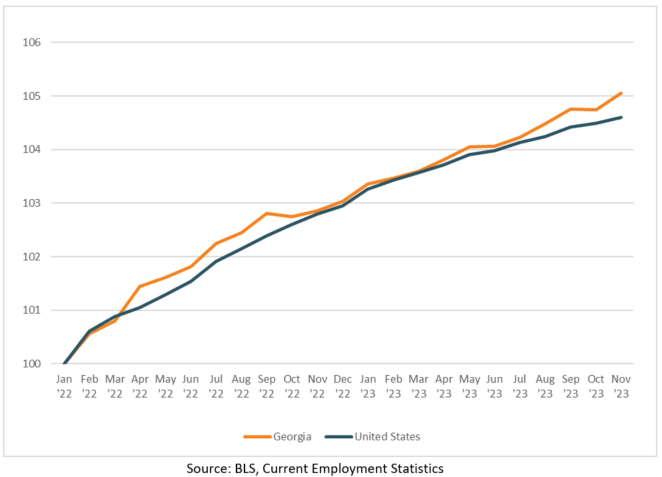
Seasonally-adjusted monthly employment offers a view of how the Georgia economy has fared to date in the COVID-19 pandemic. And as Figure 19 shows, Georgia’s strong employment growth as signals a robust and ongoing recovery from the losses of the pandemic despite headwinds such as rising interest rates and inflation. Estimates are Georgia’s employment was over 4.9 million jobs as of November 2023, which is a 5% increase from the beginning of 2022. Once again this represents a slight improvement over the national growth rate over the same period.
Figure 20. Total Non-Farm Employment with Percent Change, November 2013 to November 2023

As of November 2023, Georgia’s labor force is just under 5.2 million persons, with still low unemployment of 184,458 persons. While this represents an increase from 2022’s 10 year low of 162,060, this November 2023 unemployment number is still quite low in the context of the last 10 years illustrated in Figure 21 below. Further, Georgia’s employed persons number – 5.3 million – is at its highest during this time period, suggesting a very strong economy in Georgia leading into the 2023 holiday season.
Figure 21. Working Age Population by Unemployed, Employed and Non-Participating, November 2013 to November 2023

Figure 22 compares the unemployment and labor force participation rates of Georgia to those of the United States from November 2013 to November 2023. Over this period, Georgia’s labor force participation rate fluctuated, reaching a high of 63.9% in 2016 and a low of 60.7% in 2015, ending at 61.6% in 2023. The U.S. labor force participation rate showed a gradual increase from 2013, ending at 62.8% in 2023.
Georgia’s unemployment rates generally trended downwards over this decade, with a peak in 2013 at 7.7% and then decreasing to a low of 3.1% in 2022. There was a spike in 2020 due to the economic impact of the COVID-19 pandemic, after which the rates improved again. In comparison, the U.S. unemployment rate followed a similar trend, with a peak in 2020 at 6.7% and reaching 3.7% in 2023.
For most of the decade, Georgia's unemployment rates were higher than those of the U.S., but since 2019, Georgia has consistently reported lower unemployment rates than the national average. In the latter part of the chart, Georgia’s lower unemployment rates, alongside labor force participation rates that are relatively close to the national figures, suggest a robust labor market that may reflect more favorable conditions for job seekers in the state. The similarity in labor force participation rates indicates that a comparable proportion of the working-age population in Georgia and the U.S. is either working or actively seeking employment. However, Georgia’s lower unemployment rates in recent years suggest a stronger job market or more effective job matching in the state.
The data reveals that after the economic challenges around 2020, both Georgia and the U.S. appear to have recovered, with unemployment rates decreasing and labor force participation rates stabilizing. The trend demonstrates resilience in the labor markets and possibly improving economic conditions in the region and nationally.
Figure 22. Unemployment and Labor Force Participation Rates, November 2013 to November 2023

Figure 23A illustrates the change index for national labor force participation rates by age group from November 2013 to November 2023. The index uses 2013 as a base year (index=100) to show the relative change in participation rates over the decade. The data indicates that the labor force participation rate for the 16 to 24 years age group has increased slightly, reaching an index value of 103.2847 in 2023, which is approximately a 3.28% increase over the base year.
The 25 to 34 years age group has shown an overall positive trend, with the index rising to 102.7027 in 2023, suggesting an increase of about 2.70% from 2013. Similarly, the 35 to 44 and 45 to 54 years cohorts have shown growth, with the index for each reaching 102.3114 and 103.0113, respectively, indicating increases from the base year.
In contrast, the 55 years and over group experienced a decrease in participation, with the index dropping to 97.2431 in 2023, which is approximately a 2.76% decrease from 2013, though there is a small recovery from the previous year.
Figure 23B provides a detailed look at the seasonal labor force participation rates by age for November of each year from 2013 to 2023, alongside the highest and lowest rates within this period. Notably, in November 2023, the participation rates for all age groups except those 55 and over have reached their 10-year high. The 16 to 24 years age group's rate increased from 54.8% in 2013 to 56.6% in 2023. The 25 to 34 years group rose to 83.6% in 2023, up from 81.4% in 2013.
The 35 to 44 years age group shows a steady increase, peaking at 84.1% in 2023. The 45 to 54 years group also reached its 10-year high in 2023 at 82.1%. However, the 55 years and over group's highest participation rate was in 2019 at 40.3%, which has since decreased to 38.8% in 2023, slightly up from its 10-year low in 2021.
These figures underscore significant trends in labor force participation across age groups. The younger age cohorts have demonstrated a strong rebound and increasing participation, which may alleviate some of the workforce challenges posed by the declining participation of older age groups. The decrease in participation rates among those 55 and over could be attributed to a variety of factors, including retirement decisions influenced by the pandemic. The overall data reflects a dynamic labor market with shifting participation patterns, with potential implications for workforce planning and economic policy.
Figure 23A. Change Index for National Labor Force Participation Rate by Age, November 2013 to November 2023

Figure 23B. National Labor Force Participation Rate by Age; High, Low and Most Recent for November 2013 to November 2023

Figure 24 presents the National Labor Force Participation Rate (LFPR) for Married Persons over a decade, from November 2013 to November 2023. The LFPR measures the proportion of married individuals in the labor force, either working or seeking work.
The LFPR for married persons began at 67.0% in 2013 and experienced minor yearly fluctuations throughout the decade. There was a marginal increase to 67.1% in 2014, followed by slight variations that did not significantly deviate from this figure, indicating a relatively stable participation rate during this period. The rate saw a subtle decline to 66.5% in 2017, but this was followed by a small recovery, reaching 66.9% in 2019.
In the subsequent years, the participation rate remained fairly consistent, with a minor dip to 66.6% in 2020 and a subsequent rise to 66.8% in 2021. The year 2022 saw a small decrease to 66.7%, and by 2023, the rate had modestly decreased to 66.3%.
Throughout the decade, the LFPR for married persons showed stability with small annual changes, suggesting that while there are natural variances in economic conditions and labor market dynamics, the overall engagement of married persons in the labor force has not dramatically shifted over these years. The data suggests that married individuals' participation in the labor market has been relatively consistent, with only gentle rises and falls in the observed period.
Figure 24. National LFPR for Married Persons, November 2013 to November 2023

Figure 25 charts the National Labor Force Participation Rate (LFPR) for Women and Men from November 2013 to November 2023. The graph displays a decade-long comparison of the proportion of men and women who are actively engaged in the workforce, either employed or seeking employment.
Over the ten-year period, men's LFPR began at 69.5% in 2013, showing minor variations in the subsequent years. It reached a low of 67.5% in 2020, likely due to the economic impact of the COVID-19 pandemic. However, there has been a gradual recovery, with the rate climbing to 68.4% by November 2023. Women's participation followed a similar pattern, starting at 56.9% in 2013. There was a slight increase in the following years, with a peak in 2019 at 57.6%. Like men, women's LFPR dropped in 2020 to 55.9% but has since shown an upward trend, reaching 57.4% in November 2023.
The Change Index for men and women, which sets 2013 as the base year (index value of 100), provides an insight into the relative changes in participation rates. By 2023, the index for men shows a slight decrease to 98.4, suggesting a small drop in participation rate compared to the base year. On the other hand, women’s Change Index increased to 100.9 by 2023, indicating a growth in participation rate relative to 2013.
The LFPR trends for both genders over the decade reflect the various economic forces at play, including the substantial impact of the pandemic and the subsequent recovery. The overall higher Change Index for women by 2023 suggests an encouraging trend of increasing engagement of women in the labor market relative to the starting point of this data set.
Figure 25. National Labor Force Participation Rate for Women and Men, November 2013 to November 2023

Figure 26 displays the National Labor Force Participation Rate for various reported races and ethnicities between November 2013 and November 2023. The chart reflects the percentage of each group's adult population that was either employed or actively seeking employment over this period.
In 2013, the Hispanic or Latino population began with a participation rate of 66.0%, saw a dip to 65.5% in the middle of the decade, and experienced fluctuations peaking at 67.5% in 2019 before falling to 65.5% in 2020. A recovery is observed in the following years, with an increase to 66.9% by 2023. The Asian labor force participation rate started at 64.7% in 2013, fluctuating over the years with a low of 62.9% in 2020. It then rebounded to 65.5% in 2021 and settled slightly lower at 65.0% in 2023. For the White population, the participation rate was 63.3% in 2013, with minor changes throughout the decade, reaching its lowest at 61.5% in 2020. Thereafter, a marginal increase is seen, with the rate at 62.3% in 2023. The Black or African American group's participation rate grew steadily with start and end points of 62.9% in 2013 and 66.4% in 2023. Notably, this growth was only disrupted by the COVID-19 pandemic with a significant decrease to 62.2% in 2020, followed by a robust increase in the subsequent years.
Each of the groups experienced their lowest participation rates in 2020, coinciding with the global pandemic's impact. The subsequent increase by 2023 for the Asian and Black or African American populations is notable, with the latter reaching the highest rate of 66.4% among the groups. The data across the decade shows that while there were dips in participation rates around 2020, the years following have seen a recovery. The highest labor force participation rates within the decade were observed at different times for each group, indicating varying economic impacts and recoveries among the races and ethnicities.
Figure 26 outlines the National Labor Force Participation Rate (LFPR) for Hispanic or Latino, Asian, White, and Black or African American populations from November 2013 to November 2023. The graph tracks the participation of these racial and ethnic groups in the labor force across a ten-year timeline.
Over the decade, each group's LFPR experienced general fluctuations. The Hispanic or Latino and Asian populations showed a trend of moderate variability, with noticeable recoveries after a downturn in 2020. The White population's LFPR remained relatively more stable, and overall lower, compared to the others, with slight year-to-year changes and a gentle increase after 2020. The Black or African American group saw robust participation before and after the pandemic, indicating a strong return to the labor force by 2023.
The year 2020 stands out as a point where all groups saw a decline in labor force participation, which aligns with the economic impact of the COVID-19 pandemic. Following this, there was a general trend of improvement, with each group experiencing some degree of recovery by 2023.
Figure 26. National LFPR for Reported Race and Ethnicities, November 2013 to November 2023

II. LABOR MARKET TRENDS
Figure 27A and Figure 27B illustrate the total nonfarm employment by industry trends in Georgia from the second quarter of 2019 (2019Q2) to the second quarter of 2023 (2023Q2). These figures provide a snapshot of employment changes across various sectors, highlighting the recovery and growth in the years following the onset of the COVID-19 pandemic.
From 2019Q2 to 2023Q2, several industries have shown notable employment trends:
- Trade, Transportation, and Utilities: This sector experienced substantial growth, particularly in Retail Trade and Transportation and Warehousing, with employment figures significantly rising from their 2020 lows.
- Information: After a dip in 2020, the Information sector rebounded, approaching its 2019 employment levels by 2023.
- Construction and Manufacturing: Both sectors displayed resilience with steady growth in employment, surpassing their pre-pandemic figures by 2023.
- Professional and Business Services: This category, which includes Professional, Scientific, and Technical Services, and Management of Companies and Enterprises, saw a remarkable recovery, with employment numbers increasing each year from 2020 to 2023.
- Leisure and Hospitality: Within this sector, Accommodation and Food Services demonstrated a strong recovery post-2020, reflecting a rebound in consumer demand and economic activity.
- Health Care and Social Assistance: Employment in this critical sector remained relatively stable through 2020 and showed growth in the subsequent years.
- Financial Activities: The Finance and Insurance industry also experienced growth, with employment numbers in 2023 exceeding those of 2019.
The overall employment trend across these industries suggests that the job market in Georgia has been recovering from the pandemic's impact, with many sectors showing employment levels in 2023 that are higher than those before the pandemic.
Figure 27A. Total Non-Farm Employment by Industry Trends, 2019Q2 to 2023Q2

Figure 27B. Total Non-Farm Employment by Industry Trends, 2019Q2 to 2023Q2

Figure 28 reveals the trends in employment for key occupations from 2011 to the projected year of 2030. This span of nearly two decades highlights the dynamic nature of the job market and anticipated changes in employment across various roles.
- Retail Salespersons are expected to see a modest increase in jobs, with an estimated growth of 4,045 positions by 2030, translating to a 2.7% rise from 2011 numbers.
- Laborers and Freight, Stock, and Material Movers, Hand are projected to experience a substantial increase, with an estimated addition of 69,108 jobs, marking a significant 90.2% growth over the period.
- Cashiers will also see an uptick in employment numbers, with a projected increase of 18,640 jobs, amounting to an 18.1% rise since 2011.
- Customer Service Representatives are set to witness a growth of 23,897 jobs, which represents a 26.4% increase in their field.
- General and Operations Managers have an expected job increase of 17,845, amounting to a 25.1% rise over the two-decade span.
- Registered Nurses are among the occupations with a robust growth projection, adding 21,280 jobs by 2030, a 32.7% increase, reflecting the growing demand in the healthcare sector.
- Waiters and Waitresses are anticipated to have 15,138 more jobs available by 2030, equating to a 21.8% increase.
- Heavy and Tractor-Trailer Truck Drivers show a significant growth trend, with a projected increase of 30,757 jobs, which is a 63.9% rise.
- Stockers and Order Fillers are expected to see an increase of 23,732 jobs, translating to a 43.9% growth from 2011.
The employment data suggests a varying pace of growth across different occupations, with some, like laborers in material moving, and truck drivers, showing substantial percentage increases. In contrast, retail salespersons are seeing a more conservative growth.
Figure 28. Leading Occupations Five-Year Trends 2010-2028[2]

[2] Some jobs have been re-classified from one year to the next, resulting in numbers that do not match up in a year-to-year comparison.
III. EDUCATION AND SKILL LEVELS OF THE WORKFORCE
Figure 29 represents the level of educational attainment in Georgia’s population 25 years and older. The percentage of the total Georgians at each level of educational attainment is very similar to the nation’s. The most differentiation is that a slightly lower percentage of Georgians have an Associate’s degree or Bachelor’s degree, and slightly more have completed a portion of high school without attaining a diploma.
Figure 29. Educational Attainment for Population 25 Years and Over

The projection for jobs in 2031 indicates the highest number of positions will still require a high school diploma or equivalent, with significant growth expected, from 1,807,395 jobs in 2023 to 2,117,966 in 2033. Bachelor’s degree requirements are also on the rise, increasing from 1,216,536 to 1,331,357, showcasing the demand for higher education. On the other end of the spectrum, jobs requiring no formal educational credential are projected to see a slight decrease, from 1,109,760 to 1,070,363, underscoring the growing importance of formal education credentials in the job market.
The number of jobs requiring an Associate's degree shows a robust growth pattern, more than doubling from 97,740 to 213,336. Similarly, positions requiring Postsecondary nondegree awards are expected to increase from 313,631 to 341,454. The projections for advanced degrees show a significant upward trend, with Master’s degrees expected to grow from 74,817 to 110,443, and Doctoral or professional degrees from 109,907 to 186,896, indicating a strong market value for advanced education.
Conversely, there is a dramatic decline in jobs for individuals with some college but no degree, plummeting from 112,915 to 28,218. This suggests that completing a degree or formal educational program gives a competitive edge in the job market. These trends highlight the increasing emphasis on educational qualifications for employment opportunities by 2033.
Figure 30. Projected 2033 Jobs by Required Entry-Level Education 2023 to 2033

As illustrated in Figure 31 below, From 2023 to 2033, the largest increase in job opportunities is anticipated for positions that require no experience, with an expected rise of approximately 9.7% from 4,126,547 to 4,527,798. Jobs that do not require any On-The-Job Training (OJT) are projected to grow by about 36%, from 1,560,565 to 2,122,100, indicating a significant number of accessible jobs for individuals without prior experience.
Short-term on-the-job training positions are forecasted to increase by roughly 15.8%, from 1,756,109 to 2,034,160, suggesting that jobs with minimal training requirements are also on the rise. In comparison, roles that require less than 5 years of experience are expected to see a modest growth of about 6%, from 554,494 to 587,590.
Conversely, the number of jobs requiring long-term on-the-job training is predicted to decrease by a substantial 50%, from 331,279 to 165,408, indicating a significant shift in the job market away from roles that necessitate extensive preparatory training.
Roles requiring 5 years of experience or more are set to experience an increase of approximately 76.1%, from 161,660 to 284,645, highlighting an increasing need for more experienced professionals in certain sectors. On the other hand, internships and residency positions are projected to decrease by approximately 19.3%, from 63,426 to 51,190. Apprenticeship opportunities are expected to see a decrease of about 8.8%, from 63,335 to 57,704.
Figure 31. Projected Jobs by Experience and On-the-Job Training (OJT) Required, 2023 to 2033
