



Located in:
- III. Operational Planning Elements
The Unified or Combined State Plan must include an Operational Planning Elements section that supports the State’s strategy and the system-wide vision described in Section II(c) above. Unless otherwise noted, all Operational Planning Elements apply to Combined State Plan partner programs included in the plan as well as to core programs. This section must include—
- a. State Strategy Implementation
The Unified or Combined State Plan must include–
- 2. Implementation of State Strategy
Describe how the lead State agency with responsibility for the administration of each core program or a Combined Plan partner program included in this plan will implement the State’s Strategies identified in Section II(c). above. This must include a description of—
- 2. Implementation of State Strategy
- a. State Strategy Implementation
III. a. 2. E. Partner Engagement with Educational Institutions and other Education and Training Providers.
Describe how the State’s Strategies will engage the State’s community colleges, adult education providers, area career and technical education schools, providers on the State’s eligible training provider list, and other education and training providers, as partners in the workforce development system to create a job-driven education and training system. WIOA section 102(b)(2)(B)(iv). Include how the State’s strategies will enable the State to leverage other Federal, State, and local investments to enhance access to workforce development programs at these institutions.
Current Narrative:
The Alabama Governor’s Office of Education and Workforce Transformation (GOEWT) was created to implement Governor Kay Ivey’s Strong Start, Strong Finish education strategic plan. Governor Ivey developed the Strong Start, Strong Finish education strategic plan to integrate Alabama’s education, workforce, and human services systems. The GOEWT was not created by executive order or through an Act of the Legislature; instead, Governor Ivey established the GOEWT within her personal office. Being located within the Governor’s personal office provides the GOEWT with a stronger convening authority and a strong coordinating role, since agencies do not view the GOEWT as a subsidiary of a cognate agency.
Broadly speaking, the primary goal of the GOEWT is to align Alabama’s education, workforce, and human services programs and to provide an integrated education-to-workforce system for all Alabamians. This goal was established out of the desire to increase Alabama’s labor force participation rate and the aspiration to eliminate benefits cliffs, or marginal tax increases, for Alabamians when entering the workforce. The core competencies for the GOEWT are tapping in the governor’s convening authority to organize stakeholders across Alabama’s education, workforce, and human services systems; developing policies that will be broadly adopted across agencies within the administration; coordinating the collaboration between government, business and industry, and the non-profit sector; and cultivating legislative support for technologies and systems (such as Alabama’s longitudinal database system and sector strategies for identifying regional and statewide in-demand jobs) that are used to provide an evidence-based approach to public policy in Alabama. The GOEWT’s distinctive competencies are the ability to engender support for policies and communications strategies that go beyond the proclivities of a single agency, industry, or constituency of Alabama’s education, workforce, and human services system and motivating Alabama’s public sector through a goal-oriented approach to making progress against the GOEWT’s core competencies. The GOEWT’s core distinctive competency is the ability to leverage the governor’s convening and policy-making role to influence the policy, process, and politics affecting the GOEWT’s core competencies and its goals, desires, and aspirations. The intersection of the GOEWT’s core and distinctive competencies, the ability to convene stakeholders and generate consensus among them, is predicated on the GOEWT’s core distinctive competency.
GOEWT Organizational Chart
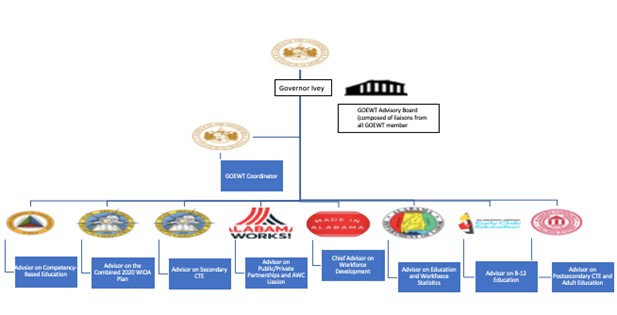
The GOEWT was charged with three goals: (1) to increase the labor force participation and to decrease the unemployment and underemployment rates; (2) to surpass the Alabama post-secondary attainment goal; and (3) to create career pathways in all 16 career clusters for in-school youth, out-of-school youth, adults, and disconnected populations. The GOEWT was assigned three objectives to achieve its three goals: (1) to braid Alabama’s federal education and workforce development funding streams to support an education-to-workforce pipeline; (2) to create and manage the Alabama Terminal for Linking and Analyzing Statistics (ATLAS) on Career Pathways as Alabama’s state longitudinal database system; and (3) to create the Alabama Office of Apprenticeship. The Director of the GOEWT is charged with nine tasks for achieving the goals and objectives of the GOEWT. The Director of the GOEWT is charged with (1) braiding Alabama’s federal education and workforce funding streams; (2) leading the Governor’s P-20W Council that governs the ATLAS on Career Pathways; (3) managing the development of the ATLAS on Career Pathways; (4) developing the Alabama Talent Triad; (5) identifying valuable credentials and career pathways aligned to secondary, post-secondary, and adult education programs of study; (6) coordinating the development of the combined WIOA 2024 State Plan; (7) coordinating with the Alabama Office of Apprenticeship; (8) creating a unified workforce marketing, outreach, and incentive strategy; and (9) coordinating Alabama’s federal education and workforce development grant applications.
The GOEWT Advisory Board consists of the 24 state agencies involved in education, workforce development, and human services in Alabama. The GOEWT Advisory Board provides advice and consent on the recommendations of the Director of the GOEWT. The Director of the GOEWT presents recommendations to implement the goals and objectives of the GOEWT to the GOEWT Advisory Board.
The GOEWT Advisory Board Member Agencies:
| Alabama Medicaid Agency | Alabama Department of Mental Health | Alabama Department of Economic and Community Affairs |
|---|---|---|
| Department of Human Resources | Department of Commerce | Department of Senior Services |
| Department of Corrections | Governor's Office of Minority Affairs | Office of Information Technology |
| Department of Labor | Department of Youth Services | State Senate |
| State House of Representatives | State Department of Education | Alabama Community College System |
| Commission on Higher Education | State Workforce Development Board | Alabama Workforce Council |
| Department of Rehabilitation Services | Department of Veterans Affairs | Department of Early Childhood Education |
| Department of Child Abuse and Neglect Prevention | Governor's Office of Volunteer Services | Department of Revenue |
The Alabama Technology Network (ATN), the Manufacturing Extension Partnership, often provides Incumbent Worker Program Training as part of its role in improving manufacturing processes. The AFL/CIO Labor Institute for Training (LIFT) provides assistance to Registered Apprenticeship programs to be added to the State’s ETPL. The Construction Education Foundation of Alabama (CEFA) is a private non-profit training provider established by the construction industry to provide pre-employment and pre-apprenticeship training for skilled trades. The Alabama Community College System (ACCS) also works with other education providers to ensure students have the opportunity to choose a seamless pathway from secondary through the community colleges to four-year institutions with multiple entry and exit points. The Alabama Workforce Council’s (AWC) Alabama Committee on Credentialing and Career Pathways develops regional and statewide lists of in-demand jobs and competency models linked to those in-demand jobs. The AWC’s Alabama Committee on Credential Quality and Transparency uses the non-degree quality and transparency criteria to evaluate credentials registered to Alabama’s credential registry.
ADRS currently engages the following educational and training providers as partners in the workforce development system to create job-driven education and training systems: Alabama Institute for the Deaf and Blind (AIDB), EH Gentry. These educational entities are focused on training individuals with visual and/or hearing impairments in curricula that are geared towards labor market needs. In addition to engaging with other educational entities, ADRS has partnered with other training providers, to include community rehabilitation programs and Alabama businesses to provide industry-specific training that is geared towards the learning styles of individuals with cognitive disabilities. ADRS will continue to seek out job-driven educational and training opportunities to enhance the skills attainment of individuals with disabilities and meet the workforce needs of Alabama’s businesses. ADRS will also work closely with all education and training providers to assess the need for and provide accommodations for the successful completion of training programs.