


Located in:
- III. Operational Planning Elements
The Unified or Combined State Plan must include an Operational Planning Elements section that supports the State’s strategy and the system-wide vision described in Section II(c) above. Unless otherwise noted, all Operational Planning Elements apply to Combined State Plan partner programs included in the plan as well as to core programs. This section must include—
- a. State Strategy Implementation
The Unified or Combined State Plan must include–
- 2. Implementation of State Strategy
Describe how the lead State agency with responsibility for the administration of each core program or a Combined Plan partner program included in this plan will implement the State’s Strategies identified in Section II(c). above. This must include a description of—
- 2. Implementation of State Strategy
- a. State Strategy Implementation
III. a. 2. E. Partner Engagement with Educational Institutions and other Education and Training Providers.
Describe how the State’s Strategies will engage the State’s community colleges, adult education providers, area career and technical education schools, providers on the State’s eligible training provider list, and other education and training providers, as partners in the workforce development system to create a job-driven education and training system. WIOA section 102(b)(2)(B)(iv). Include how the State’s strategies will enable the State to leverage other Federal, State, and local investments to enhance access to workforce development programs at these institutions.
Current Narrative:
Education in conjunction with the MPWS participants and employers is a key element in the three-legged stool of participants necessary to develop quality sector strategies in Missouri. The MPWS has strong partnerships with its educational institutions and other education and training providers. Educational institutions have long had a practice of involving employers in providing input to the development of needed training programs. Therefore, it is key to have the perspective and expertise of education as part of MPWS strategy and implementation.
The Eligible Training Provider System (ETPS) plays a key role in bringing MPWS and education together. ETPS not only can help partners engage with quality training programs, they can provide technical assistance for improvement. An example is equal opportunity training to ensure educational institutions are implementing practices and providing accurate tracking for diversity, equity, and inclusion.
Community colleges are often identified as pass-through entities for state workforce discretionary funds, intermediaries, or related-training instruction providers for apprenticeships and pre-apprenticeships as well as training providers for many of the core partner program participants. These institutions play a key role in assuring positive outcomes for individuals.
Educational institutions work alongside the MPWS to carry out the governor’s workforce initiatives and to address workforce crises which developed during and after COVID.
Through sector strategy initiatives and further asset mapping, Missouri has created educational pathways that can be seamlessly promoted through the one-stop delivery system. Using strategies which focus on customer service, sector strategies, and career pathways, business leaders, career and technical education (CTE) programs, and community colleges assist in creating accessible training programs that meet the needs of businesses and provide customers with work-based learning.
Through CSBG, Community Action Agencies (CAAs) have partnerships with community colleges and technical schools throughout the state. Partnerships provide educational opportunities, either through direct access to classroom instruction or collaborations with life skills classes that increase participants’ capacities to attain educational goals. Many partnerships have formal Memorandums of Understanding delineating responsibilities of each party.
The Department of Social Services (DSS) OWCI has educational partnerships with community colleges through the Missouri Community College Association. The community colleges offer services to Supplemental Nutrition Assistance Program (SNAP) recipients enrolled in the SkillUP program as well as participants enrolled in the MWA program. Each MWA region works locally with their educational institutions to develop programs that respond to the needs in their area. This includes the colleges providing additional class times or creating classes to meet the needs. The OWCI also has partnerships with 74 Missouri school districts that provide 114 different programs associated with the Jobs for America’s Graduates (JAG). In addition, the OWCI has a close working relationship with the six Excel Centers (adult high schools), located in St. Louis, West Branson, Florissant, Springfield, Columbia, and Poplar Bluff, where any Missourian over the age of 21 may enroll to receive their high school diploma while receiving career, life, and college counseling. The Excel Centers opened two satellite locations in FY 2023, with another two opening in FY 2024. The Missouri Legislature appropriated additional funding to create a new location in the Kansas City area, which will bring a total of five main campuses with four satellite locations.
OWD collaborates with CTEs to identify in-demand occupations which are then shared with the area career and technical schools to ensure that training needs match employer expectations.
OWD has engaged career and technical schools, community colleges, United Auto Workers, AFL-CIO, and employers to partner and develop pre-apprenticeships and apprenticeship programs. Examples are in advanced manufacturing and diesel mechanics. This partnership with education, labor, and employers ensures job-driven education and training systems.
As part of the MPWS, the Department of Corrections (DOC) plays an integral role in reaching justice-involved individuals prior to release. In FY 2023, approximately 2,500 incarcerated individuals were enrolled in basic education programs, 800 were enrolled in postsecondary education opportunities through partnership with area Career and Technical Education Centers and community colleges, and 725 individuals completed a DOC vocational training education program. In addition, 613 individuals obtained their high school equivalency at 100% success rate. Access to higher education continues to be a priority as well. DOC has partnerships with nine Missouri colleges and universities. The existing collaboration with educational institutions, AEL, MVR, OWCI, and OWD is essential to ensure that these incarcerated individuals who also experience additional barriers to employment have access to services which contribute to successful community integration upon release.
DOC is also looking for opportunities to expand services, such as utilizing DED industry cluster data sets to assist in determining needed trainings for Missourians for in demand industry opportunities. DOC is also contracting out services in the IT field of coding. These skills will aid clients in securing quality jobs in the IT field.
In addition to credentials already offered by AEL (manufacturing, IT, construction, healthcare, customer service, logistics, and more), the MPWS relies on educational institutions to provide AEL services around the state. Ten out of Missouri’s 29 AEL providers are community colleges or universities. This gives direct access to AEL students to experience postsecondary options and, in many cases, enables students through remediation of skills in preparation for credit-earning courses. K-12 institutions providing AEL services rely on CTEs to enhance occupational and workplace readiness for adult students. These partnerships that currently provide adult basic/secondary education are the primary foundation for the MPWS to expand IET programming for adult students.
In 2019, the Division of Workforce Development merged with the Department of Higher Education creating the Department of Higher Education and Workforce Development, Office of Workforce Development. The newly created department continues to closely align training and education and ensure cohesive customer support for the jobseeker and the business.
Offered through DHEWD, the Fast Track Workforce Incentive Grant is a program that supports working adults with an income of $40,000 or less, or $80,000 or less when filing jointly, in completing an associate’s or bachelor’s degree for in-demand occupations. Individuals have to meet other eligibility requirements and must be at least 25 years old or have not been enrolled in an educational program the two previous years, have not already earned a bachelor’s degree, must reside in Missouri and be a U.S. citizen, and cannot have a defaulted student loan. In 2022, the Missouri legislature added Registered Apprenticeship as an acceptable training program to receive FastTrack funding. This investment in the adult population will increase Missouri’s workforce availability and productivity.
Building Missouri's Future is Missouri's strategic plan for higher education and workforce development. Adopted in December 2021, the plan guides initiatives and priorities in Missouri for the next three to five years. The plan was created using data to determine statewide needs and compare Missouri to other Midwestern states. It outlines a comprehensive plan for education, training, and the public workforce system in order to encourage economic growth and personal success among Missourians.
It also established milestones in order to meet workforce demands and continue to help citizens compete in a global economy. Missouri will strive to be the best among other Midwestern states by reaching 60 percent educational attainment and 70 percent labor force participation by 2030, with equity goals aligned for both.
The MPWS provides adult education services to justice-involved individuals through DOC programming and AEL partnerships. Challenges for correctional adult education programs include staffing and access to technology. Instructors and proctors create new procedures to ensure the continuity of services for justice-involved individuals and often rely on paper testing and assessment. Post-pandemic, some facilities now allow certain mobile devices off the network. Teachers can use those devices to continue learning with adult correctional students outside minimal class times. The MPWS continues to support innovation in serving Missouri’s adult students in congregate care facilities.
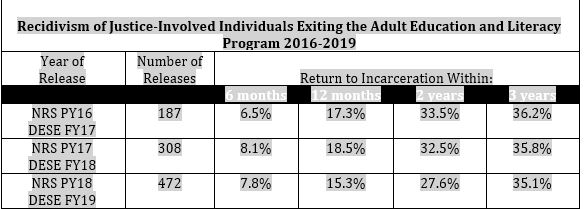
To determine the recidivism rate for criminal offenders served, Missouri uses a data match to determine all individuals enrolled in Adult Education and incarcerated in the Department of Corrections with a release date of July 2016 through June 2019. The table below shows the de-duplicated recidivism rate through 2022 for those individuals. In all date ranges measured, the AEL student recidivism rate is lower than that of the entire corrections population. The data demonstrate the capacity of Department of Corrections AEL programs to affect their students’ lives in a meaningful way.
A skilled, prepared, and motivated workforce is necessary to attract and retain businesses in Missouri. The MPWS recognizes all training opportunities beyond high school as highly valuable. Apprenticeships and on-the-job training, short-term certificates, associate degrees, bachelor’s degrees, and beyond all contribute to the economic health of the state.