


Located in:
- III. Operational Planning Elements
The Unified or Combined State Plan must include an Operational Planning Elements section that supports the State’s strategy and the system-wide vision described in Section II(c) above. Unless otherwise noted, all Operational Planning Elements apply to Combined State Plan partner programs included in the plan as well as to core programs. This section must include—
- b. State Operating Systems and Policies
The Unified or Combined State Plan must include a description of the State operating systems and policies that will support the implementation of the State strategy described in section II Strategic Elements. This includes—
- b. State Operating Systems and Policies
III. b. 3. A. State Agency Organization
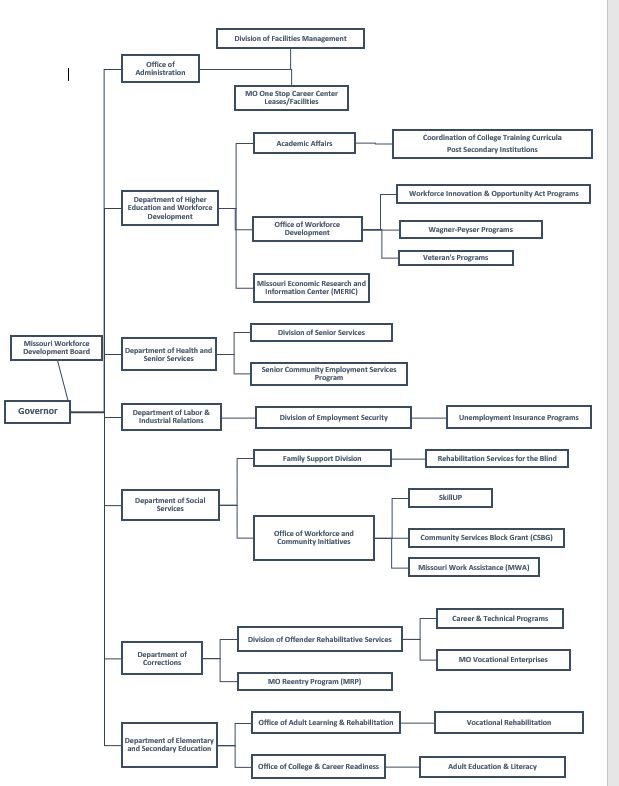
Describe the organization and delivery systems at the State and local levels for the programs covered in the plan, including the organizational structure. Include an organizational chart.
Current Narrative:
The governor serves as the grant recipient for the State of Missouri. The governor appoints the members of the State Workforce Development Board (SWDB), who, in alignment with the governor’s priorities, provide leadership across the workforce system. The Department of Higher Education and Workforce Development’s Office of Workforce Development, on behalf of the governor, oversees and administers the WIOA programs and holds primary responsibility and accountability for the oversight of Missouri’s workforce development system. The governor has designated thirteen (13) Workforce Development Areas and the Chief Elected Officials within those areas to act as grant recipients. The Office of Workforce Development is responsible for coordinating the collaboration among the WIOA core, combined plan and other state agency partners. Below is the organizational chart for the MPWS:
The SWDB represents a wide variety of individuals, businesses, and organizations throughout the state. The Board serves as a convener of state, regional, and local workforce system partners to enhance the capacity and performance of the workforce development system; align and improve employment, training, and education programs; and through these efforts, promote economic growth. The Board actively participates and collaborates closely with the required partners of the workforce development system, including public and private organizations. In addition, board meetings always allow for conversations with employers, education officials, economic development representatives, and others to further efforts towards achieving the purpose of WIOA, the state’s workforce vision and goals. Several state board members are also representatives on local workforce development boards. This provides a value-added component to state board meeting conversations. This approach has proven crucial in the Board’s role to help integrate and align a more effective job-driven workforce system that invests in the connection between education and career preparation. State Board members value the opportunity to engage and advise Missouri’s workforce partners in the setting and implementation of workforce policy for the state’s local workforce regions.
The vision of the SWDB is to prepare Missourians to enter the workforce with marketable skills and provide businesses with recruitment assistance to find workers with the skills they need.
The mission of the SWDB is to engage employers, education providers, economic development, and other stakeholders to help the workforce development system achieve the purpose of WIOA and the MPWS’s strategic and operational vision, goals, and strategies outlined in the State Plan.
The Board includes high-level management representatives from Missouri’s most successful companies, organizations, and government entities. State Board members represent a broad range of perspectives and each member has a sincere desire to help enhance the workforce system. Board members bring their individual, and sometimes regional, perspectives to board discussions. Members are connected to statewide, local, and regional workforce efforts. This mix of knowledge and skills supports a foundation of perspectives that ensures conversations are meaningful and encourages all members to contribute, especially core program officials.