



Located in:
- III. Operational Planning Elements
The Unified or Combined State Plan must include an Operational Planning Elements section that supports the State’s strategy and the system-wide vision described in Section II(c) above. Unless otherwise noted, all Operational Planning Elements apply to Combined State Plan partner programs included in the plan as well as to core programs. This section must include—
- b. State Operating Systems and Policies
The Unified or Combined State Plan must include a description of the State operating systems and policies that will support the implementation of the State strategy described in section II Strategic Elements. This includes—
- b. State Operating Systems and Policies
III. b. 3. A. State Agency Organization
Describe the organization and delivery systems at the State and local levels for the programs covered in the plan, including the organizational structure. Include an organizational chart.
Current Narrative:
State Agency Organization
Describe the organization and delivery systems at the State and local levels for the programs covered in the plan, including the organizational structure. Include an organizational chart.
This structure represents a top-down hierarchy where the Governor oversees the State Workforce Innovation Board, which, in turn, collaborates with various State Agencies, and the NH Works One-Stop Operator Consortium. Each State Agency is presented as a separate branch under SWIB, indicating their connection to the overall governance structure.
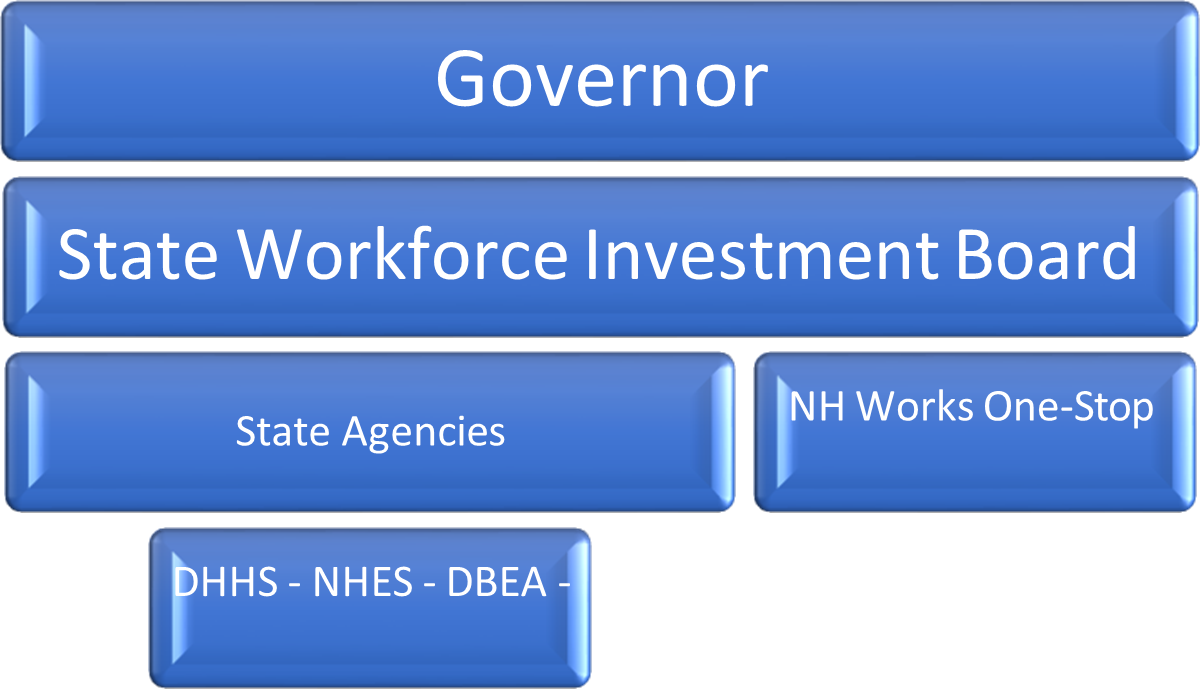
The Governor appoints Commissioners for each state agency. The Chancellor for the Community College System of New Hampshire is appointed by the CCSNH Board of Trustees. The Governor also appoints the Chair of the State Workforce Innovation Board and all other board members consistent with WIOA procedures. With the exception of DHHS—due to the size of the agency- the heads of each entity listed in the chart above are appointed members of the SWIB. In addition, the Governor holds monthly Commissioner meetings which allows for further cross-communication and information sharing specific to workforce development efforts related to the services and programs listed in the table below.
| State Agency | Program |
|---|---|
| New Hampshire Department of Education |
|
| |
| NH Employment Security |
|
| NH Health & Human Services |
|
| Community College System of New Hampshire |
|
| NH Department of Labor |
|
The Office of Workforce Opportunity (OWO) operates as the central administrative entity overseeing the allocation and utilization of WIOA Title I Adult, Dislocated Worker, and Youth funds in New Hampshire, with the Department of Business and Economic Affairs (BEA) serving as the state's fiscal agent and official grant recipient of WIOA Title I funds. The USDOL Region I Philadelphia/Boston office provides federal oversight and technical assistance.
As a single-state service delivery area, New Hampshire has strategically crafted a well-aligned governance and administrative framework, establishing policies, setting performance goals, and ensuring robust oversight to maintain the accountability of the workforce development system. The State Workforce Innovation Board (SWIB) functions as the advisory body, actively contributing to the development, updating, and evaluation of the planning process. This ensures that workforce development programs remain highly responsive to the evolving economic and labor market needs of New Hampshire.
The coordinated efforts of state agencies play a pivotal role in overseeing the effective implementation of various workforce development programs. Meanwhile, local agencies, including the local administrative arms of state agencies, are entrusted with the responsibility of program management and the provision of services to the end customers.
The organizational structure described above focuses on primary state-level program operators. However, it is important to note that the broader workforce development system encompasses numerous programs and services aimed at preparing individuals for employment and training. New Hampshire's established infrastructure facilitates comprehensive planning, policymaking, and accountability across a spectrum of workforce programs.
A range of committees, such as the One-Stop Operator Consortium (the Consortium), Interagency Business Team, Professional Development Team, Sector Strategy Team, Sector Partnership Initiative Committee, Strategic Planning Committee, and the Performance and Evaluation Committee of the SWIB, play integral roles in developing cohesive policies, strategies, and managing performance across diverse programs. The functions and roles of these committees were detailed in Section III (a)(1) State Board Functions.