



Located in:
- III. Operational Planning Elements
The Unified or Combined State Plan must include an Operational Planning Elements section that supports the State’s strategy and the system-wide vision described in Section II(c) above. Unless otherwise noted, all Operational Planning Elements apply to Combined State Plan partner programs included in the plan as well as to core programs. This section must include—
- b. State Operating Systems and Policies
The Unified or Combined State Plan must include a description of the State operating systems and policies that will support the implementation of the State strategy described in section II Strategic Elements. This includes—
- b. State Operating Systems and Policies
III. b. 4. B. Previous Assessment Results
For each four-year state plan and state plan modification, provide the results of assessments of the effectiveness of the core programs and other one-stop partner programs and Combined State Plan partner programs included in the Unified or Combined State plan during the preceding 2-year period (i.e. the 2-year period of the plan modification cycle), in accordance with methods described in 4(A). Describe how the State is adapting its strategies based on these assessments.
Current Narrative:
Oklahoma has measured the overall effectiveness of the system in the ways listed below. Executive Order 2023-21(EO) filed on August 10, 2023, with the Oklahoma Secretary of State moving the responsibility and authority to administer the WIOA Title I programs to the Oklahoma Employment Security Commission to “maximize our economic effectiveness, save taxpayer dollars, and assure that Oklahoma continues to be competitive with other states and countries.” and the establishment of the Oklahoma Workforce Commission both mean that Oklahoma will continue reviewing and redesigning assessment approaches as we grow into this new workforce strategy.
- WIOA performance measures applicable to the WIOA Core Partners include measures for education, credentials, and progress in education for both youth and adults are collected quarterly.
- Certification of local workforce boards will ensure that the boards are fully appointed and include individuals with optimum policy-making authority and expertise providing appropriate oversight and policy guidance to the local system.
- Annual program and fiscal reviews of the local boards.
- Expenditure levels are monitored at state and local levels to ensure services are flowing to participants.
- Reporting processes are in place for workforce-related complaints at the state and local levels.
- Certification of local one-stop centers.
- Accessibility and accommodations to individuals with disabilities are reviewed and monitored. Additionally, Eligible Training Providers must provide assurances through their applications for inclusion in the State List of Eligible Training Providers that their facilities are accessible and that reasonable accommodations are made for students as needed.
- Continuous improvement strategies are identified through ongoing efforts and implemented at the state and local levels.
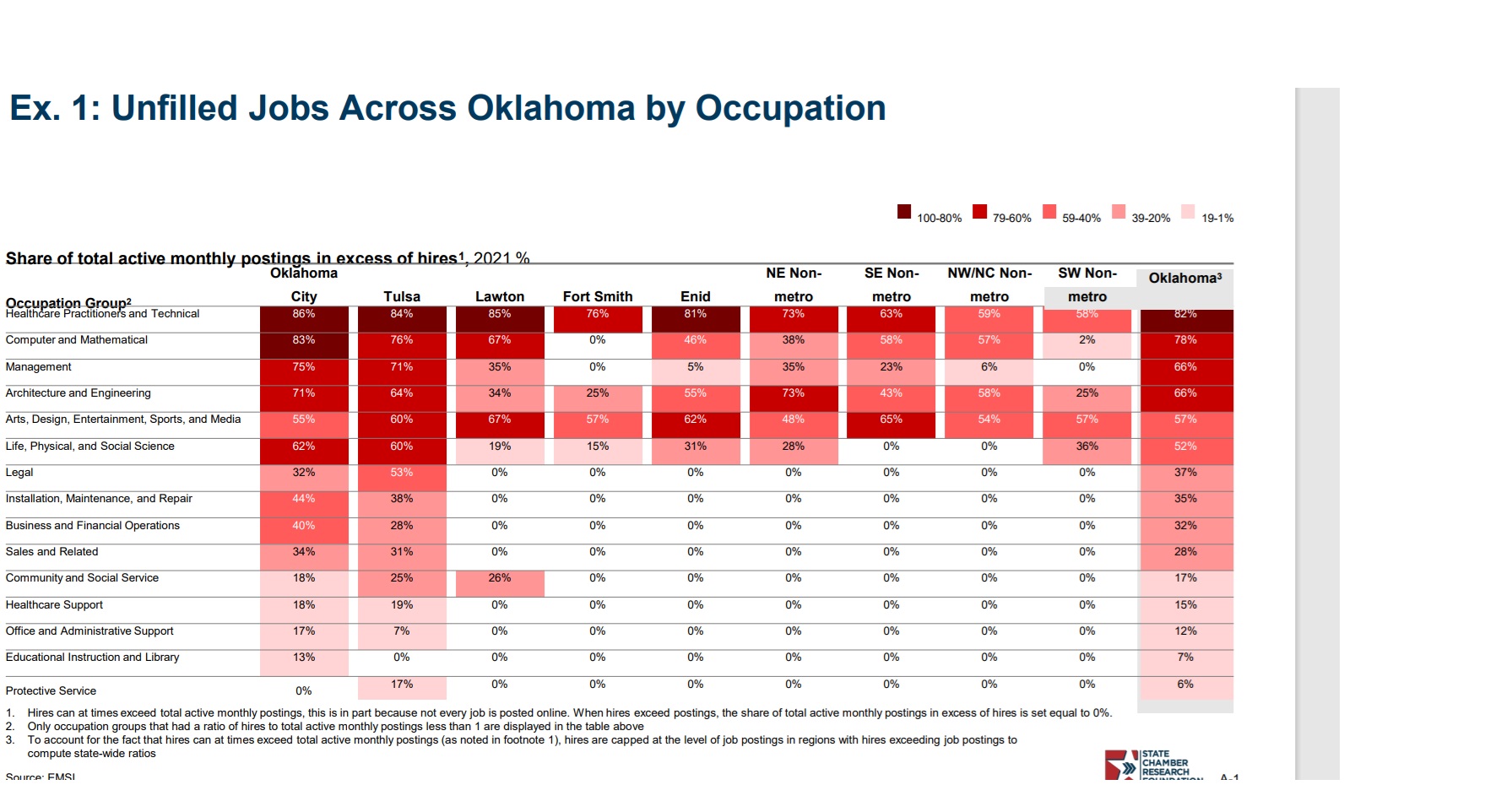
Oklahoma's most recent assessment results of Unfilled Jobs Across the State by Occupation produced the following results. The information can be found in Page 21 of the Oklahoma Workforce Transformation Report.
Results of assessments both positive and negative will be communicated to the local boards and partners. As appropriate, corrective action including improvement plans will be requested following continuous improvement principles and evaluated for their likelihood of success. Where performance, programmatic, or fiscal integrity is of concern, the State will communicate directly with the local board chair and the chief elected official.
Prior Assessments
In PY18 and PY19, Oklahoma met or exceeded performance levels for which there were negotiated targets across all four titles and core programs.
Assessments of PY20 and active monitoring of PY21 show that Oklahoma met or exceeded performance levels for which there were negotiated targets.
Assessments completed during this two year period were used in the same ways as the PY18/PY19 period. Active assessments use information derived from the state’s various data systems to analyze past and projected performance at the state and local levels. Performance and program assessments influence statewide strategies, across all four core programs, for continuous improvement aiming to develop effective and efficient strategies which assist in the successful outcomes of our participants.
Oklahoma strives to make decisions about the success and strategy of core programs using the data available to each partner. There have been staffing changes across the workforce system, enabling the state agencies administering programs to more effectively analyze and communicate with each of the core programs and with the Governor’s Council for Workforce and Economic Development.
Strategies such as monthly performance review meetings, quarterly/bi-annual collaboration calls, increased presentations, and more frequent access to real time data, provide key decision makers with the information needed to adjust or change the direction of strategies at the state and local levels.