Located in:
Other Appendices
Current Narrative:
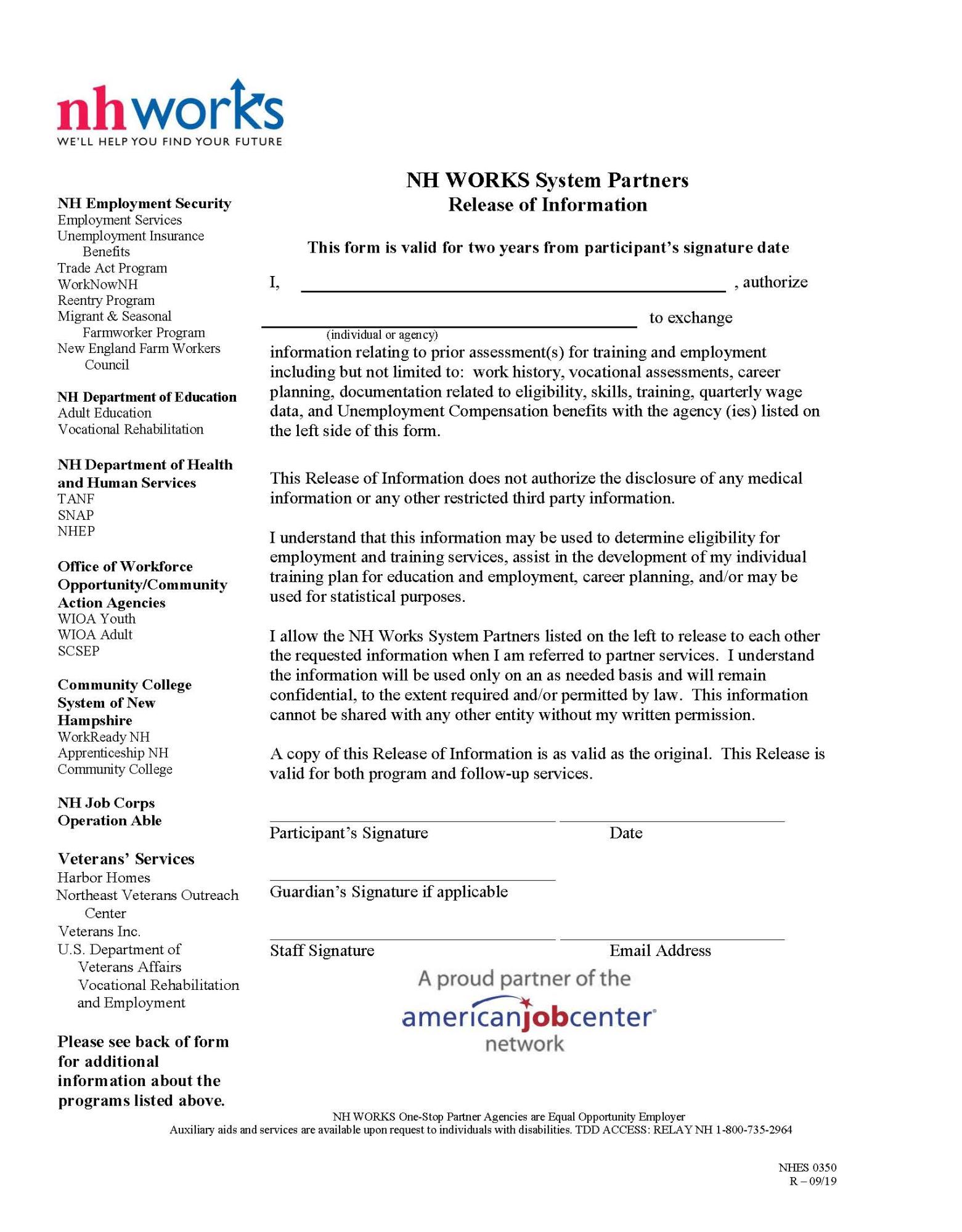
Appendix 2: Release of Information- English
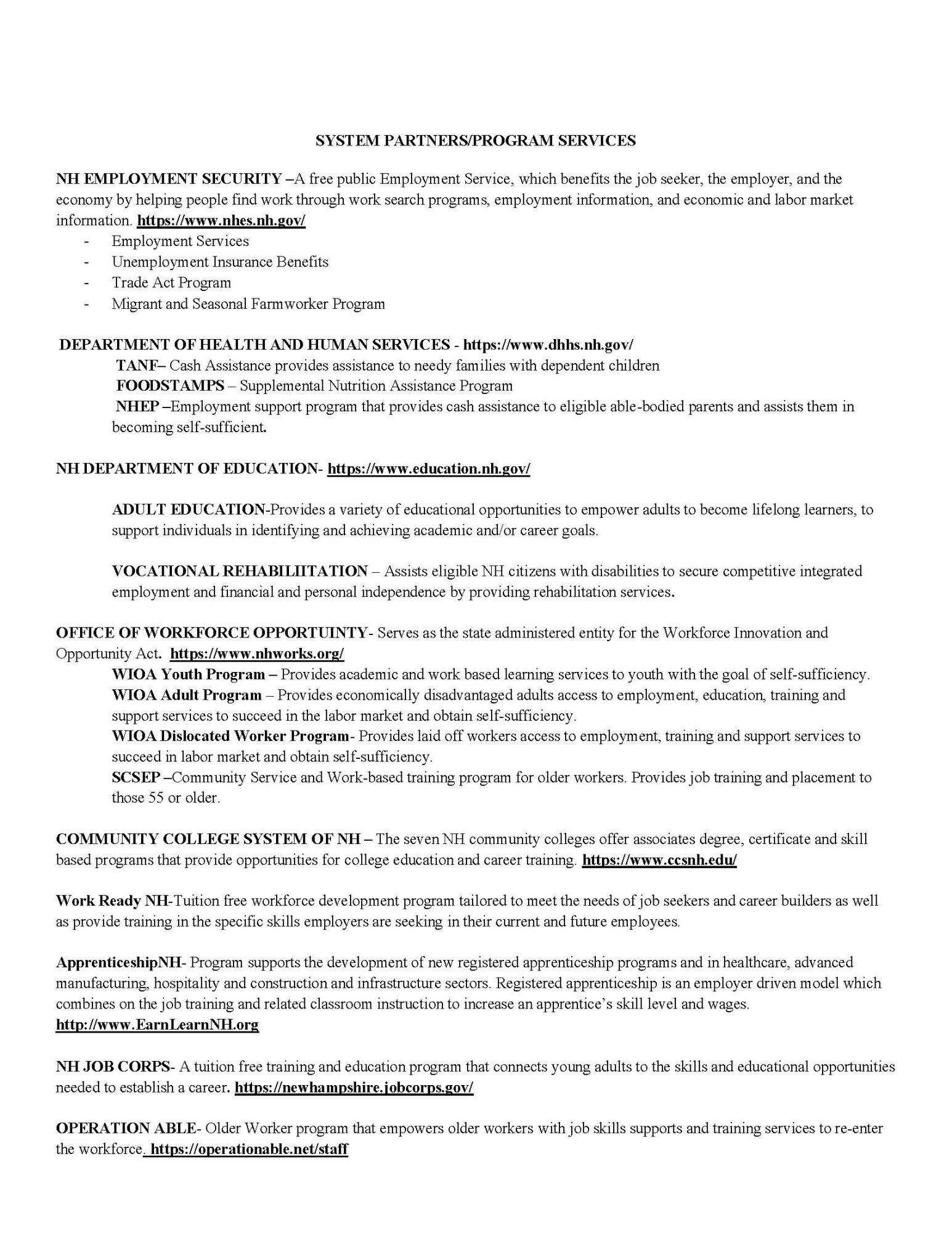
Appendix 3: State Workforce Investment Board Roster
| Required SWIB Members | Who May Satisfy The Requirement | Current Status | Region |
|---|---|---|---|
| The Governor (WIOA Section 101(b)(1)(A)) | The Governor | 1. Adam Crepeau (Proxy) | Statewide |
| Representatives of State Legislature (WIOA Section 101(b)(1)(B)) | One member of each chamber of the State legislature (to the extent consistent with State law), appointed by the appropriate presiding officers of such chamber. | 1. Senator Kevin Avard 2 Representative Joseph Alexander | Statewide |
| Board Chair –selected by the Governor | 1. Michael Kane | ||
| Representatives of Business (WIOA Section 101(b)(1)(C)(i)) | The majority (51%) of the board must consist of representatives of business who:
|
| North Northwest Seacoast West Seacoast Seacoast North West Central Central South Central Central South |
| Representatives of Workforce (WIOA Section 101(b)(1)(C)(ii)) | Not less than 20 percent shall be representatives of the workforce within the State, who must include:
|
| |
| Representatives of Government (WIOA Section 101(b)(1)(C)(ii)) | The balance of State Board membership must include:
|
|


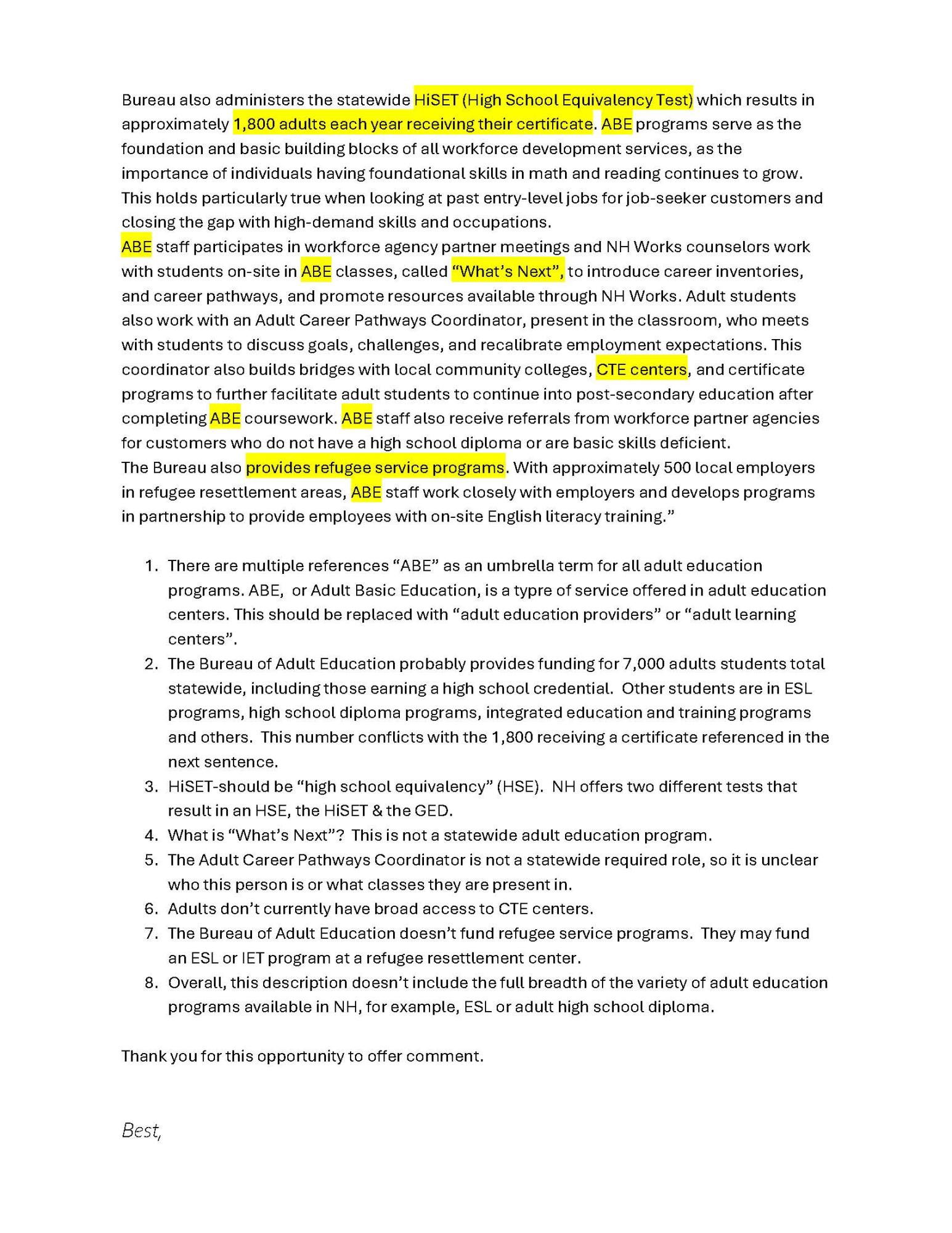

Appendix 5: Full SQSP Package
State Quality Service Plan Narrative FY 2024
New Hampshire Employment Security
A. Overview
Rebuilding and Improving Program Performance by Addressing the Significant Impact that the Workload Created by the COVID-19 Pandemic continues to have on the UI System:
New Hampshire was fairly well positioned, with regard to IT systems, at the start of the pandemic. New Hampshire’s benefit payment system was modernized in 2009, with many enhancements added since that time. These enhancements include a rewrite of the employer and claimant view portals as well as a fraud prevention program, “Spidering”, among others. All of the state’s hardware had been upgraded and fully placed into service in January of 2020, just prior to the onset of the pandemic, allowing the state the bandwidth to accept and process the extremely high number of claims received with zero down time other than scheduled system builds. This being said, New Hampshire still faced many of the same challenges as other states. Within the first few weeks of the pandemic, the number of non-monetary issues needing adjudication soared to over 40,000. With an adjudication staff consisting of 22 Certifying Officers, managing this workload in a timely manner was impossible. This extremely high volume also made evident some inefficiencies existing within the staff view of our benefit payment system, false positives with our Spidering program, staff management and new markers needed for our Benefit Payment Control system, “Investicase”, and with automation improvement with our collections software, “Collecticase”. New Hampshire was fairly well able to manage calls through the utilization of the New Hampshire National Guard and the use of non-merit staff flexibilities. Identity Verification became a huge concern for all states throughout the pandemic and remains an ongoing concern. New Hampshire was able to minimize losses resulting from Identity theft through our Spidering program as well as through manual processes.
New Hampshire was successful in integrating the Federal assistance programs along with their reporting requirements with the initial funding sources provided through their related UIPL’s. This has allowed New Hampshire to fully utilize all funds received through the 28-20 series of UIPL’s to integrate with IDH and IDV, enhance Investicase, improve intake of self-employment income (including GIG economy workers), incorporate Single Sign-On with Multi Factor authentication, increase our fraud investigator staffing levels, improve data management and analytic capabilities, and improve PUA overpayment recovery efforts.
For Investicase, BPC investigators identified several markers that are paramount in identifying potential identity theft, but which were not included in our Spidering program nor in our Tips and Leads portion of InvestiCase. Throughout the pandemic, these markers were produced through manual system queries and then manually reviewed by staff. These queries will be incorporated directly into the Investicase program on a real time basis, allowing for a much more efficient process. In addition, changes will be made to the staff management screen to allow for better search, assignment and prioritization of all BPC related issues.
After a necessary change in Law, New Hampshire was able to fully integrate with IDH/IDV. Single Sign-On with Multi Factor Identification has been developed on our side and we are just awaiting finalization of a vendor contract to go live. With UIPL 22-21, New Hampshire is in the process of onboarding a vendor, Login.gov, to provide document verification in the ID verification process. Improvements are being made to our intake of earnings within our benefit payment system as they relate to gig economy workers, other self-employed individuals and those receiving commission only earnings, such as real estate agents. UIPL 22-21 also includes some improvements to our Collecticase system.
New Hampshire also received funding under UIPL 28-20 change 4 which included more substantial changes to our Collecticase module. Such as the implementation of: enhanced and configurable case assignment rules/features; an improved dashboard; all aspects of bankruptcy within the case management system; business rule changes relating to collections remedies such as Wage Garnishment and Liens; Document Upload features to allow for the payment plan process to be fully incorporated within Collecticase; features for better visibility into the establishment and release of credit balances when repayments and offsets are reversed due to waivers and/or redeterminations; user interface pages to allow authorized Collections staff to modify some of the configurations that drive automated tasks and define the parameters related to different collections remedies; etc. Also, through 28-20 change 4, the enhancements to Collecticase will be complemented by the implementation of data analytics related to Overpayment Recoveries. The data analytics aims at facilitating an ongoing review of the effectiveness of the agency’s different collections remedies for identifying areas for refinements. Collecticase can, in turn, be fine-tuned by modifying its configuration settings and/or through future system enhancements. The Data Analytics is expected to similarly support a review of the Collections Unit’s performance and aid in sustaining it and/or improving it, as/when needed.
New Hampshire completed its process with the Tiger Teams. While the Tiger Teams represented a significant time commitment on the part of the state, its analysis was thorough, and its recommendations were in line with our identified needs and provided additional insight into the operations of our department. Through Tiger Teams funding, New Hampshire will be implementing Robotic Process Automation (RPA) in the Appeals process. Currently, it can take up to two hours for a staff member to compile the records necessary to create a paper appeal folder. Through the use of RPA, the creation of the Appeal folder will be automated with the filing of an Appeal. The RPA will create an electronic folder containing all relevant documents, will forward copies of the folder to all appeal parties, and will place the folder in a file location common to all appeal chairs. Chairs will then be able to access the documents from any location within the state, reducing postage and time. Staff who have had the responsibility of creating appeal folders will now be able to provide a greater level of support to the chairs allowing for the chairs to ultimately be able to hold a greater number of hearings per week.
New Hampshire is also improving its case management capabilities through Tiger Team funding. Tiger Teams’ interviews with NHES found the current Staff portal to be inadequate in its case management capabilities, especially during times of high unemployment. Adaptable work assignments, and smooth but robust workflows that drive effectiveness while maintaining efficiencies, uniformity and best practices through varying economic periods would allow NHES to quickly ramp up and down, as needed. The case management capabilities of NH’s Unemployment Benefits System (NHUIS) will be enhanced by implementing a dashboard that would be presented as the “Home” page when Adjudicators and their Supervisors log in. The Dashboard will display the user’s work items/assignments along with a set of metrics that will help the user in prioritizing work items, drive workflows and aid in increased overall performance and effectiveness. It will also include easy lookup features to allow for work assignments to be queried/filtered using a combination of a predefined set of criteria. The Adjudicator Dashboard will be complemented with a similar Supervisor Dashboard that allows Supervisors to review work distribution within their units, easily reassign large set of items and proactively drive performance improvements.
The Dashboard solution will be implemented using contemporary technology frameworks as a separate application that seamlessly integrates with the current Staff portal. It will include Single Sign-on capability for users of the Staff portal. To accomplish this, the login module of the current Staff portal will also be enhanced to incorporate common login capability that would allow authorized staff users to seamlessly traverse between the two applications (the Dashboard application and the current Staff Portal).
The Dashboard application will be designed in a manner that it can be extended and refined to meet similar requirements for other units (such as Appeals) within the agency.
New Hampshire has received the benefit of additional Tiger Team funds being made available through UIPL 11-23. New Hampshire is currently in the project design phase to determine the best use of these additional funds.
The extreme volume during the Pandemic forced New Hampshire to examine many of its current business processes, technologies and methods of service delivery for potential improvement. One of our first observations was that New Hampshire does not have an effective method for analyzing all of the data in its possession. To that end, New Hampshire is developing a data analytics program utilizing Business Intelligence software. date, the majority of improvements completed have had a primary focus on integrity. Improvements in the area of integrity will be discussed in New Hampshire’s Integrity Action Plan.
The pandemic also led to a large turnover in staff in terms of retirements, promotions and churn related to burnout. This led to a significant number of new staff which had to be trained quickly. New Hampshire has required all adjudication staff regardless of experience, to participate in all of the Adjudication trainings offered through NASWA’s learning site. All of our BPC investigators participated in and earned certificates in the Fraud learning components. Relevant staff have participated in the PUA training as well as other more specified trainings. All adjudication staff also recently participated in the adjudication training offered through the DOL-sponsored training “Adjudications: Past, Present, and Future” offered on August 23-25, 2022. We have also instituted a retraining program for all experienced adjudicators and a comprehensive re-training for all newly hired adjudicators to ensure there are not gaps in their training.
Focusing on Improving the Timely Delivery of Benefit Payments and the Reduction of the UI Adjudication and Appeals Backlogs:
New Hampshire has fully resolved its backlog in adjudication and appeals. All adjudication and appeal issues are now being scheduled and held timely. To address backlogs, we had temporarily promoted or reassigned staff to assist in areas where back logs remain. To address the adjudication backlog, we cross trained staff from other areas in our department to work on specific issue types, with the more complex issue being directed to experienced adjudicators. To reduce the Appeals backlog, we temporarily promoted several Certifying Officers. To assist with the BPC backlog, we reassigned a number of Certifying Officers to triage NDNH and SDNH hits to identify potential fraud. There remains a backlog within our BPC unit and staff continue to assist in this area.
Ensuring Equitable Access to UI programs
As mentioned earlier, New Hampshire will be applying for funding under UIPL 23-21 to assist us with addressing some identified Equity issues. Specifically, we will be seeking to rewrite all outward-bound communications and outward-bound facing information into plain language. We also intend to have all of this information presented in Spanish, based upon the claimant’s language preference. We are in the process of positing an additional bilingual Certifying Officer position and later, a bilingual Appeals Chair. We will be programming our system so that it will automatically assign adjudication and appeals to a bilingual adjudicator or appeals chair, if the claimant lists Spanish as their language preference. We are still in the process of building our data analytics component as mentioned earlier. Initial results indicate the Spanish speaking population to have greater delays in the payment of their claims and/ or adjudication of their issues. As we further refine our data analytics, we may identify other areas of concern with equitable access. However, plain language and Spanish translation seem to be the greatest barriers to equitable access.
Consistent with Tiger Team recommendations New Hampshire will also be utilizing some funds made available under the Tige Teams grant to improve the mobile responsiveness of our system. Throughout the pandemic, Claimants relied upon their mobile devices to submit unemployment claims. While our system will work with mobile devices, the information is not always presented in an easy-to-follow format sized to the screen being used. This did result in some claimants not providing all relevant information and delays in claims processing. Improving the mobile responsiveness of our system should help to alleviate some of these issues.
New Hampshire is also looking toward other vendor options for translation. While Spanish is the primary non-English speaking population in New Hampshire, ideally, New Hampshire would be able to translate claim information into any language. AI technology has improved translation software tremendously over recent years making such a prospect possible.
Supporting the Reemployment of UC Claimants through RESEA, Short-Time Compensation (STC), Robust Work Search Activities, and Other Targeted Initiatives:
In January of 2020, New Hampshire had planned modifications to its RESEA program within its benefit payment system. These enhancements included the creation of an intuitive, contemporary and user friendly front-end for RESEA staff to more easily to manage their workload and the scheduling of appointments, rewrite the RESEA timeslot creation component, and refine the claimant portal to more smoothly integrate with the new RESEA model. These items were delayed as a result of the pandemic. Funds originally allocated to this project will be added to funds newly made available for IT upgrades concerning RESEA to develop a more robust program. Claimants will be able to schedule their own RESEA orientation and one on one meetings as in person or virtually. Initially, they will be able to choose between virtual or in person for the orientation meeting with one-on-one meetings being offered only virtually. Eventually, all meetings will be offered as either remote or in person. We are in the process of rebuilding our staffing levels to be able to meet the demand of one-on-one in person meetings for all eligible claimants.
New Hampshire continues to utilize the profiling score to identify individuals for participation in the RESEA program. New Hampshire will has expanded the profiling score threshold to allow for greater participation with the ultimate goal of serving all potentially eligible claimants. With other enhancements to the benefit payment system, New Hampshire will include “nudging” messaging throughout the claimants filing process along with its current reminders, email or US mail by claimant preference, one week prior to the appointment with a telephone reminder 24 hours prior to the appointment, to help increase claimant participation. Increasing participation in RESEA will help to reduce improper payments and improve overall program integrity.
New Hampshire has an innovative and robust work search requirement which is designed to complement RESEA participation. It consists of three levels, a gold, silver and bronze medal level. If a claimant participates in a New Hampshire Employment Security sponsored Job Fair, they earn gold medal status, fulfilling their work search requirement for that week. Claimants are notified of all qualifying events weeks prior to their occurrence providing them plenty of opportunity to register and participate. Prior to implementation of this component, May of 2021, attendance at an NHES sponsored job fair was approximately 30 people for over 3000 job openings. After implementing this, attendance at NHES sponsored job fairs far exceeded the open number of jobs and, in fact, exceeded the number of available slots we had for the virtual event. We were forced to more than triple the available slots for the next virtual job fair. Attendance at NHES job fairs has dropped somewhat since, as the unemployment claims level has dropped significantly, however, attendance continues to remain robust. To obtain silver medal status and satisfy the work search requirement for a week, a claimant must make a minimum of two direct contacts with a hiring employer. To obtain bronze medal status a claimant must complete no less than five work search activities. The claimant may choose from a list of activities. Activities include such items as resume participation, registering on job search websites, and completion of chapters of “My Re-employment Plan” consistent with the requirements of RESEA, among others. A direct contact with a hiring employer also constitutes an activity. RESEA staff may override the level system should they conclude that the claimant would be best served by making a certain number of direct contacts per week. RESEA staff may also set the desired number of contacts. We plan to refine this a bit further with an upcoming rewrite, which was included in one of our SBR applications, to allow for RESEA staff to select specific activities to be required. We will also be including “nudging” statements to encourage a best next action in their work search efforts. For example, a claimant cannot complete Chapter 1 of the My Re-employment plan more than one time. If a claimant completes Chapter 1, they may receive a nudging statement to continue their progress with this plan and work on Chapter two this week. The next time they file, Chapter one would no longer be an option for them. We have already built in some integrity controls. For example, a claimant may not enter the same employer multiple times on the same application or for multiple weeks in a row. They may also not list the employer from which they had been recently laid off as a repeated entry. Should a claimant do either of those things an alert creates for the ES/RESEA staff to review their work search. ES/RESEA staff can then enter an issue for adjudicators if the work search is deemed insufficient. All work search activities are accurately documented within our benefit payments system and are available in real time for RESEA staff to utilize when conducting one-on-one meetings and reviewing for eligibility.
New Hampshire has a successful STC program. It had been only sparsely utilized by employers prior to the pandemic, but its use gained popularity during the pandemic and proved extremely valuable to many employers as they began to bring their workforce back. New Hampshire has noticed some areas in which we can improve our STC program. Flexibility is the primary issue raised by employers. Currently, an employer must identify the unit(s) effected and list a reduction that will prevail throughout the life of the STC plan. If an employer determines they currently require a 50% reduction, they will enter into a plan that locks them into that reduction for a period of 26 weeks. The only way to change the reduction is to terminate the plan and institute another. Ideally, an employer would be able to change the reduction percentage, on a monthly, if not weekly, basis to reflect changes in their workload over the course of the STC plan. New Hampshire will be applying for funding under UIPL 22-20 to affect these changes. We do not expect to apply for these funds until Q4 of 2023 as we have a number of time sensitive competing priorities which must be resolved prior to dedicating resources to this endeavor.
Combatting Fraud; Strengthening Identity Verification; Improving Prevention, Detection, and Recovery of Improper and Fraudulent Overpayments; and Reducing the UI Improper Payment Rate:
Prior SBR funding supported our project, “Spidering”, which incorporates cross matches and suspect data such as IP addresses into a complex scoring methodology to proactively identify situations that could lead to fraudulent payments. The Spidering program was deployed in September of 2017. Functionality in the deployment to production included:
- Random identity proofing – random requirement for claimant to answer questions to verify their identity before filing a claim.
- Selected identity proofing – an individual with a blocked attribute (such as a suspect address or bank account information) will be required to answer questions to verify their identity before filing a claim.
- Failed identity proofing - send individual down a parallel path for filing. If an individual fails the identity proofing questions, they will be allowed to proceed and file a claim so that we can collect all data points and mark them as “suspect”. The individual will be presented with a message at the end of the claims process advising them to report to a Local Office with identification. The claim is not processed until that time.
- Manual attribute marking – assign a score to various attributes whereby any individual filing a claim with a matching attribute is flagged for review or blocking.
- Automatic attribute marking – the deceased flag received from SSA will be used to automatically mark the SSN. Other attributes will be marked, or the score increased dependent on circumstances or the number of claimants filing with the same attribute.
- Pro-active messaging. For example, an individual who has been previously found overpaid due to misreported or unreported wages will receive a message when filing their next claim that we are aware of the challenges they have experienced in the past and staff are available to assist if they need help accurately reporting work and earnings.
New Hampshire has applied for and received approval for funding under all of the UIPL 28-20 series. We intend to utilize these funds to rebuild our “Spidering” program incorporating the lessons learned over this pandemic. As stated above, New Hampshire developed its “Spidering” program several years ago to assist in identifying fraud. It utilizes a series of markers and scores to identify potential fraudulent claims. The program was not designed to handle the volume of claims we received at the start of the pandemic. Some of the components of the program needed to be shut off as they were producing too many false positives. In a normal recessionary environment, we would have been able to review all of the results of the Spidering program, however, with these unprecedented numbers there were simply not the resources available to do so. The funds being provided, through the UIPL 28-20 series, will allow us to leverage the existing system while incorporating lessons learned. In addition, we will be able to integrate additional protocols specific to individuals who would typically not be covered, such as GIG workers, self-employed, and those that lack sufficient quarterly earnings.
New Hampshire has gone live with all aspects of IDH and IDV. In order to do so, New Hampshire needed a change to legislation. This did lead to some delays in implementing, but we are there now. New Hampshire is live with separation information exchange with SIDES. New Hampshire has plans to integrate the Monetary and Potential Charges, Decisions and Determinations, and Benefit Charges exchanges over this biennium period.
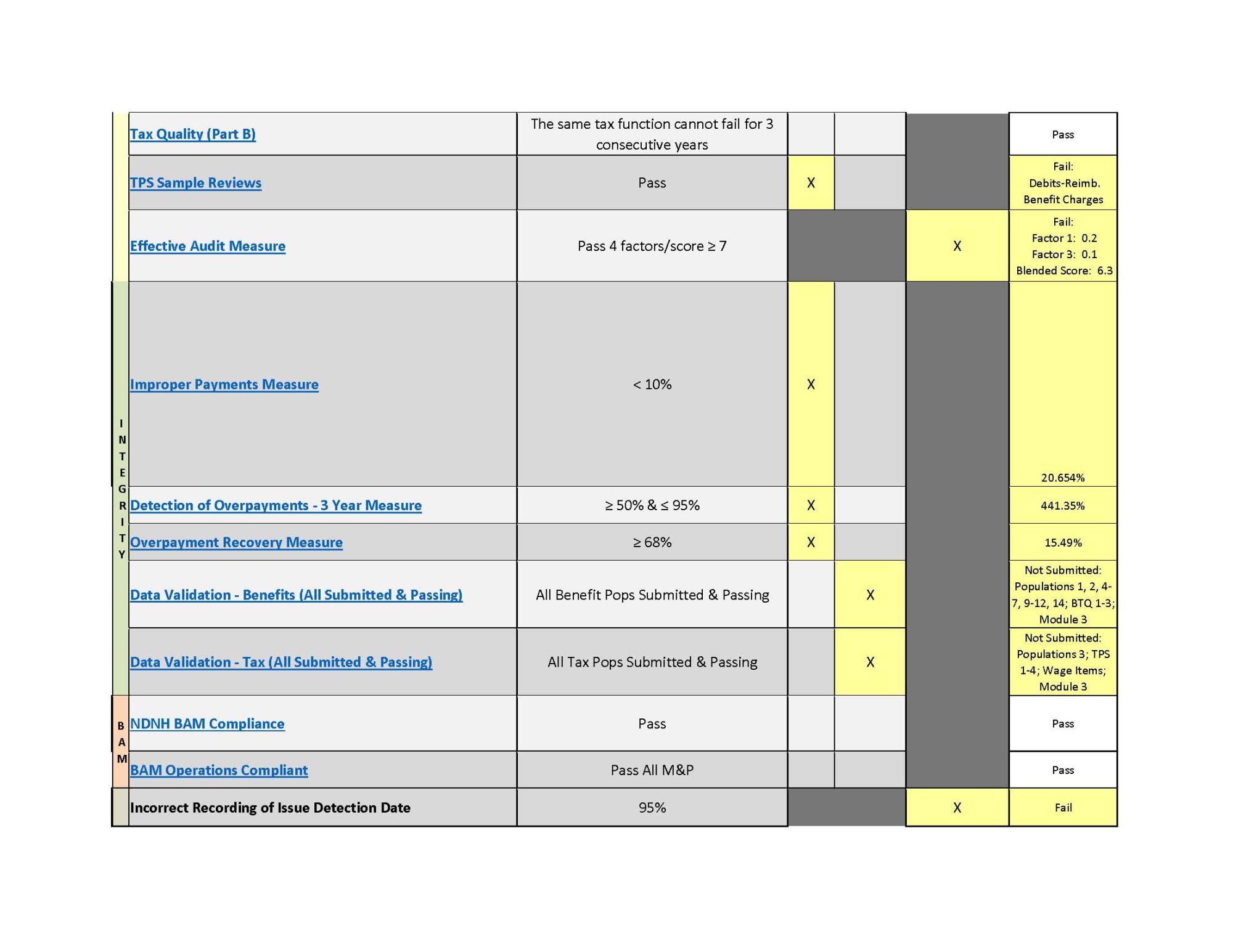
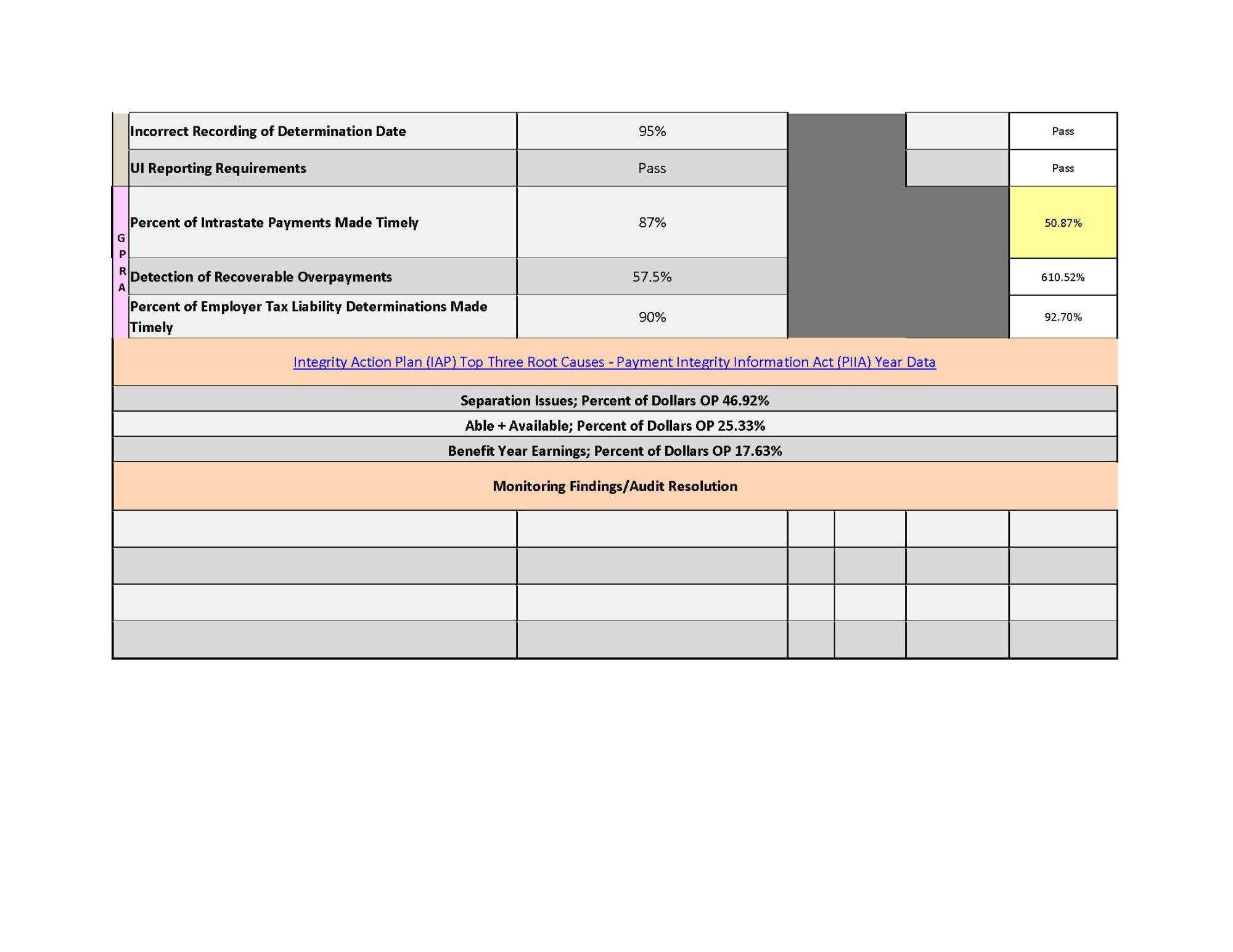
New Hampshire’s 12-month improper payment rate ending 12/31/2019 was 6.9% and for the one-year period ending 3/31/2020 we were at 5.18%. New Hampshire is proud of the gains it had made in improving its improper payment rate. New Hampshire’s improper payment rate soared for the period ended 12/31/2020 to 19.438%. New Hampshire has started to reduce its IPPR with end of year 2022 coming in at 17.34%. It appears the primary catalyst for this was due to a backlog of separation issues, with nearly 50% of all improper payments attributable to this factor. As stated earlier in this report, New Hampshire ceased holding payments on separation issues for a period of time at the start of the pandemic. As our campaign to resolve this backlog of separation issues progressed the overpayments associated to this category increased. The backlog related to adjudication and appeals has since been resolved. We may still experience some impact as claims move through upper levels of appeals, and as we work through our Benefit Payment Control backlog however, we expect our IPPR to continue to fall as we work through these remaining backlogs.
Benefit Year Earnings is the next highest contributor to New Hampshire’s improper payment rate comprising just over 20% of improper payments. New Hampshire had been very successful in controlling overpayments which are the result of benefit year earnings prior to the pandemic. Several factors have contributed to the increase. Preventing ID theft claims has dominated our BPC unit’s attention since the start of the Pandemic. There were simply not enough staff to also investigate the huge number of claimants that were not reporting their earnings in addition to the demands placed on that unit in preventing ID theft. Since ending the Federal programs on June 19, 2021, our BPC staff has been able to refocus their energies on the more traditional types of fraud such as benefit year earnings. Our system is designed, through our Spidering program, to detect unreported earnings as soon as employer wages are entered. We currently have a backlog of approximately 6,000 investigations related to benefit year earnings. It is likely this number is a bit inflated as a claimant may appear on this report more than once. As our Benefit payment Control staff work through this backlog, it is likely we will continue to see a rise in improper payments as a result of unreported earnings. As New Hampshire works to improve its ability to better verify the identity of individuals at the onset of their claims through the use of technology, the demands related to ID theft investigations, in future recessionary conditions, should be greatly reduced. This will allow for BPC to concentrate on the more traditional types of fraud at the onset. New Hampshire has temporarily assigned a number of adjudicators to assist with triaging our NDNH, SDNH and other cross match hits to allow for BPC staff to focus on those claims needing investigation. This has helped to reduce the backlog at a much greater pace.
The final primary contributor to New Hampshire’s improper payment rate is Ability/Availability issues. Prior to the pandemic, New Hampshire’s improper payment rate related to ability/availability issues was zero. The bulk of these issues were the result of claimants not being honest with their initial claim filing and the department later becoming aware the claimant was not able or available for work for reasons other than COVID-19. In some cases, these were discovered by the Department, in other cases, claimants reported availability/ability issues with subsequent filings.
New Hampshire has not lost focus on the primary causes of improper payments in a normal UI environment. Also included in our request for supplemental funding is a rewrite of our work search program in our benefit payment system. We already have a very robust and interactive work search program which incorporates activities such as participation in the “My Reemployment Plan” associated with RESEA. However, components of this program were rushed in an effort to reinstate work search at the end of May 2021. We will be revisiting these issues and also incorporating some new functionality which will include positive reinforcement and “nudging” for future work search activities. This effort is designed with the intent of lessening the claimant’s duration of unemployment while also lessening the propensity for fraud in completing these. New Hampshire incorporated three options for a claimant when completing work searches. Gold Medal – claimant attends a NH Employment Security Activity such as a job fair. Silver Medal – claimant makes a minimum of two direct contacts with a hiring employer. Lastly, Bronze Medal – a claimant completes a minimum of five work search activities. Activities can include attendance at a NHES workshop, completing chapters in the My Reemployment Plan, completing or revising a resume, registering on job search websites and etc. Some of these activities can only be performed once. For example, a claimant may only complete chapter one of their My Reemployment plan once. Once they select this item it will no longer appear as an option on future continued claims. We will be incorporating more of this type of logic with the work search rewrite.
New Hampshire has a pretty good handle on detecting benefit year earnings, or at least prior to the pandemic we did. One area in which we could improve is the reporting of income earned in self-employment and in other nontraditional employment such as with gig workers. We have received funding through the 28-20 series to assist with a rewrite of this portion of our earnings program.
As of April 2023, New Hampshire’s IPPR has fallen to 7.48%, well under the threshold of 10%. New Hampshire expects this trend to continue downward with improvements to our system relative to benefit year earnings and work search, ongoing through this reporting period.
New Hampshire has 100% of available TPA’s utilizing SIDES file exchange and has been aggressively marketing SIDES E-Response to non-TPA employers. New Hampshire made the choice to automatically sign up all non-TPA employers for E-Response in September 2016. While the use of E-Response is not mandatory by law, language is included on all Notice of Claim correspondence to encourage the employer to use this method of response. In addition, with our employer rewrite launched in 2018, all electronic employer requests for information responses are routed through the SIDES system. The agency continues to participate in Employer Seminars and provide promotional materials to educate employers about the benefits of using SIDES.
The Collections Unit takes advantage of Lexis-Nexis locator software as well as Wage Records to find debtors and aggressively pursues collection. NH is looking to implement some of the SIDES other modules module this fiscal year, also with funds provided through UIPL 28-20, which should also assist in these operations. New Hampshire utilizes TOPS for both claimant and employer debt. The department utilizes wage garnishment, property liens and distraints when attempts to set up voluntary repayment plans are not successful.
Workforce Innovation and Opportunity Act (WIOA)
New Hampshire’s UI and ES Directors work closely together and have a common goal of serving the UI claimant in a cohesive and collaborative manner. UI and ES staff work side-by-side in the Local Offices and are cross-trained in many areas. Each Local Office has staff available to assist claimants to file claims, answer questions regarding eligibility and explain department correspondence. An adjudicator is co-located in the larger offices.
New Hampshire Employment Security acquired the management of the WIOA program and related funds during calendar year 2019. Staff have been hired and program revisions and development are underway. This process has been interrupted, to some degree by the recent pandemic. Nevertheless, prior existing contracts are being managed and new contracts are being developed.
New Hampshire submits a Combined Plan and the SQSP is included, and updates supplied as part of that plan.
RESEA
In March of 2021, RESEA resumed in New Hampshire. We incorporated virtual orientation and one on one meetings. We started the program with a small population, identified individuals with job experience in our highest demand industries and included this group first. We have since resumed utilizing the claimant’s profiling score in identifying the service population. We plan to expand the population served through RESEA to include all claim filers who are not work search waived. This process of seeing everyone will begin once we have sufficient staff trained to address this population. This is a configurable item utilizing the profiling score. We can easily reduce the population we serve should volumes prohibit us from being able to continue to see all claimants. We will be incorporating a choice of either in person or virtual for all of our meetings in the near future, with staff having the ability to override and require in person if necessary. We believe this will assist in improving overall attendance. The programming is in place for this to occur. The expectation is that we will resume in person meetings in mid-November 2022. We do currently offer in person for individuals who are technologically challenged. The “My Re-employment Plan” is incorporated into both our RESEA program and as a valid work search activity within our benefit payment system. The RESEA staff conduct an eligibility review as a component of each one-on-one RESEA meeting. The staff member will review the claimants’ work searches, work history, UI eligibility criteria and advise the claimant appropriately and/or require additional work search efforts. Expanding this program to include all claim filers will provide an opportunity, early in the claims filing process, to review and explain eligibility criteria and to assist the claimant in being successful in their return to the labor market.
Worker Misclassification
In order to facilitate a higher likelihood of identifying misclassification, data received from the Internal Revenue Service, based on companies that have issued “single-payor 1099s” (Single Payor 1099 – where the recipient’s only 1099 sourced income (1099-MISC / 1099-NEC as of 2020) was issued by the business targeted for audit), are sorted by the frequency the EIN has appeared in the data. Companies appearing on the comparative lists for sorting most frequently (both registered and unregistered), and have no prior audit are prioritized for auditing.
B. Federal emphasis (GPRA goals 2021)
Percent of Intrastate Payments Made Timely (Make Timely Benefit Payments)
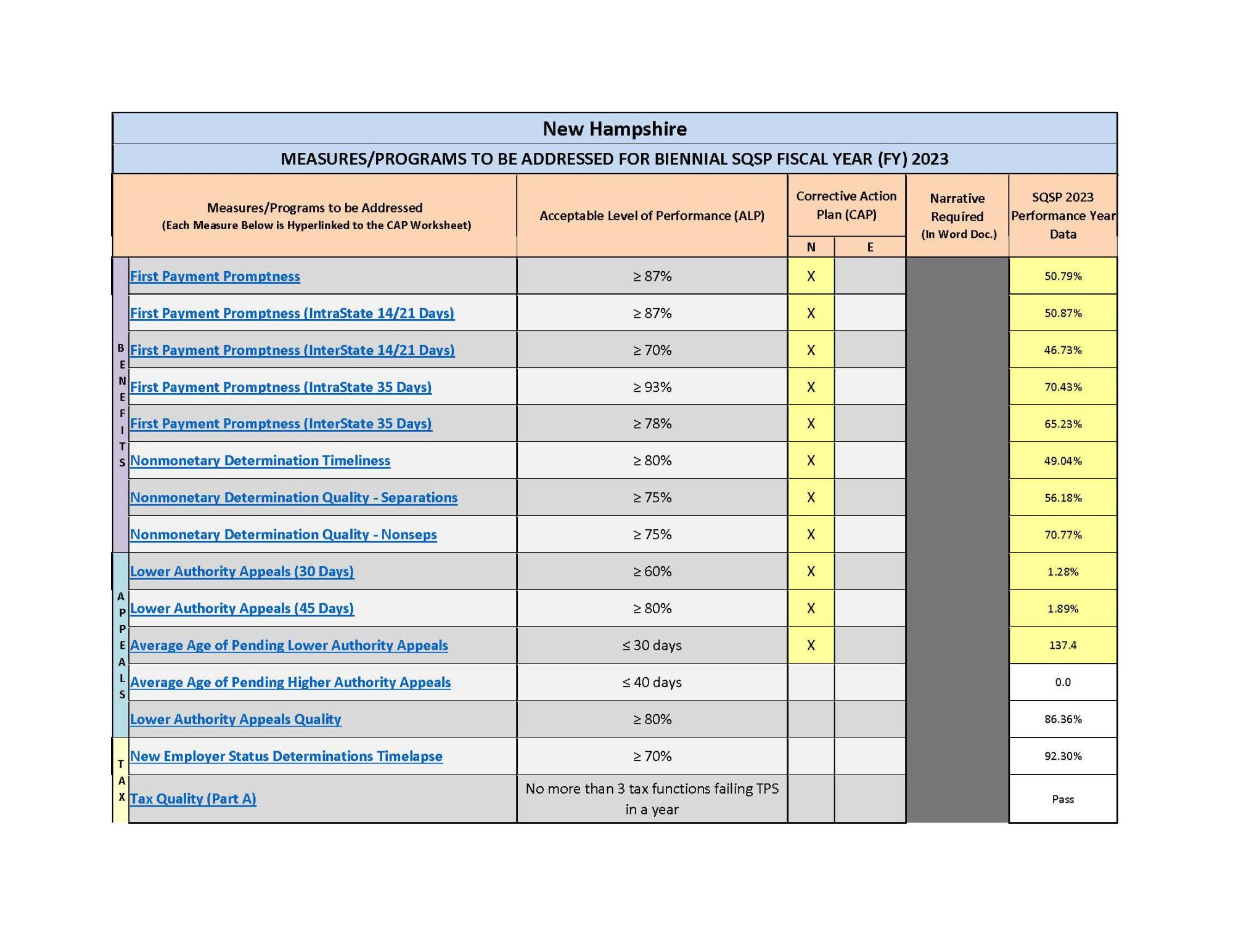
New Hampshire takes accurate and timely payments seriously. Considerable efforts have been levied on first payment timeliness, non-monetary determination timeliness and quality, reporting accuracy and data validation. Prior to the pandemic New Hampshire met all criteria associated with these measures and was not required to submit a corrective action plan.
The Pandemic changed all of that, not unexpectedly. New Hampshire has failed nearly all GPRA components for fiscal year 2022. This is a direct result of the extremely high and unmanageable workload. New Hampshire is confident, it will return to passing in all measures now that its backlog is resolved. We expect delays in returning to passing with some measures, as a result of higher-level appeals working their way through the system, however, anticipate passing all measures by q2, 2023.
Since resolving its backlog, New Hampshire has reinstated all of its timeliness and quality controls. New Hampshire redesigned its reporting, related to timeliness, in our benefit payment system in 2017. These revisions allow for a display of timeliness data, in real time, which allow for managers and supervisors to easily view and sort information to identify timeliness issues before they occur. This has proven to be a useful tool in years past in effectively managing first payment and non-monetary timeliness. Utilizing this tool, New Hampshire was able to pass first payment timeliness in July 2022, at 87.03%, for the first time since the pandemic began. While first payment may still have some potential residual impacts from the pandemic, we expect to be back on track in consistently passing first payment with q4, 2022.
New Hampshire’s first payment timeliness has been improving. New Hampshire has consistently passed first payment timeliness throughout 2023. This does remain a challenge as ID verification has had a significant negative impact on first payment timeliness. With the coming implementation of Login.gov and its postal option, it is expected additional negative impacts will occur. The postal verification component allows for the claimant to verify within seven days. If a claimant successfully verifies their identity timely, it will result in a seven-day delay in the processing of the claim for first payment. This effectively reduces the time a state has to process a claim timely by 33%. This is a significant burden to overcome.
Detection of Recoverable Overpayments (Detect Benefit Overpayments)
New Hampshire has always passed the detection of recoverable overpayments target until the pandemic. This measure is completely out of range due to the enormous number of overpayments established by BPC, both Fraud and Non-Fraud, as they worked through the grids that contained many thousands of issues. This resulted in BPC detecting and establishing over 4 times as many overpayments as QC BAM Operations. Unreported work and earnings were the most popular cause during the Pandemic for most of the non-fraud overpayments that BPC established. This measure could remain elevated as BPC continues working through its backlog. Triage (identification of those claims needing fraud investigation vs those that can be cleared or handled as non-fraud) of all outstanding BPC issues is almost completed. The BPC backlog is expected to be fully resolved by q2 end 2024.
Percent of Employer Tax Liability Determinations Made Timely (Establish Tax Accounts Promptly)
New Hampshire passed this measure for fiscal 2022 with a score of 92.7%. New Hampshire will continue its successful approaches in this category.
Improve Effective Audit Measure
New Hampshire has recognized a 20% growth rate in the number of registered employers over the past two years. We attribute much of this to the increase in remote workers in the fields of administration and technology, with many Massachusetts companies allowing their employees to work out of their homes in New Hampshire. To address this additional need, New Hampshire has created an additional permanent Field Auditor position. We expect the addition of this position along with a greater emphasis in conducting audits on larger employers to improve our effective audit measure both in numbers of employers audited and in total dollars audited.
C. Program review deficiencies
Improving Data Validation and Federal Reporting
Per UIPL 16-15, New Hampshire was awarded additional funds to enable staff and time to be dedicated to the accuracy of reporting and data validation. This project was completed in December of 2018. Unfortunately, a couple of small errors in programming resulted in NH continuing to fail Data Validation as well as BAM. In September of 2019, New Hampshire completed its revisions to the BAM reporting. We will continue to monitor this to ensure accuracy.
New Hampshire failed data validation for populations 4, 5, 6, 12, 9 and 14 with our most recent submission. We have not yet identified a cause for these failures. We are currently investigating and will update with our quarterly SQSP submission as information becomes available.
New Hampshire is also having additional difficulties with pop 3 for tax. Changes to the charging of employers including reimbursors, over the pandemic period, resulted in incomplete and incorrect reports being generated from our tax system related to pop 3 tax. New Hampshire has a legacy tax system. Over the course of the Pandemic, the IT resources responsible for maintaining this system retired. New Hampshire has been unable to find qualified IT resources to maintain this system. We have just contracted with our benefit payment system managing vendor to take on the responsibility of maintaining this system. This contract is effective as of 10/1/2022. The after a knowledge transition period, their first priority will be to resolve the pop 3 tax issue. New Hampshire does plan to build a new tax system, the process of allocating funding and planning of this upgrade had begun prior to the pandemic.
New Hampshire has failed nearly all data validation components. We are reevaluating all of the measures to identify causes for the failures. We expect this assessment period to extend throughout the majority of 2024 with development to begin in the fourth quarter of 2024.
D. Program deficiencies
Improper Recording of Detection Dates
New Hampshire has levied considerable resources to the accuracy of detection dates. The importance of detection dates is included in new staff training and reminders are sent regularly. The Quality Control Unit provides feedback about any claim picked for BAM or BTQ for which the detection date is incorrect, and the error is reviewed with the individual adjudicator. Checking the accuracy of the detection date is part of the QCRP and AQUIP quality programs that the training unit and supervisors use to assess staff performance and provide direction and training.
E. Reporting requirements
New Hampshire has been current with all reports.
F. Customer Service Surveys
New Hampshire has not conducted customer surveys over the most recent completed fiscal year. However, New Hampshire did participate in the Tiger Teams process. Tiger Teams did make contact with New Hampshire Legal Assistance, as well as other Human Service agencies in the development of their recommendations. New Hampshire does plan on utilizing customer surveys as a part of its upcoming plain language project, provided funding is approved through the Equity Grant offering.
Through New Hampshire’s plain language initiative, we will be contracting with a vendor to assist with creation of focus groups with an emphasis on Behavioral Insights. New Hampshire is currently working with NASWA in developing its project plan and with assistance in identifying a vendor with experience and success in this process.
G. Other (approach to maintaining solvency, requests for technical assistance)
New Hampshire’s trust fund is solvent, and no monies are owed for funds borrowed. To date, as a result of the pandemic, the Governor has inserted 75 million dollars of Cares Act funds to help assure the funds solvency. This has allowed for New Hampshire’s trust fund to exceed the first threshold ($250 mil) for a fund balance reduction to the tax rate for employers. Beginning with q4 of 2022, employers, in good standing, will receive a .5% reduction to their current tax rate.
Beginning with q-2 2023, employers began receiving a 1% reduction to their current tax rate.
H. Assurances
New Hampshire’s UI IT Contingency Plan was reviewed and updated in December of 2019. In December of 2019, New Hampshire completed an extensive upgrade to the hardware (e.g., workstations, servers) and software of the systems used to process and store the information supporting New Hampshire’s Unemployment Insurance System (NHUIS), staffing changes on critical disaster response teams, information regarding recent disaster recovery tests completed and updates to disaster recovery policy and procedure.
The NHES Unemployment Insurance Operational Security Plan is has been reviewed and updated to include the recent hardware and software upgrades as well as changes to the department’s disaster recovery procedures.
Upon completion of the hardware upgrade New Hampshire completed a formal in-house Risk Assessment.
The NHES Information Security Officer has conducted internal inspections of the NHES Data Center and NHES Administrative Building housing IRS Federal Tax Information (FTI) as required by IRS Publication 1075.
New Hampshire Cyber Incident Response Exercise Program
In 2017, the State of New Hampshire kicked off the New HampshireCyber Incident Response Exercise Program. The program consists of a progressive series of events including workshops, tabletops, and functional exercises to review, test, update, and enhance (the state’s) Cyber incident response plans and procedures. The NHES Information Security Officer/COOP Coordinator and DOIT IT Manager participated in in a series of events (State Government training; planning workshops; table top exercises and full day functional exercise) beginning in September 2017 through May 2018. Additionally, the NHES Information Security Officer (ISO) regularly participates in quarterly State of New Hampshire Cybersecurity Advisory Committee (CAC) and Continuity of Operations Planning (COOP) Coordinator meetings to stay current on Cybersecurity and Disaster Recovery policy and procedure.
IRS 2019 Safeguard Security Report (SSR)
NHES submitted the 2021/2022 IRS Safeguard Security Report (SSR) and CAP to the IRS Office of Safeguards in May 2022. Since the 2021 IRS SSR was not submitted until May of this year, this submission satisfied the Agency’s requirement for the 2022 SSR as well. The Safeguard Security Report is the primary document agencies use to report to the IRS on the processes, procedures, and security controls in place to protect Federal Tax Information (FTI) in accordance with the Internal Revenue Code (IRC 6103 (p) (4)). All agencies executing data exchange agreements involving access to FTI and subject to safeguarding requirements must have an approved SSR in place to continue their access to this protected information. This report must be updated annually to reflect any changes to our safeguarding procedures that may that impact the protection of FTI.
Internal Revenue Service (IRS) On-Site Safeguard Review
An IRS On-site Safeguard Review was conducted in February 2022. The purpose of the review was to verify agency compliance with Internal Revenue Code safeguard requirements. The review was conducted by an IRS Disclosure Enforcement Specialists and a team of Computer Security Specialists (Booz Allen Hamilton) who were responsible for conducting the computer security portion of the review. An on-site compliance review is required every three years. New Hampshire’s next on-site review will occur in 2026.
Social Security Administration (SSA) On-Site Security Compliance Review
The Social Security Administration (SSA) conducted an On-Site Security Compliance Review in accordance with the Information Exchange Agreement (IEA) between our agencies on September 7, 2022. The purpose of the review is to verify that appropriate security safeguards remain in place to protect the confidentiality of the information provided by the Social Security Administration. An on-site compliance review is required every three (3) years. Our next SSA On-site review will be due in 2026.
Cybersecurity Awareness Training
The State of New Hampshire implemented an annual state-wide Cybersecurity Awareness Training Program requirement on April 3, 2017. The program is designed to ensure state employees have an awareness of the potential cyber threats that could put their organizations and the sensitive data they work with at risk and provide the information needed to ensure employees understand their individual responsibilities and how to consistently apply best practices with regard to cybersecurity.
Maintaining ongoing security awareness training is required to maintain compliance with the security requirements outlined in the information exchange agreements between NHES and a number of federal partners including the Social Security Administration, the Internal Revenue Service and the Office of Child Support Enforcement.
The training is provided through a web-based application, called “Securing the Human” which was developed by the SANS Institute. The program consists of (23) mandatory modules that have been designated as baseline training needed by all state employees.
In addition to the initial and annual security awareness training required for all NHES employees and contractors, designated employees and contractors with access to FTI, NDNH, and SSA provided information must maintain their authorization to access this sensitive information through specific role-based annual training and recertification. Prior to granting an agency employee or contractor access to this information, each authorized employee or contractor must certify his or her understanding of the agency’s security policy and procedures for safeguarding IRS information.
The training provided (before the initial certification and annually thereafter) also includes the department’s incident response policy and procedure for reporting any unauthorized disclosures and data breaches. For both the initial certification and annual recertification, the employee or contractor must sign a confidentiality statement certifying his or her understanding of the penalty provisions and security requirements as well as the obligation to report the improper inspection, disclosure or misuse of the restricted data.
Disaster Unemployment Assistance
Just prior to the start of the Pandemic, New Hampshire had begun a rewrite of its DUA program within its benefit payment system. We will be reinitiating this project with the benefit of the lessons learned over the pandemic period. New Hampshire does have and maintains a manual for the standard operating procedures related to DUA. We do expect this manual will be recreated with the development of the new DUA program. While no in house training program currently exists for staff responsible for DUA, we will avail ourselves of the training offered through the NASWA learning center and utilize this as an annual refresher until such time as we complete development of our new system and develop an in-house training program. We have utilized NASWA’s training modules for both initial and refresher training of adjudicators as well as for BPC investigators and found them to be very beneficial. Individuals responsible for the operation of New Hampshire’s DUA program will have an active involvement in the development of the new program giving them a full understanding of its operation from go live.