


Located in:
- Program-specific Requirements for Adult, Dislocated Worker, and Youth Activities under Title I-B
The Unified or Combined State Plan must include the following with respect to activities carried out under subtitle B—
- c. Youth Program Requirements.
With respect to youth workforce investment activities authorized in section 129 of WIOA, States should describe their strategies that will support the implementation of youth activities under WIOA. State’s must-
- c. Youth Program Requirements.
c. 3. Describe how the State assists local workforce boards in implementing innovative models for delivering youth workforce investment activities, including effective ways local workforce boards can make available the 14 program elements described in WIOA section 129(c)(2); and explain how local areas can ensure work experience, including quality pre-apprenticeship and registered apprenticeship, is prioritized as a key element within a broader career pathways strategy.
Current Narrative:
The Workforce Innovation and Opportunity Act (WIOA) provides innovative programs to assist in-school and out-of-school Youth, as well as Youth with disabilities and other significant barriers to employment. These programs serve Youth between the ages of 14 and 24 by providing a broad array of activities designed for educational and occupational skills training in seven Local Workforce Development Areas throughout the State of Alabama. Current Youth programs in Alabama focus on educational attainment, work-based learning opportunities, and training linked to careers aligned with the skills needs for in-demand industries throughout the state. The goal of these programs is to help Youth attain the education and job skills that are necessary for employment and advancement in their chosen career pathway.
The Governor’s Workforce Innovation Directive (GWID) below, GWID PY2015-09, demonstrates the State’s policy that all Local Workforce Development Areas are required to make each of the program elements required in 20 CFR § 681.460 available to Youth participants. Local Youth program providers have the discretion to determine what specific program services a youth participant receives, based on each participant’s objective assessment and individual service strategy. Local Youth programs are not required to provide every program service to each participant. Youth enrollment occurs only after the youth receives one of these fourteen (14) elements for the first time.
GOVERNOR’S WORKFORCE INNOVATION DIRECTIVE NO. PY2015-09
SUBJECT:Workforce Innovation and Opportunity Act (WIOA) Youth Program Requirements and Procurement of Youth Workforce Investment Activities
- Purpose. This Directive identifies the State-developed criteria to be used by local boards in awarding grants (contracts) for youth workforce investment activities.
- Discussion.The State Workforce Development Board supports cost-efficient, collaborative efforts that result in comprehensive and innovative services that lead youth to academic improvement, high school graduation or High School Equivalency attainment, employment, military services, advanced or apprenticeship training, paid and unpaid internships, and/or post-secondary education. Local programs must link academic and occupational learning and develop measures of successful outcomes. Effective programs require the involvement of local groups providing input on the proposed program design and coordinating the delivery of the youth services with local employers, One-Stop Career Centers and other youth services already available in the community.
Local programs have the discretion to determine what specific program services will be
provided to a youth participant, based on each participant’s objective assessment and individual service strategy. Critical to the success is integrating a youth development strategy that focuses on a young person’s assets, provides a variety of interventions and supports allowing the youth to grow, learn and mature—successfully transitioning to careers and productive adulthood.
Youth development activities include leadership development opportunities that encourage responsibility, employability, and other positive social behaviors. It is expected that each youth will participate in more than one of the fourteen program elements required as part of any local youth program. The overall goal of the youth program is to help youth complete a high school diploma or equivalent and to prepare for a career pathway that will transition into skilled employment and/or postsecondary education.
Youth program outcomes should prepare youth for post-secondary educational opportunities, provide better linkages between academic and occupational learning, prepare youth for employment; and offer effective connections to intermediary organizations that provide strong links to the job market and employers. All youth must receive some form of follow-up services for a minimum period of 12 months, following the completion of participation in the program.
Local Workforce Development Areas (LWDAs) will follow the procurement procedures established by each local area to ensure proper competition and transparency. Procurement of WIOA funded Youth Services requires the selection of youth providers through a competitive selection process (Section 123(a)). Each LWDA, is afforded the opportunity to identify providers of youth services that effectively address the needs of local youth.
Per WIOA Section 123(b), a local board may award grants or contracts on a sole-source basis if such board determines there is an insufficient number of eligible providers of youth workforce investment activities in the local area involved (such as a rural area) for grants and contracts to be awarded on a competitive basis under Section 123(a). Failed competitive competition would be necessary to make such determination for sole-source procurement.
The local boards will fund youth providers based on performance and program cost data provided by potential providers and based on criteria that may include those youth activities and providers that:
- Develop relationships between youth and caring adults
- Involve family members
- Build youth responsibility
- Develop youth citizenship and leadership skills
- Place high expectations on youth and staff
- Provide appropriate services based on age and needs of each youth
- Demonstrate involvement of the business/employer community
- Provide accessible facilities and provide accommodations for special needs populations, including individuals with disabilities
- Demonstrate prior successes in providing employment and training services to youth
- Prepare youth for success in employment
- Advocate for the youth perspective
- Demonstrate the connection between work and learning
- Provide comprehensive guidance and counseling
The criteria to solicit competitive proposals (per WIOA Section 123(a)) for the operation of Workforce Innovation and Opportunity Act (WIOA) Title I, Public Law 113-128 youth purposes and activities, will ensure that Youth Programs are competitively procured and solicited for comprehensive year-round Youth Programs for out-of-school youth between the ages 16-24, and in-school youth between the ages of 14 and 21. Local Areas’ youth program design must offer a unique opportunity to provide a creative and innovative mix of services designed to address the academic, vocational, and employment needs of at-risk youth. WIOA Title I Youth Programs are required to provide access to the following 14 program service elements:
- Tutoring, study skills training, instruction, and evidence-based dropout prevention and recovery strategies that lead to completion of the requirements for a secondary school diploma or its recognized equivalent (including a recognized certificate of attendance or similar document for individuals with disabilities) or for a recognized postsecondary credential.
- Alternative secondary school services, or dropout recovery services, as appropriate,
- Paid and unpaid work experiences that have as a component, academic and occupational education, which may include:
- summer employment opportunities and other employment opportunities available throughout the school year,
- pre-apprenticeship programs,
- internships and job shadowing, and,
- on-the-job training opportunities,
- Occupational skill training, which shall include priority consideration for training programs that lead to recognized postsecondary credentials that are aligned with in demand industry sectors or occupations in the local area involved, if the local board determines that the programs meet the quality criteria described in WIOA Section 123.
- Education offered concurrently with and in the same context as workforce preparation activities and training for a specific occupation or occupational cluster.
- Leadership development opportunities, which may include community service and peer- centered activities encouraging responsibility and other positive social and civic behaviors, as appropriate.
- Supportive services.
- Adult mentoring for the period of participation and a subsequent period, for a total of not less than 12 months.
- Follow-up services for not less than 12 months after the completion of participation, as appropriate.
- Comprehensive guidance and counseling, which may include drug and alcohol abuse counseling and referral, as appropriate;
- Financial literacy education.
- Entrepreneurial skills training.
- Services that provide labor market and employment information about in-demand industry sectors or occupations available in the local area, such as career awareness, career counseling, and career exploration services, and
- Activities that help youth prepare for and transition to postsecondary education and training.
State policy for “requires additional assistance to complete an educational program or to secure and hold employment” is a low-income individual who has at least one of the following criteria:
- Indian, Alaska Native, or Hawaiian Native.
- Individuals who are English language learners.
- Individuals with low levels of literacy.
- Individuals facing substantial cultural barriers.
- Eligible migrant and seasonal farm workers.
- Low academic performance (a grade point C or below or basic academic skills in the bottom quartile of the class).
- A past record of excessive absences as verified by school officials.
- Has been suspended, expelled, or put on probation during high school.
- Has dropped out of school previously.
- Limited English proficiency.
- Family environment is not conducive to education or career goals.
- Has documented alcohol and/or substance abuse.
- Has a record of violent behavior.
- Lacks motivation or maturity to pursue education or career goals.
- Emotional disorder which impairs education or career goals.
- Health problems which impair education or career goals.
- Eligible for free lunch under the National School Lunch Programs.
- Has inadequate or no work experience.
- Lacks marketable, occupational skills that are in demand in the local labor market.
The State understands and provides guidance that in each local area, not more than five percent (5%) of the in-school youth assisted may be made eligible using WIOA Section 129(a)(1)(C)(iv)(VII) as follows: (VII) An individual who requires additional assistance to complete an educational program or to secure or hold employment.
The five percent (5%) “Limitation” is calculated based on all in-school youth served in the WIOA local youth program in a given program year. For example, if you serve a total of 40 in-school youth, only 2 may be eligible using clause (VII) “requires additional assistance” (40 x .05 = 2).
Local Areas / Local Boards must follow a procurement process that ensures compliance with the prescribed rules and regulations. At a minimum, the procurement process must ensure:
- Solicitation methods that promote fair and open competition;
- A written code of conduct that includes specific conflict of interest provisions to ensure that those who develop or issue a proposal are separate and distinct from those who are involved in the selection process;
- A clear and accurate description of the services being procured; and
- A specific contract time frame with the option to extend the contract for a specified period based on a provider's compliance with the terms of the contract. (Note: This option (to be valid) must be included in the Request for Proposals (RFPs) as well as in the subsequent contracts resulting from the RFPs).
In addition, each Local Area/LWDB must use the following criteria in awarding contracts for youth services:
- Ability to measure and attain youth-related core performance levels; participant and employer (customer) satisfaction levels (Note: The State calculates and tracks official standards and performance.)
- Coordination with local secondary and post-secondary institutions;
- Prior experience working with disadvantaged, special populations, and in operating education, training, and employment programs;
- Leveraging funds with other funding sources;
- Fiscal accountability; and
- Program design that includes the following components:
- An objective assessment for each participant;
- Individual Service Strategies (ISS); and
- Services that prepare youth for post-secondary education opportunities, link academic and occupational learning, prepare youth for employment, and provide connections to intermediary organizations linked to the job market and employers.
WIOA has established core performance indicators (See Table 1 on Next Page) to ensure that Federal investments in employment and training programs are accountable to job seekers, employers, customers, and taxpayers. This is a renewed system, which will ensure access for all individuals, of every skill level, the opportunity to pursue the skills, training, and education they need to obtain employment that will lead to financial stability and economic security for themselves and their families. Employers will also have the assurance that trained and qualified workers will be available to fill their current and future openings. Specifically related to this Youth Policy are the Youth Measures and Descriptions.
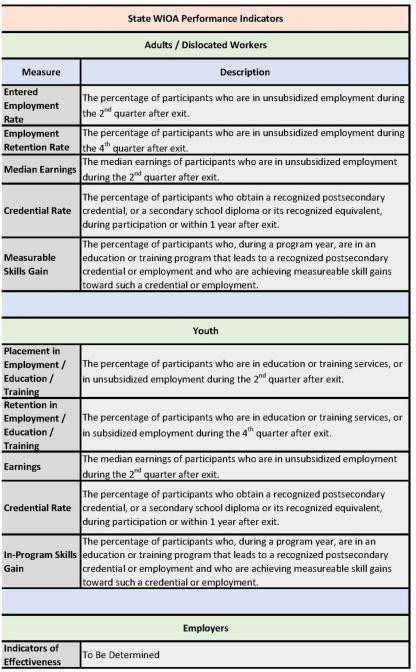
Action. Local Workforce Development Areas / Local Workforce Development Boards will follow this policy in regard to the selection of Youth Program Service Providers beginning with the procurement of Youth Services and Activities for WIOA programs beginning on or after April 1, 2016.
To comply with the State’s policy that all 14 program elements described in WIOA section 129(c)(2) be made available to Youth participants, Local Workforce Development Areas have addressed this requirement through the Request for Proposal (RFP) process. All seven (7) Local Workforce Development Areas within the State competitively procure Youth provider services via All Youth provider responses submitted to these RFPs are graded and scored by Local Workforce Development Area staff using a grading instrument. These RFP grading instruments lists, among other criteria, the requirement to discuss which of the fourteen (14) required Youth elements providers will offer to participants. Alabama currently does not have any active Pre- Apprenticeship programs in the state. The Alabama Office of Apprenticeship (AOA) is currently considering developing a Pre-Apprenticeship program to go along with their Registered Apprenticeship programs throughout the State.
To ensure that all 14 program elements described in WIOA section 129(c)(2) are effectively implemented through the State, Local Workforce Development Area monitors visit Youth programs on a regular basis throughout the program year. Local Area monitors examine all aspects of the Local Area’s Youth programs, including programmatic performance, adherence to contractual agreements, and the availability of the 14 program elements required by Governor’s Workforce Innovation Directive (GWID) PY2015-09. The State’s Program Integrity Section monitors will also provide technical assistance, monitoring, and oversight of Local Area Youth programs to ensure that local area policies, procedures, and programmatic activity meet the requirement delineated in WIOA Section 129(c)(2).
Once a youth program has been selected and a subrecipient agreement implemented, the youth program participants are registered in AlabamaWorks! (AW!), our statewide case management, participant tracking, and reporting system. WIOA staff enters into this system all of the services that have been provided to the youth participants, the case notes, outcomes, and follow up services. Each of these services is reported in the PIRL and tied to a reporting data element, i.e., Youth Summer Employment (AW! service code 400) is reported in the PIRL as Data element 1405. Each of the 14 Youth program elements is listed in the AW! System and is made available to each youth participant from either the Career Center, partner services, or a youth program provider.
The Alabama State Workforce Board supports each local area’s work-based learning programs which are designed to provide youth participants with valuable hands-on training opportunities that align with their career goals and enhance their employability. These programs offer participants the chance to gain practical experience in real work environments, through paid placements with local employers or community-based organizations. The work-based learning program focuses on enrolling WIOA eligible Out-of-School Youth (OSY), and In-School Youth (ISY) limited to High School Juniors and Seniors. In-school youth may be enrolled for summer work experience, part-time work experience, or an internship while still attending school. Participants are assigned to a worksite based on an assessment of their skills and interests. WBL job assignments are for up to 390 hours with a participant not working more than 32 hours per week. The pay range for the program varies based on the type of job assigned and the Local Workforce Development Area. All participants receive soft skills training prior to entering the work experience. Participants are eligible receive support services to help them successfully navigate and complete their work placements. Ultimately, the goal of work-based learning program is to equip individuals with the skills, knowledge, and experience necessary to secure and maintain employment in high-demand industries, fostering economic self-sufficiency and long-term career success.