



Located in:
- Career and technical education programs authorized under the the Carl D. Perkins Career and Technical Education Act of 2006, as amended by the Strengthening Career and Technical Education for the 21st Century Act (Perkins V) (Title 20, United States Code (20 U.S.C. 2301 et seq.))
NOTE: Unless otherwise noted, statutory references in this section are to Pub. L. 115–224,— The Strengthening Career and Technical Education for the 21st Century Act (“Perkins V” or “the Act”). (20 U.S.C. 2301 et seq.) The term “the State” used throughout this section refers to the State Perkins Eligible Agency and “the State Plan” refers to the “Perkins State Plan”.
(OMB Control Number: 1830-0029)
a. Plan Development and Consultation
- Describe how the State plan was developed in consultation with the stakeholders and in accordance with the procedures in section 122(c)(2) of Perkins V. See Text Box 1 for the statutory requirements for State plan consultation under section 122(c)(1) of Perkins V.
- Consistent with section 122(e)(1) of Perkins V, each eligible agency must develop the portion of the State plan relating to the amount and uses of any funds proposed to be reserved for adult career and technical education, postsecondary career and technical education, and secondary career and technical education after consultation with the State agencies identified in section 122(e)(1)(A)-(C) of the Act. If a State agency, other than the eligible agency, finds a portion of the final State plan objectionable, the eligible agency must provide a copy of such objections and a description of its response in the final plan submitted to the Secretary. (Section 122(e)(2) of Perkins V)
- Describe opportunities for the public to comment in person and in writing on the State plan. (Section 122(d)(14) of Perkins V)
Text Box 1: Statutory Requirements for State Plan Consultation |
|---|
(Section 122(c)(1) of Perkins V) |
Current Narrative:
(a1) Plan Development and Consultation
Describe how the State plan was developed in consultation with the stakeholders and in accordance with the procedures in section 122(c)(2) of Perkins V. See Text Box 1 for the statutory requirements for State plan consultation under section 122(c)(1) of Perkins V.
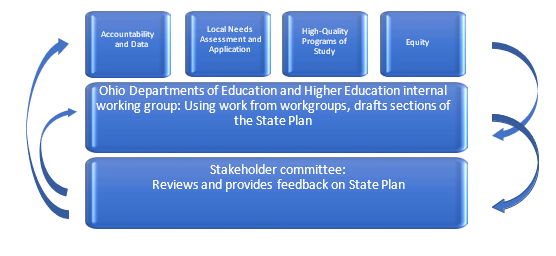
The Ohio Department of Education and Workforce (ODEW) and the Ohio Department of Higher Education (ODHE) developed the Perkins State Plan collaboratively with feedback from a variety of stakeholders across the State. Stakeholders were selected through collaborative efforts with professional organizations representing business, industry and the education community. This work was completed in three phases.
- Beginning in April and May of 2019, four topically focused workgroups began meeting approximately one time per month, with more meetings scheduled as needed. The topical workgroups collaborated on details of the State Plan, including policy development and implementation timelines. The workgroups deeply studied the contents of the Perkins V legislation, reviewed current Ohio policies and made recommendations for how Ohio will address these requirements in the Perkins V State Plan.
- Recommendations from the topically focused workgroups were used by an internal working group to draft the contents of the State Plan. In addition to drafting sections of the State Plan, the internal workgroup, comprised of staff from across ODEW and ODHE, created and updated relevant guidance, ensuring the appropriate changes were made to data and reporting and information technology systems. The group then communicated the work to relevant internal stakeholders.
- The stakeholder committee then reviewed the content of the plan and provided feedback to the internal working group and topical work groups. Topics reviewed included accountability; local needs assessments and applications; programs of study to be developed and/or supported by the State; and implementation timelines, ensuring all Ohioans have access to the programs supported through Perkins and connections to other programs across the State. Members of the stakeholder group represented all stakeholder requirements outlined in the Perkins V legislation. Feedback from the stakeholder committee was summarized and provided to the internal working group and topical workgroups for consideration of relevant edits and updates.
Topical Working Groups
The agencies organized and facilitated workgroups on specific topics required in the law. These groups met monthly, with additional meetings scheduled as needed. Topics include:
- Equity (workgroup ongoing)
- Facilitator: Ben Williams, National Alliance for Partnerships in Equity
- Key ODEW staff: Leah Amstutz, Brenna Bartlett, Crystal Dortch, Cheryl Krohn, Amy Szymanskiand Becky Crance
- Purpose: Provide input on equity labs, data and supports needed at the local level to enact the equity provisions in the law.
- Representatives collaborate with other workgroups to ensure equity provisions are being carried throughout the plan.
- External members:
- Joyce Malainy, Career-Technical Education Center of Licking County
- Ben Carter, Canton City Schools
- Amy Schakat, Southwestern City Schools
- Laura Gale, Great Oaks Career Campus
- Joel King, Warren County Career Center
- Dan Murphy, RG Drage Career Center
- Sharon Mastroianni, EHOVE Career Center
- Dennis Blatt, Washington County Career Center
- Jesse Maxfield, Mad River Local Schools
- Keith Horner, Apollo Career Center
- Local Needs Assessment and Application
- Facilitator: Tawanna Fields-Mphande, Education Program Specialist, Office of Career-Technical Education
- Key ODEW staff: Leah Amstutz
- Key ODHE staff: Brett Visger, Anthony Landis
- Purpose: The State is required to develop templates for the needs assessment and application. This group will:
- Provide input and feedback on templates for the needs assessment and application;
- Provide input and recommendations on the supports local Perkins recipients need to successfully complete the needs assessment and use the results to make any changes indicated by the needs assessment.
- External members:
- Cory Stein, Terra State Community College
- Marisa Rohn, Stark State Community College
- Katie Good, Washington State Community College
- Frank Polen, Buckeye Career Center
- Ken Porter, Ashtabula County Technical and Career Campus
- Kip Crain, Wayne County Career Center
- Bob Timmons, Polaris Career Center
- Nancy Luce, Upper Valley Career Center
- Glenn Faircloth, Lorain County Joint Vocational School
- Krista Gearhart, Canton South High School
- Liz Jenson, Kettering City Schools
- Nathan Runyan, Akron City Schools
- Peggy Reeves, Medina County Career Center
- Terri Sandu, Lorain Community College
- Data and Accountability
- Facilitators: Chris Woolard, Senior Executive Director for Performance and Impact
Shelby Robertson, Accountability and School Performance Administrator
- Key ODEW staff: Kelsey Stephens, David Ehle, Leah Amstutz
- Key ODHE staff: Brett Visger, Anthony Landis
- Purpose: Provide input on accountability measures, data collection supports, and reports needed to implement the data and accountability provisions of Perkins V.
- External members:
- Brian Bachtel, Six District Compact
- Ron Matter, Penta Career Center
- Brook Click, Penta Career Center
- Matt Meyer, Upper Valley Career Center
- Marcy Roll, Upper Valley Career Center
- Mary Beth Freeman, Delaware Area Career Center
- Cheryl Mellen, Delaware Area Career Center
- Krista Gearhart, Canton Local
- Joshua Jennings, Global Impact STEM Academy
- Kyle Newton, Warren Local
- William Nye, Grand Valley School District
- Amy Pogacsnik, Medina County Career Center
- High-Quality Programs of Study
- Facilitator: Graham Wood, Program Administrator, Office of Career-Technical Education
- Key ODEW staff: Graham Wood
- Key ODHE staff: Brett Visger, Anthony Landis, Paula Compton
- Purpose: Review and provide feedback on existing programs of study, with the intent of:
- Ensuring existing programs of study meet the requirements of law;
- Reviewing labor market data, including future data, to suggest areas where the State may need to add additional programs of study;
- Reviewing labor market data to suggest areas where programs may need to be phased out;
- Reviewing and providing feedback on Quality Program Standards; and
- Reviewing and providing input on Annual Program Review processes for ensuring programs are of high quality.
- External members:
- Roger Wright, Four Cities Compact
- Julie Sanford, Sylvania City Schools
- Michelle Patrick, Springfield Clark Career Technology Center
- Jerome Brockway, Ashtabula County Technical and Career Campus
- Kyle Copley, Scioto County Career-Technical Center
- Kevin Kratzer, Southern Hills Career-Technical Center
- Carrie Fife, Pickaway-Ross Career Center
- Tracy Green, Lorain County Community College
- Lada Gibson-Shreve, Stark State Community College
- Loleta Collins, Edison State Community College
- Marcy Green, Cuyahoga County Career Center
- Sonja Pluck, Madison Local Schools
Internal Working Group
The internal working group was charged with drafting sections of the State Plan and considering recommendations from the topical workgroups and feedback from the stakeholder committee. This committee coordinated with working group facilitators and stakeholder committee facilitators to consider feedback.
- Facilitator: Leah Amstutz, Director, Office of Career-Technical Education
- Purpose: To share and discuss outcomes from topical and stakeholder engagement meetings, assist with drafting and reviewing plan sections and coordinate with ODHE.
- Internal Members:
- Steven Tate (Office of Learning and Instructional Strategies)
- Neeta Agrawal (Office of Learning and Instructional Strategies)
- Shelby Robertson (Office of Accountability)
- Kelsey Stephens (Office of Data Quality and Governance)
- Anthony Landis (ODHE)
- Paula Compton (ODHE)
- Brett Visger (ODHE)
- Shannon Teague (Office for Improvement and Innovation)
- Cheryl Krohn (Center for Teaching, Leading and Learning)
- Amy Szymanski (Office for Exceptional Children)
- Susannah Wayland (Office of Integrated Student Supports)
- Matthew Imperato (Office of Integrated Student Supports)
- Becky Crance (Office of Career-Technical Education)
- Diane Neal (Office of Federal Programs)
- Scott May (Office of Federal Programs)
- Jason Wagner (Office of Chief Legal Counsel)
- Toby Lichtle (Office of Communication and Outreach)
Note: This group sought expertise from other staff from ODEW and ODHE as needed throughout the plan development process
Stakeholder Engagement Committee
The committee reviewed and provided feedback on key topics in the Perkins Four-Year State Plan, including accountability, local needs assessments and applications, programs of study to be developed and/or supported by the State, implementation timelines, ensuring all Ohioans have access to the programs supported through Perkins, and connections to other programs across the State.
- Facilitators: Kate Kreamer, Advanced CTE and Alisha Hyslop, Association for Career-Technical Education
- Purpose: To review all materials in advance and share relevant information with their constituents to garner feedback to share at meetings. Additionally, share relevant opportunities for engagement (such as meetings and public comment periods) with the groups they represent.
- External Members:
Secondary Educators
- Rich Baird, North Union Local Schools
- Greg Edinger, Vanguard-Sentinel
- Josh Gallagan, Delaware Area Career Center
- Krista Gearhart, Canton Local Schools
- Alicia Henry, Flex High School of Ohio
- Heather Powell, Williamsburg High School
- Sarah Taylor, Great Oaks Career Center
- Suzanne Wittmer, Mad River Local Schools
- Diane Zimmer, Firelands Local Schools
Postsecondary Educators
- Michael Evans, Ohio Association of Community Colleges
- Cassie Rickenberg, Northwest State Community College
- Lauren Massie, Career-Technical Education Center of Licking County
- Crystal Jones, Clark State Community College
Parents, Students and Community Representatives
- Rev. Landon Adams, Alpha Rho Lambda Education Foundation
- Jackie Arendt, Ohio Parent Teacher Association
- Lisa Newman, Mt. Healthy Preparatory and Fitness Academy
- Reese White, Delaware Area Career Center
- Eric Burkland, Ohio Manufacturer’s Association
- Roger Geiger, National Federation of Independent Business – Ohio
- Gordon Gough, Ohio Council of Retail Merchants
- Lisa Gray, Ohio Excels
- Claudia Kovach, City Machine Technologies, Inc.
- Craig Sernik, Northeast Ohio Consortium Council of Governments
- John Sherwood, Governor’s Office of Workforce Transformation (OWT)
State Staff
- Leah Amstutz, ODEW
- Devin Babcock, Office of Governor Mike DeWine
- Amy Dumbaugh, Ohio Department of Job and Family Services (ODJFS)
- Senator Theresa Gavarone, Ohio Senate
- Julie Hance, Opportunities for Ohioans with Disabilities (OOD)
- Christine Kohler, Ohio Department of Youth Services
- Representative Susan Manchester, Ohio House of Representatives
- Susannah Wayland, ODEW
This committee met to provide input on the State Plan according to the schedule below. June 2019:
Overview of the law and requirements, current Career-Technical Education system across the State and the transition plan. August 2019:
Local needs assessment and application discussion.
September 2019: Equity discussion. November 2019: Data, accountability and program quality discussion. February 2020: Review final draft of the State Plan, discuss public comment, finalize draft submission to governor’s office
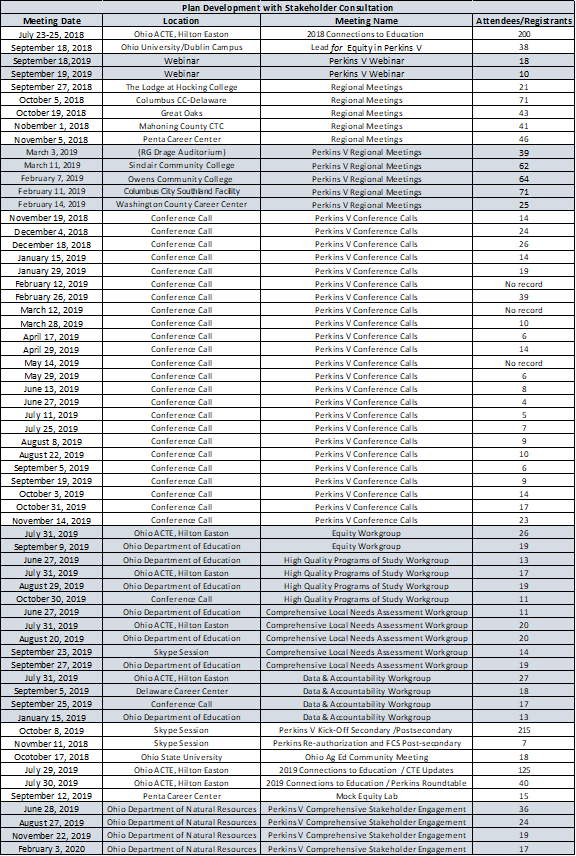
Ohio Stakeholder Engagement Summary
(a2) Consistent with section 122(e)(1) of Perkins V, each eligible agency must develop the portion of the State plan relating to the amount and uses of any funds proposed to be reserved for adult career and technical education, postsecondary career and technical education, and secondary Career and technical education after consultation with the State agencies identified in section 122(e)(1)(A)-(C) of the Act. If a State agency, other than the eligible agency, finds a portion of the final State plan objectionable, the eligible agency must provide a copy of such objections and a description of its response in the final plan submitted to the Secretary. (Section 122(e)(2) of Perkins V)
The State Plan was developed in collaboration between ODEW and ODHE. ODEW is responsible for secondary education in Ohio, while ODHE coordinates postsecondary education, which includes universities, colleges and adult career centers. No objections were made in the development of the State Plan.
(a3) Describe opportunities for the public to comment in person and in writing on the State plan. (Section 122(d)(14) of Perkins V)
To disseminate the plan and provide opportunities for public comment, ODEW, in collaboration with ODHE, conducted two public hearings on the State Perkins V plan.
The following groups were informed about the hearings through various channels, including social media advertising that was published 30 days prior to the first hearing: teachers, faculty, specialized instructional support personnel, paraprofessionals, school leaders, college and career center administrators, authorized public chartering agencies and charter school leaders employers, labor organizations, parents, students, and community organizations.
The following text was provided:
ODEW is holding public hearings on Ohio’s four-year (FY2020-2023) Career-Technical Education plan, Strengthening Career-Technical Education for the 21st Century Act (Perkins V). This law reauthorizes the Carl D. Perkins Career-Technical Education Act of 2006, known as Perkins IV. Perkins V makes key changes to implementing Career-Technical Education programs and administrative processes.
A draft of Ohio’s plan will be available on ODEW’s website; and the department will present and take comments during the two public-comment hearings:
- Wednesday, December 4, 10 a.m., Pike County Career Tech Center, 175 Beaver Creek Rd. Piketon; and
- Wednesday, January 8, 10 a.m., Sandusky High School/Career Center, 2130 Hayes Ave., Sandusky.
For answers to general questions about the public hearings, contact Rhedeshia Young-Willingham or call (614) 387-6001.
Perkins V requires each eligible agency desiring assistance for any fiscal year under the Act to prepare and submit a State Plan to the Secretary. Each eligible agency must develop its State Plan in consultation with key stakeholders, the Governor, and other State agencies with authority for career-technical education, consistent with section 122(c) of the Act.
Each eligible agency shall make the State Plan publicly available for public comment for a period of not less than 30 days, by electronic means and in an easily accessible format, prior to submission to the Secretary for approval under this subsection. In the plan the eligible agency files under this subsection, the eligible agency shall provide an assurance that public comments were taken into account in the development of the State Plan. Section 122(a)(3)(4).
A draft of Ohio’s plan will be shared and public comment taken during the hearings. For more information go to Perkins V webpage. Further information can be obtained Rhedeshia Young-Willingham or call (614) 387-6001.
The following audiences were notified prior to the hearings:
- K-12 principals;
- Community school principals;
- Community school superintendents;
- Public school superintendents;
- Education associations;
- Ohio public libraries;
- Perkins V Stakeholder Committee (September 2019);
- Ohio technical Center directors; and
- Community college stakeholders.
The following means of communication were used:
- EdConnection (53,719);
- Social Media – Twitter;
- Facebook advertisement;
- GovDelivery (171,965); and
- Postsecondary email List Serves.
In addition to public hearings, the State Plan was posted on the Perkins V page of ODEW website, with a survey link clearly identified and available for public comment.
Public Hearing Process
The two hearing locations were selected to geographically represent the north and south regions of the State. The director of the Office of Career-Technical Education at ODEW and the senior director who oversees postsecondary Career-Technical Education presented formal information and monitored the discussion and questions at each of the three-hour hearings. The draft plan was posted on ODEW and ODHE websites seven days prior to the hearing. Additionally, paper copies were available at each hearing site.
Names of those attending were documented via a sign-in sheet. Those giving formal, oral testimony (limited to five minutes per person, per site) also signed a separate sheet. Spoken testimony was audio taped. An option of written (regular mail, submission at the site or email) also was communicated. Any written comment received by 5 p.m. on Jan. 10, 2020, 40 days from the plan posting date, was accepted into record.
Spoken testimony was transcribed by a court reporter and combined with written testimony that is provided verbatim in Appendix A.6A and Appendix A.6B of this plan with a synthesis of the formal testimony topics and respective responses from the State. The appendices also include data with specific numbers of attendees at each hearing.
Additionally, the Office of Career-Technical Education provided two staff members to take handwritten notes of public hearing informal comments and questions. This informal discussion, along with formal testimony, was studied and used to form the final Perkins V plan. Likewise, both before and after public hearings, input was solicited and received from various constituent professional associations, such as the Ohio Association of Career-Technical Superintendents, Ohio Association of City Career-Technical Schools, Ohio Council of Chief Academic Officers of Two-Year Colleges and Ohio Association for Career-Technical Education. Input from these groups was considered by those drafting the plan and their views were communicated to the State leadership who finalized the plan.
As a result of Ohio submitting a Combined State Plan to better align the state’s largest workforce programs to better connect to businesses to qualified workers. On December 4, 2023, Ohio released the draft of its Combined State Plan for a 30-day public comment period. The plan covers the time period July 1, 2024, through June 30, 2028, for all of the following programs:
- Title I of the federal Workforce Innovation and Opportunity Act (WIOA), which funds county OhioMeansJobs Centers and job training and job search assistance programs for adults, dislocated workers, and low-income youth;
- The Wagner-Peyser Act Program, which funds a variety of employment services to connect job seekers and employers;
- Adult Basic and Literacy Education (known as ASPIRE), which funds GED preparation, adult math, reading, and literacy courses;
- The Vocational Rehabilitation Program through Opportunities for Ohioans with Disabilities, which supports vocational rehabilitation programs for individuals with disabilities;
- Carl D. Perkins Career and Technical Education, which provides funding for career technical training for secondary and post-secondary students;
- Senior Community Service Employment Program, which is a community service and work-based job training program for older Ohioans; and
- Jobs for Veterans State Grants Programs, which helps veterans find jobs through employment services at local OhioMeansJobs Centers.
Ohio’s Combined State Plan is built through the collaboration of various state agencies and stakeholders to incorporate programs required under WIOA.