



Located in:
- Career and technical education programs authorized under the the Carl D. Perkins Career and Technical Education Act of 2006, as amended by the Strengthening Career and Technical Education for the 21st Century Act (Perkins V) (Title 20, United States Code (20 U.S.C. 2301 et seq.))
NOTE: Unless otherwise noted, statutory references in this section are to Pub. L. 115–224,— The Strengthening Career and Technical Education for the 21st Century Act (“Perkins V” or “the Act”). (20 U.S.C. 2301 et seq.) The term “the State” used throughout this section refers to the State Perkins Eligible Agency and “the State Plan” refers to the “Perkins State Plan”.
(OMB Control Number: 1830-0029)
d. Accountability for Results
- 1. Identify and include at least one (1) of the following indicators of career and technical education program quality—
- a. The percentage of CTE concentrators (see Text Box 6 for the statutory definition of a CTE concentrator under section 3(12) of Perkins V) graduating from high school having attained a recognized postsecondary credential;
- b. The percentage of CTE concentrators graduating high school having attained postsecondary credits in relevant career and technical education programs and programs of study earned through a dual or concurrent enrollment program or another credit transfer agreement; and/or
- c. The percentage of CTE concentrators graduating from high school having participated in work-based learning. (Section 113(b)(2)(A)(iv)(I) of Perkins V)
Include any other measure(s) of student success in career and technical education that are statewide, valid, and reliable, and comparable across the State. (Section 113(b)(2)(A)(iv)(II) of Perkins V) Please note that inclusion of “other” program quality measure(s) is optional for States.
Provide the eligible agency’s measurement definition with a numerator and denominator for each of the quality indicator(s) the eligible agency selects to use.
- 2. Provide on the form in Section V.B, for each year covered by the State plan beginning in FY 2020, State determined performance levels or each of the secondary and postsecondary core indicators, with the levels of performance being the same for all CTE concentrators in the State. (Section 113(b)(3)(A)(i)(I) of Perkins V)
| Text Box 6: Statutory Definition of CTE Concentrator |
|---|
The term ‘CTE concentrator’ means—
* This means that once a student completes 2 courses in a single CTE program or program of study, they are counted as a CTE concentrator. (Section 3(12) of Perkins V) |
- 3. Describe the procedure the eligible agency adopted for determining State determined levels of performance described in section 113 of Perkins V, which at a minimum shall include—
- a. A description of the process for public comment under section 113(b)(3)(B) of Perkins V as part of the development of the State determined levels of performance (see Text Box 7 for the statutory requirements for consultation on State determined performance levels under section 113(b)(3)(B) of Perkins V);
- b. An explanation for the State determined levels of performance that meet each of the statutory requirements in Text Box 8; and
- c. A description of how the State determined levels of performance set by the eligible agency align with the levels, goals and objectives other Federal and State laws, (Section 122(d)(10) of Perkins V).
As part of the procedures for determining State determined levels of performance, describe the process that will be used to establish a baseline for those levels.
- 4. Provide a written response to the comments regarding State determined performance levels received during the public comment period pursuant to section 113(b)(3)(B) of Perkins V. (Section 113(b)(3)(B)(iii) of Perkins V).
As part of the written response, include a description of any the changes made to the State determined performance levels as a result of stakeholder feedback.
- 5. Describe how the eligible agency will address disparities or gaps in performance as described in section 113(b)(3)(C)(ii)(II) of Perkins V in each of the plan years, and if no meaningful progress has been achieved prior to the third program year, a description of the additional actions the eligible agency will take to eliminate these disparities or gaps. (Section 122(d)(11) of Perkins V)
As part of the written response, and pursuant to the Report of the Senate Committee on Health, Education, Labor, and Pensions (HELP),2 the eligible agency could indicate that it will analyze data on the core indicators of performance to identify gaps in performance, explain how they will use evidence-based research to develop a plan to provide support and technical assistance to eligible recipients to address and close such gaps, and how they will implement this plan. The eligible agency is not required to submit a new State plan prior to the third program year in order to address this requirement.
| Text Box 7: Statutory Requirements for Consultation on State Determined Performance Levels |
|---|
(Section 113(b)(3)(B) of Perkins V) |
[2] See page 11 of Committee Report at https://www.congress.gov/115/crpt/srpt434/CRPT-115srpt434.pdf.
Current Narrative:
D.1.Identify and include at least one (1) of the following indicators of career-technical education program quality—
a. the percentage of career-technical education concentrators (see Text Box 6 for the statutory definition of a career-technical education concentrator under section 3(12) of Perkins V) graduating from high school having attained a recognized postsecondary credential;
b. the percentage of career-technical education concentrators graduating high school having attained postsecondary credits in relevant career-technical education programs and programs of study earned through a dual or concurrent enrollment program or another credit transfer agreement; and/or
c. the percentage of career-technical education concentrators graduating from high school having participated in work-based learning. (Section 113(b)(2)(A)(iv)(I) of Perkins V)
The State of Ohio will use the percentage of Career-Technical Education concentrators graduating from high school having participated in work-based learning as an indicator of Career-Technical Education program quality. Stakeholders representing the Career-Technical Education community felt the work-based learning indicator provided equitable access for all students in all career pathways. Additionally, State policy already exists for industry credential and postsecondary credit attainment through the State report card and graduation requirements.
Work-based learning is defined as sustained interactions with industry or community professionals in real workplace settings, to the extent practicable, or simulated environments at an educational institution that fosters in-depth, firsthand engagement with the tasks required in a given career field, that are aligned to curriculum and instruction. Experiences may include one or more of the following:
- Job Site Placement and Internship;
- Apprenticeship and Pre-Apprenticeship;
- Remote/Virtual Placement;
- Entrepreneurship;
- School-based Enterprise;
- Simulated Work Environment.
Students should accumulate 250 hours of work-based learning aligned to the program of study, graduation plan for students in the classes of 2023 and beyond, or student Success Plan beginning when students identify as ninth-graders. Students may accumulate hours across multiple types of work-based learning experiences.
Reference Appendix A.5 Work-based Learning Guidance Document
D.1 Include any other measure(s) of student success in career-technical education that are statewide, valid, and reliable, and comparable across the State. (Section 113(b)(2)(A)(iv)(II) of Perkins V) Please note that inclusion of “other” program quality measure(s) is optional for States.
The State of Ohio will use technical skill attainment as an additional measure of student success in career-technical education. Technical skill attainment measures the proportion of students passing state-approved end-of-course technical assessments. The assessments are designed to measure the skills and knowledge learned in a student’s Career-Technical Education program.
D.1 Provide the eligible agency’s measurement definition with a numerator and denominator for each of the quality indicator(s) the eligible agency selects to use.
The State of Ohio will use the following equations for its quality indicators:
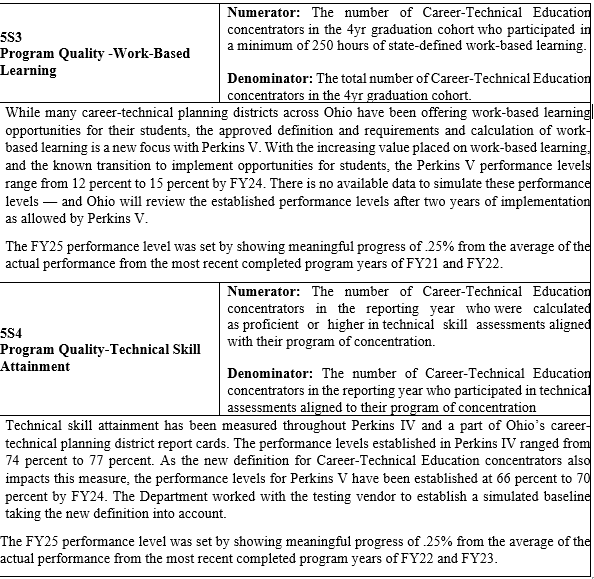
| 5S3 Program Quality -Work-based Learning | Numerator: The number of Career-Technical Education concentrators in the 4yr graduation cohort who participated in a minimum of 250 hours of state-defined work-based learning. Denominator: The total number of Career-Technical Education concentrators in the 4yr graduation cohort. |
|---|---|
| 5S4 Program Quality-Technical Skill Attainment | Numerator: The number of Career-Technical Education concentrators in the reporting year who were calculated as proficient or higher in technical skill assessments aligned with their program of concentration. Denominator: The number of Career-Technical Education concentrators in the reporting year who participated in technical assessments aligned to their program of concentration. |
D.2. Provide on the form in Section V.B, for each year covered by the State plan beginning in FY 2020, State determined performance levels or each of the secondary and postsecondary core indicators, with the levels of performance being the same for all CTE concentrators in the State. (Section 113(b)(3)(A)(i)(I) of Perkins V)
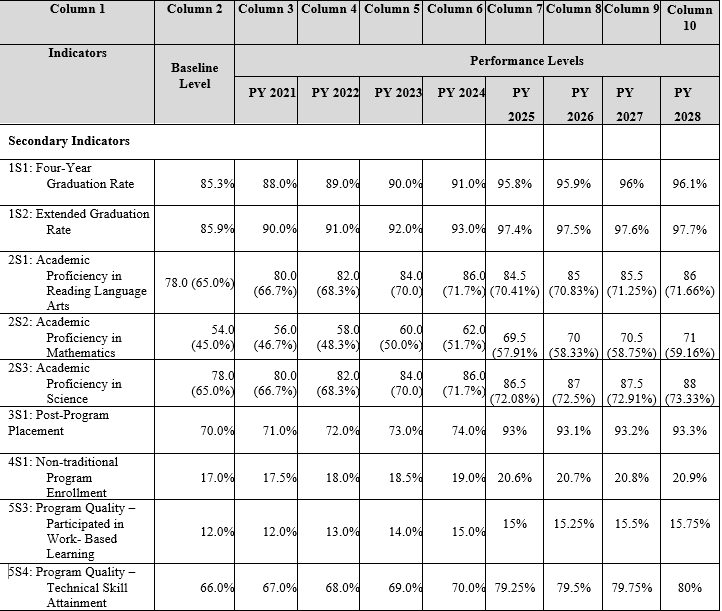
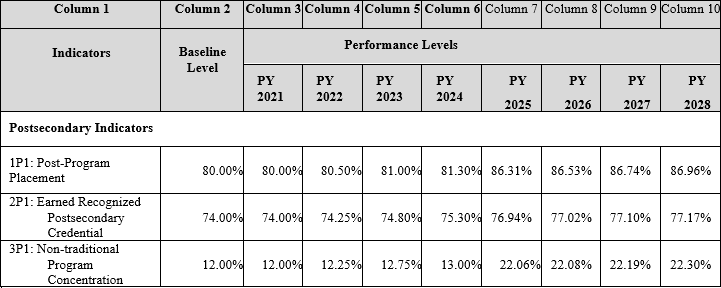
Note: Each eligible recipient shall agree to accept the State determined levels of performance for each year of the plan as local levels of performance or negotiate with the State to reach agreement on new local adjusted levels of performance, for each of the core indicators of performance. The level of performance shall be expressed in a percentage or numerical form and shall require the eligible recipient to continually make progress toward improving the performance of all CTE concentrators, including subgroups of students described in section 1111(h)(1)(C)(ii) of the Elementary and Secondary Education Act of 1965 and special populations, as described in section 3(48).
D.3 Describe the procedure the eligible agency adopted for determining State determined levels of performance described in section 113 of Perkins V, which at a minimum shall include—
a. a description of the process for public comment under section 113(b)(3)(B) of Perkins V as part of the development of the State determined levels of performance (see Text Box 7 for the statutory requirements for consultation on State determined performance levels under section 113(b)(3)(B) of Perkins V);
To disseminate the State-determined levels of performance and provide opportunities for public comment, the ODEW, in collaboration with the ODHE, posted the levels of performance table (refer to the response to (d)(2)), along with a narrative description, including the numerator and denominator of each indicator (refer to the response to (d)(3)(B)) on the Perkins V page of the ODEW website with a survey link clearly identified and available for public comment.
The public comment period for the State-determined levels of performance opened on December 5, 2023, and closed January 5, 2024. This information also was included in the public hearing process for the State Perkins V Plan, as described in the response to (a)(3).
b. an explanation for the State determined levels of performance that meet each of the statutory requirements in Text Box 8.
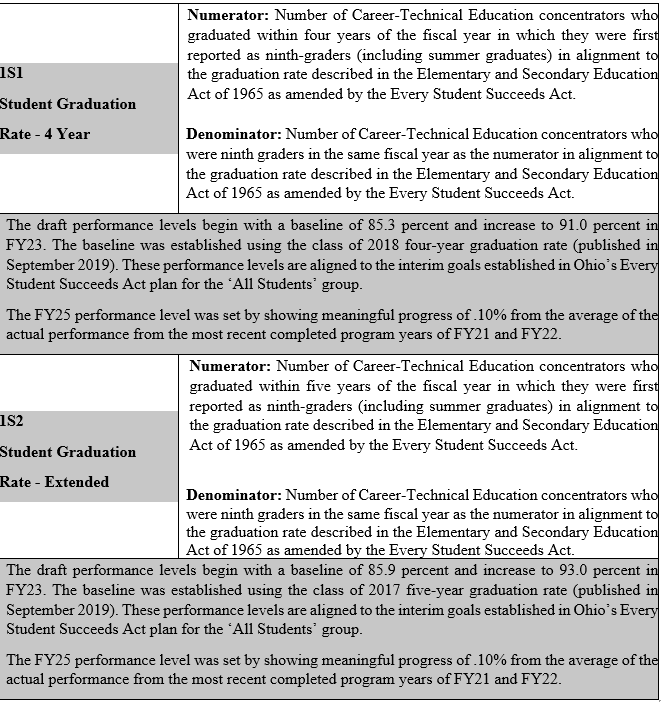
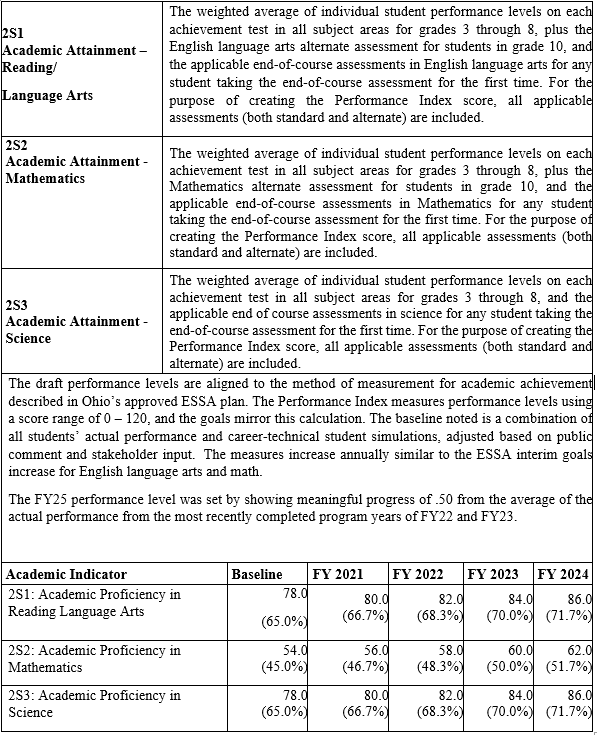
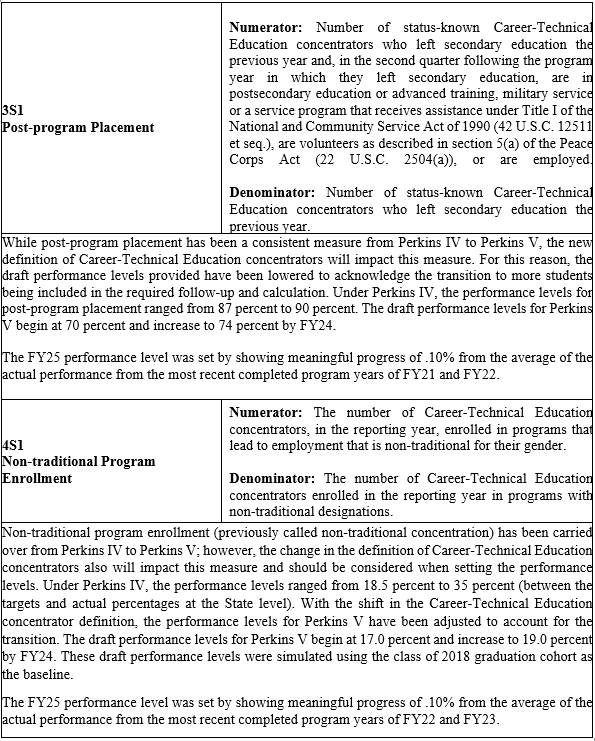
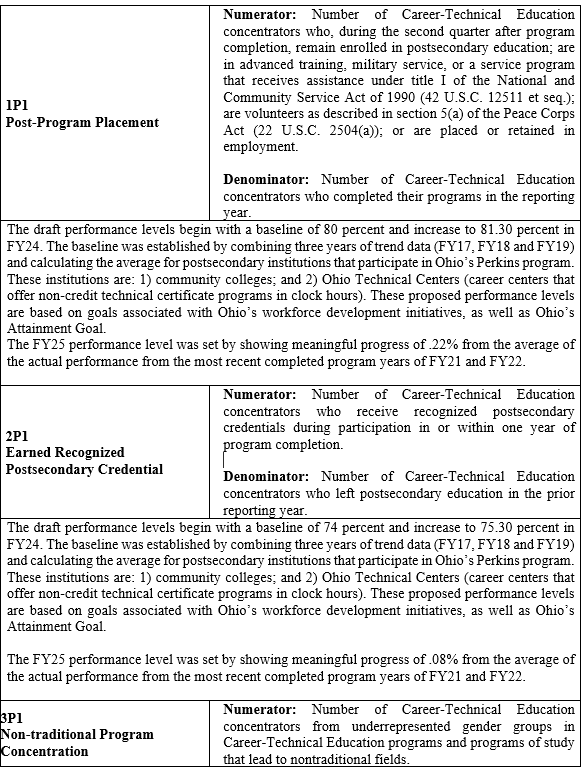
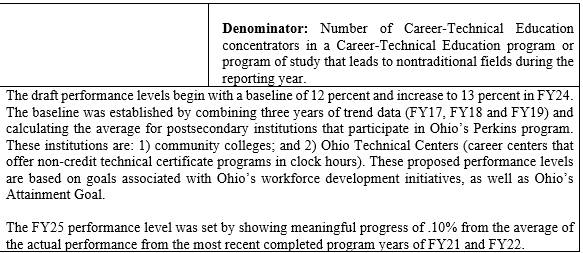
The following tables provide a summary description of the baseline and progress expectations for each State-determined level of performance that meets the Perkins V statutory requirements. An explanation of the numerator and denominator is provided for each measure, except for the three academic indicators. For the academic indicators, a description of the calculation, aligned to ESSA, is provided in Appendix A.7.
c. a description of how the State determined levels of performance set by the eligible agency align with the levels, goals and objectives other Federal and State laws, (Section 122(d)(10) of Perkins V). As part of the procedures for determining State determined levels of performance, describe the process that will be used to establish a baseline for those levels.
The following summarizes both the strong alignment between the state-determined performance levels and the levels, goals and objectives of Perkins V and other federal and state laws.
- The Student Graduation Rates (1S1,1S2), based on the concentrator population, are aligned to the graduation rate interim and long-term goals established in Ohio’s approved State Plan under the Every Student Succeeds Act.
- The indicators of academic proficiency in Reading/Language Arts (2S1), Mathematics (2S2) and Science (2S3), based on the concentrator population, are aligned to the interim and long-term academic goals established in Ohio’s approved State Plan under the Every Student Succeeds Act.
- The State of Ohio Post-Program Placement indicator of performance is aligned with the Perkins 3S1 core indicator of performance (Post-Program Placement).
- The State of Ohio Non-traditional Program Concentration indicator is aligned with the corresponding Perkins 4S1 core indicator of performance (Non-traditional participation).
- The State of Ohio Work-Based Learning Indicator is aligned with the corresponding Perkins 5S3 Indicator of Program Quality. Required parameters of the work-based learning experience are aligned with the work-based learning requirement of an alternate State of Ohio graduation option.
- The State of Ohio Technical Skill Attainment measure, meeting requirements of one of the measures of program quality, is aligned to the technical skill measure on Ohio’s career-technical planning district report card, as required by the ODEW (Ohio Revised CODE Section 3302.033).
- Ohio’s Attainment Goal (1P1, 2P1, and 3P1) is offset to increase the number of Ohioans with postsecondary credentials that lead to employment. Ohio’s emphasis on adult learner strategies is aligned to positively impact these measures. The attainment goal was established by Department of Higher Education in conjunction with postsecondary stakeholders at the state’s colleges, universities, and adult career centers.
ODEW, in collaboration with the ODHE, calculated State baseline levels using current performance level data, when available, and simulated data based on the Perkins V concentrator definition for each core indicator of performance. Baseline levels, along with growth targets, then were shared with the data and accountability working group and the postsecondary Perkins fall meeting participants to gain consensus prior to disseminating for public comment.
D.4 Provide a written response to the comments regarding State determined performance levels received during the public comment period pursuant to section 113(b)(3)(B) of Perkins V. (Section 113(b)(3)(B)(iii) of Perkins V).
As part of the written response, include a description of any the changes made to the State determined performance levels as a result of stakeholder feedback.
Secondary state-determined performance levels were analyzed using the following methodology:
- Don’t Know responses were ignored;
- Strongly Agree and Agree responses were combined;
- Strongly Disagree and Disagree responses were combined;
- Combined responses were compared to determine public approval/disapproval of each measure;
- Individual comments were analyzed to determine root cause of disapproval.
Analysis Summary
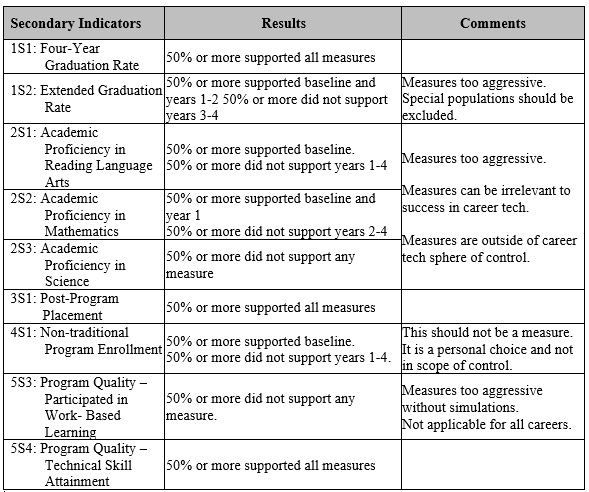
Based on survey results and public comment, the data and accountability internal workgroup met to review data and prepare proposed revisions to present to the data and accountability external workgroup. The results of this collaboration were then sent to the Stakeholder Engagement Committee for final approval.
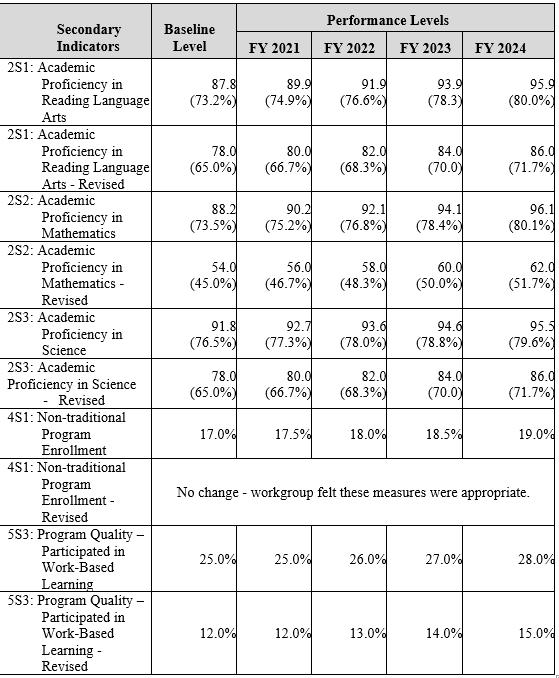
As a result of this collaborative process, performance levels were adjusted as indicated below for all three academic indicators, non-traditional program enrollment and work-based learning.
The responses to the postsecondary State-determined performance levels during the comment period were collected through an online survey mechanism. They were reviewed and assessed. The following is a summary of the results:
Postsecondary State-determined performance levels were analyzed using the following methodology:
- Don’t Know responses were ignored;
- Strongly Agree and Agree responses were combined;
- Strongly Disagree and Disagree responses were combined;
- Combined responses were compared to determine public approval/disapproval of each measure;
- Individual comments were analyzed to determine root cause of disapproval.
Analysis Summary
As a result of Ohio submitting a Combined State Plan to better align the state’s largest workforce programs to better connect to businesses to qualified workers. On December 4, 2023, Ohio released the draft of its Combined State Plan for a 30-day public comment period. The plan covers the time period July 1, 2024, through June 30, 2028, for all of the following programs:
- Title I of the federal Workforce Innovation and Opportunity Act (WIOA), which funds county OhioMeansJobs Centers and job training and job search assistance programs for adults, dislocated workers, and low-income youth;
- The Wagner-Peyser Act Program, which funds a variety of employment services to connect job seekers and employers;
- Adult Basic and Literacy Education (known as ASPIRE), which funds GED preparation, adult math, reading, and literacy courses;
- The Vocational Rehabilitation Program through Opportunities for Ohioans with Disabilities, which supports vocational rehabilitation programs for individuals with disabilities;
- Carl D. Perkins Career and Technical Education, which provides funding for career technical training for secondary and post-secondary students;
- Senior Community Service Employment Program, which is a community service and work-based job training program for older Ohioans; and
- Jobs for Veterans State Grants Programs, which helps veterans find jobs through employment services at local OhioMeansJobs Centers.
Ohio’s Combined State Plan is built through the collaboration of various state agencies and stakeholders to incorporate programs required under WIOA.
To view the draft plan or offer comment, please visit jfs.ohio.gov/combinedstateplan. The online portal will be open to public comment until 5 p.m. on January 4, 2024.
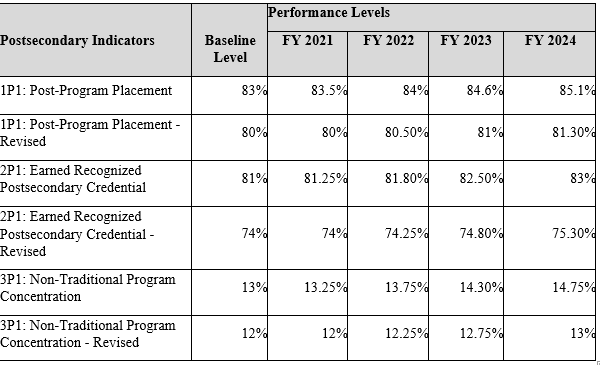
The draft Combined State Plan included revisions to establishing state determined performance levels for FY2024 through FY2027. There were zero public comments related to the state determined performance levels.
D.5 Describe how the eligible agency will address disparities or gaps in performance as described in section 113(b)(3)(C)(ii)(II) of Perkins V in each of the plan years, and if no meaningful progress has been achieved prior to the third program year, a description of the additional actions the eligible agency will take to eliminate these disparities or gaps. (Section 122(d)(11) of Perkins V)
As part of the written response, and pursuant to the Report of the Senate Committee on Health, Education, Labor, and Pensions (HELP),8 the eligible agency could indicate that it will analyze data on the core indicators of performance to identify gaps in performance, explain how they will use evidence-based research to develop a plan to provide support and technical assistance to eligible recipients to address and close such gaps, and how they will implement this plan. The eligible agency is not required to submit a new State plan prior to the third program year in order to address this requirement.
The State annually will review and analyze State performance results for each core indicator of performance to identify disparities or gaps. For identified gaps, the State will develop and implement an improvement plan in consultation with appropriate stakeholders and stakeholder agencies and organizations. Implementation will occur the first program year succeeding the program year for which the State identified disparities or performance gaps.
The improvement plan will be based on State-collected Career-Technical Education data, evidence-based research and stakeholder feedback. As part of the plan development process, Ohio will require resources and support strategies to be identified and developed in collaboration with stakeholders. The State will use a process that mirrors the comprehensive local needs assessment to develop goals and improvement strategies. Potential resources and support strategies may include:
- Regional workshops;
- Webinars;
- Distribution of evidence-based or research-based strategies;
- Targeted professional development;
- Targeted assistance for outlier districts; and
- Prescribed improvement plans.
If no meaningful progress has been made prior to the third year, an evaluation of the local recipient’s performance improvement efforts will be made. If the State determines a subrecipient is not properly implementing its responsibilities or is not making substantial progress, the State will provide technical assistance to the subrecipient focusing on implementation of improvement activities.
The State will determine whether to impose sanctions of withholding from the subrecipient all, or a portion, of the subrecipient’s allotment, if a subrecipient meets any of the following conditions:
- Fails to implement an improvement plan;
- Fails to make any improvement in meeting the local adjusted level of performance for any of the core indicators of performance within the first program year of implementation of its improvement plan; or
- Fails to meet at least 90 percent of an agreed-upon local adjusted level of performance for the same core indicator of performance for three consecutive years.
Any determination regarding sanction will not be made without notice and opportunity for the local entity to have a hearing. In determining whether to impose sanctions, the State will consider:
- Exceptional or uncontrollable circumstances, such as a natural disaster or a precipitous and unforeseen decline in the financial resources of the subrecipient; or
- The impact of the small size of the Career-Technical Education program operated by the subrecipient on the subrecipient’s reported performance.
If the State does withhold funds due to performance as described above, the State will use those funds to provide (through alternative arrangements) services and activities to students within the area served by the subrecipient.