



Located in:
- II. Strategic Elements
The Unified or Combined State Plan must include a Strategic Planning Elements section that analyzes the State’s current economic environment and identifies the State’s overall vision for its workforce development system. The required elements in this section allow the State to develop data-driven goals for preparing an educated and skilled workforce and to identify successful strategies for aligning workforce development programs to support economic growth. Unless otherwise noted, all Strategic Planning Elements apply to Combined State Plan partner programs included in the plan as well as to core programs. Where requirements identify the term “populations”, these must include individuals with barriers to employment as defined at WIOA Section 3. This includes displaced homemakers; low-income individuals; Indians, Alaska Natives, and Native Hawaiians; individuals with disabilities, including youth who are individuals with disabilities; older individuals; ex-offenders; homeless individuals, or homeless children and youths; youth who are in or have aged out of the foster care system; individuals who are English language learners, individuals who have low levels of literacy, and individuals facing substantial cultural barriers; farmworkers (as defined at section 167(i) of WIOA and Training and Employment Guidance Letter No. 35-14); individuals within 2 years of exhausting lifetime eligibility under the Temporary Assistance for Needy Families program; single parents (including single pregnant women); and long-term unemployed individuals. Additional populations include veterans, unemployed workers, and youth, and others that the State may identify.
- a. Economic, Workforce, and Workforce Development Activities Analysis
The Unified or Combined State Plan must include an analysis of the economic conditions, economic development strategies, and labor market in which the State’s workforce system and programs will operate.
- a. Economic, Workforce, and Workforce Development Activities Analysis
II. a. 1. C. Comparison of Economic and Workforce Analytical Conclusion. Describe areas of opportunity for meeting hiring, education, and skills needs identified in the economy compared to the assets available in the labor force in the state.
Current Narrative:
Several opportunities exist to improve hiring and retention rates, educational attainment, and skills needs across all markets. Data analysis indicates labor market trends throughout the U.S. progressing toward a broader spectrum of requirements to meet workforce needs and develop talent in the workforce, such as adopting skills-based requirements from traditional educational requirements. Additionally, a paradigm shift has been observed in the development of apprenticeship programs toward more professional-oriented careers.
In Guam, opportunities stem from leveraging existing strengths such as vocational training and work-based learning and resources, while addressing gaps and challenges such as policy changes, expanding job criteria, and shifting priorities within the workforce ecosystem. There exists already a strong framework within the apprenticeship system for vocational training which has seen exponential growth in the last five years through program incentives and public-private partnerships. Expansion of apprenticeship programs into more professional careers offer a strategic approach to meeting demands in Guam’s workforce needs and address the shortage in labor in industries such as education and healthcare, and attract new industry growth in areas like finance, software development, and engineering.
Guam stands to benefit from shifting its priorities in its hiring practices to address the lack of job applicants and short supply of qualified candidates. By prioritizing experience and skills over traditional educational qualifications, such as college degrees, Guam can create more inclusive and equitable pathways to employment, and access more diverse career opportunities. Several states have adopted this model at a government level, removing degree requirements or prioritizing experience and skills over four-year degrees for as much as 90% of classified jobs. By removing the educational requirement, government agencies expand the pool of qualified candidates and fill shortages in employment. Adopting this model in private sector employment, in addition to other initiatives, such as positive workplace culture, diversity and inclusivity, better incentives, and flexible schedules can also address the labor shortage.
HIREGUAM, the official state job bank for Guam that offers free services for job seekers and employers and administered by the Guam Department of Labor, shows that from January 2022 to January 2023, there were 19,040 jobs available but only 3,522 applications were submitted for those roles (Table 7). In the same period a year later, 23,211 jobs were posted while only 1,041 applications were submitted, indicating that while the number of job postings shot up by 21.9% year-over-year, HIREGUAM saw 70.4% less applicants in the same period. This data demonstrates that, at least for HIREGUAM, the number of job vacancies are gradually outpacing the number of jobseekers.

In a tight labor market, other opportunities aimed at enhancing workforce development and targeted recruitment strategies can help attract and retain qualified candidates. Recruitment strategies that leverage technological upgrades and AI technology can help broaden the pool of qualified candidates.
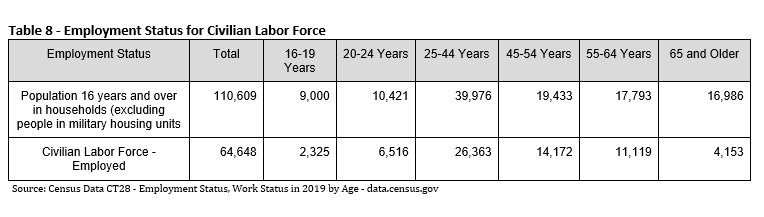
Data from the 2020 U.S. Census Bureau (Table 8) suggests that there is a changing landscape in the labor market which could shift the dynamic of the workforce in the next five to ten years as the torch passes from one generation to the next with an aging workforce and a disproportionate number of younger workers to replace them.
According to Census data for Guam, a straight comparison of those employed in the Civilian Labor Force showed that seniors 55 years and older occupied more jobs at 23.6% while those 16-24 years of age took up 13.7% of jobs recorded. The pool of candidates is also shrinking, based on figures from the Census data, which shows that the population of 55 years and older excluding military housing units was at 34,779 while there were 19,421 in the 16-24 age group.
As the labor force shifts with an aging population, more emphasis must be placed on programs aimed at preparing youth not just for employment, but for employment in in-demand industries. Educational attainment data suggests, and educational institutions report that more people are getting degrees, enrolling in college, and less people are dropping out of high school. The younger generation of qualified candidates are smarter but not as skilled as the exiting workforce.
Investing in alternative educational programs is crucial through partnership development. Educational programs and curricula such as STEM (Science, Technology, Engineering, and Mathematics), Business Development, Charter Schools, Hospitality and Culinary Arts programs, can address potential shortfalls and gaps in skills in the future workforce.
A qualitative analysis of youth, their interests, educational level and standards would benefit employers and researchers to gain a better understanding of their competencies compared to emerging industries and occupations, and help create effective strategies for recruiting, training, and retaining young talent in the workforce.
Another strategy that can be taken to maximize labor force participation, as seen in other Asia-Pacific countries, is to introduce initiatives that exclusively target the attraction and retention of older workers. These initiatives would require policy changes, reskilling programs, wellness benefits, better accommodations, and promotion of hiring incentives. By keeping older persons employed, stability in the workforce can be attained.
Women can also be a crucial asset in the workforce and policy changes, guaranteed paid parental leave, flexible work arrangements, incentives, and career growth can lead to job satisfaction, thereby attracting and retaining more female employees to fill shortages in labor gaps.
The U.S. Census Data also shows a substantial disparity in the gender wage gap with women on Guam earning 26% less than men in 2019, or 0.74 on the dollar[1]. The national average in 2019 was 82%, according to the U.S. Bureau of Labor Statistics. [2]
By industry in Guam, the gender pay gap varied even further (Table 9). The largest gap was in Manufacturing with women earning 0.67 on the dollar compared to men, followed by Agriculture, Forestry, Fishing and Hunting, and Mining at 0.68 on the dollar. Public Administration also had a wide gap with women earning 27% less than men. The gender wage gap was smaller in industries such as Wholesale Trade at 0.98 on the dollar; Transportation and Warehousing, and Utilities at 0.94 on the dollar; and Educational Services, and Healthcare and Social Assistance at 0.92 on the dollar.
The Construction industry was the only sector in which women earned more than men by 0.09. However, according to the Census Bureau, women made up only 10% of the construction industry in Guam.[3] Although construction has historically been a male-dominated industry, with women comprising only 10% of the construction industry, there exists a significant opportunity to expand the pool of candidates and fill labor shortages. Recruiting and supporting women in the construction industry can diversify the workforce and advance gender equality.

[1]data.census.gov, Decennial Census of Island Areas, CT91 Work Status in 2019 and Sex by Median Income in 2019
[2] https://www.bls.gov/opub/reports/womens-earnings/2019/home.htm
[3]data.census.gov, Decennial Census of Island Areas, CT11 Industry and Sex by Race