


Located in:
Community Services Block Grant (CSBG)
Note: Below is information about the employment and training activities carried out under the Community Services Block Grant (CSBG) (42 U.S.C. 9901 et seq.) that is included in the WIOA Combined State Plan. The complete CSBG State Plan is submitted directly to the Federal agency that administers that program and is collected under OMB Control Number: 0970-0382.
Where CSBG is included in the Combined State Plan, the State CSBG Lead Agency (as designated by the chief executive of the State under the requirements of section 676(a) of the CSBG Act (42 U.S.C. 9908(a)) will coordinate plans for employment and training activities under CSBG as part of a larger antipoverty and workforce development strategy.
As part of the Combined State Plan, the State CSBG Lead Agency must:
(a) Describe how the State and the eligible entities will coordinate the provision of employment and training activities through Statewide and local WIOA workforce development systems; and may
(b) Provide examples of innovative employment and training programs and activities conducted by eligible entities or other neighborhood-based organizations as part of a community antipoverty strategy.
Current Narrative:
(a)
- Missouri’s nineteen (19) Community Action Agencies (CAA’s) provide assistance to individuals, families, and communities to reduce or eradicate poverty. CAA’s act as a catalyst for community coordination to bring about changes in their communities and to better the lives of the families they serve on a daily basis. CAA’s address the ‘whole family’ through a strengths based, family development approach to supporting individuals and families attain self-sufficiency which includes:
- Intake, assessment and referral - individuals are guided through a process to identify their strengths and needs
- Family support and case management services - an intensive one on one relationship to empower individuals and families set goals toward achieving self-sufficiency.
- Life skills classes to assist individuals in learning better ways to handle basic living skills, such as budgeting, employment readiness, etc…
- Coordination and referral for services to address barriers to achieving self-sufficiency, including: education; transportation; housing; child care; and other issues
- Several CAA’s also have employment and training units within their organizational structure, including, Missouri Job Centers (hosted by the CAA, or co-located with the CAA), WIA Youth Employment programs, Adult/Dislocated Worker Services, career preparation, internships, on-the-job training, mentoring, HiSET, and other supportive services. Community Action Agencies collaborate in the governance of the workforce development system by serving on Workforce Development Boards (WDBS), administering employment and training programs, sharing referrals with workforce partners, and coordinating services at the local level
- Missouri’s State CSBG office will work collaboratively with other state agency partners and with Community Action Agencies to nurture and extend the existing collaborative partnerships and develop new partnerships to enhance the effectiveness of the workforce system throughout the state.
(b)
The programs listed below were developed in partnership with Community Action, or are CAA programs that employ innovative or collaborative approaches to helping individuals attain self-sufficiency:
- Reality Enrichment and Life Lessons (REALL): The Reality Enrichment and Life Lessons (REALL) project is a simulation designed to challenge youth to think critically about how choices and decisions made in adolescence may have consequences in adulthood. This program is conducted by several CAA’s. Participating youth are given the life of someone who has made reactive or negative choices (all have dropped out of high school, some have past legal histories, some have low paying jobs, etc). Following this, they are given the life of someone who has made proactive or positive choices (all have graduated from high school and obtained some type of higher education, all are employed at a living wage, all have affordable child care, etc.). Youth are challenged to live those two lives and compare and contrast the experiences to draw conclusions in their own lives. It is the expectation that youth will draw on their experiences at the Reality Enrichment and Life Lessons simulation to make proactive choices in their own lives, so they may know self-sufficiency in adulthood.
- The Purses for Success and Scrubs for Success: These are 2-3 year programs conducted by Northeast Central Community Action Corporation (NECAC) that work directly with unemployed, underemployed individuals that are seeking gainful employment Case managers work directly with individuals to increase their self-worth/confidence/emotional stability, knowledge of work-ethic/professionalism, balance and well-being by mentoring consistency, goal setting, time management and organizational skills that will thus increase their marketability and gain employment. Clients attend weekly meetings/workshops and register with Missouri Access Point at the local NECAC office if an Access Point is located there. Upon successful completion, the client is provided with necessary attire, shoes, tools, personal hygiene kit, and/or other donated items as may be available. Local business, nursing homes, and physicians’ offices collaborate with NECAC.
- PAVE (Projects, Assets, Values in Education) the Way: PAVE the Way is an innovative program designed to provide career education and job readiness opportunities for at risk high school students from low-income families conducted by Community Action Agency of Greater Kansas City (CAAGKC). PAVE the Way is uniquely positioned to help young people reach beyond their current circumstances and put themselves in the best possible position to be successful and have a more optimistic view of their future success. PAVE the Way students meet once per week in the classroom and utilize an online component to learn more about college and career readiness and to work on their writing skills for the college admission program. Students will also have additional exposure throughout the year in the form of community engagement, community service, and fieldtrips.
PRA BURDENS TABLE
Please note that the burden calculations for this table have been calculated differently depending on the referenced ICRs. The burdens included below are the same burdens that exist for these programs regardless of whether a state chooses to submit a Combined State Plan.
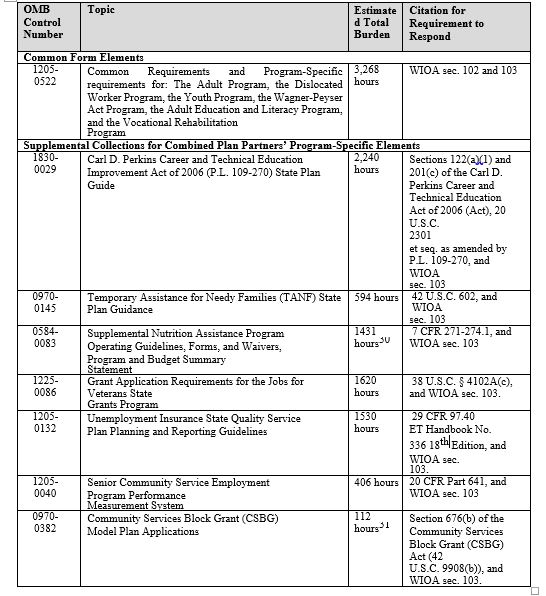
OMB Control Number 1205-0522
- This number represents estimated average burden for the portion of the SNAP plan that covers programs authorized under section 6(d)(4) and section 6(o) of the Food and Nutrition Act of 2008 only.
- This number represents estimated average burden for the portion of the CSBG plan that covers employment and training activities only.