



Located in:
- II. Strategic Elements
The Unified or Combined State Plan must include a Strategic Planning Elements section that analyzes the State’s current economic environment and identifies the State’s overall vision for its workforce development system. The required elements in this section allow the State to develop data-driven goals for preparing an educated and skilled workforce and to identify successful strategies for aligning workforce development programs to support economic growth. Unless otherwise noted, all Strategic Planning Elements apply to Combined State Plan partner programs included in the plan as well as to core programs.
- a. Economic, Workforce, and Workforce Development Activities Analysis
The Unified or Combined State Plan must include an analysis of the economic conditions, economic development strategies, and labor market in which the State’s workforce system and programs will operate.
- a. Economic, Workforce, and Workforce Development Activities Analysis
II. a. 1. B. Workforce Analysis
The Unified or Combined State Plan must include an analysis of the current workforce, including individuals with barriers to employment, as defined in section 3 of WIOA4. This population must include individuals with disabilities among other groups5 in the State and across regions identified by the State. This includes—
[4] Individuals with barriers to employment include displaced homemakers; low-income individuals; Indians, Alaska Natives, and Native Hawaiians; individuals with disabilities, including youth who are individuals with disabilities; older individuals; ex-offenders; homeless individuals, or homeless children and youths; youth who are in or have aged out of the foster care system; individuals who are English language learners, individuals who have low levels of literacy, and individuals facing substantial cultural barriers; farmworkers (as defined at section 167(i) of WIOA and Training and Employment Guidance Letter No. 35-14); individuals within 2 years of exhausting lifetime eligibility under the Temporary Assistance for Needy Families program; single parents (including single pregnant women); and long-term unemployed individuals.
[5] Veterans, unemployed workers, and youth, and others that the State may identify.
i. Employment and Unemployment
Provide an analysis of current employment and unemployment data, including labor force participation rates, and trends in the State.
ii. Labor Market Trends
Provide an analysis of key labor market trends, including across existing industries and occupations.
iii. Education and Skill Levels of the Workforce
Provide an analysis of the educational and skill levels of the workforce.
iv. Skill Gaps
Describe apparent ‘skill gaps’.
Current Narrative:
Employment and Unemployment
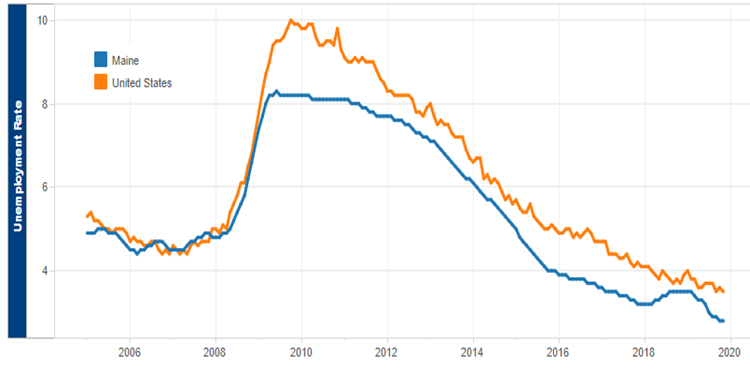
The statewide seasonally adjusted unemployment rate was near three percent throughout 2019, and as the year closes, it has been below four percent for 48 consecutive months—more than twice the previous record. The graph below shows that Maine’s unemployment rate since the recession has been below the national average.
These positive conditions pushed the job openings rate to new highs in 2019. The job openings rate in Maine was not markedly different than for the nation. Due to the large influx of summer tourists, however, there is much more seasonality to openings in Maine than in most of the nation. Hospitality businesses that cater to tourists, especially in communities along the coast, have been particularly challenged to attract the staff they need during the peak season in the summer and early fall. This situation has been exacerbated by a reduction in seasonal H2B visa workers that previously had been an important source of labor during those peak months of the year. The graph below shows that there have been more job openings than unemployed people in the United States for the last two years; in Maine that has been the case for three years.

The Labor Force Participation Rate measures the share of the population age 16 and over that is employed or actively seeking employment. The graph below shows that the labor force participation rate in Maine and across the country has declined over the last two decades. This follows a pronounced rise in participation in the previous three decades. Maine’s current labor force participation rate of 62 percent is the lowest since 1983, but it is higher than at any point before that.


The decline in participation over the last two decades is due to the advancing age of the large baby boom generation, the same reason it increased in the previous three decades. In the 1970s and 1980s, many baby boomers entered the labor force. In the 2000s, boomers began to move beyond the 25 to 54 peak age of participation. As the graph on the following page shows, participation rates have not changed much over the years in the three age cohorts that include people aged 25 to 54. However, participation is up in older cohorts as people now tend to work well into their 60s, and down among those under 25 years of age as more are enrolled in school than in the past.
Close to 425,000 people age 16 and over in Maine are not employed, while just 22,000 of those are classified as “unemployed.” Those who are unemployed are people who are able and available to work and are actively looking for work. While they are between jobs, unemployed people are considered to be in the labor force. The rest of those who are not employed are not in the labor force for a variety of reasons. They may be retirees, full-time students, homemakers raising children. They may have a disability or some other barrier that prevents them from working.

Taking a longer view of the labor force, the growth that was the norm in the three decades before the turn of the 21st century has not been present for the last two decades. This is because of a decline in the number of births over the last five decades especially since the 1990s. As baby boomers born in the two decades after World War II advance in age to retirement, fewer young people are aging into the labor force to replace them. Succession planning for employees and business owners will be critical as these individuals move to retirement. The State projects a relatively flat trend in its labor force over the next decade.
A look at employment rates (the share of the population that is employed) of the working age population is illustrative of the very different outcomes those with limited education face compared to those with higher educational attainment. Data from the American Community Survey 2018 one-year estimates, includes outcomes for Maine people aged 25-64. The data shows that 53 percent of those with less than a high school diploma are in the workforce compared to 74 percent of those with a high school diploma and 87 percent of those with a bachelor’s degree or higher. Further, unemployment decreases as education levels increase even in this current period of low unemployment. Unemployment is eight percent for those without a high school diploma and decreases to four percent for those with a high school diploma and two percent for those with some level of post-secondary education.
Educate Maine’s report on Education Indicators for Maine 2018 states that approximately 87 percent of Maine students graduate from high school in four years, placing Maine above the national average for high school completion. However, only 55 percent of the state’s high school graduates enroll in some form of postsecondary education. Of those who begin college, only 46 percent return for a second year and 30 percent receive a two- or four-year degree. The rates of enrollment and completion are substantially different based on the economic standing of the student. Only 16 percent of students who are economically disadvantaged receive their two- or four-year degree.
Occupational projections to 2022 indicate that 60 percent of net job growth is expected to occur in occupations requiring some form of postsecondary training or credential, including 35 of the 50 fastest growing occupations. Workers entering or returning to the job market with lower levels of education find a much more challenging environment to prosper in than was the case not many years ago.
There has been a great deal of discussion about a rising skills gap as the recovery has advanced and unemployment rates have reached very low levels. Many businesses and trade associations assert that the available labor force lacks the knowledge and skills they need. This has been widely reported in the media.
It is challenging to quantify the gaps between the skills that employers seek and those that job seekers possess. Skills are attributes of performance requirements, ranging from basic functions such as hand-eye coordination, repetitive machine feeding, and instruction following, to advanced functions such as deductive reasoning, analytical thinking, and complex problem solving. At present, there is no way to catalog or inventory skills to determine who possesses what skills and at what level. Additionally, employer requirements for certain functions vary.
Though we cannot broadly define or measure skill gaps, we can see indications of a mismatch between employer needs and the available workforce in job trends over the last decade. There are declining numbers of jobs in production, administrative support, and other functions that value physical labor, routine tasks, and direction following. There are rising numbers of jobs in managerial, professional, and technical occupations that require skills in critical thinking, problem solving, reading comprehension, social perceptiveness, communication, and other more cognitively-oriented functions. The transition from operating a production machine in a manufacturing environment to operating a diagnostic imaging machine in a hospital, for example, is complicated. This transition and many others involve learning entirely new technical skills and different ways of interacting with customers and coworkers.
Individuals with barriers to Employment
Priority populations
Stakeholders and businesses in Maine grasp the need to prioritize services that will facilitate participation of all potential members of the labor force. They will continue to work to implement strategies that alleviate barriers to attaining employment.
SWB advocates on behalf of individuals facing challenges to employment. An official standing committee is charged with examining the barriers specific target populations face and developing recommendations that address such barriers. SWB promotes employment without discrimination based on the basis of gender, race, age, ethnicity, national origin or other barriers.
Individuals with barriers to employment include the following:
- Displaced homemakers
- Eligible migrant and seasonal farmworkers
- English language learners and those facing substantial cultural barriers
- Formerly incarcerated
- Foster care youth or youth transitioning out of foster care
- Homeless individuals
- Native American Indians, Alaskan Natives, and Native Hawaiians
- Individuals with disabilities, including youth with disabilities
- Individuals with low literacy levels
- Older individuals
- Individuals within two years of exhausting lifetime eligibility for TANF
- Long-term unemployed individuals
- Low income individuals
- Single parents
Persons with disabilities
Maine can rightly claim a long standing and abiding concern with the employment issues facing people with disabilities. Addressing these issues and increasing the workforce participation of this population must be a priority to improve the economic wellbeing of individuals with disabilities but also for the state as a whole.
From 2013 through 2017, an average of 208,600 persons with one or more disabilities resided in Maine, equal to about 16 percent of its civilian non-institutionalized population of 1.3 million. This proportion was higher than that of the United States in which an estimated 13 percent of residents had a disability. The age distribution of the civilian noninstitutionalized population with disabilities differs from the general population (with and without disabilities) and has a higher share of persons over 64 and a lower share in cohorts 64 or younger. In Maine, nearly 40 percent of the population with disabilities is over 64 years, more than double the comparable share of the general population (18 percent).
Adults with disabilities in Maine are less likely to be employed than adults without disabilities. Fewer than half work or seek work; the unemployment rate among adults with disabilities is three times that of other working age adults. From 2013 through 2017, 33 percent of working-age Mainers with disabilities were employed compared to 80 percent of those with no disability. Those who do work earn less than workers with no disability. Median earnings of workers with disabilities were $18,434 in a twelve-month period, compared median earnings of $31,217 among workers with no disability. Adults with a disability are more likely to live in or near poverty regardless of work status and are less likely to have postsecondary education than adults with no disability (Source: CWRI).
The Commission on Disability and Employment (CDE):
The CDEwas established by the Maine Legislature in 1997. It promotes collaboration with the public and private sectors to increase awareness of and influence policy related to employment for people with disabilities. Its members envision a Maine workforce that includes all people with disabilities employed in jobs that meet both their economic and personal needs. The CDE issues a formal annual report that includes recommendations to the Governor and Legislature.
women
According to the June 2016 brief Gender Pay Gap- Recent Trends and Explanations, issued by the Council of Economic Advisors, women represent approximately 47 percent of the labor force. On average, women make 79 cents for every $1.00 earned by men in similar occupations. This gap is even larger when race and ethnicity are factored in. A non-Hispanic Black woman earns 60 cents to a non-Hispanic White man’s $1.00, a Hispanic woman earns 55 cents. While the disparity is smaller, women of color make less when compared to men of color.
The 2017 Report on the Status of Women and Girls in Maine was presented as a series of one-page briefs presented to the Maine Legislature and covers the topics of economic security, freedom from violence, health and education. The report indicates that Maine women continue to be drawn to jobs that are traditionally female and, as such, traditionally pay low wages. Despite long-term efforts to encourage Maine women to explore traditionally male, high-wage occupations such as the construction trades, those jobs often require travel to different areas, overnights or weeks away from home, longer work days, and other issues that specifically impede women from entering them particularly those who are single parents with childcare needs.
Single heads of household are made up more of women than men, due, in part, to the fact that women live longer than men (more widowed), but also because more remain unmarried or divorced. According to the U.S. Census Bureau’s American Community Survey, this population group included an estimated 33,570 females with nearly 40 percent of these households living in poverty.
The Women’s Employment Committee:
The Women's Employment Committee (WEC) is committed to taking action on current factors affecting women’s participation in the workforce such as the gender wage gap and affordable dependent care. Committee members review women-specific employment issues and develop recommendations to the SWB that remove barriers which prevent women from attaining economic success and security and that result in legislation supporting full economic opportunity for all Maine women. Five years ago, the WEC produced a report entitled “Working Women in Maine, Indicators for Progress” which featured quantifiable benchmarks to measure, monitor, and evaluate Maine’s progress in achieving economic opportunity and security for all Maine women. WEC has identified the following program and policy priorities for the next five years:
Education and Training:
- Affordable, accessible college and degree attainment, including advising services to help women and girls of all ages become informed about higher education and how to plan for college or other pathways to earning credentials
- Access to comprehensive workforce preparation, training, and support services that help women and girls to develop foundational skills and transition to education and employment leading to higher paying jobs in growth sectors
- Access to support services to assist them as adult learners to persist and achieve degree attainment, including such services as scholarship assistance, healthcare, access to child and elder care, and transportation resources
Employment and Business Ownership:
- Pay equity and paycheck fairness, including minimum wage increases
- Family-friendly workplace policies and benefits, such as paid sick and family medical leave health insurance, retirement, flexible work options, support for education and advancement
- Training and technical assistance to employers to build and sustain a diverse workforce
- Support for women’s entrepreneurship and business ownership for starting and growing their own businesses
Financial Education and Asset Ownership:
- Access to timely and relevant financial education and coaching services
- Support for multi-generational savings and asset building strategies (education, business, home ownership) and equitable tax policies which address the income gap
- Increase retirement savings options including protecting Social Security
Address Barriers to Economic Security for Women:
- Access to affordable healthcare and family planning services
- Access to affordable and available child and elder care services
- Affordable and energy-efficient housing and transportation options
- Freedom from violence and sexual harassment
- Support for leadership development of girls and women to contribute to the workforce, business ownership, and public life
Rural Residents lacking reliable transportation
Maine is a geographically large, rural state in which those without affordable, reliable transportation face significant barriers to accessing occupational training and employment. Rural communities in the state’s three regions have limited or non-existent public transportation services. The larger cities are served by municipal or regional bus services, but intercity bus links are limited. Stakeholders must work to identify new ways for rural Mainers to access workforce and educational resources. Some do not have access to high-speed internet and many lack basic computer literacy skills.
Partnering with Maine's Public Library System
Workforce boards will work to promote the resources of Maine’s public library system as a key partner in addressing this issue. Maine has over 266 public libraries, the smallest of them serving an island population and the largest serving urban hubs (Portland, Lewiston-Auburn, and Bangor). Libraries are vital centers of community access to technology and resources for online learning. Recent surveys reveal that 750,000 Mainers have a library card. Over 1.7 million high speed internet sessions took place through 230 libraries. (Each library has between 100 mbps to 1 gigabit of fiber connections.) Maine libraries offer safe, family welcoming environments where single parents can access job search resources with children in tow. They offer informal training in digital literacy from tools to set up email accounts (which are needed to register for labor exchange and file unemployment claims) to assisting with uploading resumes to various job sites.
In partnering with Maine’s public library system, workforce providers can promote participant access to resources in the Digital Maine Library, specifically, the Career Preparation, Adult Skills and Computer Skills Center. The Digital Maine Library also provides access to “Career Transitions,” an online resource for job seekers that assists them in finding sustainable employment. The Maine State Library invests state and federal dollars as well as money from the Maine MTEAF (Maine Telecommunications Access Fund) to provide a vast array of resources for all Maine citizens. The Career Preparation Center provides specific occupational practice tests that assess and provide online skill development through varied occupationally-specific tools that address readiness to enter careers from allied health to homeland security. Residents can also access tools that prepare them to pass high school equivalency exams such as the High School Equivalency Test (HiSET) and post-secondary entrance exams such as the Scholastic Aptitude Test (SAT) or Accuplacer.
Local Boards will develop agreements with regional libraries and, using best practices already available in state, engage in staff cross-training that will inform workforce system staff about the resources libraries offer and how to promote these to their customers. Library staff, in turn, will become versed in promoting the programs and resources provided through CareerCenters.
When the CareerCenter closed in Waterville, the Waterville Library (Library) established an active partnership to provide access to career services and expertise from agencies such as the Augusta CareerCenter, New Ventures, the Kennebec Valley Community Action Program, Chambers of Commerce, local workforce boards. The Library has fully integrated and embedded workforce development as part of its mission and activities. The Library hosts itinerant staff from the Augusta CareerCenter who are able to provide employment and training services as well as a local job fair.
Many public libraries can assist members of the public who are not digitally literate, including those who either do not have access to or do not know how to navigate the internet or on-line resources. All partners must continue to engage in creating solutions because the need for this level of one-on-one digital guidance far outstrips the capacity of either library or CareerCenter staff to address alone.
Older workers
Older workers in Maine face considerable barriers to employment. The median age in Maine is 44.6 years compared to the national average of 38.1. This segment of Maine’s population is large and growing rapidly. In 2018, 21 percent of the population was over age 65; by 2036 this figure is expected to increase to 28 percent. As the first baby boomers reach traditional retirement age, labor force participation among older workers will increase. As increasing numbers age into their 70s and beyond, labor force participation is likely to decline. This initial increase presents an opportunity to find ways to capitalize on the skills and experience of older workers who continue to work, either in their current careers or in “encore” careers.
Proven strategies to engage older workers include educating employers about the benefits of hiring older workers who, as a cohort, are recognized for their expertise and skills, judgement, commitment to quality, and demonstrated work ethic. Older workers are valued for their flexibility regarding work hours, schedules, place and benefits, deferred retirement option plans, job sharing, and workplace accommodations.
The Older Workers Committee:
The SWB’s Older Workers Committee (OWC) is dedicated to working with employers, employees, retirees, and older worker advocacy groups.
Members of OWC work to promote the value of Maine’s workers (age 55+) through advocacy, education, and policy development. The main objective of OWC is to address the needs of older workers and their employers. The OWC instituted the “Silver Collar Employer Award” to recognize employers in Maine whose policies and practices fulfill the needs of older workers.
formerly Incarcerated
The formerly incarcerated often face barriers re-entering life outside of the corrections system. The Maine Department of Corrections (DOC) estimates it will release 6,000 prisoners from its facilities within the next five years. Based on the current population, at the time of their release, 31 percent of these individuals will have reading skills comparable to the middle school level and 76 percent will be similarly prepared in math. This lack of proficiency in math, reading and other skills create barriers to employment. The lack of employment prospects often lead to other problems such as securing housing and accessing support services.
Finding employment after release greatly reduces the likelihood that an individual will commit another crime. Workforce service providers assist those transitioning out of the corrections system to access job search assistance resources, but system partners will need to work more closely with employers to identify ways they can best capitalize on this prospective labor pool. Evidence-based approaches will be promoted. Some local areas are currently launching projects that include provision of career services in pre-release and county jails that educate soon to be released inmates about job search and workforce training resources and that establish relationships between them and prospective employers. Maine is also working with employers to reduce concerns about hiring formerly incarcerated. Previous job fair–like events have been held at two Maine State Prison facilities. Employers who attended reported that it helped to better understand the system as well as the rehabilitation and education programs in which inmates participate. In addition, Maine is promoting the Work Opportunity Tax Credit (WOTC) and the Federal Bonding Program as incentives to employers considering hiring justice-involved individuals. The MDOL and DOC recently agreed to a partnership where DOC staff will pre-certify for WOTC and issue Federal Bond vouchers to inmates as part of their release processing. These formerly incarcerated individuals will leave correctional facilities with documents offering incentives to employers who hire them.
DOC has also implemented registered apprenticeship programs in some of its facilities for both staff and inmates. They also work closely with the university and community college system in the provision of educational opportunities for inmates.
Younger workers
WIOA requires that all programs serve youth with significant barriers to employment or education, including: high school dropouts, pregnant or parenting, homeless or runaway youth, those subject to the criminal justice system, youth with disabilities, and low-income youth who are basic skills deficient or lack English proficiency. These are documentable barriers, but the youth that fall under these categories often cope with numerous additional challenges such as low aspirations, depression, substance use, unstable homes, lack of appropriate adult role models, family violence, neglect, abuse, rural isolation, lack of transportation, sexual orientation and gender identity discrimination, and an overall lack of basic work-readiness competencies.
Youth service providers will partner to assess the need for a full menu of youth-oriented services from attainment of high-school diploma to parenting skills, financial literacy and career counseling. Employers will be at the table to offer work experience, internships and adult role-modelling and will continue to be involved with occupational and career awareness activities like EPIC Maine (a partnership of regional employers and education providers that introduces young adults to various careers) and the Annual Crafts Championships (a collaboration between industry, career and technical education centers and community colleges to showcase careers in the construction trades).
The Younger Worker Committee:
This committee works to identify, evaluate and address issues facing youth ages 14 to 24 who are in transition and to ensure multiple partner resources are available. Committee membership includes representatives from the Bureau of Employment Services (BES), Job Corps, Jobs for Maine’s Graduates, Title IB youth service providers, secondary and post-secondary career and technical education programs, YouthBuild, juvenile justice, private industry, Office of Child and Family Services serving transitioning foster youth, Maine Youth Transition Coalition, the Division of Vocational Rehabilitation (DVR), and Adult Education to name a few. In the past, the committee has focused on development of a youth resources guide that was distributed through schools and service agencies. Most recently, committee members have focused on strategies to address transportation, childcare, and housing issues that impede the ability of younger workers to enter employment or access higher education. Committee members collaborate to develop new and innovative ways to jointly serve youths in transition.
Veterans
The flow of veterans and transitioning service members through Maine’s one-stop CareerCenters averages over 3,500 people per year. Unemployment for veterans in Maine is at an all-time low with less than 2 percent of our veterans currently unemployed. Wagner-Peyser, WIOA and other USDOL funded projects operate in unison with the Jobs for Veterans State Grant (JVSG) to ensure that all veterans receive priority of service within the workforce delivery system. These and other workforce programs are the point of entry for Maine veterans, disabled veterans and covered persons. Our employment service capacity is strategically distributed throughout the CareerCenters to serve veterans.
The JVSG is a non-competitive, USDOL funded program that provides over $800,000 annually to Maine, supporting 11 full time staff positions. A mix of disabled veterans outreach program specialists and local veteran's employment representatives (LVERs) work out of one-stop CareerCenter offices. There is one LVER who serves as the state veterans program manager based at the central office in Augusta.
The Veterans’ Employment Committee:
This committee works to improve training and employment opportunities for Maine veterans, disabled veterans, and eligible spouses. The committee focuses on building employers’ awareness of the advantages of hiring veterans and works to develop policy recommendations to increase the effectiveness and efficiency of veterans’ employment and training programs in Maine. The committee began initiatives to improve outreach and education to both employers and veterans. This resulted in a new web portal at the Maine Bureau of Veterans Services which has been very effective. In addition, an advanced military culture training was developed and delivered to over 200 employers. This training is now available on YouTube. The committee members include representatives from the following organizations: Boots2Roots, Easterseals Maine, Employer Support of the Guard and Reserve, Maine Bureau of Veterans’ Services, Maine National Guard, Maine State Approving Agency for Veterans’ Education, Military OneSource, Military Talent Source, student veterans' programs, Togus Veterans Administration Medical Center, Volunteers of America Northern New England, and several Maine employers. The MDOL’s Veterans Employment and Training Services (VETS) program manager staffs this committee.
This committee continues its Hire-A-Vet campaign that promotes hiring of 100 veterans in 100 jobs with 100 employers in 100 days. The average wage for veteran hires increased from $17.43 in 2015 to $23.06 in 2019. Employers partnered to make the initiative a success and all goals have been exceeded in each of the last four years. The campaign connected nearly 750 employers with 1,000+ veteran-hires since its inception in 2015 and was recognized as a best practice by the USDOL and the National Association of State Workforce Agencies (NASWA).
Persons with language barriers
People who are foreign-born and for whom English is not their primary language typically face considerable barriers to employment in the United States. According to 2018 American Community Survey one-year estimates, approximately 3.5 percent of Mainers were born outside the United States. Of those, nearly one third entered the U.S. since 2010.
According to the American Community Survey, about 6 percent of the population speaks a language other than English at home.
Persons with language barriers live throughout the state. However, clusters of foreign-born Mainers with language barriers are more prevalent in cities where services are more available, such as in Lewiston/Auburn, Greater Portland and Saco/Biddeford. According to the Maine Center for Economic Policy, in addition to New Mainers. Maine has a population of second-, third-, and even fourth-generation French-speaking Franco-Americans. Roughly 10 percent of adult Franco-Americans and Acadians in Maine do not have a high school diploma or equivalency and one in five has some college but no degree. Low English language proficiency among this population may account for some of these numbers. Even within the cities, the state does not have enough current resources available to meet the need for English language instruction.
Individuals living in poverty and with low levels of education
Other people with barriers to employment in Maine include those who are low income with low levels of education. Twelve percent of the population lives in poverty. Of that figure, 35 percent are Native Indian and Alaskan Native, and 20 percent are black or African American. In addition, 25,361 Mainers over 25 have less than a 9th grade education and 43,100 are without a high school diploma (American Community Survey 2018 ACS 1-Year Estimates). The State Workforce Board’s (SWB) subcommittees focus on many of those populations who are statistically in poverty. Committee chairs are working across the committees in recognition that each constituent group is not mutually exclusive and many barriers to employment are crosscutting.
WIOA - TANF PARTNERSHIP OBJECTIVES
Under Governor Mills’ administration, the Temporary Assistance for Needy Families (TANF) program will be a full partner of the one-stop system as recommended under WIOA. As such, the Maine Department of Health and Human Services (DHHS) will support and guide its TANF service provider (currently and hereafter, Fedcap) to work with core and required partners of the one-stop system to jointly serve customers and, as appropriate, leverage and share resources on their behalf.
First-Steps to Partnership
The Greater Portland and Rockland CareerCenters will serve as pilot sites for the development of collaborative service delivery. Staff from each agency have identified program services that each agency provides, such as assessment, case management, plan development, barrier mitigation, training, and job search activities such as job fairs and job development through outreach to employers.
The pilot project teams identified specific services they can collaborate on, including the following:
- Supplemental job search services, such as participation in job search, resume, and interviewing workshops offered by each provider
- Registration with Maine JobLink, the labor exchange system that matches worker skills with jobs listed by Maine employers (i.e.: teaching Fedcap staff how to guide TANF clients through this process and/or having employment services staff assist TANF recipients with this process)
- Coordination between agencies on client service plan development to eliminate unnecessary duplication of services for co-enrolled customers
- Referrals and program co-enrollment that will enable customers to leverage the supports and resources of multiple programs
- Co-management and accountability of participant involvement in activities and services of partner programs, such as coordinated and/or shared case management and formal protocols for communication between programs on behalf of shared customers
- Ongoing cross-informing between Fedcap and employment services to better align service coordination overall
- Collaboration on employer outreach and job development activities
Staff collaboration and communication steps have been drafted between employment services, Fedcap and other DHHS staff to include:
- Involvement of DHHS regional planners acting as liaisons between programs and possibly co-located at pilot sites (CareerCenters or Fedcap service sites)
- Formal cross-training in which Fedcap staff will learn how to access WIOA core and required partner services and vice versa
- Sharing of best practices and practical example of resource leveraging and braiding of services
- Instituting regular (monthly) partner team meetings to:
- Further develop relationships
- Fine tune and implement collaborative practices
- Discuss pilot and customer progress and success and address identified challenges
- Promote continuous improvements
- Define success and establish measurable outcomes
Coordinated Sector Pilot
A second pilot designed to address worker shortages in the healthcare sector and meeting the work requirements of TANF is in development. The pilot will focus on workforce needs of healthcare providers and how TANF and other partner resources can be aligned to meet the sector needs. The project will focus on locations with high but unmet demand for entry-level healthcare positions. The project will involve Adult Education, the Maine Community College System, and the TANF-funded Parents as Scholars and Higher Opportunity for Pathways to Employment (HOPE) programs. The collaborative will work to launch participants on career paths with advancement opportunities and the potential for ongoing training and development, allowing trainees to advance in skills and earnings over time.
Formal Steps
DHHS will formally partner with each of Maine’s three local workforce boards to take part in a Memorandum of Understanding (MOU) that guides collaborative and integrated service delivery across programs and funding streams. Local workforce boards act as the lead conveners of partners for their regions.
The Northeastern Workforce Development Board (NWDB) has oversight of Aroostook, Hancock, Penobscot, Piscataquis and Washington counties.
The Central Western Maine Workforce Development Board (CWMWDB) has oversight of Androscoggin, Franklin, Kennebec Oxford, and Somerset counties.
The Coastal Counties Workforce board, (CCWI) has oversight of Cumberland, Knox Lincoln, Sagadahoc, Waldo, and York Counties.
The boards work with partners to develop and maintain the local one-stop system and to articulate the coordinated service delivery design for their local region. Local boards bring additional partners to the table and promote collaborative resolution of issues facing the region such as poverty, the effects of opioid use and more. Local boards also negotiate cost sharing between partners to ensure adequate one-stop infrastructure and access to all partner programs and eliminate redundancies such as multiple intake or assessment specialists when these could possibly be provided by staff shared between programs.
Signing of a MOU is a formal step that introduces TANF as a partner to the one-stop system and outlines how TANF service providers will work with all required partners going forward.
Future Steps
For partner agencies to better serve TANF recipients it will be beneficial for them to adopt a whole family approach to jobs that looks at not only the enrolled individual but that takes children and other family dependents into consideration when developing service delivery approaches that will enable them to achieve success through a holistic approach to employment services. Likewise, partners should understand how the benefits cliff affects TANF recipients.
TANF could play a key role in educating system partners regarding the benefits of two-generation approaches to service, as well as how to use a benefits cliff tool to be developed for Maine.