


Located in:
- II. Strategic Elements
The Unified or Combined State Plan must include a Strategic Planning Elements section that analyzes the State’s current economic environment and identifies the State’s overall vision for its workforce development system. The required elements in this section allow the State to develop data-driven goals for preparing an educated and skilled workforce and to identify successful strategies for aligning workforce development programs to support economic growth. Unless otherwise noted, all Strategic Planning Elements apply to Combined State Plan partner programs included in the plan as well as to core programs.
- a. Economic, Workforce, and Workforce Development Activities Analysis
The Unified or Combined State Plan must include an analysis of the economic conditions, economic development strategies, and labor market in which the State’s workforce system and programs will operate.
- a. Economic, Workforce, and Workforce Development Activities Analysis
II. a. 1. A. Economic Analysis
The Unified or Combined State Plan must include an analysis of the economic conditions and trends in the State, including sub-State regions and any specific economic areas identified by the State. This must include—
i. Existing Demand Industry Sectors and Occupations
Provide an analysis of the industries and occupations for which there is existing demand.
ii. Emerging Demand Industry Sectors and Occupations
Provide an analysis of the industries and occupations for which demand is emerging.
iii. Employers’ Employment Needs
With regard to the industry sectors and occupations identified in (A)(i) and (ii), provide an assessment of the employment needs of employers, including a description of the knowledge, skills, and abilities required, including credentials and licenses.
Current Narrative:
II.(a.1.A) Economic Analysis
Economic conditions in much of Maine are positive going into 2020. In the last several years, growth has created new jobs and driven unemployment and other measures of the labor market to near record lows. These tight labor market conditions, with high numbers of job openings and rising wages, provide a positive environment for individuals but are a challenge for many employers seeking to attract and retain the staff they need.
While we are currently in a positive, expansionary environment, economic cycles still exist; we need to be prepared for the next downturn. In addition, the aging of our population presents a significant challenge to maintaining the size of our labor force in the years to come.
Recent Trends and Current Conditions
Total output of the economy increased at accelerating rates in recent years with gross domestic product reaching $67 billion in 2019. The average of 633,000 nonfarm payroll jobs was up more than 4,000 from 2018, marking the ninth straight year of job growth. Though the recovery from the very deep recession of 2008 and 2009 was initially quite slow, conditions today are better by nearly every measure than before the decade-ago downturn.
Economic analysis
Existing Demand Industry Sectors and Occupations
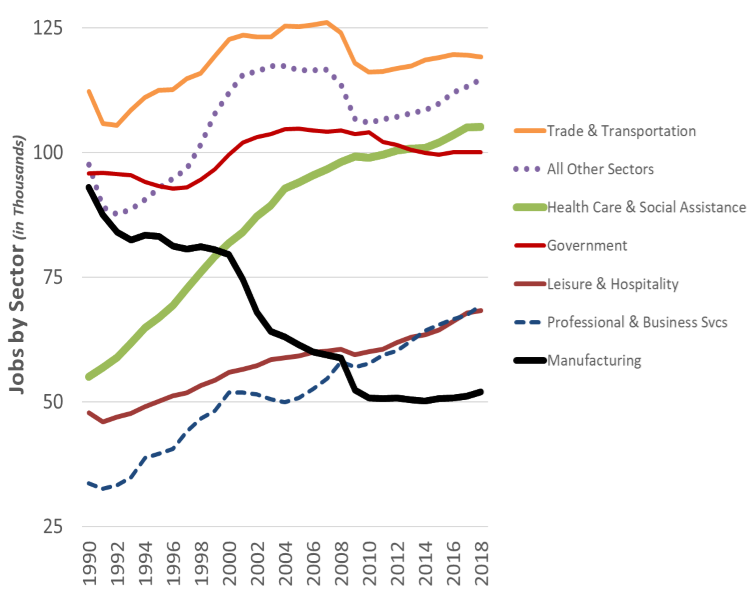
Over the last three decades, the industry structure of jobs changed significantly. The most prominent trends were the near doubling of jobs in the healthcare and social assistance and the professional and business services sectors, as well as a sharp decline in manufacturing jobs. The types of jobs in sectors that are growing have different education, skill, and performance requirements than the types of jobs in sectors that are declining.
Regarding occupations, the ten highest occupational groupings employ almost three-quarters of those working Maine. 2018 data available through the U.S. Bureau of Labor Statistics shows that the top three occupational groups for the state are Office and Administrative Support with 92,250 employees, Sales and Related Occupations with 57,760 employees, and Food Preparation and Serving-Related Occupations with 56,960 employees. These three groups, along with the others that round out the top ten, include approximately 451,000 employees and about 75 percent of Maine workers. The top ten categories and number of workers in each are provided in the following table. Standard Occupational Codes are also provided for reference. The top category, Office and Administrative Support, is comprised of such occupations as customer service representatives, administrative assistants, and stock clerks.
| Rank | Occupational Major Group | # Employed |
|---|---|---|
| 1 | Office and Administrative Support | 92,250 |
| 2 | Sales and Related | 57,760 |
| 3 | Food Preparation and Serving-Related | 56,960 |
| 4 | Education, Training and Library | 41,760 |
| 5 | Healthcare Practitioners and Technical | 41,280 |
| 6 | Transportation and Material Moving | 36,360 |
| 7 | Production | 35,900 |
| 8 | Management | 35,630 |
| 9 | Personal Care and Service | 26,850 |
| 10 | Construction and Extraction | 26,140 |
Emerging Demand Industry Sectors and Occupations
Job openings and growth in the decade through 2026 are concentrated in two areas: human capital-intensive occupations that generally require postsecondary education and offer above average earnings and in labor-intensive functions that generally do not require high levels of education and offer lower than average earnings. Middle-income jobs that traditionally have had limited education or skill demands are either declining or rapidly changing, requiring increasingly higher levels of technology competency.
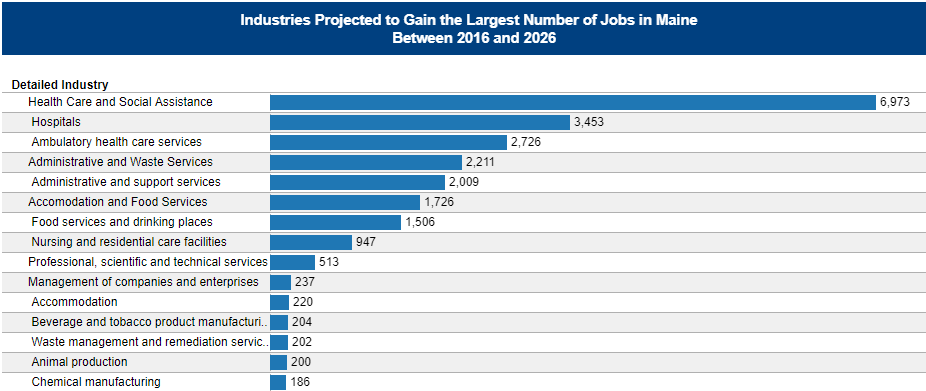
Healthcare is the largest sector in Maine, accounting for nearly 17 percent of jobs. As the chart below shows, Maine will see the largest growth in healthcare-related sectors over the next several years
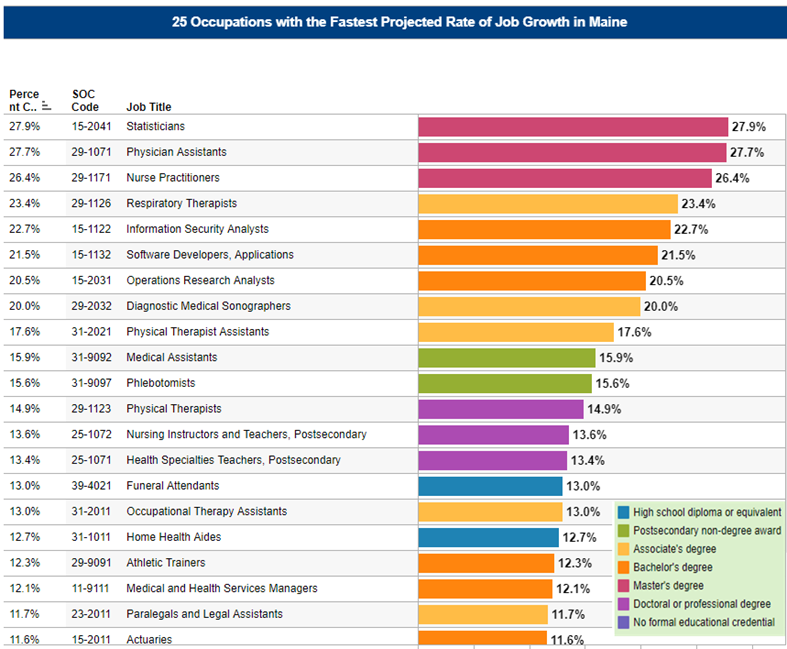
From an occupational standpoint, large numbers of physicians, nurses, laboratory, and diagnostic technicians will be required. Healthcare practitioner and technician occupations require postsecondary education ranging from certifications to highly advanced degrees.
Information technology (IT) is expected to continue to increase in importance across every sector of the economy with IT-related occupations continuing to be among the fastest growing. Many IT jobs not only require certification in certain applications but the types of applications, systems, and platforms are changing quickly, and require a flexible, adaptable workforce that is regularly pursuing additional education. Technology competency will increasingly pervade most occupations often in ways that cannot yet be anticipated.
Other areas of projected job growth include hospitality industries including food service and other associated occupations with mostly limited education and skill demands.
Manufacturing was the backbone that built many cities in Maine in the 19th and 20th centuries. Textile mills, shoe shops, paper and saw mills, and others provided middle income jobs for tens of thousands of workers without postsecondary education. The number of manufacturing jobs peaked in the late 1970s but declined sharply until about 2010 before stabilizing.
The forecast through 2026 is for fewer manufacturing jobs as automation continues to be adopted in an even wider range of processes. This will mostly impact the number of jobs in production occupations. This will also continue to be the case for jobs in administrative support occupations as office technology continues to advance which will allow people in professional and technical occupations to perform those functions digitally.
Regional Trends
Economic performance across the state has been uneven. Maine’s economy is strongest in the south especially along the Interstate 95 and 295 corridors. The economy has been more limited in the central and mid-coast regions, while some counties along the northern rim of the state continue to lose residents and jobs.
There are a wide range of factors involved in the differing performance of regions. The economic structure of northern Maine is highly concentrated in forest products and agriculture. Advances in mechanization of harvesting of timber and crops, as well as other factors, have displaced thousands of workers from those industries over the years. Much of the region has not found the economic development solutions to replace those industries. This has caused stagnation or decline in many communities as a large share of young people leave for southern Maine or other states in search of better job opportunities, leaving a generally older population behind. Several counties in Maine are among the oldest in the nation by median age.
Jobs are increasingly concentrated in and around cities primarily because stable and growing industries tend to be in densely populated areas. Healthcare, the strongest growing industry in Maine, is mostly concentrated in and around hospitals which are only found in places of population density. Law and accounting firms and other types of professional services, colleges, and some other industries that comprise a rising share of jobs also are primarily found in cities.
Maine has identified three regions for the purpose of aligning workforce development resources to regional economies as shown in the map on the following page. These regions are referred to as Northeastern, Central/Western and Coastal Counties. State and Local Boards considered factors such as alignment with economic development districts and postsecondary institutions, inclusion of major urban hubs and distribution of employment by industry. It is also very important to support partnerships already in place for community planning and development and appropriate distribution of financial resources for workforce development.
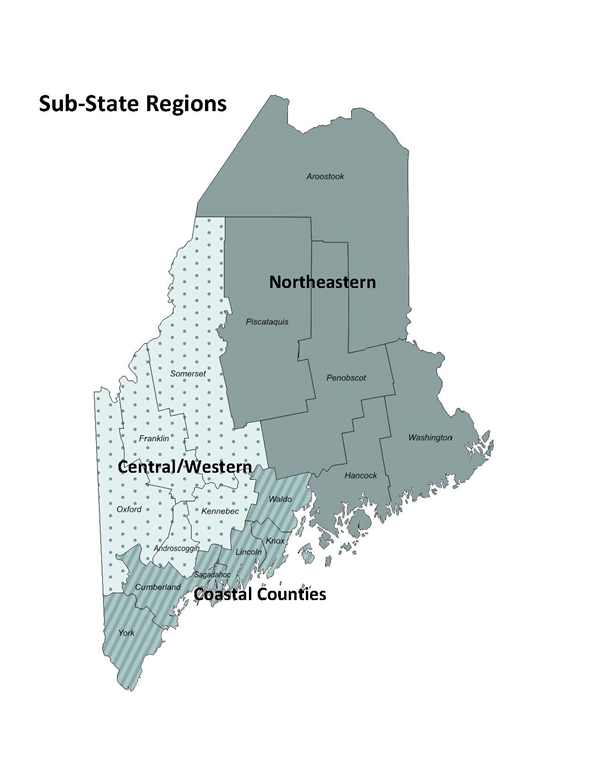
Several factors set the workforce board regions apart. The Coastal Counties region contains 49 percent of the population and 52 percent of jobs on just 12 percent of the land area, making by far the most densely populated of the regions. This region has high concentration of jobs in the financial services and hospitality sectors. Coastal Counties is the only region that has had population growth in the last decade. Some of that growth is from people moving from northern Maine in search of better job prospects.
The Central/Western region has 25 percent of the jobs and 28 percent of the population on 29 percent of the state’s land area. The region has the state’s highest concentration of jobs in manufacturing and education and--as home to the state capital--a large share of jobs in government. Farming and food production are burgeoning growth industries. Demographics and population declines are the region’s most pressing issues; the outlying counties are projected to experience a decline in the working age population over the next two decades.
The expansive but sparsely populated Northeastern region represents nearly 60 percent of the state’s land and 24 percent of the population. The region has 22 percent of the jobs in the state with relatively high concentrations in natural resources, government and retail. The Northeastern region also has the lowest share of manufacturing jobs. Many companies in this sector downsized or ceased operations, displacing thousands of workers over the years.
A more detailed discussion for each region follows below.
The Coastal Counties Region is comprised of six counties and is the most demographically and economically diverse of Maine’s three regions. Six of the ten largest municipalities in the state are in this region: Portland, South Portland, Brunswick, and Scarborough in Cumberland County and Biddeford and Saco in York County.
Given the size of the area, the region is generally classified into four distinct hubs for service delivery purposes.
York County, located in the southern area of the region, is the gateway to Maine. Its coastal plain contains Maine’s most visited beaches and supports a large tourism base. Beyond tourism, York has several defined economic clusters related to defense-dependent industries, healthcare, retail, and manufacturing. Interstate 95, which runs north to south through York and Cumberland Counties, creates an east to west demarcation that separates the seasonal tourist industry of the beaches and larger commerce centers from the rural, agricultural, bedroom communities and, for the most part, small business and retail-centered communities. Commerce in extreme southwestern county towns is focused on New Hampshire where there is no sales tax.
Just up the coast, Cumberland County, is the most populated county, and home to Portland, the most significant commerce hub and the largest city in the state. Portland capitalizes on its strategic location. The city’s port has had a resurgence of shipping and bulk cargo transfers and it is a major port of call for cruise ships. The city hosts the state’s major airport and it is a hub for healthcare, banking, insurance, IT, bio tech, retail, and education. West of Interstate 95 is characterized by growing bedroom communities and retail expansion. The lakes and mountain regions focus on tourism and seasonal, recreational-based economies.
Sagadahoc, Lincoln, Knox, and Waldo counties, commonly identified as the mid coast, comprise the northern segment of the region. These counties are historically steeped in farming, dairy, and the traditions of the sea including boat building and fishing. Similar to York County, the mid coast attracts and is supported by a significant influx of seasonal tourists. The three cluster communities of Brunswick, Topsham, and Bath form one of the major economic regions of the four-county mid coast. Shipbuilder Bath Iron Works is the largest manufacturer in the state. The nearby Brunswick Landing, which is the redevelopment of a former Naval Air Station, is one of the most significant commerce parks in the state. Healthcare, retail and colleges offer opportunities for growth on the southern end of the mid coast hub.
The closure of Brunswick Naval Air Station in 2011 presented a challenge for economic and workforce development in the region, potentially removing millions of dollars of economic activity from the region and reducing demand for a wide range of products and services. Redevelopment of the former base locations in Brunswick and Topsham is well underway and having a positive economic impact. To date, the project has attracted $400 million in capital investment. Over 135 public and private entities employ more than 2,000 people in six target sectors: aerospace, composites, IT, bio tech, renewable energy, and education as well as other complementary industries.
The Boothbay/Damariscotta hub features a strong tourist industry, hosts Renys retail and distribution operations and Mölnlycke Medical, as well as two substantial boat builders, Washburn and Doughty and Hodgdon Yachts. The north end of this hub features the retail commerce cluster of Thomaston, Rockland, Rockport, and Camden. Major employers include Fisher Engineering, Dragon Cement, Penbay Medical Center and those associated with the tourist industry. Rockland, Rockport, and Camden are home to working waterfronts, both commercial and seasonal recreational. The one area of commonality among all four counties in this hub is the fact that tourism is a critical industry either on a transient or destination basis. Route 1 (the coastal route) hugs the coast, providing access points to the hundreds of miles of coast line and peninsular amenities found along the way.
Biggest Challenges:
- The tightening labor market--unemployment is at a historic low--has challenged many employers in their efforts to attract and retain the staff they need.
- Population demographics are impacting growth as mid coast counties, with a large share of retirees, are among the oldest in the nation.
Population and workforce trends in this region are more favorable than in the other two regions due to higher birth rates and in-migration, both from around the state and from outside it. Still, the region will be challenged by a rapidly aging population. Between 2016 and 2031, the Coastal Counties population is projected to rise by 3.5 percent, though the working-age population is projected to decline somewhat.
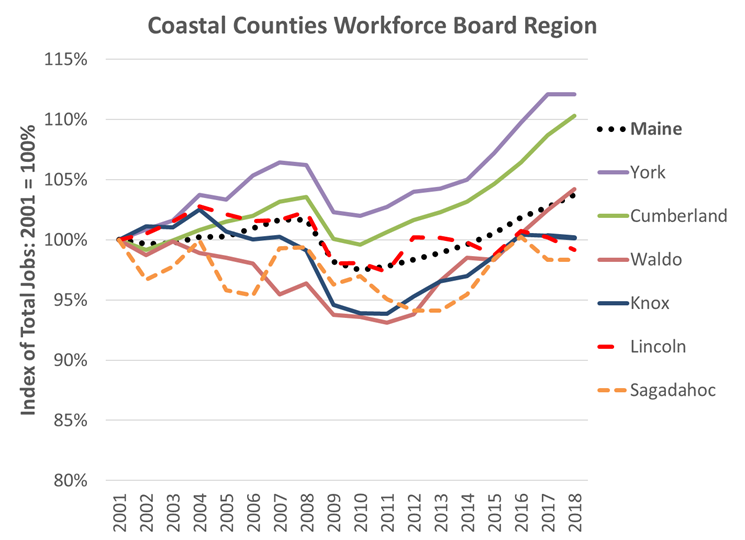
Because the region comprises such a large share of jobs in Maine, its industry composition is not significantly different from the state’s as a whole. The region has a slightly smaller share of government jobs than the statewide average. The distribution of other industries is nearly the same as the state.
The 2018 annual average unemployment rate of 2.9 percent in the region was well below the statewide average rate of 3.4 percent. Within the region, unemployment rates ranged from a low of 2.7 percent in Cumberland County to a high of 3.3 percent in Lincoln County.
Incomes are higher in the southern counties of York, Cumberland and Sagadahoc compared to the state and to the mid-coast counties of Lincoln, Knox, and Waldo. From 2013 through 2017, median household income ranged from a high of $65,700 in Cumberland County to a low of $50,200 in Waldo County. The state median household income is $53,000 ( U.S. Census Bureau, 2013-2017 ACS).
The range of incomes and unemployment rates across the six counties is due in large part to internal variations in economic structure. Southernmost York and Cumberland counties have the highest density of population and jobs. Together, these two counties account for 82 percent of the region’s jobs, with an above-average share of jobs in growth industries (healthcare and social assistance, professional and business services, private education, and leisure and hospitality). The mid coast counties of Sagadahoc, Lincoln, Knox, and Waldo are less populated and more reliant on seasonal tourism, agriculture, and fishing. These counties have a below-average share of jobs in growing industries.
Employers
In 2019 the largest private employers were primarily in the healthcare and social assistance, retail trade, and manufacturing sectors. The three southernmost counties have a concentration of jobs associated with national defense which includes the federal Portsmouth Naval Shipyard, Pratt and Whitney Aircraft Group, General Dynamics Armament Systems, and Bath Iron Works.
| Rank | Employer | Number of Jobs (Range) |
|---|---|---|
| 1 | MAINEHEALTH | 12,501 to 13,000 |
| 2 | BATH IRON WORKS CORP GEN DYNAMICS | 4,001 to 4,500 |
| 3 | HANNAFORD BROS CO | 3,501 to 4,000 |
| 4 | L.L. BEAN, INC. | 2,501 to 3,000 |
| 5 | UNUM GROUP | 2,001 to 2,500 |
| 6 | PRATT & WHITNEY AIRCRAFT GROUP | 1,501 to 2,000 |
| 7 | WAL MART | 1,001 to 1,500 |
| 8 | SHAWS SUPERMARKETS INC | 1,001 to 1,500 |
| 9 | MERCY HOSPITAL | 1,001 to 1,500 |
| 10 | MID COAST HOSPITAL | 1,001 to 1,500 |
| 11 | UNIVERSITY OF NEW ENGLAND | 1,001 to 1,500 |
| 12 | WEX LLC | 501 to 1,000 |
| 13 | IDEXX LABORATORIES INC | 501 to 1,000 |
| 14 | BOWDOIN COLLEGE | 501 to 1,000 |
| 15 | T D BANK N A | 501 to 1,000 |
| 16 | YORK HOSPITAL | 501 to 1,000 |
| 17 | MARTINS POINT HEALTH CARE CENTER | 501 to 1,000 |
| 18 | ATHENAHEALTH INC | 501 to 1,000 |
| 19 | TYLER TECHNOLOGIES INC | 501 to 1,000 |
| 20 | IDEXX DISTRIBUTION INC | 501 to 1,000 |
| 21 | GOODWILL INDUSTRIES OF NORTHERN NEW ENGLAND | 501 to 1,000 |
| 22 | LOWES HOME CENTERS LLC | 501 to 1,000 |
| 23 | INTERMED PA | 501 to 1,000 |
| 24 | BANK OF AMERICA, NA | 501 to 1,000 |
| 25 | SPURWINK SERVICES INCORPORATED | 501 to 1,000 |
| 26 | SWEETSER | 501 to 1,000 |
The latest available statistics reveal that the majority of the region’s workforce--280,300 primary job holders--lives and works within the area. About 56,600 resident workers commute to jobs outside the region, offset by 52,700 non-resident workers commuting into the region ( 2017, OnTheMap, U.S. Census Bureau).
The Central/Western Region encompasses 29 percent of Maine’s land area. It is home to 28 percent of the state’s population and 25 percent of private sector jobs. The largest population centers in the region are the cities of Lewiston and Auburn in Androscoggin County, and Augusta and Waterville in Kennebec County.
Similar to the state, the region will be challenged by a rapidly aging population. Between 2016 and 2031, the Central/Western Region is projected to lose two percent of its population, with a sharper decline in the working-age population.
In 2018, the annual average unemployment rate of 3.6 percent in the Central/Western region was close to the 3.4 percent statewide average. Unemployment rates ranged from lows of 3.2 and 3.3 percent in Kennebec and Androscoggin counties to a high of 4.8 percent in Somerset County.
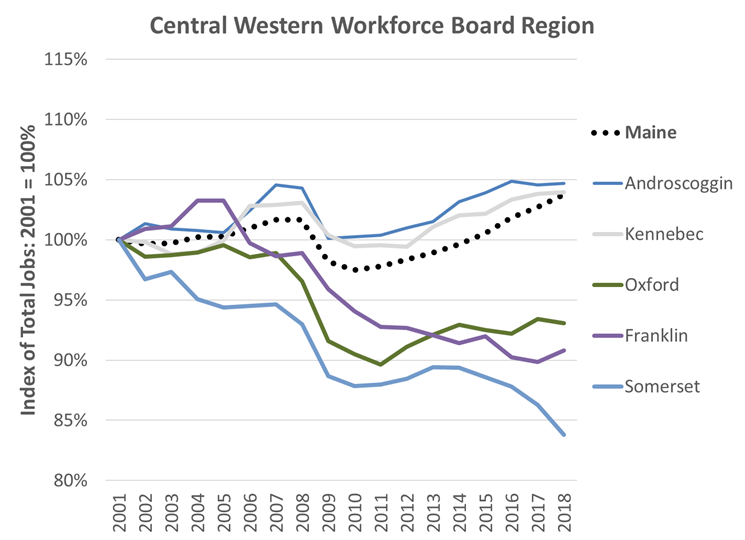
The disparity of unemployment rates across the five counties is due in large part to variations in the economic structure within the region. The central more populous counties of Androscoggin and Kennebec—have more job opportunities than the more sparsely-populated rim counties of Franklin, Oxford and Somerset.
The economic base in Androscoggin and Kennebec counties is diversified across a broad spectrum of industries, with higher concentrations of jobs in professional and business services, transportation and warehousing, and healthcare than the region or the state. In addition, Kennebec County is home to Augusta, Maine’s capital city, and has a significant concentration of jobs in state government. Kennebec and Androscoggin counties are home to 72 percent of jobs in the region.
In the rim counties, the economy is less diverse and more concentrated in forestry-related industries, seasonal agriculture and hospitality, including major ski resorts.
Within the region, incomes are higher in the central counties of Androscoggin and Kennebec compared than the western counties of Franklin, Oxford, and Somerset. From 2013 through 2017, the median household income ranged from a high of $50,100 in Kennebec County to a low of $41,500 in Somerset County. Median household income was lower in each county in the region than the state median income of $53,000 (U.S. Census Bureau, 2013-2017 ACS).
Employers
In 2019, the largest private employers were primarily in the healthcare and social assistance, manufacturing, and retail trade sectors.
| Rank | Employer | Number of Jobs (Range) |
|---|---|---|
| 1 | MAINEGENERAL MEDICAL CENTER | 2,501 to 3,000 |
| 2 | WAL MART SUPERCENTER | 2,001 to 2,500 |
| 3 | CENTRAL MAINE COMMUNITY HEALTH CORP | 1,501 to 2,000 |
| 4 | HANNAFORD BROS CO | 1,501 to 2,000 |
| 5 | T D BANK N A | 1,001 to 1,500 |
| 6 | ST MARY'S REGIONAL MEDICAL CENTER | 1,001 to 1,500 |
| 7 | MAINEHEALTH | 1,001 to 1,500 |
| 8 | COLBY COLLEGE | 501 to 1,000 |
| 9 | BATES COLLEGE | 501 to 1,000 |
| 10 | T MOBILE USA INC | 501 to 1,000 |
| 11 | NEW BALANCE ATHLETIC SHOE INC | 501 to 1,000 |
| 12 | S D WARREN | 501 to 1,000 |
| 13 | JOHN F MURPHY HOMES INC | 501 to 1,000 |
| 14 | REDINGTON MEDICAL PRIMARY CARE | 501 to 1,000 |
| 15 | ND PAPER INC | 501 to 1,000 |
Statistics describing worker flow into and out of the Central/Western region reveal that 71 percent of the region’s 145,000 resident primary jobholders lived and worked within the area. In 2017, about 46,000 resident workers commuted to jobs outside the region, partially offset by 36,700 nonresident workers commuting into the region to work, for a net outflow of 9,300 commuters (2017, OnTheMap, U.S. Census Bureau).
Northeastern Region
The five counties comprising Northeastern Region encompass 59 percent of Maine’s land area. They are home to 25 percent of the state’s population and 23 percent of private sector jobs. The largest population centers in the region are the cities of Bangor, Orono, and Brewer in Penobscot County and Presque Isle and Caribou in Aroostook County.
Like the state, the region will be challenged by a rapidly aging population. Between 2016 and 2031 the region is projected to lose 1.3 percent of its population, with a sharper decline in the working-age population.
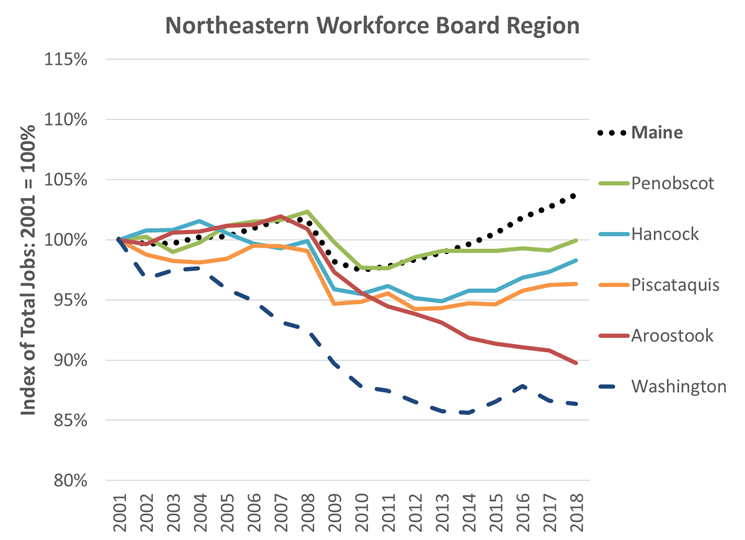
The 2018 annual average unemployment rate of 4.1 percent was higher than the 3.4 percent statewide average. Within the region, unemployment rates ranged from a low of 3.8 percent in Penobscot County to a high of 4.9 percent in Washington County.
The disparity of unemployment rates across the five counties is due in large part to the diverse makeup of the region’s economic structure. The more densely populated Hancock and Penobscot Counties offer better job prospects than the sparsely populated northern and eastern counties of Piscataquis, Aroostook, and Washington.
There are three distinct economies within the region: coastal Hancock and Washington counties, regional service centers in Bangor and Presque Isle/Caribou, and Piscataquis, interior Hancock, Washington, and rural Penobscot and Aroostook counties.
The economic base in coastal Hancock and Washington counties is dependent on seasonal, tourism-related commerce and maritime trades, with concentrations of jobs in hospitality, retail, and construction industries.
The economic base in the Bangor metropolitan area and Presque Isle/Caribou is diversified across a broad spectrum of industries with relatively large shares of private jobs in retail, wholesale trade, health care and social assistance. These areas are commercial and regional centers for government administration and educational services.
Away from the coast and outside of its service areas, the region is rural. The economic base is heavily dependent on natural resource-based industries (farming and logging), woods-based manufacturing and seasonal tourism. Relatively high concentrations of private jobs occur in natural resources, retail and manufacturing industries.
The industry structure of the Northeastern Region features higher concentrations of jobs in government, healthcare and social assistance, and retail trade. Five percent of the region’s jobs are in natural resources and mining compared to one percent statewide.
Within the region, incomes were higher in the central Hancock and Penobscot counties than the northern and eastern counties of Aroostook, Piscataquis, and Washington. From 2013 through 2017, the median household income ranged from a high of $51,400 in Hancock County to a low of $38,800 in Piscataquis County. Median household income was lower in each county in the region than the state median wage of $53,000 (U.S. Census Bureau, 2013-2017 ACS).
Employers
In 2019, the largest private employers were primarily in the healthcare and social assistance, retail, and manufacturing sectors.
| Rank | Employer | Number of Jobs (Range) |
|---|---|---|
| 1 | EASTERN MAINE MEDICAL CENTER | 3,001 to 3,500 |
| 2 | WAL MART | 1,001 to 1,500 |
| 3 | HANNAFORD BROS CO | 1,001 to 1,500 |
| 4 | THE JACKSON LABORATORY | 1,001 to 1,500 |
| 5 | NORTHERN LIGHT HEALTH | 501 to 1,000 |
| 6 | ST JOSEPH HOSPITAL INC | 501 to 1,000 |
| 7 | THE AROOSTOOK MEDICAL CENTER | 501 to 1,000 |
| 8 | PENOBSCOT COMMUNITY HEALTH CARE | 501 to 1,000 |
Statistics describing worker flows into and out of Northeastern region reveal that most of the region’s 116,600 primary job-holders lived and worked within the area. In 2017, about 7,400 resident workers commuted to jobs outside of Aroostook-Washington counties, partially offset by 4,400 non-resident workers who commuted in. About 20,100 resident workers commuted to jobs outside of the Penobscot, Piscataquis, Hancock counties, offset by 20,100 non-resident workers who commuted into the three counties (2017, OnTheMap, U.S. Census Bureau).
Employers’ Labor Force Needs
Employment has shifted towards industries with a greater share of educated workers. Over the last two decades, industries recording employment gains had a higher share of workers with a bachelor’s degree than industries that shed jobs. The education, health, business, and professional services industries have a higher than average share of workers with a bachelor’s degree. Conversely, manufacturing and construction, which have shed thousands of jobs, have a lower than average share of workers with a bachelor’s degree.
The changing educational needs of employers reflect the changing nature of work, that is, the shifting occupational structure of the workplace. Changes that have been taking place and are expected to continue include:
- An increase in higher level jobs and a decline in traditional manual occupations
- Movement from skills associated with manual dexterity toward skills associated with understanding and monitoring complex systems
- A shift away from routine processes toward coordination and collaboration
- An increase of general work skills required in many jobs such as the ability to use computers
- Expanded need for communication skills
- Jobs that include a broader range of responsibilities
Even among production workers, the demand for highly educated workers has grown. Since 1990 the share of production workers with some college or an associate degree and a bachelors’ degree rose by 15 percentage points and two percentage points, respectively, even as the number of workers fell by 52 percent.