


Located in:
- II. Strategic Elements
The Unified or Combined State Plan must include a Strategic Planning Elements section that analyzes the State’s current economic environment and identifies the State’s overall vision for its workforce development system. The required elements in this section allow the State to develop data-driven goals for preparing an educated and skilled workforce and to identify successful strategies for aligning workforce development programs to support economic growth. Unless otherwise noted, all Strategic Planning Elements apply to Combined State Plan partner programs included in the plan as well as to core programs.
- a. Economic, Workforce, and Workforce Development Activities Analysis
The Unified or Combined State Plan must include an analysis of the economic conditions, economic development strategies, and labor market in which the State’s workforce system and programs will operate.
- a. Economic, Workforce, and Workforce Development Activities Analysis
II. a. 1. A. Economic Analysis
The Unified or Combined State Plan must include an analysis of the economic conditions and trends in the State, including sub-State regions and any specific economic areas identified by the State. This must include—
i. Existing Demand Industry Sectors and Occupations
Provide an analysis of the industries and occupations for which there is existing demand.
ii. Emerging Demand Industry Sectors and Occupations
Provide an analysis of the industries and occupations for which demand is emerging.
iii. Employers’ Employment Needs
With regard to the industry sectors and occupations identified in (A)(i) and (ii), provide an assessment of the employment needs of employers, including a description of the knowledge, skills, and abilities required, including credentials and licenses.
Current Narrative:
Recessions and Recovery
Alabama lagged the nation experiencing the effects of the December 2007-June 2009 Great Recession. Alabama experienced the most significant economic losses of that recession in 2009. Alabama lagged again when the rest of the nation started pulling out of the recession. In 2015, construction had not yet begun to recover, and economists wondered if it would ever get back to prerecession levels. Federal, state, and local government budgets suffered tremendously, and cutbacks occurred at all levels. Federal budget constraints hurt the state’s military base operations and federal research contracts in the state. This led to fewer jobs and a slower recovery. In 2016 when states began to see their unemployment rates finally decline, Alabama had the highest unemployment rate in the Southeast Region and was one of the top five highest rates in the nation. However, the data reflected some confidence in the recovery with rising civilian labor force numbers. In just two short years, Alabama not only recovered from that recession, but reached historic high levels of civilian labor force and number of people employed.
The population and economy at all levels suffered in 2020 when the labor market bottomed out during the COVID pandemic and briefest recession in history. The recession associated with the pandemic lasted two months and resulted from mandated industry shutdowns. Unemployment claims reached over 106,000 for the week ending April 4, 2020, and over 221,000 claims were paid during the week of May 9, 2020. Even as businesses in Alabama slowly opened back up, the unknown effects and fear in the population related to the pandemic continued to inject uncertainty in the labor force participation and economic projections that require consistency. Even so, Alabama has largely rebounded from the COVID recession and the labor market is returning to pre-COVID health. Average annual 2020 figures compared to preliminary 2021 suggest that even while labor force numbers are not where they were pre-pandemic, a healthy recovery is occurring in Alabama labor markets.
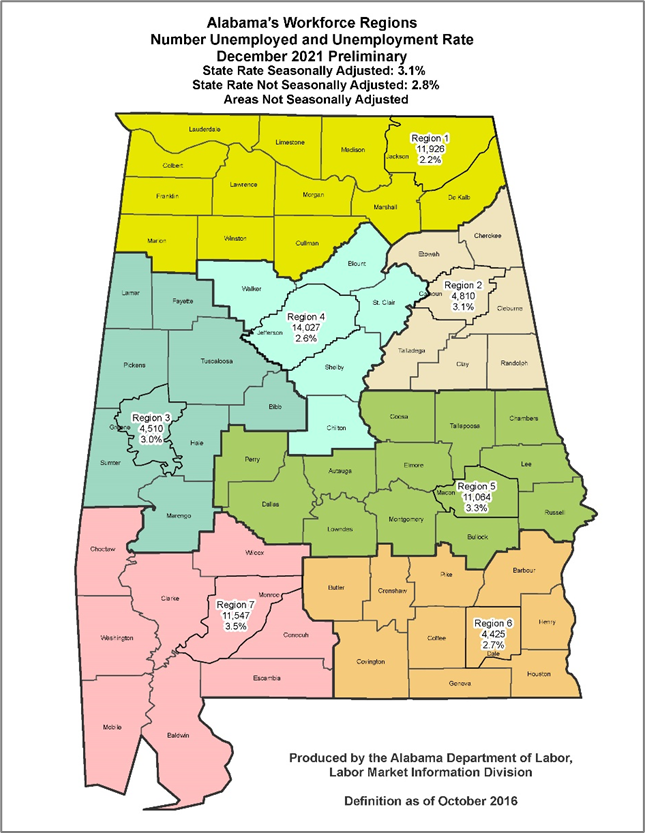
The latest seasonally adjusted data are for December 2021. At this time, the civilian labor force was 2,227,172, with 69,854 people in the state classified as unemployed, equating to an unemployment rate of 3.1%.
Alabama’s Population and Population Growth
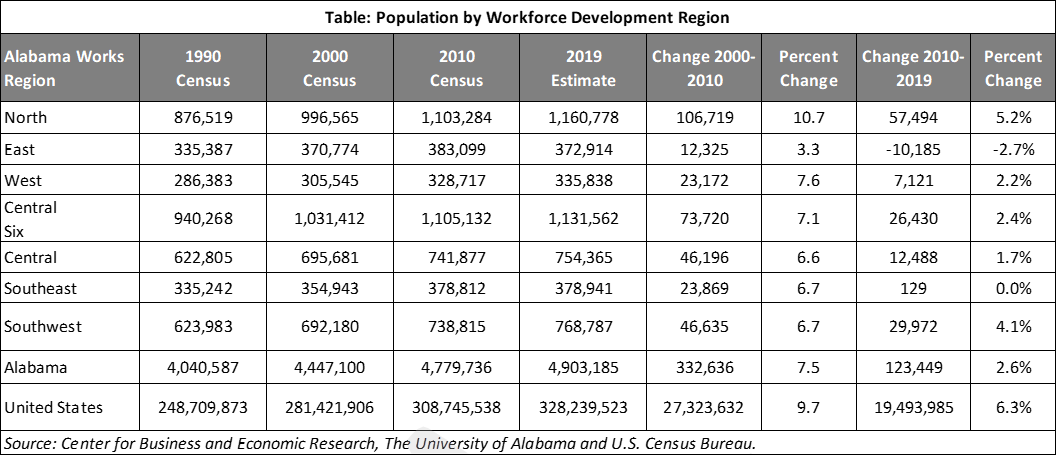
The Alabama population count of almost 4.8 million for 2010 was 7.5 percent more than in 2000. The state’s population growth was lower than the nation’s growth of 9.7 percent. During that period, population growth in the North and West AlabamaWorks regions were higher than the state’s average. North AlabamaWorks had the highest population growth at 10.7 percent, followed by West (7.6 percent) and Central Six (7.1 percent). East AlabamaWorks had the lowest population growth at 3.3 percent.
The 2019 population estimates show a 2.6 percent population increase, or 123,449 people for the state since 2010 with much of the regional growth occurring in the North AlabamaWorks with an 57,494 more people, and Southwest AlabamaWorks with an additional 29,972. This is a 5.2 percent and 4.1 percent respective increase over the 9-year period. The estimates indicate population declined in East AlabamaWorks by -2.7 percent or -10,185 individuals. The Southeast region remained steady with no measurable growth and only a small increase of 129 people. The remaining five regions fell in between this range and are presented below.
Census Bureau five-year estimates for 2019 indicate the population in the state is 68.1 percent White, 26.6 percent Black, 1.4 percent Asian, and 0.5 percent American Indian. The largest percentage of the White population lives in north Alabama, while the largest percentage of the Black population lives in central Alabama. The state’s largest population of American Indians reside in Washington County (7.4%) followed by Lawrence County (5.6%) and Escambia County (4.0%). The counties with the largest Asian population are Lee County (4.3%) and Montgomery County (2.8%). The counties with the largest percentage of Hispanic population are Franklin (17.4%), DeKalb (14.6%), and Marshall (14.0%), all counties in the northern part of the state.
The population decennial counts, estimates, and projections by age group.
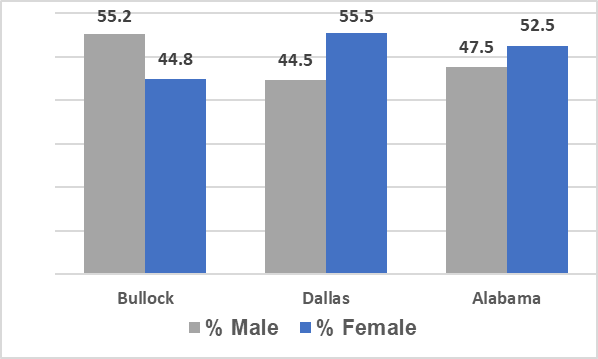
Population members 18 years of age and over break out statewide as 47.5 percent male and 52.5 percent female. The split between sexes is most noted in Dallas County being 44.5 percent male and 55.5 percent female and Bullock County with 55.2 percent male and 44.8 percent female. The challenges faced by families that rely on quality childcare to participate in the labor force must be addressed and are crucial to economic recovery from the COVID recession. Support for the childcare communities exist in part with agencies such as the Alabama Department Human resources, Child Care Services Division and childcare subsidy programs (see the ADPH 2020 Annual Report WEB.pdf, retrieved 2/16/2022). A full discussion of the Child Care Workforce Stabilization Grant is beyond the scope of this report, however this labor force dynamic in families must be addressed in order to increase labor force participation and encourage parents to return to work post-COVID.
Source: U.S. Census Bureau, U.S. Census Bureau, 2015-2019 American Community Survey 5-Year Estimates, Retrieved from https://api.census.gov/data/2019/acs/acs5/profile 2/8/2022.
According to the Alabama State of the Workforce Report XIV, the population aged 65 and over is growing rapidly as the baby boomer generation ages. Consequently, growth of the prime working age group (20-64) and youth (0-19) is expected to lag that of the total population through 2040. From a 2018 base, prime working age population growth is expected to decline through 2030 but grow by 2.1 percent by 2040 as an exodus of baby boomers from the workforce will end. This poses a challenge for workforce development. To meet long-term occupational projections for growth and replacement, labor force participation of younger residents must increase; additionally, older workers may need to be incentivized to work longer.
Alabama’s Manufacturing Environment in the 21st Century
Historically, the economy in the United States has thrived from its manufacturing industries. At the turn of the 21st century, many states had shifted away from manufacturing, due to cheaper labor overseas. Alabama is one of only 5 states in the nation where manufacturing was the largest industry every year since 1990.The 21st century began with an influx of new major automotive manufacturers into the state, making up for thousands of textiles and apparel manufacturing jobs lost over the past two decades.
While auto manufacturers did suffer during the Great Recession, they have experienced increases in auto sales and exports since, which has led to additional shifts and more employees. This, in turn, had a positive effect on the output of the parts suppliers in the state. The resurgence in automotive manufacturing has also led to additional transportation manufacturers locating in the state. Aerospace Manufacturing has always had a large presence due to Marshall Space Center in Huntsville, Alabama, but since 2000 this industry has expanded into new regions of the state to become a major aerospace presence across the nation. According to Census records, from 2019 to 2020, exports have dropped 17.6 percent, with largest percent change occurring with Passenger Motor Vehicles (Census HTS codes 8703.32 and 8703.24). For 2020, Alabama exported over 17.1 billion dollars in goods down slightly from 2019’s 20.8 billion.
Overview of Alabama’s Workforce Development Regions & Regional Workforce Councils
In 2016, the state had 10 regional workforce development councils that worked with industry to ensure they had trained workers to meet the demand of those high demand industries. In 2017, the leadership of the Alabama Workforce Council along with partner agencies of WIOA and the WIOA State Board decided to reduce the regions to seven. At the same time, state WIOA leadership and The US Department of Labor (USDOL) worked toward increasing the number of local WIOA boards from 3 to 7 and matched those regions to the 7 regional workforce councils (RWCs). Each of the regions has boards consisting of industry leaders, educators, economic developers, and community leaders. The RWCs are arranged as 501c3 organizations with executive directors and are primarily funded by the state through the Alabama Department of Commerce.
Southwest Alabama Workforce Development Council (SAWDC) was the first of these in Alabama and includes the Mobile and Daphne/Fairhope/Foley metropolitan areas. In 2017, the Mobile local WIOA board expanded to the same geographic area of SAWDC and became the Southwest Alabama Partnership for Training and Employment (SWAPTE). The Jefferson County local WIOA board expanded to the geographic area of the Central Six Workforce Development Council and became Central Alabama Partnership for Training and Employment (CAPTE). The remaining counties that were previously part of the third local state board were divided into the geographic areas of the other 5 RWCs and function under the same names. Each of the 7 regions in the state varies economically. All include at least one metropolitan area, which drives the economy and jobs in the region. All of the regions also include at least one four-year college or university.
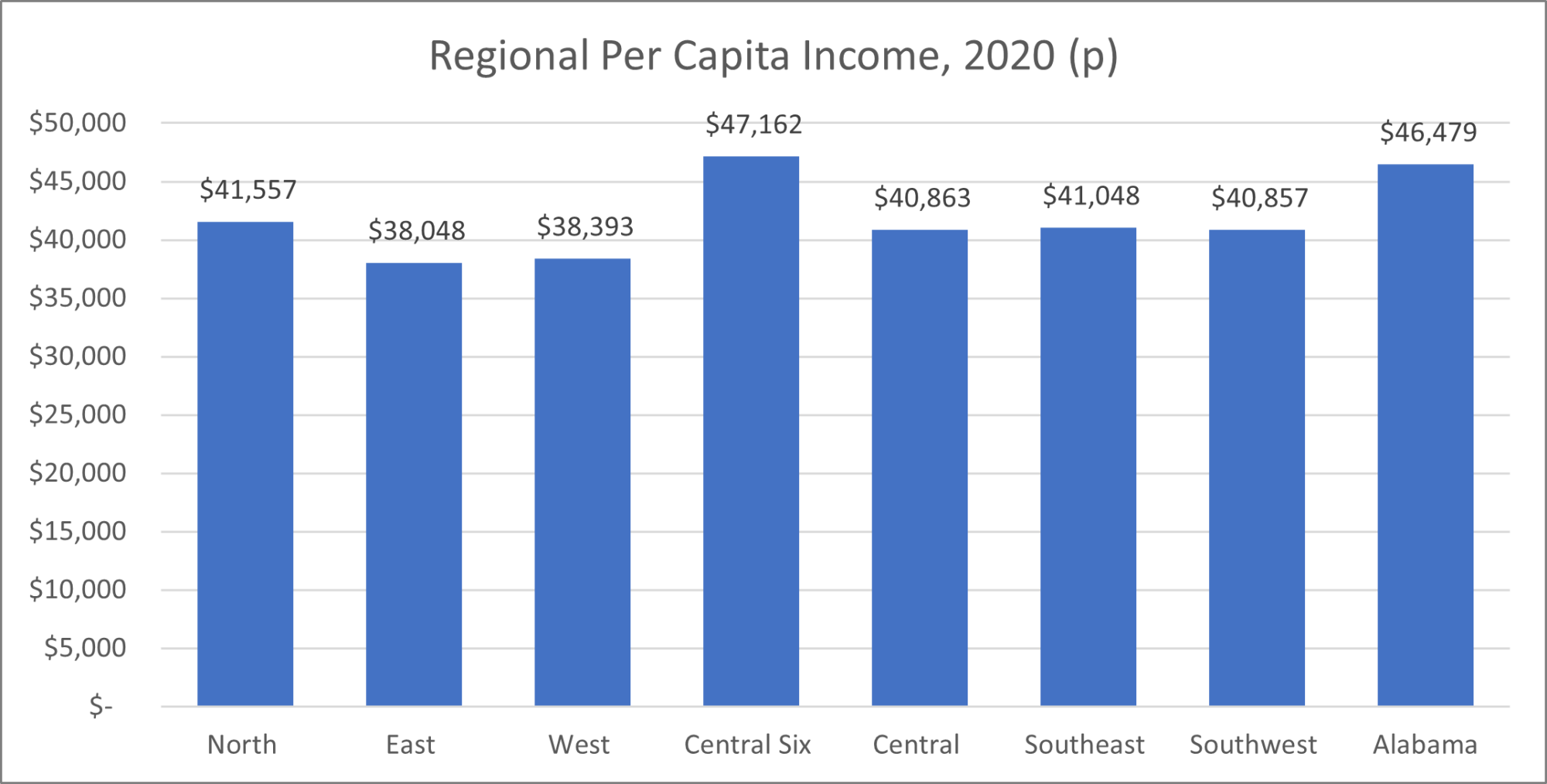
Source: U.S. Bureau of Economic Analysis, https://apps.bea.gov/iTable/iTable.cfm?reqid=70&step=1&isuri=1&acrdn=5#reqid=70&step=1&isuri=1&acrdn=5, retrieved 2/15/2022.Note: Per capita personal income was computed using Census Bureau midyear population estimates. Estimates for 2010-2020 reflect county population estimates available as of March 2021. These estimates are based on the 2010 census. BEA will incorporate Census Bureau midyear population estimates based on the 2020 census results when they become available
North Alabama Works
North Alabama Works (Region 1) encompasses three metropolitan areas, Huntsville, Decatur, and Florence/Muscle Shoals. The estimated population in 2019 was 1,160,778 which is a 5.2 percent gain since 2010. The per capita income in 2020 was $41,557, $4,922 below the state estimate. Total preliminary employment in March 2020 was 519,093, which is a -1.1 percent decline from 2017. Manufacturing employs the largest percentage of the workforce in the region, at 20.3 percent. This region is known for its nationally recognized high-tech hub in the Huntsville metro. With the second largest research and development park in the United States, the area is home to a large array of fortune 500 companies, local and international high-tech companies, and U.S. space and defense agencies. This hub for research and development employs nearly half of the state’s total architecture and engineering occupations, and a third of the computer and mathematical occupations.
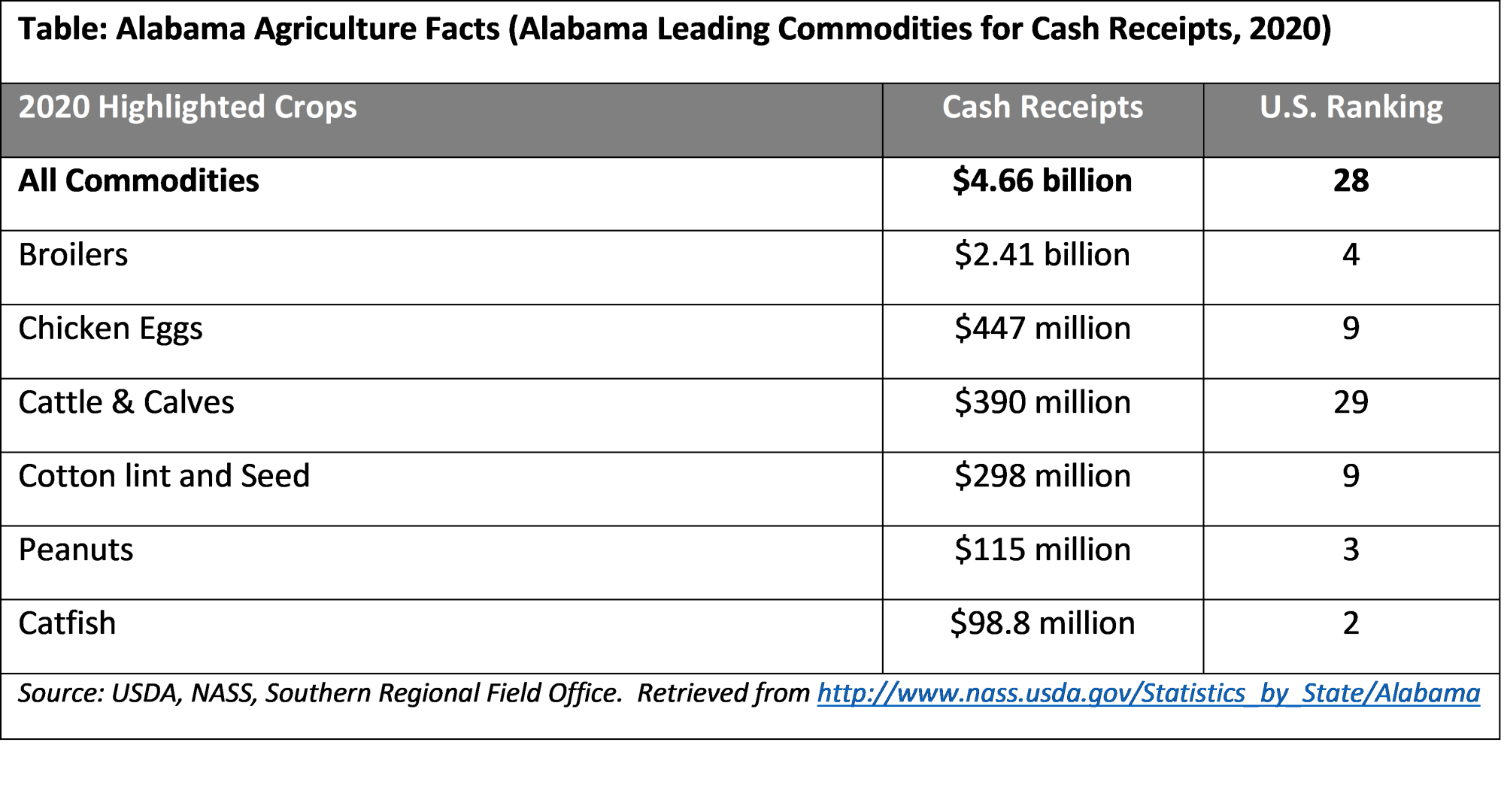
Along with the rest of the state, this region has experienced immense growth in transportation and manufacturing occupations. For several years motor vehicle body and trailer manufacturing were a large part of the economy in the western portion of the region. In addition, Toyota has operated an engine manufacturing plant in the Huntsville area since 2003, but since the 2008 recession, the region has attracted numerous motor vehicle parts manufacturers. Employment in this industry has slightly decreased by 0.2 percent since 2016. In January of 2018, Toyota announced plans to build a $1.6 billion plant located between Decatur and Huntsville that will employ up to 4,000 people. As of June 2021, Toyota has added 1,600 employees to the workforce. Toyota’s new presence will certainly increase the business for surrounding parts and metals manufacturers in the region and statewide. Although the Huntsville metro is centered on technology, many of the surrounding counties in the region still depend on agriculture, with an estimate of over 17,300 employed. The region continues to be a large producer of large poultry, cattle, corn, and cotton.
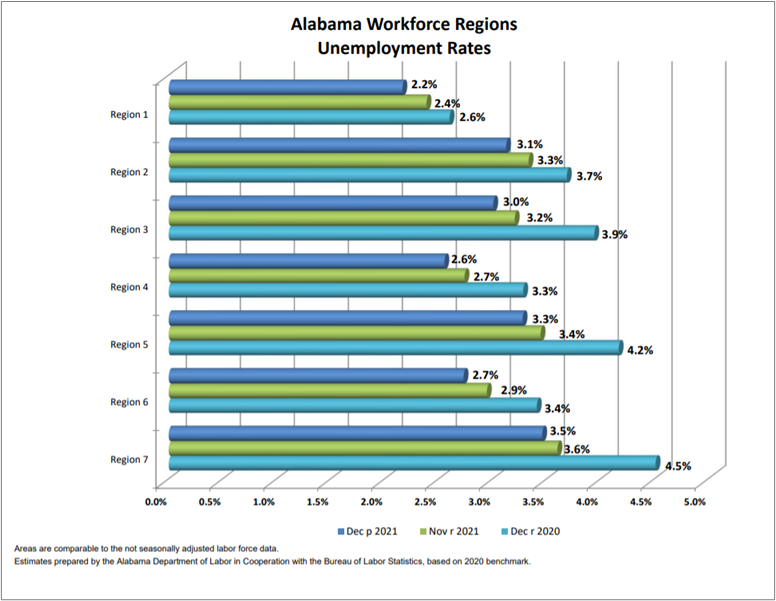
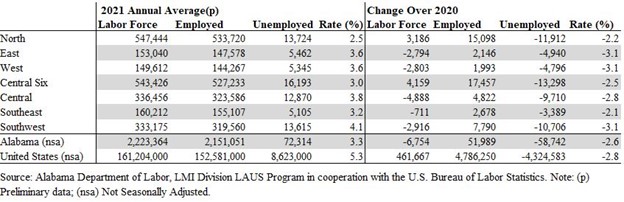
The labor force impact from the COVID recession began in April 2020, when the unemployment rate for the region reached 10.9 percent with 57,820 people counted as unemployed. Just one month later, the number of unemployed dropped to 33,659 with a rate of 6.3%. Since that time, the region has logged a tremendous recovery to almost pre-pandemic levels and a current preliminary December 2021 rate of 2.5% unemployment.
East Alabama Works
East Alabama Works (Region 2) includes the Gadsden and Anniston metropolitan areas. In 2019 the region’s population estimate was 372,914, a loss of 2.7 percent from 2010. Population in the two metro areas make up over 55 percent of the region’s population. These metro areas had a population decline of over 10,000 people since 2010. Per capita income in the region for 2020 was $38,048. Total employment in 2020 was 149,430, down 4.2% percent since 2016. While manufacturing has the highest employment in the region, most of the growth over the last two years occurred in construction, adding 543 jobs, and transportation and warehousing. In just two years, transportation and warehousing added 921 jobs in this region, equaling a 24.6 growth rate.
In March 2020, the region had approximately 6,098 unemployed, equaling a 3.9 percent unemployment rate. By April, that had jumped to 26,835 unemployed and a corresponding rate of 17.1 percent. Annual 2021 figures indicate a positive rebound from COVID levels with only 5,462 unemployed and a rate of 3.6 percent.
West Alabama Works
West Alabama Works (Region 3) includes the Tuscaloosa metropolitan area; however, a majority of the counties in the region are rural. The region had an estimated population of 335,838 in 2019, 62 percent in Tuscaloosa County. Per capita income is over $8,000 less than the state average, with an estimate in 2020 of $38,393. Tuscaloosa County makes up approximately 68 percent of the region’s total employment. Educational Services is the dominant industry in Tuscaloosa County, with the presence of The University of Alabama. Manufacturing has a large impact on the region’s economy, with nearly 19 percent of the total employment. Total employment has slightly decreased 2.7 percent since 2016, reaching 149,153 in 2020. The manufacturing industry, employing 19,429 people in 2016, experienced over 9.5 percent growth since 2016. With the Mercedes Plant announcement to build electric cars in the region and an estimated employment of 3,200, growth is expected to continue.
In March 2020, an estimated 5,028 people were unemployed, equaling an unemployment rate of only 3.3 percent. Only the following month in April those numbers would jump to 24,045 unemployed with an unemployment rate of 16.2 percent. The annual average in this region now indicates only 5,345 unemployed persons with a rate back down to 3.6 percent.
CAPTE
The most heavily populated region in the state is in Central Alabama Partnership for Training & Education (CAPTE or Region 4), which consists of the Birmingham metropolitan area. The 2019 population estimate was 1,105,132, showing an increase from 2010 of 2.4 percent. The region’s per capita income based on the 2020 estimate is $47,162. Nearly 25 percent of the state’s workforce is located within the region, with a total employment of 519,431 in 2019. This region is centrally located in the state with a six-spoke interstate system, which establishes it as a distribution hub. The region is also the financial center of the state, with approximately 36,778 employed in finance and insurance industries, 52.4 percent of the state total. According to the Federal Reserve, Birmingham has nearly $220 billion in bank assets, ranking it as the second largest banking center in the south and 11th nationally. Corporate headquarters for four financial institutions and several major insurance companies are located here. CAPTE also leads the state in health care services and medical research. The University of Alabama at Birmingham (UAB) is the fourth largest academic medical center in the United States, and it ranks 44th out of 965 institutions in the National Science Foundation Total R&D Expenditures. Furthermore, UAB’s University Hospital is the third largest public hospital in the nation. In 2018, Amazon announced that it would open a fulfillment center in Jefferson County, that would add 1,500 workers. This center is expected to contribute $232 million to the state’s economic output annually, and add $137 million to the state’s GDP, according to the University of Alabama, Center for Business and Economic Research. The increase in transportation and warehousing employment since 2016 is partly due to Amazon. This industry added over 793 jobs equaling a growth rate between 2016-2020 of 5.9% percent, with more growth expected.
During the COVID Recession, in March 2020, this region had an unemployment rate of 3.0 percent, with 16,120 unemployed. By April, unemployment had increased to 11.4 percent with 59,519 unemployed. Average annual figures for 2021 show a remarkable recovery back to 16,193 unemployed people with a rate of 3.0 percent.
Central Alabama Works
Central Alabama Works (Region 5) comprises 13 counties and includes the Montgomery and Auburn/Opelika Metropolitan areas. The 2019 population estimate for this region is 754,365, which represents 15.4 percent of the total state population. In 2020, the per capita income was $40,863, $5,616 lower than the state average. Total employment in the region was estimated at 325,034 in 2019, which is a gain of over 4.1 percent from 2016. But average. Many veterans live in this region, with the presence of the Maxwell Air Force Base. Like most of the other regions of the state, Central Alabama Works has experienced immense employment growth in transportation manufacturing industries. With the location of a major automobile manufacturing plant in the region, employment has grown 9 percent in automotive manufacturing and a 6 percent decline in automotive parts manufacturing since 2018. Another major industry in the area is education services, due to the presence of several major universities, such as Auburn, Tuskegee, Alabama State, AUM, Huntingdon, Faulkner, Troy Montgomery, and many community colleges in the region. A study by the Association of Public and Land-grant Universities reported that Auburn had a $5.63 billion economic impact in the state in 2019. Since 2016, employment in transportation and warehousing has increased 13.2 percent, adding over 1,070 jobs.
The COVID impact on the civilian labor force in March 2020, an estimated 11,676 people were unemployed, producing a 3.5 percent unemployment rate. Only the following month the unemployed numbered 45,465 and a corresponding rate of 13.7 percent. Tremendous recovery is seen in the 2021 annual average of 12,780 unemployed at a rate of 3.8 percent.
Southeast Alabama Works
Southeast Alabama Works (Region 6) includes the Dothan metropolitan area and surrounding counties. Population in the region remained stable with an estimate of 378,941 in 2019. Coffee County showed the most population growth of 4.8 percent since 2010, reaching 52,342. Military veterans are a huge part of this region, with an estimated 34,000, the highest in the state. Houston County had the highest percentage of veterans, with an estimated 8,228 residing there. Coffee county had the highest per capita income in the region, at $43,094 in 2018, slightly higher than the state average. The region’s 2020 per capita income was $41,048. This region is home to a major university, military base, and strong presence in aviation training. Additionally, the area continues to be a large producer of cotton, peanuts, and poultry and eggs, with an estimated agriculture employment of 7,556 in 2017. Total employment in the region in 2019 was estimated at 156,601.
COVID civilian labor force estimates for March 2020 show the unemployment rate was 3.5 percent, with 5,497 people unemployed. In April that had ballooned to 15,708 unemployed at a rate of 10.1 percent. The 2021 annual average for his region shows a recovery back to 5,105 unemployed at 3.2 percent, much better than pre-COVID levels.
SWAPTE
Southwest Alabama Partnership for Training & Education (SWAPTE), also know as Region 7, encompasses the southwest region of the state. This area consists of the Mobile and the Daphne-Fairhope-Foley metropolitan areas. The latest population estimates for the metro areas combined are approximately 636,444 while the total population for the remaining six counties in the region is 132,343. Per capita income for the region in 2020 was $40,857. Total employment has grown 3 percent between 2018 and 2020, while manufacturing employment has remained stable. With the expansion underway at Airbus, after announcements to produce a new A220 assembly line in Mobile, growth is expected to continue.
The March 2020 data shows that approximately 13,245 people were unemployed, equaling an unemployment rate of 4.0 percent, the highest of all the regions. Wilcox County, one of the poorest counties in the nation, reported a 9.6 percent unemployment rate, up 3.4 percent from September 2019. In April of 2020, this region had 46,646 people unemployed representing a rate of 14.1 percent - a 10 percent increase over the month. These numbers dropped again by the Annual average 2020 estimate to 13,615 unemployed. This reflects an unemployment rate of 4.1 %
(i) Existing Demand Industry Sectors and Occupations
Existing Demand Industry Sectors and Occupations. Provide an analysis of the industries and occupations for which there is existing demand.
Alabama’s number one manufacturing export is in transportation equipment manufacturing, to include aerospace, automotive, and shipbuilding. At the height of the Great Recession, transportation manufacturing dropped down to 43,205 employed, but since 2010 has grown over 38.9 percent, with automotive parts manufacturing growing the most at 75.4 percent. Ship and boat building had a slight downturn in 2010, possibly affected by budget cuts and fewer federal contracts. However, it has shown the second largest growth at 45.6 percent through 2020.
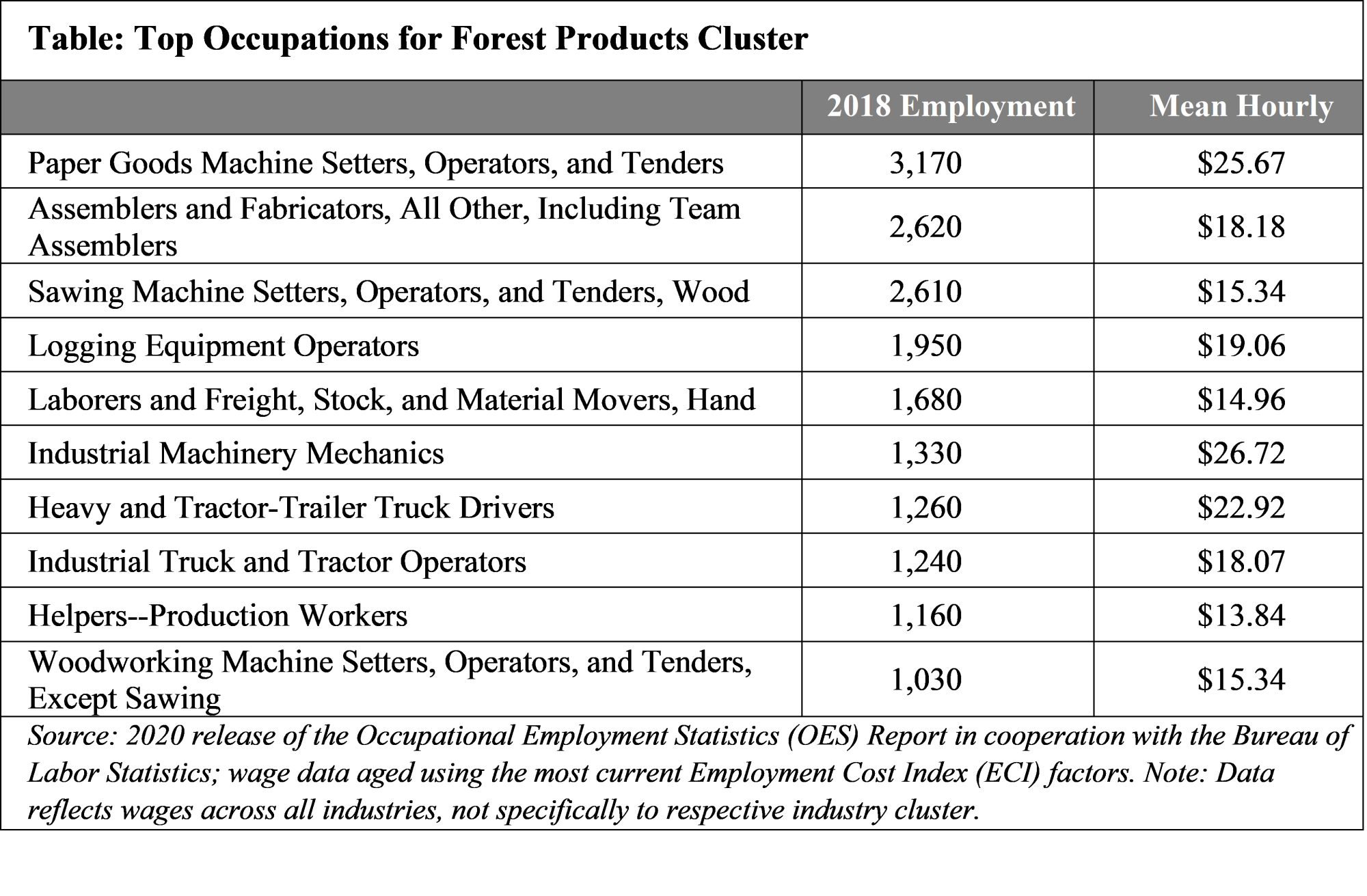
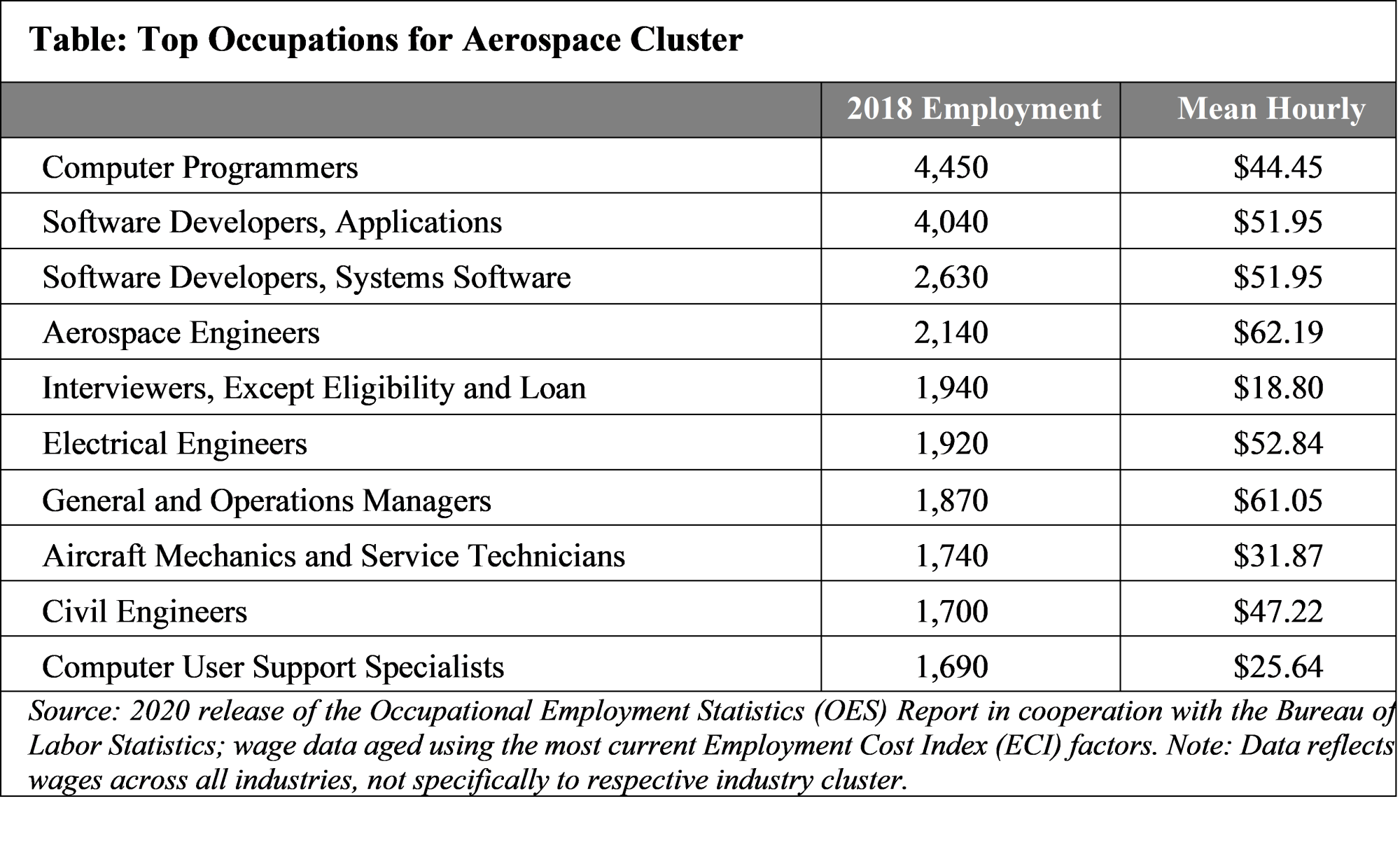
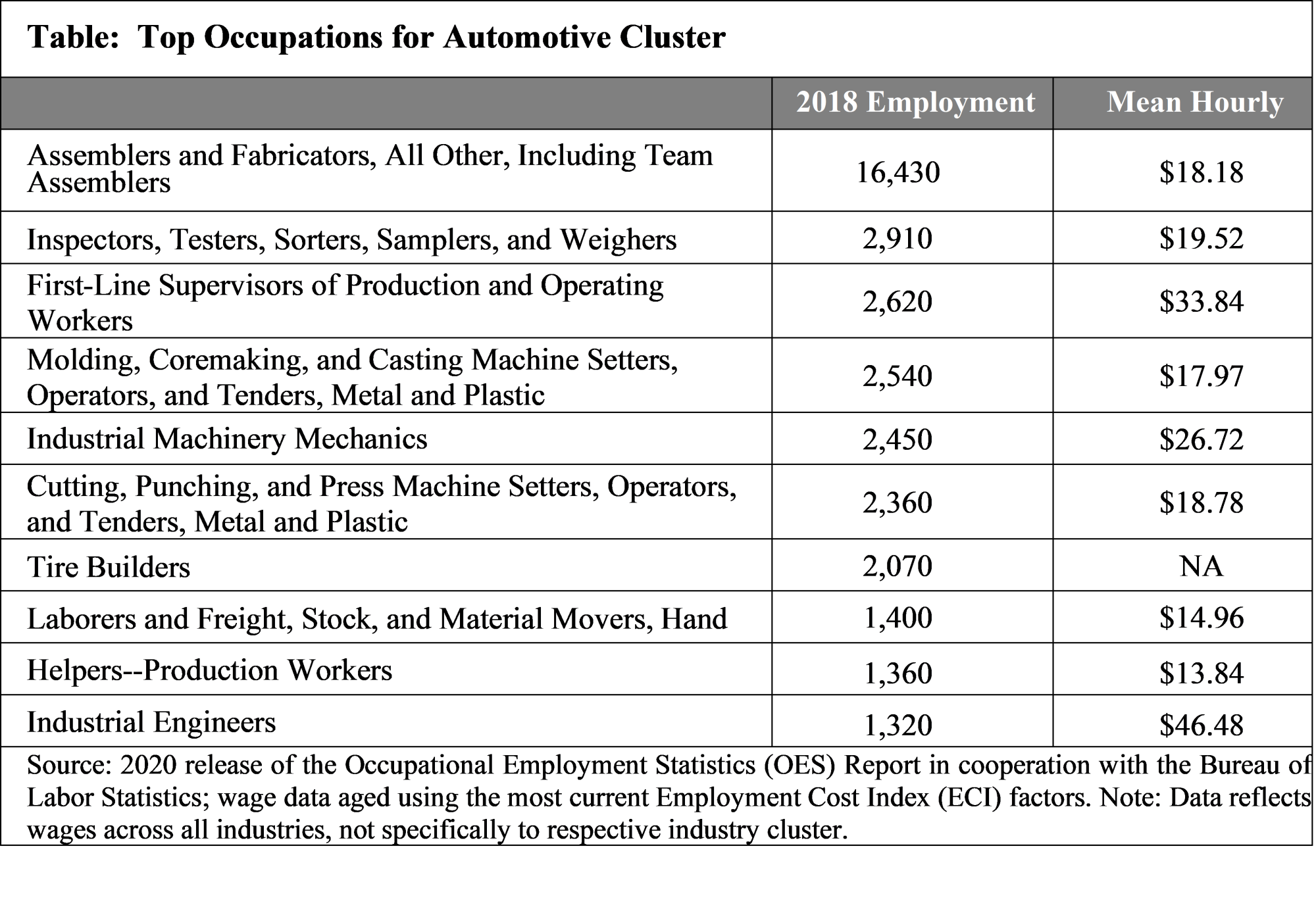
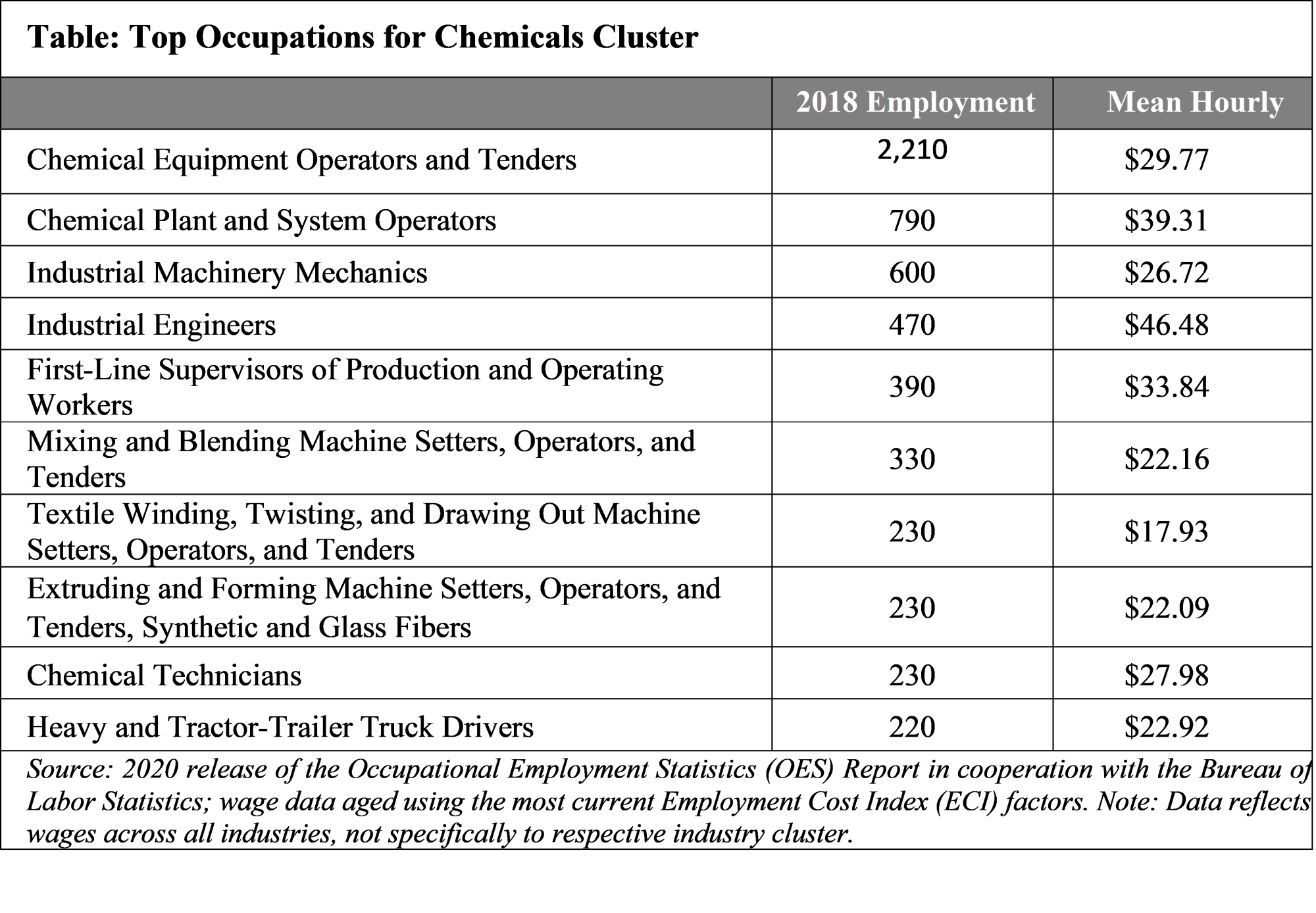
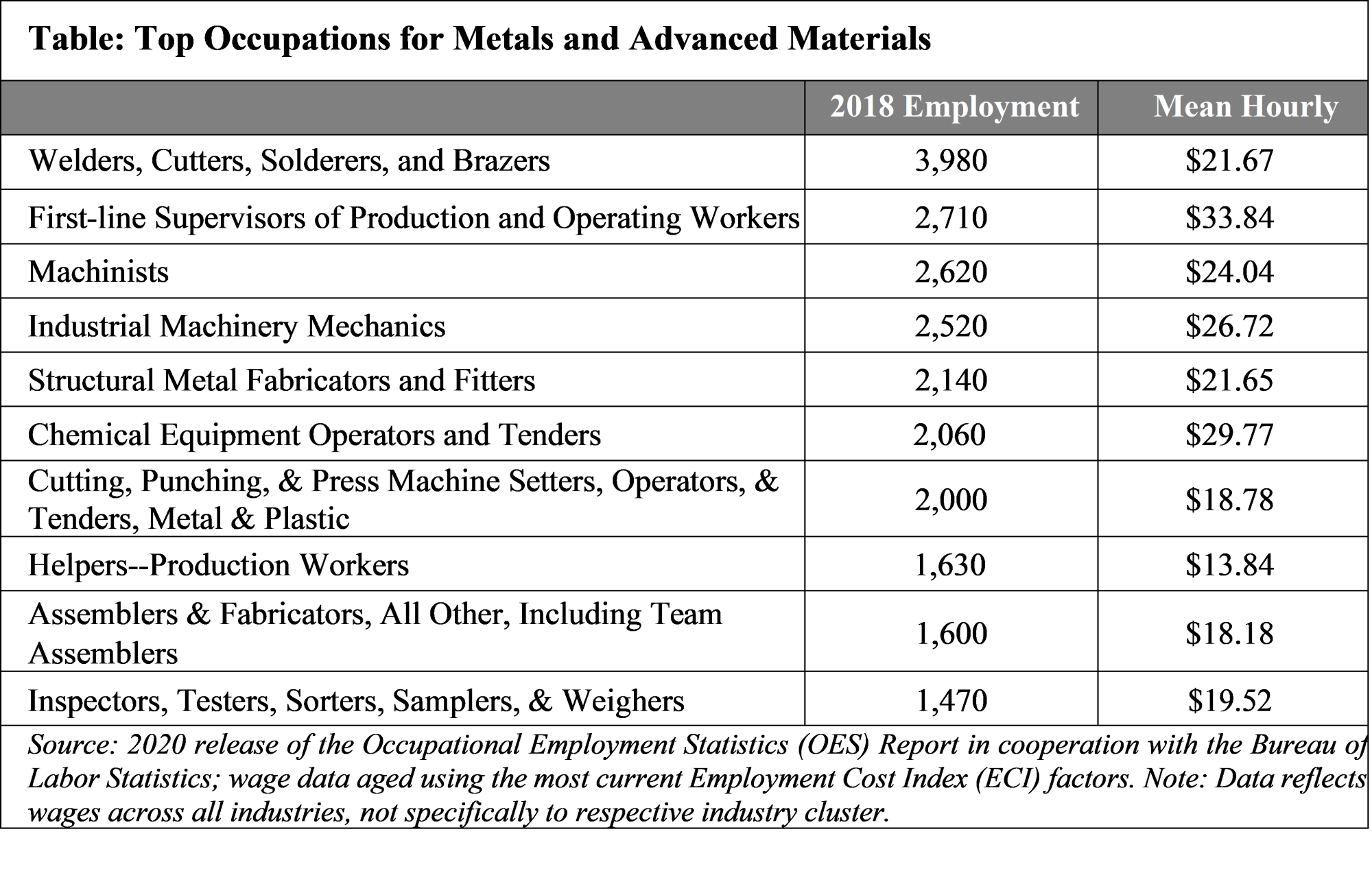
Due to economic development efforts, thousands of new jobs have been announced for the coming years. Alabama’s Air National Guard’s 187th Fighter Wing in Montgomery will be home to the F-35 jets, which are key to the nation’s future military needs. This will bring more aerospace jobs to the central region. Furthermore, thousands of jobs were announced around the state with companies like Boeing, Airbus, Aerojet Rocketdyne, and Lear. This will boost the need for jobs like avionics technicians and various other engineering and engineering technician jobs. The state will also gain another major automotive manufacturer in North Alabama. Toyota announced that it would open a plant to build both Toyotas and Mazdas, creating around 4,000 new jobs in the state. Thousands of additional parts manufacturing and other jobs will follow to supply this new plant. The state is going to have to produce thousands more trained workers in jobs such as CNC operators, machinists, fabricators, industrial machinery mechanics, industrial maintenance specialists, and other skilled manufacturing jobs that require some training and education beyond high school.
One of the industries that was hardest hit by the recession was Construction. In 2008 employment in construction totaled over 105,000 in Alabama. In one short year, that total was down over 15,000. When recover began and unemployment rates started to slowly decline in 2015, Construction employment continued to decline. In 2016 Construction employment in the state was only approximately 83,000. But with major new industries bringing new construction projects within the last two years, and infrastructure improvements to roads and bridges across the state, Construction employment finally increased. In 2020, employment was over 92,000, which surpassed the level in 2010. While the industry has not reached pre-recession employment levels, it’s expected that growth will continue over the next few years. After many people lost their jobs during the recession, many who were at retirement age never returned to work, which caused the industry to lose some of its highest experienced and skilled workers. Now that the industry is recovering, employers are finding it extremely difficult to find experienced midlevel managers. They are also having problems hiring individuals for many of the skilled trade positions, such as electricians, HVAC techs, heavy equipment operators, and cost estimators.
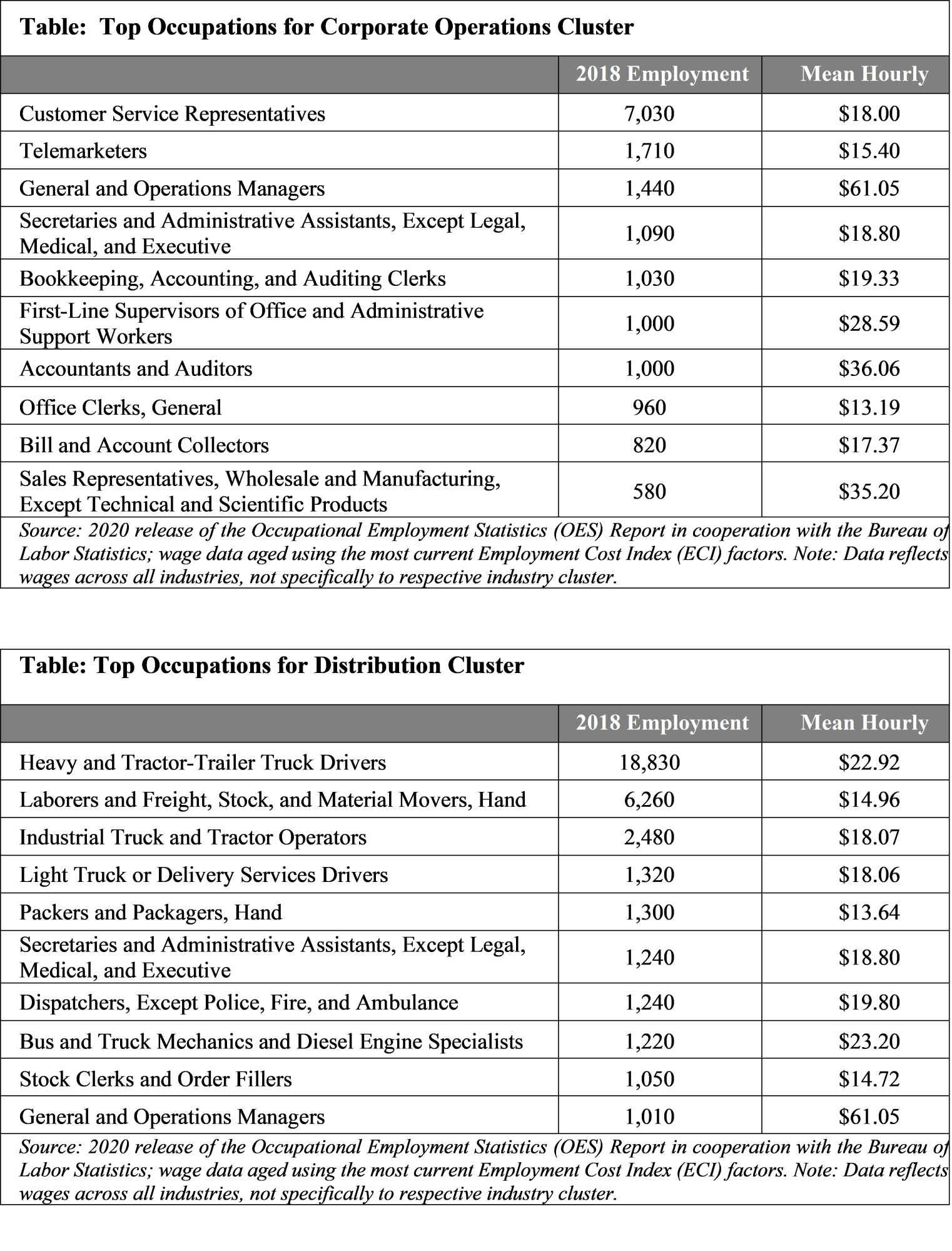
While transportation and warehousing—like most industries—took a hit during the recession, it has steadily increased in employment since 2010. Warehousing has especially grown, with an increase of nearly 70.0 percent since 2010. In the last three years, nearly 12,000 jobs have been added statewide in the transportation and warehousing industry. Companies like Amazon, Walmart, Publix, Facebook, and several others have all contributed to this large increase in employment. Regions 1, 4, 5, and 7 added the most jobs totaling over 15,000. Several new jobs in food and beverage distribution were announced across the state, many in the Birmingham metro area. For at least five years, heavy and tractor-trailer truck drivers have had the highest number of online job ads statewide, averaging over 1,200 each month. With the increases in distribution and warehousing, plus increases in manufacturing, demand for qualified truck drivers will likely increase. Furthermore, these new companies are going to require hundreds of customer service reps, computer user support specialists, and warehouse jobs requiring industrial equipment operation and maintenance.
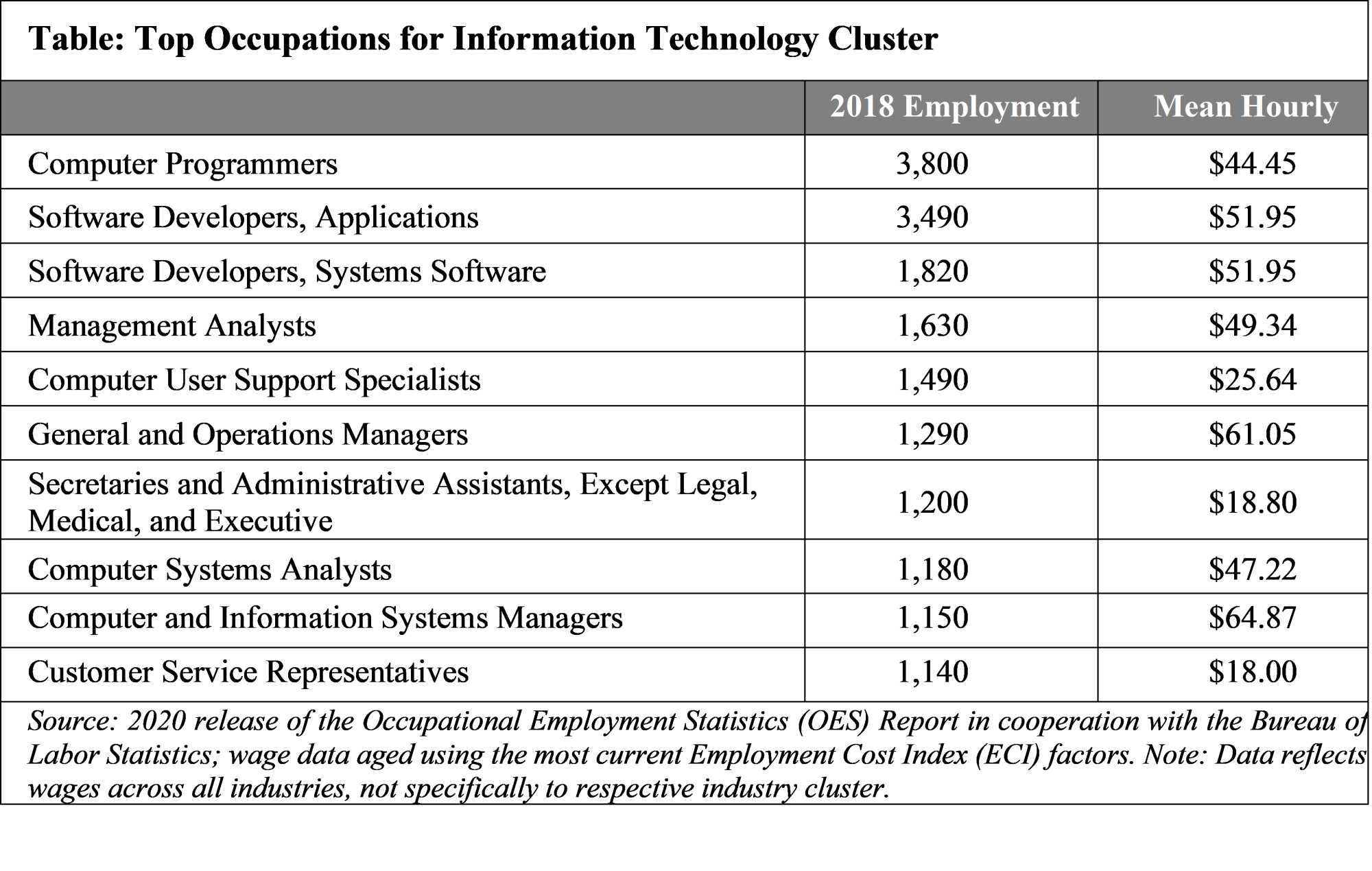
Information Technology is another targeted industry cluster. The largest industry in the information technology cluster is business support services. This industry has grown at a steady pace, even during the recession, of over 63.0 percent since 2000. The Huntsville area is the prime location for IT industries in the state.
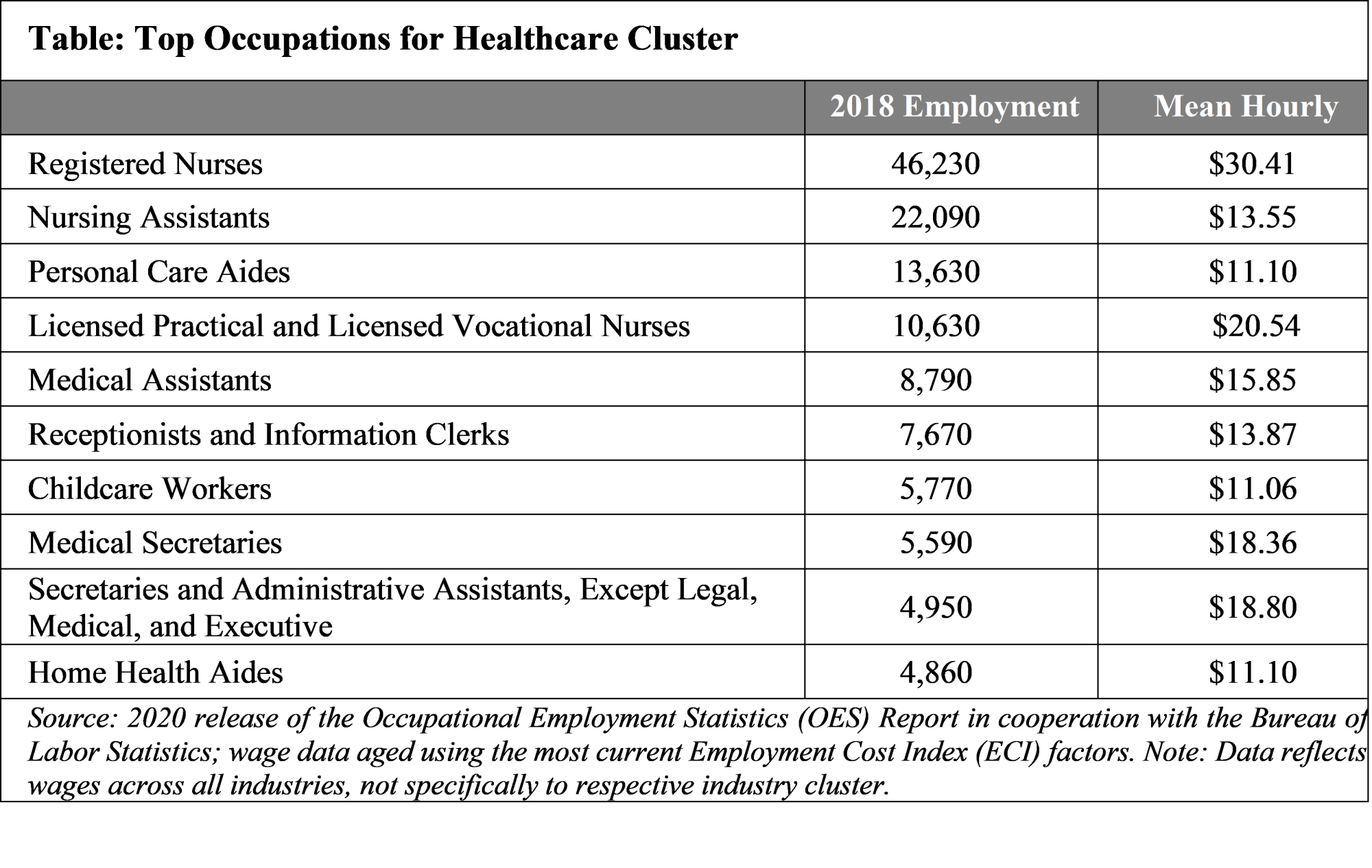
The fact that the baby boomers are hitting retirement age and people are living longer is having a large impact on the health care system. Additionally, there are many more specialized jobs in healthcare than in the past because healthcare costs have risen, and so has demand for healthcare. While hospitals have experienced small but steady growth every year since 2010, most of the growth in health care employment comes from industries that provide more focused care. Industries such as outpatient care centers, home health care services, and specialized health practitioners have doubled in employment since 2010. In addition, employment in residential disability, mental health, and substance facilities have grown 226.0 percent since the turn of the century. Continuing care retirement and assisted living facilities have also doubled in employment. Furthermore, as the population ages, so does the workforce in the health care industry. In Alabama in 2020, 23.0 percent of the health care workforce was over the age of 55. With the projection—for the period 2018-2028—of nearly 90,000 new jobs in health care, combined with an increasing number of workers retiring, the demand for healthcare workers will continue to increase.
One of the industries within the healthcare sector that has experienced a large amount of demand is home health care services. According to the U.S. Census Bureau there are about 54 million Americans aged 65 and older, with that number only expected to grow through 2060. Occupations within this group with the highest projected employment in 2028 include: Registered Nurses, Home Health Aides, Personal Care Aides, Nursing Assistants, Licensed Practical and Licensed Vocational Nurses, and Healthcare Social Workers. Demand for occupations within this industry will only continue to grow as Baby Boomers age and retire from the workforce. Caring for the increasing elderly population, who may be living alone, places stresses on support systems with only an estimated 400 Healthcare Social Workers across the state in 2018.
ii) Emerging Demand Industry Sectors and Occupations
Emerging Demand Industry Sectors and Occupations. Provide an analysis of the industries and occupations for which demand is emerging.
Alabama’s strategic plan for economic development is also targeting industries that are associated with Enabling Technology, due to the increased use of nanotechnology and robotics used in many of the large automotive production plants in Alabama and surrounding states. To show the dedication to prepare the workforce for these types of jobs, the State of Alabama, Calhoun Community College, AIDT, and robotics industry leaders across the nation collaborated to build the robotics technology park. The robotics technology park consists of three training facilities, each targeted to a specific industry need. While the industries associated with this cluster show minimal growth thus far, over 1,000 additional jobs have recently been announced specifically for this high-tech cluster, and many of the new manufacturers in the state employ the use of robotics and other advanced technology in their plants. In 2018 an Air Force innovation hub, MGMWERX, began operations in Montgomery, AL. MGMWERX is a partnership with the Air Force Research Laboratory and will take ideas generated from the Air University at Maxwell AFB to further develop them to solve technological and efficiency challenges within the military.
Cyber Security is an emerging industry, another cluster which overlaps the Enabling Technology cluster. Huntsville in North Alabama is home to the second largest research park in the United States, Cummings Research Park, with over 400 companies that include Fortune 500 companies, local and international high-tech enterprises, and US space and defense agencies. It also includes a thriving business incubator and competitive higher education institutions. In 2016 the Air Force created a cyber college and headquartered it at Maxwell Air Force Base in Montgomery, where the Air University is located. The capacity of this training reaches airmen around the world. It brings in both local and external experts in cyber security to teach these courses. Many of these experts come from the Maxwell Gunter Annex in Montgomery, where IT services are provided to the air force, and where cyber defense is handled for the Air force. Due to the military’s needs for this cyber training, Montgomery became the first of only four cities in the Southeast, and first in the state, with an Internet Exchange. Furthermore, Maxwell in partnership with the City of Montgomery, the County, and the State plan to build and innovation center, which will be a place where leading experts from across the country in tech advancements can work with the military toward advancements. This will create a huge advantage for economic development in the region.
The average monthly wage in 2020 across all industries in the state was $4,435. New hire monthly earnings averaged $2,670 or 60.2 percent of the average monthly wage. The highest average monthly wages were for Utilities at $8,569; Professional, Scientific, and Technical Services at $7,280; Finance and Insurance at $7,127; and Management of Companies and Enterprises at $6,841. Accommodation and Food Services paid the least at $1,734. Utilities had the highest average monthly new hire wage at $5,412, followed by Mining at $5,245 and Professional, Scientific, and Technical Services at $5,177. Accommodation and Food Services paid newly hired workers the least, $1,180. The leading industries did not provide the highest wages. The highest wages were in smaller industry sectors—Utilities; Professional, Scientific, and Technical Services; Finance and Insurance; Management of Companies and Enterprises; and Mining. Larger sectors, like Construction, Manufacturing, and Health Care did have higher earnings than the state average of all industries.
Employers’ Employment Needs. With regard to the industry sectors and occupations identified in (A)(i) and (ii), provide an assessment of the employment needs of employers, including a description of the knowledge, skills, and abilities required, including credentials and licenses.
In 2013, The Alabama Department of Labor conducted a skills survey. Over 5,000 employers from manufacturing, construction, and utilities responded. The most significant findings appeared around soft skills. The overwhelming problem employers faced is attendance problems with their staff. In addition, when asked the top reasons for not hiring candidates for open positions, the top reason was that candidates did not pass a drug test. Since employers only perform drug tests on individuals they believe to be viable, qualified candidates, it’s conceivable that these are skilled people whose barrier to employment is substance abuse. This survey published five years ago, still holds true across all industries in Alabama. Employers still speak of the same problems hiring and maintaining their workforce.
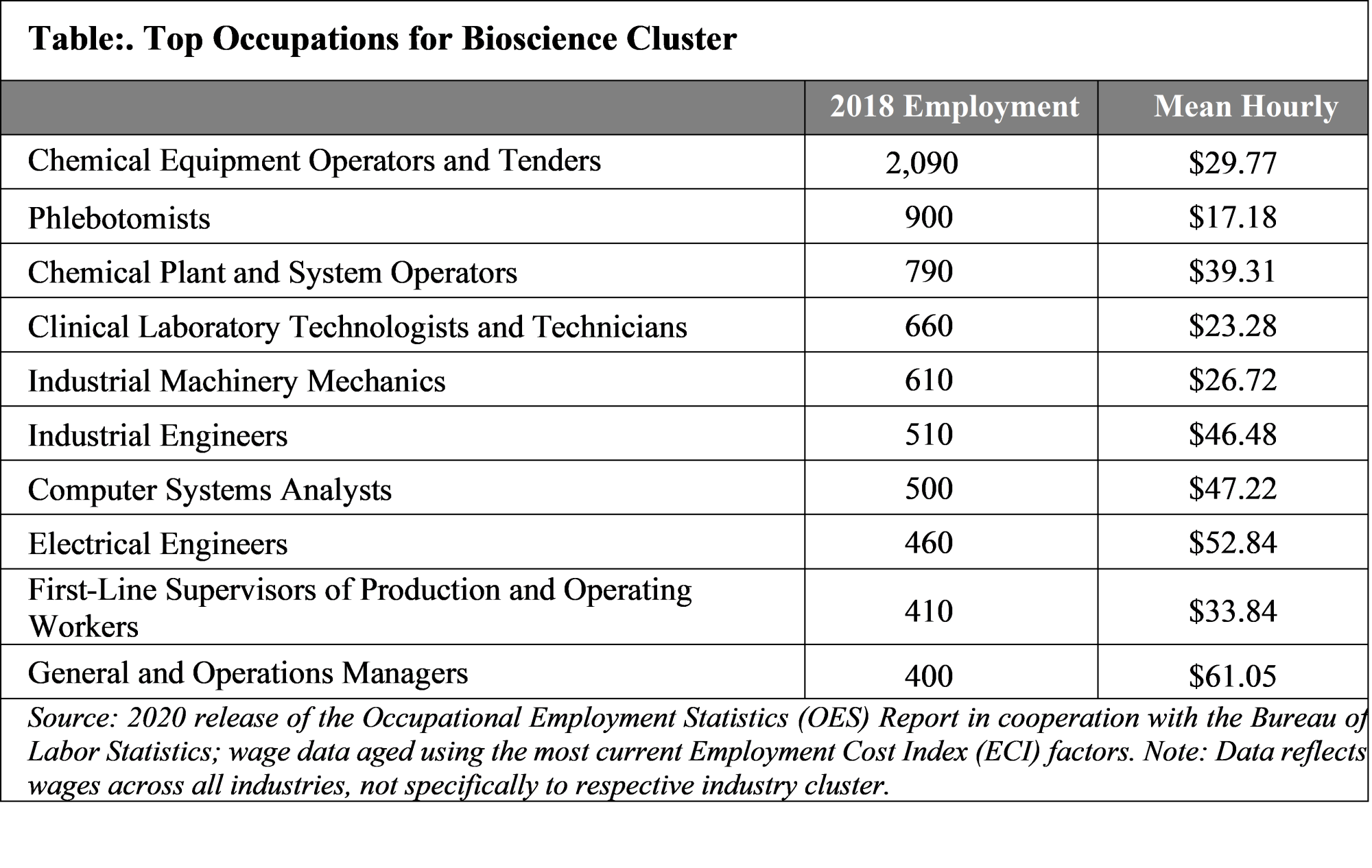
The seven regional workforce councils in the state are charged with connecting with industries in the region to assist them with their hiring needs for trained, skilled workers. Many of these regional councils conduct industry-specific meetings with business leaders to determine the most pressing occupational needs, so that the councils can connect with educational providers in the area to provide training, in cooperation with industry leaders, to fulfill those needs. Each workforce council develops target industry clusters and occupations based on feedback from industry in their regions. Below are the latest Targeted Industries and Occupations by Workforce Development Regions.
In 2018, only 33 percent of jobs were in occupations that typically require formal postsecondary education for entry. Within this group, jobs in occupations which require a bachelor’s degree for entry held the largest share at 16 percent. Occupations requiring a high school diploma or equivalent and less than high school made up 67 percent of jobs in 2018. Occupations requiring postsecondary non-degree award or associate degree are expected to grow 6.8 percent through the 2018-2028 period. When categorized by on-the-job training levels, internship/residency jobs are expected to have the most growth over the period at 9.3 percent.