



Located in:
- III. Operational Planning Elements
The Unified or Combined State Plan must include an Operational Planning Elements section that supports the State’s strategy and the system-wide vision described in Section II(c) above. Unless otherwise noted, all Operational Planning Elements apply to Combined State Plan partner programs included in the plan as well as to core programs. This section must include—
- a. State Strategy Implementation
The Unified or Combined State Plan must include–
- 2. Implementation of State Strategy
Describe how the lead State agency with responsibility for the administration of each core program or a Combined Plan partner program included in this plan will implement the State’s Strategies identified in Section II(c). above. This must include a description of—
- 2. Implementation of State Strategy
- a. State Strategy Implementation
III. a. 2. A. Core Program Activities to Implement the State’s Strategy
Describe the activities the entities carrying out the respective core programs will fund to implement the State’s strategies. Also, describe how such activities will be aligned across the core programs and Combined State Plan partner programs included in this plan and among the entities administering the programs, including using co-enrollment and other strategies, as appropriate.
Current Narrative:
WIOA Services delivered by Department of Labor and Workforce Development through One-Stop Career Centers (WIOA Title I Activities)
Covid-19 has led to dramatic shifts and changes in our state and local workforce systems, as both state and local services adapt to restructuring labor markets, new jobseeker interests and pressures, and the incorporation of virtual technology and communications into our everyday world. We are still in the middle of these changes and the ultimate impacts of the broad-based economic and social shifts that Covid-19 has catalyzed are still unknown.
New Jersey’s state plan focuses on three core goals for our One-Stop Career Centers:
- Coordination and integration of partners and services in our One-Stop Career Centers
- Service delivery models that support individualized and customized strategies for jobseekers and employers through our One-Stop Career Centers
- Strong local governance of One-Stop Career Center operations
Through state coordination and investments in common information and resources, professional development and staff training, and virtual technologies, the state seeks to support a network of One-Stop Career Centers that can meet the dynamic needs of jobseekers and employers.
Integration of Partners and Services
Services are delivered by state and local government, as well as through competitive opportunities for funding. These services are accessible through 30 One-Stop Career Centers, with at least one center located in each of its 21 counties
Our One-Stop Career Centers integrate partners aligned with WIOA’s partnership requirements, as well as specific New Jersey partners like NJBUILD and New Jersey Youth Corps. Additionally, our network of Career Centers leverages the strength of anchor institutions and organizations in our local communities, including community colleges, libraries, community and faith‐based organizations, labor unions and educational institutions. By weaving together the supports, services, and funding that exist across these entities, we seek to ensure that jobseekers and students, at all levels, have access to high‐quality career guidance, training opportunities, and job search and networking support.
Local WDBs provide leadership and oversight in establishing the structure of the One-Stop Career Center and the roles and responsibilities of different partners and staff operating within the local workforce system, including through the procurement of One-Stop Operators, career services, youth services, and TANF and SNAP employment and training services.
Although formal authority is spread across several agencies, New Jersey’s workforce strategy is to promote a system where staff from different agencies and programs come together to support a common set of services, approaches, and functions within local One Stop Career Centers. We believe that support of selected co-enrollment and integrated staffing structures, including functional alignment of partner staff performing similar functions, can transform One-Stops from a loosely connected group of partners operating in silos to an efficient and coordinated collection of staff each focused on what they do best, to provide optimal service delivery for both jobseekers and employers.
For example, Title I and ES counselors that may have worked in parallel with a customer in the past, now work to integrate service delivery, reduce duplication of services, and establish differentiated roles and responsibilities that represent the strengths and expertise that different programs bring to the One Stop Career Center. In some cases, this might represent a hand-off from one role or program to another, in other cases co-enrollment and differentiated engagement across roles and programs may serve a jobseeker best.
As part of this integrated approach, customers are referred based on their needs and who can best help them. Functionally aligned staff have the same tools in their toolbox so there is no wrong door approach. Aligning partner staff by their function such as those providing counseling, interviewing, or group activities results in the ability to provide customers a better range of services when they need them, leading to improved efficiency and, most importantly, improved customer service and outcomes.
The table below outlines the full range of partners and programs that WIOA brings together and the specific government agencies and entities that help to guide, govern, and implement the work of these different partners in our One-Stop Career Center system.
New Jersey WIOA Partners and Responsible Entities
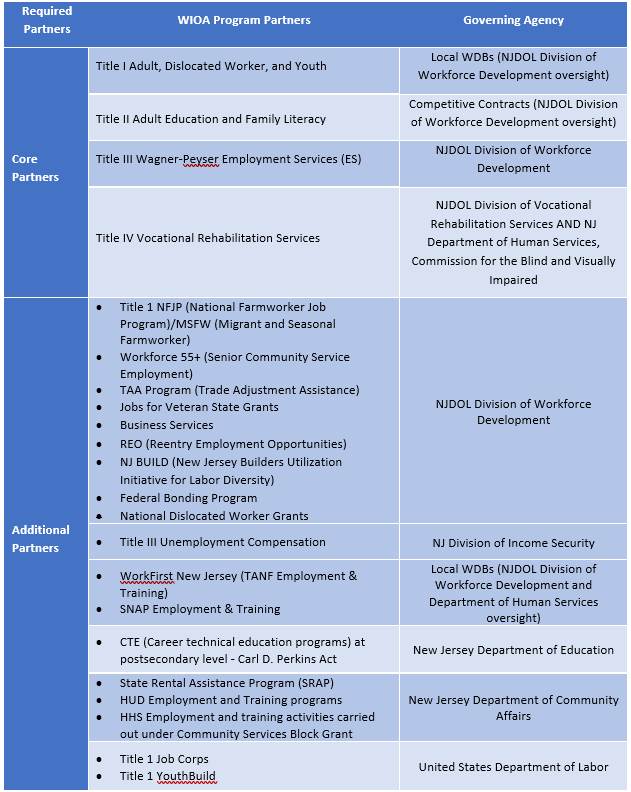
The above chart discusses the WIOA program partners, core and additional. It also provides clarifying information regarding each partner's governing agency. The core/required partners include all the WIOA titles; Title I for Adults, Dislocated Workers and Youth, Title II for Adult Education and Family Literacy, Title III for Wagner-Peyser Employment Services and Title IV for Vocational Rehabilitation Services. Each of these are administered through the New Jersey Department of Labor and Workforce Development. Titles I and II services are delivered locally through workforce development boards (Title I) and consortia of local literacy and family education providers. Titles III and IV services are delivered by the New Jersey Department of Labor and Workforce Development.
Additional partners included in the effort include a number of programs at the New Jersey Department of Labor and Workforce development including programs that serve Older Workers, Veterans, Farmworkers, Reentrants, workers impacted by trade, and programs promoting diversity in building. Other partners include the Unemployment program run by the New Jersey Department of Labor and Workforce Development, programs targeting individuals receiving TANF or SNAP assistance (family welfare of food supplement) from the New Jersey Department of Human Services and local Workforce Development Boards, the Career and Technical Education program operated by the New Jersey Department of Education, housing assistance, community Service block grants and employment and training programs under the auspices of the new Jersey Department of Community Affairs and the Job Corps and YouthBuild programs that are part of the United State Department of Labor.
In addition to the partners highlighted in the table above, WIOA encourages engagement of Small Business Administration (SBA) Programs, Public Libraries, Transportation Agencies, and Mental Health Agencies in One-Stop Career Center operations. Additional NJ-based programs targeting specific special populations such as Helmets to Hardhats (H2H) and New Jersey Youth Corps (NJYC) also may serve as additional partners enhancing the opportunities available to jobseekers locally.
The development of local level Memorandums of Understanding (MOUs) and Infrastructure Funding Agreements (IFAs) are a critical tool for supporting the integration of services across these required and additional optional partners – including specific opportunities for (1) coordinating career and training services across required partner programs, (2) leveraging expertise and resources of partners to support the success of unique populations, and (3) facilitating outreach and connection to specific prioritized groups. The development and refinement of MOUs and IFAs serve as a planning process and centering point for ongoing communication regarding service coordination and resource sharing. MOUs/IFAs, at their best, help to bring abstract partnerships into concrete plans for an integrated model of service delivery within One-Stop Career Centers.
Individualized and Customized Strategies for Jobseekers and Employers
The figure on the next page provides an overview of the different pathways and service flows available from initial intake in New Jersey’s One-Stop Career Center network. This is a renewed method of service delivery in keeping with a deeper engagement between WIOA Title I, Title II, Title III and Title IV services, and aligns with expectations of WIOA around coordinated service across Titles, building career pathways, deeper business services, and regional collaboration.
On-site customer flow begins with intake. When a customer enters the One-Stop Career Center, they are greeted by designated intake professionals composed of core partner staff knowledgeable about all One-Stop service offerings among core and additional partners. Scheduled customers pre-selected for participation in programs such as RESEA and TANF/GA/SNAP programs are directed to the appropriate orientation. Likewise, customers with one-on-one appointments are directed to the appropriate staff.
Intake staff serve a critical role in quickly assessing the needs of walk in customers, ensuring that they are registered in the One-Stop case management system, and routing those customers to the most appropriate partner or service based on the customers’ needs. Ensuring that intake staff are adequately trained on the various career and training service available across partners and programs promotes the WIOA objective that services can be provided in any order based on customer need, e.g., job preparation activities might take place before and/or after completion of training services.
Additionally, as part of the customer flow highlighted in the pages below, One-Stop Career Centers also provide information to customers about rights and protections afforded to workers under state and federal law. This expands a long-standing NJDOL policy of protecting jobseekers from unscrupulous employers by explaining, for example, minimum wage and overtime rules, differences between an employee and independent contractor, and laws around family leave and earned sick time.
The below provides a visual flow chart of service operations. While service begins with intake/Triage referrals are made based upon need. Potential offerings include a wide array of services including self-referrals, job clubs, employment referrals, virtual opportunities and referrals to a wide array of more intensive and training options. These may include driver's license restoration, record expungement, referrals for social and financial assistance, mental health counseling and, when appropriate, a full group of workforce development training options including employment counseling, literacy services, occupational preparation, and services targeted to and prepared for special populations.
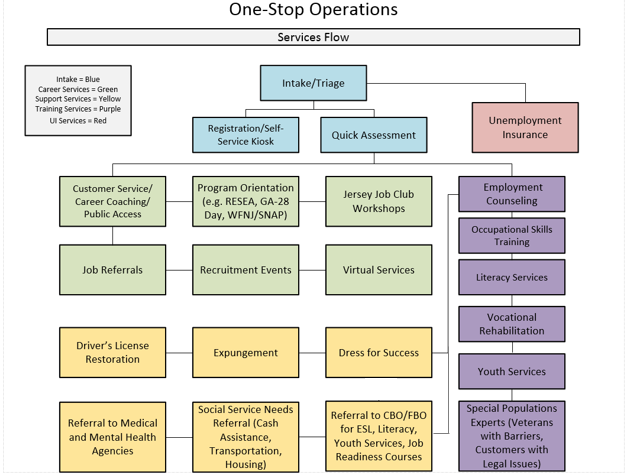
Depending on the outcome of the initial quick assessment performed by intake staff, an individual may be directed to individualized career and training services available through WIOA Title I programs, additional Wagner Peyser services, and/or programs of other One-Stop Career Center partners.
Across programs, a set of universal service delivery components help to ensure the ongoing individualization and customization of supports for jobseekers, including the opportunity to engage in:
- Assessments that offer an evaluation of needs, assets, and, interests,
- The development of individualized service plans based on assessment results,
- Engagement in career, training, and follow-up services that meet individual goals and interests, including supportive services that reduce barriers to employment
These service delivery components are critical in serving individuals with specific needs and barriers, including individuals with disabilities, veterans, and youth, and ensuring that service offerings best support the success of the individual jobseeker.
Assessment
After initial intake, One-Stop Career Center services often start with additional assessment of academic and occupational skills, as well as supportive service needs. Key assessment tools available for use across New Jersey’s One-Stop Career Center network include:
- CASAS – Measures basic skill and academic achievement in reading, listening, math, writing, and related areas. Best Plus – Face-to-face oral interview of listening and speaking skills to assess English language proficiency
- Best Literacy – Test of reading and writing skills using authentic situations to assess skill level
- New Jersey Career Assistance Navigator (NJCAN) – Several assessments of skills, career interest and suitability.
- Prove It – Assessment used to show proficiency in multiple occupations and skillsets. More than 30,000 test modules are available that can be used in a customized manner to determine customers’ readiness for specific jobs.
In addition to these assessments, many other high-quality assessment tools are available to ensure that participants have a chance to learn and explore more about their own academic skills, occupational skills and interests, and supportive service needs. As much as possible, the state seeks to support a use of common tools across different Title I, II, III, and IV programs and local areas, however, our approach also offers flexibility for integrating different tools based on the unique needs of individuals.
Plan Development
Whether called an Individual Employment Plans, Individualized Service Strategy, an Employability Development Plan, or something else, these service plans all offer the opportunity to develop an individualized plan that translates assessment outputs and results into specific educational and employment goals and service plans for meeting these goals. This serves as an agreement between One-Stop Career Center staff and customers about what to expect, and a tool to return and reflect on and service plans. Furthermore, these plans may incorporate service elements that cross over specific programs and funding streams, outlining a specific plan for co-enrollment in services.
Service Engagement
Individualized career services, training services, supportive services, and follow-up services all offer opportunities for supporting the successful connection and success of jobseekers to sustained career pathways and employment.
Individualized Career Services: Job preparation and job placement supports offer opportunities for providing customized career support to individuals – whether supporting the development of an individual’s resume, or utilizing that resume to build specific job leads and connections for an individual. WIOA allows for these types of services to precede or follow training services, or to stand alone in the support of an individual. As a state, we will work with our local areas to continue to deepen individualized career services available to individuals in our One-Stop Career Centers – providing customized support, coaching, and guidance to navigate connection to employment.
Training Services: New Jersey prioritizes strategies and investments in work-based learning opportunities including Pre-apprenticeship, Apprenticeship, Internship, Job Shadowing, Job Coaching, Mentoring and On-the-Job Training models that support match and support both the needs of jobseekers and employers.
The following make up New Jersey’s main training methods:
- Adult Basic Education (Title II): If a customer is determined in need of these services, they are referred directly to WIOA Title II Adult Education services for remedial basic skills, English as a Second/Other Language and related services.
- Literacy Labs: Computer labs at One-Stop Career Centers (often blended with the Resource Centers) with extensive computer-based learning tools and are the state’s main effort to provide basic skills, literacy, and English as Second Language training to customers on a drop-in, open-access basis.
- Individual Training Accounts (ITAs) for vocational training through training providers on the Eligible Training Provider List (ETPL) as outlined later in this section and in Section VI. ITA training is delivered based on customer choice, labor demand occupations, and in keeping with the customer’s IEP.
- On-the-Job Training (OJT): Business Services staff at each One-Stop may work with customers and area businesses to develop On-the-Job Training (OJT) agreements when appropriate. New Jersey continues to promote greater use of OJT as it is a method of ensuring that employers gain a workforce with the exact skills and training desired.
- Apprenticeship and Pre-Apprenticeship: The New Jersey Apprenticeship Network is focused on driving economic development through skills and educational attainment by concentrating efforts on sector-focused, demand-driven training programs that lead to meaningful employment; attainment of advanced credentials; diversity and inclusion; and sustainable linkages between employer needs, training providers, and the workforce. Registered Apprenticeship and pre-apprenticeship programs and initiatives have and will remain continued strategies for New Jersey. The models, by design, incorporate both theory and experiential learning that business and industry often request, and simultaneously create career pathways for participants. The Registered Apprenticeship model leads to a nationally recognized industry credential that is both portable and stackable. Strategies to incorporate Registered Apprenticeship and pre-apprenticeship are project-specific, allowing NJDOL and its partners to build specific solutions to identified needs and incorporate promising practices gleaned from previous projects.
- Opportunity Partnership: This program utilizes State funds to support cohort training for dislocated workers. Employers or groups of employers work with community colleges or private trainers to develop curricula that are needed for targeted openings at their firms, and then commit to interview successful completers from a cohort enrolled in the program. These trainings are paid for by the class rather than through an ITA or another customer-level manner.
- Other Work-Based Training including Internships, Job Shadowing, Job Coaching, Mentoring and a number of customized training and related services built to benefit employers and jobseekers; provide better exposure of jobseekers, especially Youth and those with limited work history to the State’s key industries and in-demand occupations; and offer customized methods of preparing new and existing workers for specific job opportunities.
For individuals in need of additional skill development, our objective as a state is to direct jobseekers to training opportunities through ITAs and work-based learning opportunities that help individuals to secure credentials and employment that provide entry and advancement in career pathways. The New Jersey Department of Labor is in the process of updating its labor demand occupations list. Under the Workforce Innovation and Opportunity Act (WIOA), the list is used to identify occupational skills training programs that are eligible for Individual Training Accounts (ITA), as well as provide direction and guidance to local areas regarding the credentials that offer the most value to jobseekers in New Jersey’s labor market.
Given the dynamic changes in New Jersey’s labor market due to Covid-19 and resulting economic factors, while the state works on updates to this list, we will also work hand-in-hand with local areas to assure that the credentials offered and obtained by job seekers are of value to industry and support career development and success. The current list of labor demand occupations is available on the New Jersey Career Connections website at: http://careerconnections.nj.gov/careerconnections/prepare/skills/credentials/industry_valued_credentials.shtml.
Supportive Services: Supportive services offer a holistic set of supports for addressing a wide variety of barriers to employment to help meet the unique circumstances and needs of individuals and open up opportunities for achieving their employment and education goals. Supportive services may include, assistance with childcare, housing, accommodations for unique needs, legal services, training-related costs, and a range of other services needed to address barriers individuals face to succeeding in WIOA programs, training and/or employment, including needs-related payments. Supportive services must be coupled with long term plans for sustaining barrier reduction. Local WDBs must consider and develop specific plans and policies for robust provision of supportive services.
Follow-up Services: Follow-up services offer targeted support to individuals based on identified needs. Follow-up services support transitions and the success of individuals in employment or education placements. These services are critical to sustaining growth and progress achieved during an individual’s engagement in One-Stop Career Center services.
Service Integration Priorities
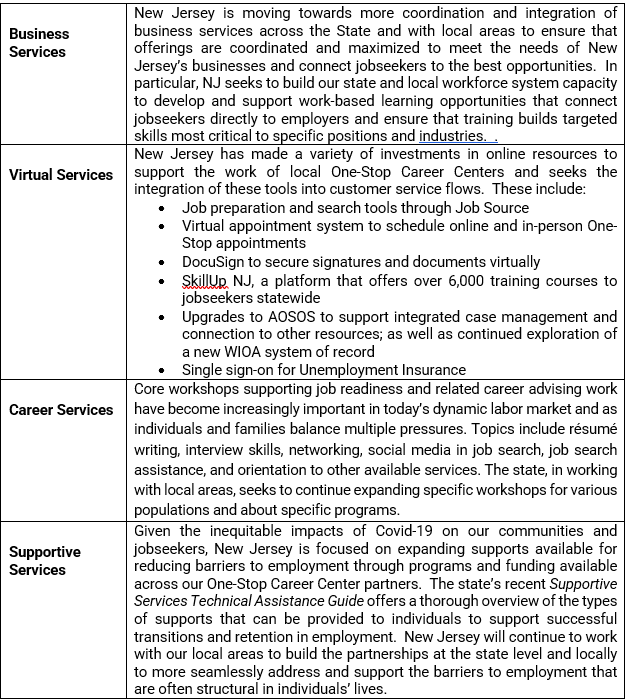
As we move forward, some key priorities will guide our investments and work as a state and with our local areas. As highlighted above, local WDBs and One Stop Operators are responsible for developing and executing local plans that emphasize the organization of state and local resources to support individualized access and engagement in One-Stop Career Centers. This includes leveraging:
- Business Services: Building capacity to match and fill gaps between employer needs and jobseeker skills and interests through state and local business service functions, particularly in developing and operationalizing work-based learning opportunities
- Virtual Services: Increasing access and engagement through investments in tools that support virtual intake, assessment, and service delivery – including virtual self-services and staff-assisted virtual services
- Career Services: Emphasizing work readiness and career advisement across WIOA services, including in Wagner Peyser and Title I programs specifically.
- Supportive Services: Leveraging resources across required partners and additional community partners to reduce barriers to employment beyond specific training-related needs
The below chart elaborates on the above citing the purpose of business services to support work-based b=learning opportunities and connect jobseekers directly to employers. Virtual services represents a variety of investment in online services to support the work of local One-Stop career Centers. Career services supporting job readiness and related career advising have become increasingly important in a changing labor-market where there are more and increasingly specialized needs. And, supportive services based upon expanding supports available for reducing barriers to employment through programs and funding made available from the workforce development system.
The table below highlights specific state actions that New Jersey is taking to support these efforts and the development of these capacities locally:
Local Governance of One-Stop Career Centers
The state’s plan moving forward also focuses on local governance of One-Stop Career Centers through New Jersey’s local WDBs. Local WDBs are responsible for critical functions related to the procurement of career services through One-Stop Operators, youth service providers, and other vendor contracts, as well as oversight and monitoring of these procured contracts, including certification of local One-Stop Career Centers.
The SETC is committed to supporting local WDBs through its Local Workforce Board Certification and Capacity Building processes. The Commission has built on its foundation of required certification and capacity building for local boards, with an expanded certification process that includes enhanced communication, capacity building and technical assistance in partnership with the Department of Labor and Workforce Development.
WIOA requires that local areas competitively select the One-Stop Operator. Based on WIOA, One-Stop Operators may be an institution of higher education; an employment service State agency established under the Wagner-Peyser Act (29 U.S.C. 49 et seq.), on behalf of the local office of the agency; a community-based organization, nonprofit organization, or intermediary; a private for-profit entity; a government agency; or another interested organization or entity, which may include a local chamber of commerce or other business organization, or a labor organization.
In New Jersey’s WIOA system, each One-Stop Operator serves to integrate partner services, manage activity, ensure collaboration and coordination of services, and work to build a smooth system of services that maximizes the impact and value of each distinct program and funding stream.
One-Stop Operators promote the integration of State, local government, and vendor agency staff providing WorkFirst NJ (TANF and GA), SNAP, and WIOA funded employability assessment, service identification and sequencing, Individual Employment Plan (IEP) development, and case management services. The staff at each One-Stop includes a mix of NJDOL and local government staff, as well as those from other partners such as national SCSEP grantees.
WIOA defines the minimum role of the One-Stop Operator as a convener, coordinator and manager of the one-stop delivery system in a local workforce area. NJDOL envisions the One-Stop Operator as the entity who promotes an integrated, customer-focused delivery system that maximizes each partner’s strength and reduces redundancies. Local boards can develop a more expanded definition of the role of the One-Stop Operator as long as that role is consistent with state law. In addition to designing the expectations of this role, local WDBs must ensure the procurement and ongoing monitoring of the One-Stop Operator and the operations of all One-Stop Career Centers based on identified roles.
The One-Stop Operator roles are to:
- Provide an integrated delivery system;
- Ensure hardest to serve populations are prioritized;
- Coordinate service delivery among partners;
- Coordinate service delivery among physical and electronic sites; and
- Coordinate services across the local workforce area.
Other responsibilities are to:
- Maintain a common intake system among core partners;
- Manage hours of operation at all sites;
- Manage technological resources such as websites, case management information, business networking software, on-line testing sites;
- Manage daily operations through coordination with WIOA Fiscal Agent for lease, utilities, and other invoice remittance;
- Manage partner responsibilities as defined in MOU;
- Manage services for individuals;
- Manage services for business;
- Provide of basic services such as orientations, information on careers and labor markets, and resource rooms;
- Submit annual staffing plans and operational budgets;
- Following federal and state regulations pertaining to handling of EEO responsibilities, customer complaints, and physical and programmatic accessibility;
- Implement board policies; and
- Report to the Board on operations, performance accountability, and continuous improvements.
Each local board selects the One-Stop Operator through a competitive process. Any Request for Proposal shall clearly delineate the role of the prospective one-stop operator to deliver services “at a minimum” level described within proposed 20 CFR 678.620 or near it, so as to ensure continued compliance with state and federal law. The local area process for Competitive Selection of the One-Stop Operator must be open, transparent and made available to all eligible entities. Local areas must follow state procurement laws at a minimum. Competitive selection must be made no less than every two years. Local areas may offer no more than two one-year extensions to successful One-Stop Operator contracts. A successful One-Stop Operator meets or exceeds local area and state performance standards, as applicable; satisfies the requirements of the One-Stop Career Center Certification, provided in SETC Policy Resolution #2016-14, included in Appendix 3 of this Plan. Further, the local Workforce Development Board (WDB) must have determined that neither its One-Stop Operator, nor any of its sub-contracted entities, has engaged in fraud or abuse, as those terms are used within 29 U.S.C. 3122 (c)(3)(A), and that neither the One-Stop Operator, nor any of its sub-contracted entities, has engaged in any of the prohibited conduct listed as cause for corrective actions and penalties under N.J.A.C. 12:42-3.6.
The local area grant recipient retains the financial and administrative responsibility to ensure that the procurement and resultant system is appropriate, aligns with area needs and service structure, and is consistent with the local plan as approved by the local Workforce Development Board.
Local boards must also ensure that the selected One-Stop Operator:
- Discloses any potential conflicts of interest arising from the relationships of the operators with particular training service providers or other service providers;
- Does not establish practices that create disincentives to providing services to individuals with barriers to employment who may require longer-term services, such as intensive employment, training, and education services; and
- Complies with Federal regulations, and procurement policies, relating to the calculation and use of profits.
On September 20, 2016, the State Employment and Training Commission (SETC) adopted Policy Resolution #2016-14, creating the One-Stop Career Center Certification Process. New Jersey’s One-Stop Career Center Certification process had an effective date of July 1, 2017. It considers the requirement that a competitively selected One-Stop Operator should be in place in each local Workforce Development Area. Under this policy, local Workforce Development Boards are to establish a local process of review that may include a qualified group of non-conflicted local board members or a qualified third-party entity. All local areas will have the responsibility to ensure that the group established locally is qualified and able to perform such work. Pre-requisites to One-Stop certification are necessary. This recognizes essential elements of programming and services that must be in place prior to certification. The pre-requisites include accessibility standards, establishment of a grievance/complaint system for customers, a certified local Workforce Development Board (WDB), and a local memorandum of understanding (MOU) that includes the local WDB and its partners. SETC Policy Resolution #2016-14 is provided in Appendix 3 of this Plan.
Through the early stages of the pandemic the SETC and NJDOL hosted weekly meetings designed to share with local partners ideas, practices and information with the intention of related to the ongoing situation. Sessions included presentations regarding Unemployment Insurance, Labor Market Information and employer perspectives. Presenters included the Heldrich Center For Workforce Development, Future Works and the NJDOL.
In addition, state law N.J.S.A 34:15D-4.7 and 21 also requires that all counseling services in One-Stop Career Centers must be either provided by a job counselor hired and employed by the State pursuant to N.J.S.A 11A or hired and employed by a political subdivision of the State with the exception of those One-Stop Centers grandfathered under P.L. 2004, c. 39. State law further requires that all staff who are hired and supported by moneys from the Workforce Development Partnership Fund or the Supplemental Workforce Fund for Basic Skills, including any of those staff located at any One-Stop Career Center will be hired and employed by the State pursuant to N.J.S.A 11A or hired and employed by a political subdivision of the State, with the exception of those One-Stop Centers grandfathered under P.L. 2004, c. 39.
Local Boards are required to comply with both the federal and State law.