



Located in:
- Program-specific Requirements for Adult, Dislocated Worker, and Youth Activities under Title I-B
The Unified or Combined State Plan must include the following with respect to activities carried out under subtitle B—
e. Waiver Requests (optional) (e1-e6)
States wanting to request waivers as part of their title I-B Operational Plan must include a waiver plan that includes the following information for each waiver requested:
1. Identifies the statutory or regulatory requirements for which a waiver is requested and the goals that the State or local area, as appropriate, intends to achieve as a result of the waiver and how those goals relate to the Unified or Combined State Plan;
2. Describes the actions that the State or local area, as appropriate, has undertaken to remove State or local statutory or regulatory barriers;
3. Describes the goals of the waiver and the expected programmatic outcomes if the request is granted;
4. Describes how the waiver will align with the Department’s policy priorities, such as:
A. Supporting employer engagement;
B. Connecting education and training strategies;
C. Supporting work-based learning;
D. Improving job and career results, and
E. Other guidance issued by the department.
5. Describes the individuals affected by the waiver, including how the waiver will impact services for disadvantaged populations or individuals with multiple barriers to employment; and
6. Describes the processes used to:
A. Monitor the progress in implementing the waiver;
B. Provide notice to any local board affected by the waiver;
C. Provide any local board affected by the waiver an opportunity to comment on the request;
D. Ensure meaningful public comment, including comment by business and organized labor, on the waiver.
E. Collect and report information about waiver outcomes in the State’s WIOA Annual Report.
7. The Secretary may require that States provide the most recent data available about the outcomes of the existing waiver in cases where the State seeks renewal of a previously approved waiver.
Current Narrative:
Ohio is applying for four waivers as described on the following pages.
Waiver 1: Allow TANF funds to count toward the 75 percent expenditure requirement on out-of-school youth and to calculate the expenditure requirement on a statewide basis.
- Identify the statutory or regulatory requirements for which a waiver is requested and the goals that the State or local area, as appropriate, intends to achieve as a result of the waiver and how those goals relate to the Combined State Plan.
Section 129 (a)(4) and 20 CFR 681.41 requires that local workforce development areas must expend a minimum of 75 percent of WIOA youth funds on out-of-school youth. Ohio would like to waive the requirement to allow for the inclusion of a percentage of TANF funds as part of the 75 percent expenditure for out-of-school youth requirement. Additionally, as part of this waiver, Ohio would like to calculate this expenditure requirement on a statewide basis. Ohio is requesting this waiver for PY22 and PY23-July 1, 2022 through June 30, 2024.
Under CCMEP, with its emphasis on co-funding to benefit more cost-effective service delivery, the number of disconnected youth that can be served will increase, particularly given the large infusion of TANF dollars. This will ultimately allow WIOA youth dollars to have a further reach and greater impact in local communities. Additionally, by allowing the calculation of the expenditure rate to be statewide, there would be more flexibility amongst all the local workforce development areas to serve the population of participants unique to that local area.
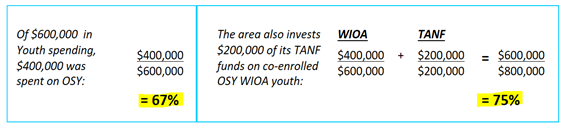
To recognize the influx of TANF dollars being invested in the WIOA out-of-school youth (OYS) population under CCMEP, ODJFS will include the amount of TANF dollars spent on co-enrolled WIOA OSY during a program year in both the numerator and denominator of the OSY rate calculation. The formula below defines the proposed alternative calculation to be used beginning with PY 20 funds:
Proposed OSY Rate Calculation Under Waiver Authority
(WIOA OSY expenses/Total WIOA OSY+ISY Expenses) + (TANF spent on co-enrolled WIOA OSY/TANF spent on co-enrolled WIOA OSY)
The example below compares the OSY rate calculation under current WIOA law to the proposed waiver flexibility for a local area that spent $400,000 of its $600,000 in PY18 WIOA Youth program funds during the two years of availability as well as $200,000 of its CCMEP TANF funds spent during the second year of the Youth grant on services for OSY who are co-enrolled:
The waiver supports the principles of streamlining services, increasing accountability and accessibility, State and local flexibility and ease of administration. Furthermore, this waiver supports the implementation of CCMEP by using both WIOA and TANF funding sources together to support the different needs of the same customer while easing administrative burden associated with managing two different Federal funding streams.
It should be noted that the LWDB still maintains the authority to determine how to fund the WIOA youth program, including how much funding should be dedicated to the WIOA in-school and out-of-school programs.
- Describe the actions that the State or local area, as appropriate, has undertaken to remove State or local statutory or regulatory barriers.
There are no State or local statutory or regulatory barriers to implementing the proposed waiver.
- Describe the goals of the waiver and the expected programmatic outcomes if the request is granted.
This waiver encourages co-enrollment and braiding of WIOA youth and TANF funds by allowing more flexibility in serving youth but also the ability to serve more youth as the amount of funds available increased. With the implementation of the previous waiver approved in PY 17, the number of WIOA funded youth participants has increased. Below is an illustration showing the increase in youth being served through this waiver.

Prior to the implementation of CCMEP, Ohio served 5,629 WIOA youth in PY 2015. In the last four program years since the initial implementation of CCMEP, Ohio has served 8,674 youth in PY 2017, 9,483 youth in PY 2018, 8,900 youth in PY 2019 and 8,570 in PY 2020. CCMEP has also seen an increase in the several harder-to-serve populations of individuals being served. CCMEP has served twice as many single parents and foster youth as previously. Although the pandemic and the increasingly tight labor market has decreased out of school enrollment, Ohio has been working with local workforce areas to amplify outreach and to develop strategies to boost enrollment. ODJFS has been working with a marketing firm to develop a social media toolkit and videos to help with outreach.
Our goal moving forward is to continue the trend to increase co-enrollment of WIOA and TANF youth as well as conduct outreach to increase enrollment and the populations being served in CCMEP.
Ohio is also anticipating increases in our WIOA youth outcomes. With the implementation of CCMEP, the WIOA youth outcomes pertaining to employment and training 2nd and 4th quarter after exit as well as median earnings have all increased. For example, in PY 17, the employment and training 2nd quarter after exit was 71.9%. In PY 18, this same measure was 75.3%. PY 19's data for this measure was 75.7%. Finally, PY 20 was 71.7% Another example is median earnings. In PY 17, the median earnings for youth was $2,766. In PY 18, this same measure was $2,856. PY 19's data was $3,216 and PY 2020 was $3,300. With increased co-enrollment and a delivery of services methodology that focuses on the individual, we anticipate that our outcomes will continue to increase while continuing to serve youth with multiple barriers to employment and training. Our goal is to increase enrollments back to pre-pandemic numbers, which would mean a projected outcome of serving 9,000 youth by the end of PY23.
- Increase the number of WIOA funded youth participants;
- Continuity and greater efficiency of service delivery;
- Flexibility in deciding the funding source for CCMEP participants who are eligible for these separate funding sources;
- Increase enrollment in youth populations which are harder to serve;
- Increase the co-enrollment in WIOA and TANF so that youth have the full array of services and funding necessary to complete services;
- Decrease in administrative costs to deliver services;
- Increased percentage of youth who obtain employment or enroll in training and are able to maintain employment and/or training; and
- Integration of WIOA and TANF services as part of the CCMEP program.
- Describe how the waiver will align with the Department’s policy priorities, such as:
- Supporting employer engagement;
- Connecting education and training strategies;
- Supporting work-based learning;
- Improving job and career results, and
- Other guidance issued by the Department.
With the development of CCMEP, Ohio is pushing traditional program boundaries by integrating components of Ohio's TANF program with WIOA employment programs to create a better-coordinated, person-centered case management system. CCMEP takes a coordinated, holistic approach to stabilizing individuals and families by addressing the myriad of factors that may be contributing to poverty and unemployment, including health, housing, education, transportation, and child care. In conjunction with supportive services, the program will provide access to employment and training services, including career counseling, job placement, and the fourteen program elements to facilitate job retention.
This waiver supports co-funding and coordination of services and provides more flexibility on how funding is allocated. Furthermore, this waiver would extend WIOA funds and allow resources to go further. It will allow CCMEP to serve more youth by allowing both TANF and WIOA funds to be used when calculating the 75 percent expenditure requirement for out-of-school youth.
The population of youth and young adults fluctuates across Ohio. The population in some local areas is high density with a lot of resources to serve this population. In other local areas in the State, particularly the rural and Appalachian areas, the population is lower and resources are minimal. The waiver to calculate this expenditure requirement on a statewide basis would provide flexibility in serving CCMEP participants, allow the LWDB to focus on the populations who need services the most, and reflect the populations of participants who should be served.
- Describe the individuals affected by the waiver, including how the waiver will impact services for disadvantaged populations or individuals with multiple barriers to employment.
CCMEP serves TANF work-eligible recipients and WIOA in-school and out-of-school youth ages 14 to 24 years. By virtue of the program eligibility requirements, CCMEP is directly addressing service delivery for disadvantaged populations and individuals with multiple barriers to employment. This waiver will allow local areas to fund services in a manner which best meets the needs of the participant. The waiver to allow the use of TANF funds as part of the 75 percent expenditure requirement for out-of-school youth will allow additional funding flexibility so that both TANF and WIOA youth program funds can be used effectively and efficiently.
Furthermore, by allowing the 75 percent expenditure rate to be calculated on a statewide basis, the local areas may focus on serving the populations the LWDB has chosen to serve as well as the population of individuals who may benefit from the delivery of CCMEP services.
- Describe the processes used to:
- Monitor the progress in implementing the waiver;
- Provide notice to any local board affected by the waiver;
- Provide any local board affected by the waiver an opportunity to comment on the request;
- Ensure meaningful public comment, including comment by business and organized labor, on the waiver.
- Collect and report information about waiver outcomes in the State’s WIOA Annual Report.
ODJFS will monitor implementation and impact of this waiver through a combination of reporting from the local level using the Ohio Workforce Case Management System (OWCSM) and State monitoring, oversight, and evaluation functions. Monitoring of the waiver may be conducted through a variety of approaches that may include routine desk reviews and on-site compliance monitoring. ODJFS may also monitor the implementation of this waiver through feedback from local workforce development areas and review of all fiscal data systems. Meetings between ODJFS staff and local board directors are held on a regular basis, which serves as a venue to address any issue with the implementation of this waiver.
In addition to monitoring, CCMEP is being formally evaluated by the Ohio State University (OSU) to assess the impact of CCMEP on youth employment, education, and training outcomes using an experimental study design. OSU is using a broad evaluation strategy to assess CCMEP on three levels:
- A random-assignment outcome evaluation
- An implementation study to assess the key indicators of successful TANF-WIOA integration; and
- A descriptive study of the overall program, including an analysis of participant demographic, participation, and outcome data and an assessment of administrative effectiveness.
Additionally, the WIOA annual report published each year and provided to USDOL will include a section related to the effects of this waiver showing a re-calculation of the statewide OSY rate to include the TANF funds spent on co-enrolled OSY during the program year being reported.
Workforce development stakeholders, including local boards, businesses, and organized labor organizations, were notified of the proposed waiver request through an e-mail alert. The e-mail alert contained instructions on how to submit comments. In addition, both the general public and stakeholders had access to the waiver request on the OWD website.
Waiver 2: Allow the use of individual training accounts (ITA) for in-school youth, ages 18-21 years.
- Identify the statutory or regulatory requirements for which a waiver is requested and the goals that the State or local area, as appropriate, intends to achieve as a result of the waiver and how those goals relate to the Combined State Plan.
20 CFR 681.550 allows ITAs funded by WIOA youth funds to be used by out-of-school youth. The final rule did not expand the use of ITAs to in-school youth. Instead, in-school youth wishing to access ITAs may only do so through the WIOA adult program. Ohio would like to waive the requirement to only allow ITAs for out-of-school youth and expand this flexibility to in-school youth.
The intent of using ITAs in the WIOA out-of-school youth program is to expand training options, increase program flexibility, enhance customer choice, and reduce paperwork. Ohio would like in-school youth to also have this option. This waiver encourages this youth population to seriously look at career pathways and in-demand occupations and empowers them to make their own decisions, thereby taking responsibility for their actions.
This waiver request supports the principle of accountability and ease of administration. Co-enrollment in the WIOA adult program would not be necessary under this waiver. The ITA could be issued from one funding source and will increase accountability.
- Describe the actions that the State or local area, as appropriate, has undertaken to remove State or local statutory or regulatory barriers.
There are no State or local statutory or regulatory barriers to implementing the proposed waiver.
- Describe the goals of the waiver and the expected programmatic outcomes if the request is granted.
Ohio expects to achieve the following goals and programmatic outcomes:
- Improve the ability of LWDBs, youth program providers, and CCMEP lead agencies to respond quickly to the needs of in-school youth;
- Increase the quality of learning opportunities;
- Increase employment and training opportunities;
- Improve coordination by reducing fragmentation of service delivery;
- Improve customer choice and increase empowerment for youth, making them capable and responsible for making thoughtful choices about their career;
- Reduce unnecessary paperwork;
- Develop the emerging workforce with prepared candidates ready for work; and
- Increase accountability.
During PY 2020, ITAs were provided to 552 in-school youth. That was an increase from the last program year, which was 491. In PY 2021, we have served 588 in-school youth with an ITA (Participant counts based on Quarters 1-3) We anticipate serving 615 in-school youth by the end of PY23. Without the approval of this waiver, we will be unable to serve any in-school youth with an ITA. Ohio is requesting this waiver for PY22 and PY23- July 1, 2022-June 30, 2024.
- Describe how the waiver will align with the Department’s policy priorities, such as:
- Supporting employer engagement;
- Connecting education and training strategies;
- Supporting work-based learning;
- Improving job and career results, and
- Other guidance issued by the Department.
In the WIOA Final Rule, the intent of using ITAs in the WIOA out-of-school youth program is to expand training options, increase program flexibility, enhance customer choice, and reduce paperwork. Ohio would like in-school youth to also have this option. This waiver encourages this youth population to seriously look at career pathways and in-demand occupations and empowers them to make their own decisions, thereby taking responsibility for their actions. The waiver also assists in the preparation of an emerging workforce with candidates who are ready for work.
- Describe the individuals affected by the waiver, including how the waiver will impact services for disadvantaged populations or individuals with multiple barriers to employment.
WIOA in-school youth participants will benefit from this waiver. In Ohio, CCMEP serves TANF work-eligible recipients and WIOA in-school and out-of-school youth. By virtue of the program eligibility requirements, CCMEP is directly addressing service delivery for disadvantaged populations and individuals with multiple barriers to employment. This waiver will allow this youth population to seriously look at career pathways and in-demand occupations, increase training and employment opportunities for this population of youth, and empower youth to make their own decisions.
- Describe the processes used to:
- Monitor the progress in implementing the waiver;
- Provide notice to any local board affected by the waiver;
- Provide any local board affected by the waiver an opportunity to comment on the request;
- Ensure meaningful public comment, including comment by business and organized labor, on the waiver.
- Collect and report information about waiver outcomes in the State’s WIOA Annual Report.
ODJFS will monitor implementation and impact of this waiver through a combination of reporting from the local level using the Ohio Workforce Case Management System and State monitoring, oversight, and evaluation functions. Monitoring of the waiver may be conducted through a variety of approaches that may include routine desk reviews and on-site compliance monitoring. ODJFS may also monitor the implementation of this waiver through feedback from local workforce development areas and review of all fiscal data systems. Meetings between ODJFS staff and local board directors are held on a regular basis, which serves as a venue to address any issue with the implementation of this waiver.
Workforce development stakeholders, including local boards, businesses, and organized labor organizations, were notified of the proposed waiver request through an e-mail alert. The e-mail alert contained instructions on how to submit comments. In addition, both the general public and stakeholders had access to the waiver request on the OWD website.
Waiver 3: Allow TANF funds to count towards the 20 percent work experience expenditure requirement.
1. Identify the statutory or regulatory requirements for which a waiver is requested and the goals that the State or local area, as appropriate, intends to achieve as a result of the waiver and how those goals relate to the Combined State Plan.
The Ohio Department of Job and Family Services (ODJFS) is the state workforce agency. In that capacity, ODJFS is seeking a waiver from provisions in 20 CFR 681.590 (b) that requires tracking WIOA youth program funds spent on paid and unpaid work experiences as calculated based on the total local area WIOA youth funds and report such expenditures as part of the local WIOA youth financial reporting.
Ohio is requesting a waiver to include TANF work experience wages towards the 20% requirement in addition to WIOA youth program funds spent on paid and unpaid work experiences, including wages and staff costs for development and management of work experiences. The purpose of this waiver is to increase participant enrollment in work experiences by having TANF funded, co-enrolled participants count towards the 20% requirement defined in 20 CFR 681.590. The waiver supports the principles of streamlining services, increasing accountability and accessibility, state and local flexibility and ease of administration.
We anticipate rolling out this waiver statewide July 1, 2022.
If TANF funds are used for a co-enrolled youth’s work experience wages, we would like to add those funds to the numerator and denominator of the existing 20% work experience calculation.
WIOA paid youth wages for work experience
+ WIOA staff costs for development and maintenance of work experiences
+ TANF paid youth wages for co-enrolled work experience
= Total Work Experience Calculation
By allowing the State of Ohio to include TANF work experience wages, the local area will not be limited to just WIOA Youth program funds when developing work experience opportunities. This will allow for more youth to be served in the WIOA Youth program, more work experiences to be developed and ultimately better outcomes for co-enrolled WIOA and TANF youth.
Without this waiver, the local areas may be reluctant to develop work experiences funded with TANF dollars because it negatively affects their 20% work experience requirement. Approval of this waiver will ultimately benefit both programs, grow overall work experience enrollments, and increase access to services for our participants.
The State is prepared to implement the waiver immediately. The work experience calculation would be a simple change and easy to implement by adding in the additional TANF work experience funds.
- Describe the actions that the State or local area, as appropriate, has undertaken to remove State or local statutory or regulatory barriers.
There are no State or local statutory or regulatory barriers to implementing the proposed waiver.
- Describe the goals of the waiver and the expected programmatic outcomes if the request is granted.
Ohio expects to increase the percentage of WIOA youth funds used for work experience as a direct result of this waiver. We anticipate an increase in the State-wide percentage and an increase in each local area. Ohio anticipates that with approval of the waiver, there will be an increase to the work experience percentage that exceeds the 20% minimum.
During program year 2020 (PY 2020) Ohio provided 9,221 TANF and WIOA youth work experiences.
In PY20, Ohio provided 6,477 TANF Youth work experiences. With the approval of this waiver, we expect our TANF funded work experience percentage to increase by 20%, so we anticipate that number growing to 7,772.
- Describe how the waiver will align with the Department’s policy priorities, such as:
- Supporting employer engagement;
- Connecting education and training strategies;
- Supporting work-based learning;
- Improving job and career results, and
- Other guidance issued by the Department.
Ohio’s 2020 Combined State Plan identified four specific strategic goals:
- Coordinate efforts across entities (public, private, local, and State) to reduce unnecessary duplication and maximize resources.
- Leverage technology and data to create efficiencies and improve services and outcomes.
- Deploy locally driven programs that produce results.
- Invest in and promote education and training for jobs that
- empower people with 21st Century skills and strengthen Ohio’s strategic economic advantage, and
- ensure that our State has a workforce to support the health and well-being of Ohioans, their families, and communities.
Approval of this waiver will directly impact Goal #2. Our data shows that Ohio’s local workforce areas are successfully co-enrolling participants in WIOA and TANF. The reporting also suggests that with the ability for TANF enrollments to count towards the work experience percentage, a larger number of participants would receive this valuable service. When a larger portion of Youth participants are receiving work-based learning services that will propel them towards self-sufficiency, outcomes are improved.
This waiver would also directly impact Goal #1. By allowing the flexibility for local workforce development areas to co–enroll TANF eligible and Title I youth program eligible participants they are better able to utilize funding in a manner that is most cost–effective and in a way that maximizes resources.
Under the U.S. Department of Labor FY 2018-2022 Strategic plan, Strategic Goal 1, ETA Strategic Objective 1.1, ETA plans to expand opportunities for work-based learning and credential attainment. ETA will focus on programs that support work-based learning, skills development, and work readiness and promotes training strategies that lead to credential attainment and closing the skills gap.
Work-based learning programs where youth receive wages are shown to have positive employment outcomes, labor force participation, and wage and earning increases.
This proposed waiver directly correlates with the Department of Labor priority to expand opportunities for work-based learning.
Approval of this waiver will greatly increase access to work experience opportunities, because the local areas will be able to use both WIOA Youth funds and TANF funds for paid work experiences. With both programs offering paid work experience for youth, more youth in Ohio will gain experience that will improve employment outcomes and wages, as they transition into the unsubsidized labor force.
- Describe the individuals affected by the waiver, including how the waiver will impact services for disadvantaged populations or individuals with multiple barriers to employment.
Individuals enrolled in the WIOA youth program will directly benefit from this waiver. Approval of this waiver will allow more youth with barriers to ultimately be served in Ohio’s youth program. By virtue of the program eligibility, CCMEP is directly addressing service delivery for disadvantaged populations and individuals with multiple barriers to employment. This waiver will allow local areas to fund services in a manner that best meets the needs of the participant.
Ohio businesses will also benefit from approval of this waiver. According to the Short Term Forecast (2020-2022) report using data derived from Ohio Labor Market Information, the top five occupations in Ohio with the most annual openings are, Cashiers, Laborers, Retail Salespersons, Customer Service Representatives, and Office Clerks. These occupations generally operate within business hours that are conducive to youth participants. Upon approval of this waiver, Ohio will seek to enroll more youth in work experiences and assist Ohio businesses in filling crucial roles that they need to operate successfully.
- Describe the processes used to:
- Monitor the progress in implementing the waiver;
- Provide notice to any local board affected by the waiver;
- Provide any local board affected by the waiver an opportunity to comment on the request;
- Ensure meaningful public comment, including comment by business and organized labor, on the waiver.
- Collect and report information about waiver outcomes in the State’s WIOA Annual Report.
Local areas are currently required to report WIOA youth work experience dollars as part of their monthly expenditure reports. Local areas will continue to report these expenditures and each local area will be required to report on any dollars from TANF funds used for work experiences as a separate category. Combining the WIOA youth work experience dollars with the TANF work experience dollars will create an overall youth experience percentage.
All local areas will be notified once the waiver is approved and be given formal reporting instructions.
Annual WIOA on-site programmatic reviews will include an evaluation of how local waivers are being utilized to ensure programmatic goals and outcomes are being met.
Workforce development stakeholders, including local boards, businesses, and organized labor organizations, were notified of the proposed waiver request through an e-mail alert. The e-mail alert contained instructions on how to submit comments. In addition, both the general public and stakeholders had access to the waiver request on the OWD website.
Waiver 4: Waiver associated with the requirement at WIOA Section 129(a)(4)(A) and 20 CFR 681.410 that the State expend 75 percent of Governor’s reserve youth funds on OSY.
- Identify the statutory or regulatory requirements for which a waiver is requested and the goals that the State or local area, as appropriate, intends to achieve as a result of the waiver and how those goals relate to the Combined State Plan.
The State of Ohio is seeking a waiver from the WIOA Section 129(a)(4)(A) and 20 CFR Part 681.410, which require not less than 75 percent of funds allotted to states under Section 127(b)(1)(C), reserved under Section 128(a), and available for statewide activities under subsection (b), and not less than 75 percent of funds available to local areas under subsection (c), shall be used to provide youth workforce investment activities for Out-of-School Youth (OSY).
Specifically, the state of Ohio is requesting a waiver to lower the minimum OSY expenditure requirement for when providing direct services to youth to 50 percent.
On March 12, 2020, Governor Mike DeWine made an announcement ordering all of Ohio's public, community and private K-12 school buildings to be closed to students due to the ongoing coronavirus health crisis. Students were required to transition learning from home and no longer had the supports that attending school in-person provides including meals, social-emotional learning and access to medical professionals. Nearly two years later, a growing body of national research focuses on understanding the pandemic’s impact on student learning and outcomes. Many studies have identified learning gaps and chronic absenteeism which can more significantly affect vulnerable student populations, increasing the risk of drop out.
This waiver will allow more flexibility of funding special projects with WIOA Statewide Activities funding that meet the mission of the state and address the effects that the COVID-19 pandemic and the subsequent shutdown of schools to in-person instruction has had on students.
Describe the actions that the State or local area, as appropriate, has undertaken to remove State or local statutory or regulatory barriers.
There are no State or local statutory or regulatory barriers to implementing the proposed waiver.
- Describe the goals of the waiver and the expected programmatic outcomes if the request is granted.
The goal of this waiver is to promote innovative special projects through the implementation of evidence-based programs and strategies that increase services to at-risk, in-school youth in local schools and communities, despite their education status.
Approval of this waiver request would allow the state and local areas to focus WIOA Statewide Activities funding and services on engaging at-risk in-school youth to reduce dropout rates and ensure that effective student career pathway guidance is provided prior to graduation. This pre-graduation intervention would also better prepare high school students for post-graduation success, especially for those that have barriers to that success.
Additionally this waiver will increase WIOA Program Services to a larger percentage of low-income youth, minorities, and youth with disabilities that were more significantly affected by the COVID-19 pandemic. This waiver will allow local areas to partner with Ohio schools to identify students who are most in need, provide necessary services, and leverage federal funding for positive results.
Another goal of this waiver is to serve more in-school youth in rural communities. In many rural areas, the school systems are sometimes one of the only ways that local areas can connect to a critical mass of youth ages 14-24. While there are support systems in the K-12 school system for individuals with barriers to employment, counselors and teachers have many required academic and administrative tasks and are not always able to provide intensive supports to student in need. According to the American School Counselor Association, Ohio has a ratio of 409 students to one counselor. The Association recommends a ratio of 250 to one. The increased flexibility of WIOA Statewide Activities funding under this waiver would allow the local areas to design innovative initiatives to pick up some of the intensive support the needs of these at risk, in school youth.
- Describe how the waiver will align with the Department’s policy priorities, such as:
- Supporting employer engagement;
- Connecting education and training strategies;
- Supporting work-based learning;
- Improving job and career results, and
- Other guidance issued by the Department.
This waiver will allow flexibility for funding special projects with WIOA Statewide funds that meet the mission of the state and address the effects that the COVID-19 pandemic and the subsequent shutdown of schools to in-person instruction has had on students.
This waiver request aligns with the four specific strategic goals of Ohio’s 2020 Combined State Plan
- Coordinate efforts across entities (public, private, local, and State) to reduce unnecessary duplication and maximize resources.
- Leverage technology and data to create efficiencies and improve services and outcomes.
- Deploy locally driven programs that produce results.
- Invest in and promote education and training for jobs that
- empower people with 21st Century skills and strengthen Ohio’s strategic economic advantage, and
- ensure that our State has a workforce to support the health and well-being of Ohioans, their families, and communities.
This waiver request aligns with the following USDOL policy priorities, as found in the ETA FY 2018 – 2022 Strategic Plan.
- The USDOL Employment and Training Administration (ETA) has a strategic objective to create customer-focused workforce solutions for American workers, including development of a strong youth pipeline;
- The ETA has prioritized improvement of the effectiveness and efficiency of workforce development programs, including supporting state and local flexibilities to enable these entities to effectively tailor their workforce strategies to meet their needs;
- The ETA focuses on programs that support work-based learning, skills development, and work readiness while promoting training strategies that lead to credential attainment and closing the skills gap;
- The ETA has prioritized implementation of evidence-based programs and strategies, including adoption of proven programs and strategies.
- Describe the individuals affected by the waiver, including how the waiver will impact services for disadvantaged populations or individuals with multiple barriers to employment.
This waiver will impact Ohio’s at-risk, in-school youth population. OhioMeansJobs Center and subcontracted service provider staff, workforce development partners, employers, parents, and school counselors will also benefit from the waiver.
- Describe the processes used to:
- Monitor the progress in implementing the waiver;
- Provide notice to any local board affected by the waiver;
- Provide any local board affected by the waiver an opportunity to comment on the request;
- Ensure meaningful public comment, including comment by business and organized labor, on the waiver.
- Collect and report information about waiver outcomes in the State’s WIOA Annual Report.
All local areas will be notified once the waiver is approved and be given formal reporting instructions.
Annual WIOA on-site programmatic reviews will include an evaluation of how local waivers are being utilized to ensure programmatic goals and outcomes are being met.
Workforce development stakeholders, including local boards, businesses, and organized labor organizations, were notified of the proposed waiver request through an e-mail alert. The e-mail alert contained instructions on how to submit comments. In addition, both the general public and stakeholders had access to the waiver request on the OWD website.