


Located in:
- II. Strategic Elements
The Unified or Combined State Plan must include a Strategic Planning Elements section that analyzes the State’s current economic environment and identifies the State’s overall vision for its workforce development system. The required elements in this section allow the State to develop data-driven goals for preparing an educated and skilled workforce and to identify successful strategies for aligning workforce development programs to support economic growth. Unless otherwise noted, all Strategic Planning Elements apply to Combined State Plan partner programs included in the plan as well as to core programs. Where requirements identify the term “populations”, these must include individuals with barriers to employment as defined at WIOA Section 3. This includes displaced homemakers; low-income individuals; Indians, Alaska Natives, and Native Hawaiians; individuals with disabilities, including youth who are individuals with disabilities; older individuals; ex-offenders; homeless individuals, or homeless children and youths; youth who are in or have aged out of the foster care system; individuals who are English language learners, individuals who have low levels of literacy, and individuals facing substantial cultural barriers; farmworkers (as defined at section 167(i) of WIOA and Training and Employment Guidance Letter No. 35-14); individuals within 2 years of exhausting lifetime eligibility under the Temporary Assistance for Needy Families program; single parents (including single pregnant women); and long-term unemployed individuals. Additional populations include veterans, unemployed workers, and youth, and others that the State may identify.
- a. Economic, Workforce, and Workforce Development Activities Analysis
The Unified or Combined State Plan must include an analysis of the economic conditions, economic development strategies, and labor market in which the State’s workforce system and programs will operate.
- a. Economic, Workforce, and Workforce Development Activities Analysis
II. a. 1. A. Economic Analysis
The Unified or Combined State Plan must include an analysis of the economic conditions and trends in the State, including sub-State regions and any specific economic areas identified by the State. This must include—
i. Existing Demand Industry Sectors and Occupations
Provide an analysis of the industries and occupations for which there is existing demand.
ii. Emerging Demand Industry Sectors and Occupations
Provide an analysis of the industries and occupations for which demand is emerging.
iii. Employers’ Employment Needs
With regard to the industry sectors and occupations identified in (A)(i) and (ii), provide an assessment of the employment needs of employers, including a description of the knowledge, skills, and abilities required, including credentials and licenses.
Current Narrative:
Arkansas’ economic analysis provides a robust foundation for understanding the existing demand in industry sectors and occupations, offering insights into the anticipated trends and dynamics of the labor market and the changing needs of the employers. The reliance on authoritative data sources and advanced software contributes to the reliability and accuracy of the projections, providing valuable information for policymakers, businesses, and individuals alike.
The state of Arkansas is in many ways a reflection of the changes facing the nation as a whole. Despite a population size of only one percent of the nation, seven of the Fortune 500 companies are headquartered here. This list includes the largest retailer in the world (Walmart), one of the largest food producers in the world (Tyson) and a national chain of gas stations (Murphy USA).
The other four companies making that list (Murphy Oil, Dillard’s, Windstream and J.B. Hunt) further demonstrate the diverse economic base of the state. Arkansas is also fortunate to be home to major operations with companies headquartered in other states such as Baxter International, Lockheed Martin, Hewlett-Packard, FedEx, Post Foods, Kimberly-Clark and Nucor to name a few. Arkansas has been fortunate to host the creation of unique information and service provider companies, such as Acxiom, Southwest Power Pool and the aforementioned Windstream. The Arkansas workforce is cosmopolitan, with workers from all corners of the globe that come for the opportunities available in the Natural State.
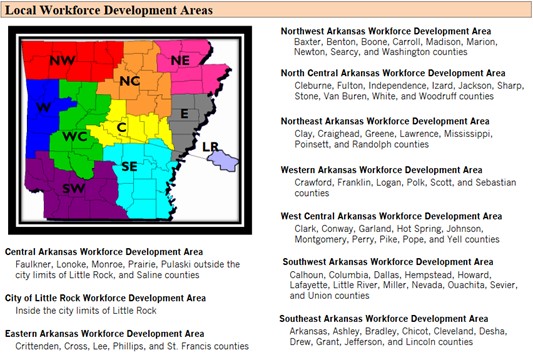
Arkansas has 75 counties and 10 Local Workforce Development Areas. There are also six Metropolitan Statistical Areas (MSAs). The MSAs are Little Rock/North Little Rock/Conway, Fayetteville/Springdale/Rogers (which includes McDonald County in Missouri), Pine Bluff, Hot Springs, Jonesboro and Fort Smith (which includes Leflore and Sequoyah Counties in Oklahoma). Parts of two other MSAs are in the state but are based in other states. Crittenden County is part of the Memphis/West Memphis MSA, which is based in Tennessee, and Miller County is part of the Texarkana AR/TX MSA, which is based in Texas.
Arkansas is rich in natural resources. There are many historical landmarks, including over 2,600 listings on the National Registry of Historical Places and 53 state parks scattered throughout the state. This is one of the reasons Arkansas is called the Natural State.
Educational opportunities in the state of Arkansas are numerous. Prospective students have a wide range of institutions to choose from, ranging from two-year community and technical colleges to four-year universities. Students can also choose between public/state institutions and private or religious-based institutions. These schools offer a variety of programs, ranging from technical certificates and associate degrees to graduate degrees. Arkansas also has several small institutions that focus on specific types of careers. With all these educational opportunities, an array of occupational careers is waiting for students. Arkansas’ population, based on State Census Data Center estimates, was 3,045,637 as of July 1, 2022, an increase of 17,515 residents from the July 1, 2021, estimate of 3,028,122. The not-seasonally adjusted average unemployment rate for first quarter 2022 was 3.6 percent, while the seasonally adjusted number was 3.2 percent.
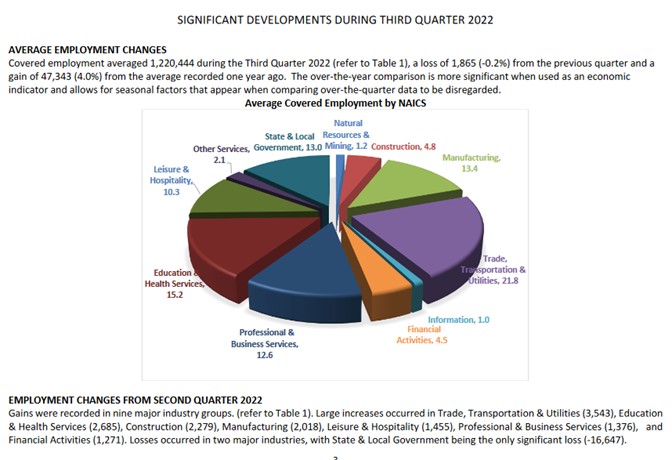
Source: https://www.discover.arkansas.gov/_docs/Publications/QCEW/Current/CEE.pdf
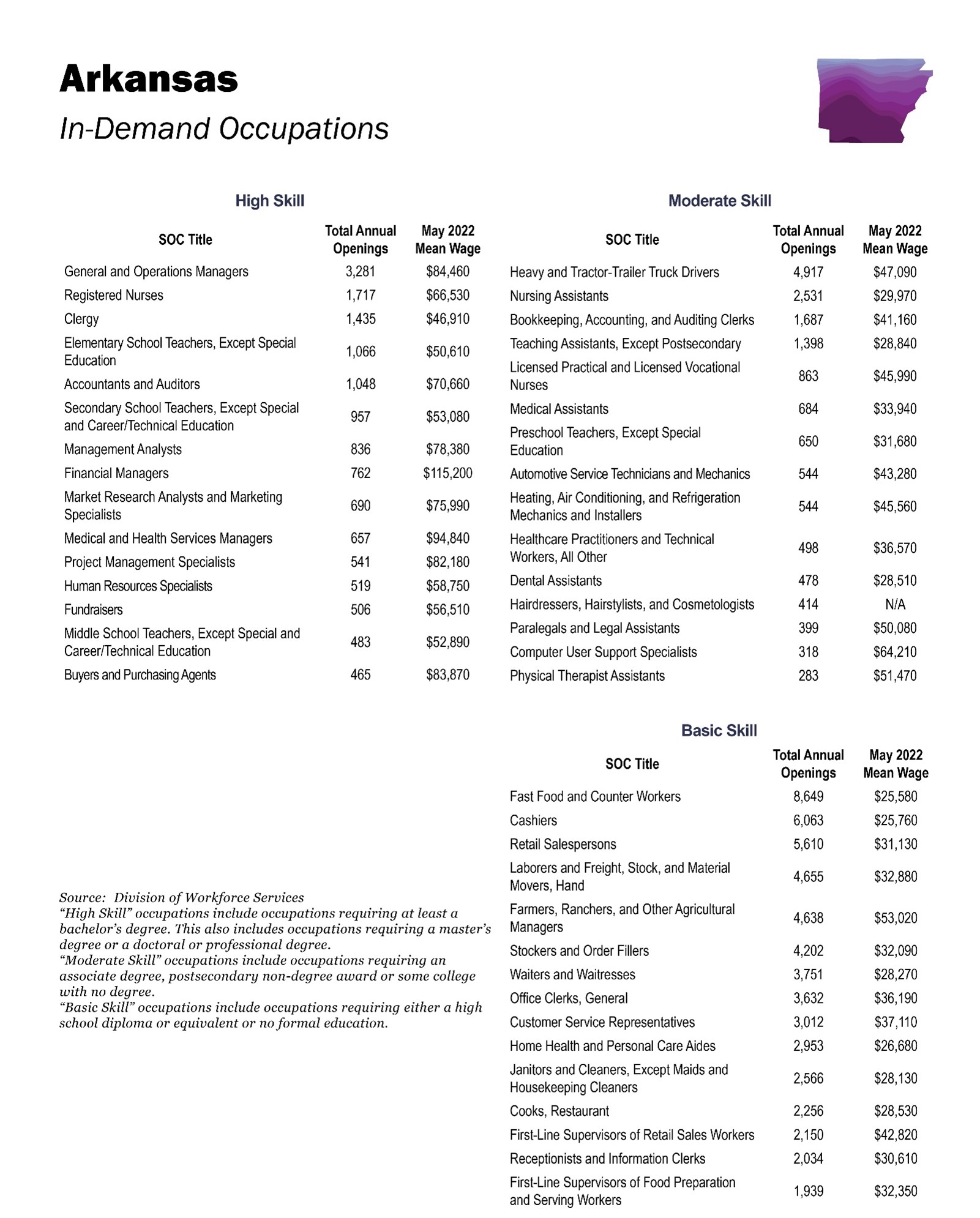
Source: https://www.discover.arkansas.gov/_docs/Publications/Economic-Report-OCI/Economic-Report.pdf
Existing Demand Industry Sectors and Occupations. Arkansas (“The Natural State”), nestled in the heart of the United States, boasts an economic landscape characterized by diversity and resilience. The state’s current economic outlook reflects a dynamic interchange of various industry sectors and occupations, showcasing an extensive and multifaceted demand that highlights its economic vitality. As the Natural State embraces the challenges of the contemporary business environment, it stands out as a demonstration to adaptability and innovation, fostering a rich tapestry of opportunities for both businesses and workers.
In exploring Arkansas’ economic dynamics, one cannot overlook the mosaic of industry sectors that form the foundation of its economic prowess. From agriculture and manufacturing to healthcare, technology and services, the state’s economic canvas is painted with a broad spectrum of activities.
This diversity not only contributes to the state’s resilience in the face of economic variations but also positions Arkansas as a key player in the national economic landscape.
Occupationally, Arkansas presents a vibrant and evolving employment scenario. Skilled professionals find themselves in high demand across various sectors, fueling a continuous cycle of innovation and productivity. The state’s commitment to education and workforce development further enhances the skills pool, ensuring a steady supply of talent equipped to meet the evolving needs of an ever-changing economy.
The current economic landscape highlights a diverse range of existing demand in various industry sectors and occupations, showcasing opportunities for growth and development. Key sectors include
- Merchant Wholesalers of Durable Goods with 26,433 openings,
- Local Government (excluding Education and Hospitals) with 42,913 positions,
- Building Equipment Contractors offering 19,790 opportunities,
- Offices of Physicians featuring 27,189 openings,
- Religious Organizations with 34,943 positions,
- Services to Buildings and Dwellings providing 15,527 opportunities,
- Business Support Services offering 10,060 positions,
- Credit Intermediation and Related Activities with 20,553 openings,,
- Animal Slaughtering and Processing featuring 34,724 opportunities, and
- Social Advocacy Organizations presenting 6,056 positions.
These numbers underscore the demand for skilled professionals and labor across a spectrum of industries, reflecting the dynamic nature of the current job market. As individuals navigate their career paths, these sectors stand out as key areas where talents and expertise are in high demand, creating pathways for meaningful employment and contribution to the broader economic landscape.
Source: https://www.discover.arkansas.gov/_docs/Publications/Economic-Report-OCI/Economic-Report.pdf
Emerging Demand Industry Sectors and Occupations.
In a world characterized by rapid change and technological advancement, it is imperative for us to not only adapt but also anticipate the evolving needs of Arkansas’ workforce and industries.
Arkansas has long been recognized for its resilience and ability to innovate, and today we find ourselves at the forefront of identifying new opportunities and addressing emerging demands. As we explore the dynamic landscape of industry sectors and occupations, we'll uncover the trends, innovations and strategies that will shape the future of our state.
From cutting-edge technologies to sustainable practices, the opportunities before us are diverse and promising. We continue to explore these emerging demands, but also to initiate a dialogue that fosters collaboration, innovation, and strategic planning. Together, we can ensure that Arkansas remains a leader in economic development, creating a prosperous and sustainable future for all.
As we stand at the intersection of tradition and progress, our state is witnessing the evolution of industry sectors and the emergence of new occupations that promise to redefine the economic fabric of Arkansas. We embark on a journey of discovery, shedding light on the transformative forces shaping our economic future and the pathways that will lead us toward innovation, prosperity, and sustainable growth.
From the forefront of technology to inventive strategies in agriculture, healthcare, manufacturing and beyond, we are committed to progressing amidst the opportunities and challenges that arise in these evolving domains.
Together, we have the power to propel Arkansas into a new era of economic vitality, ensuring our workforce is equipped with the skills and knowledge needed to thrive in an ever-evolving landscape.
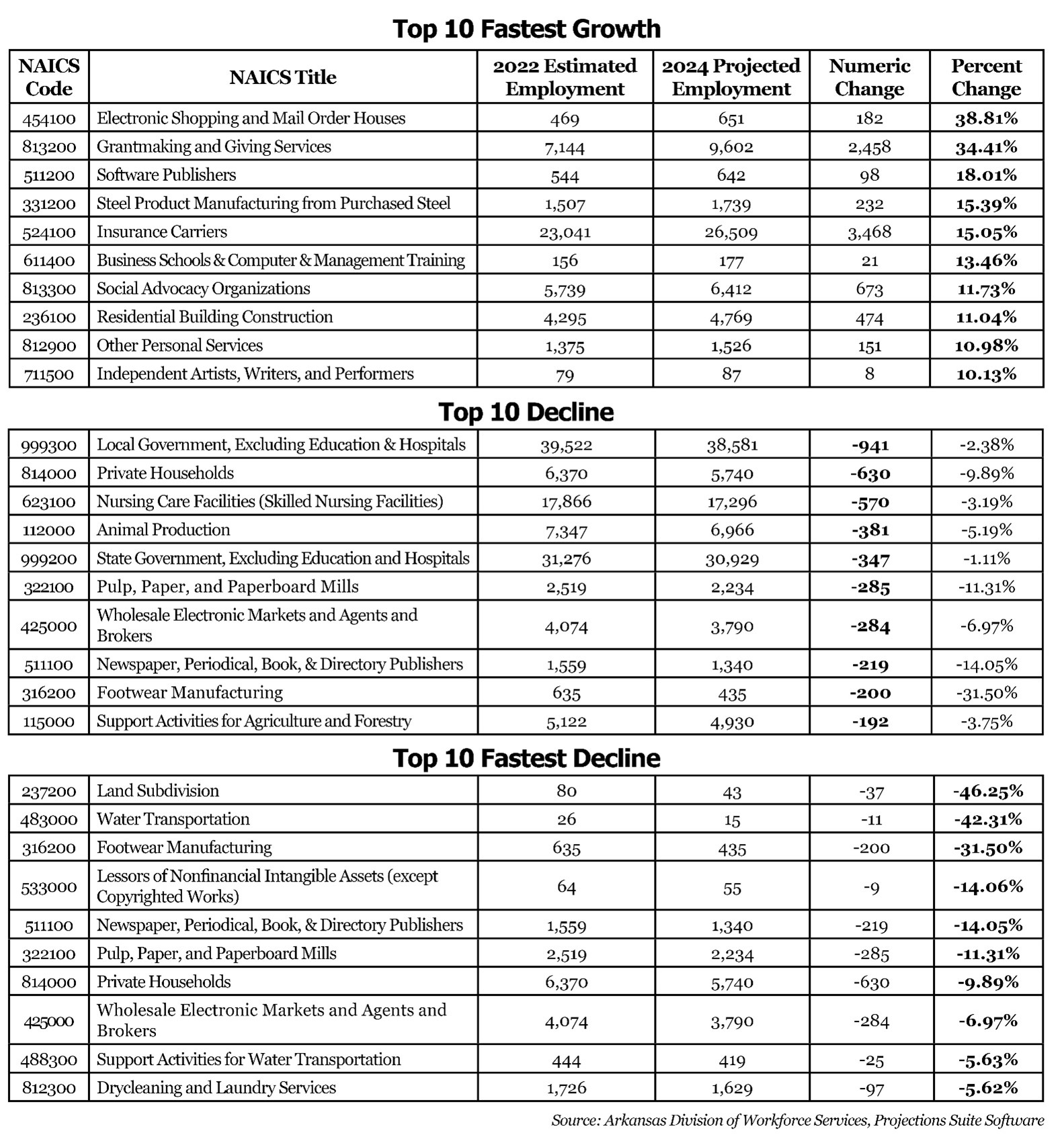
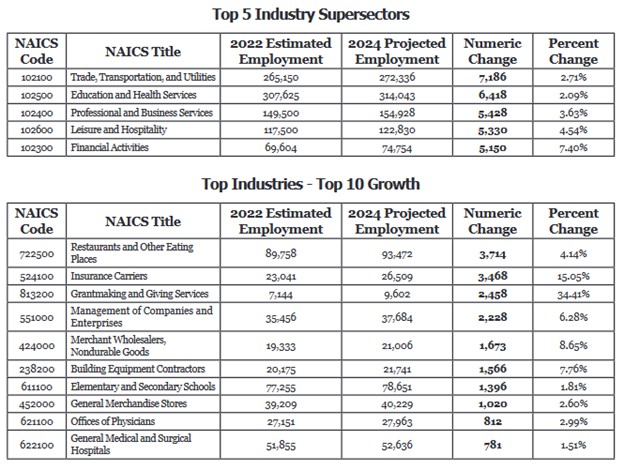
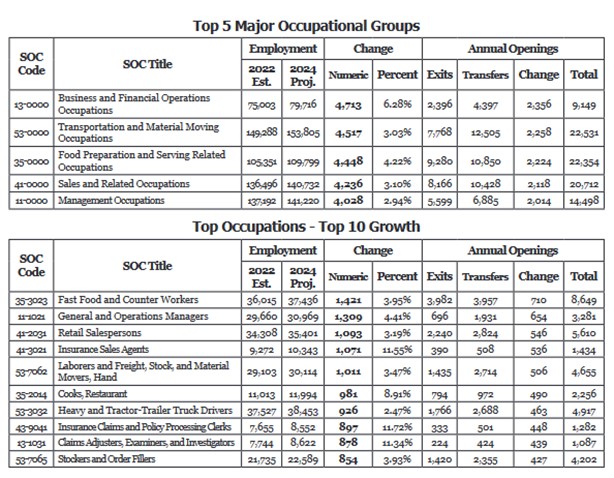
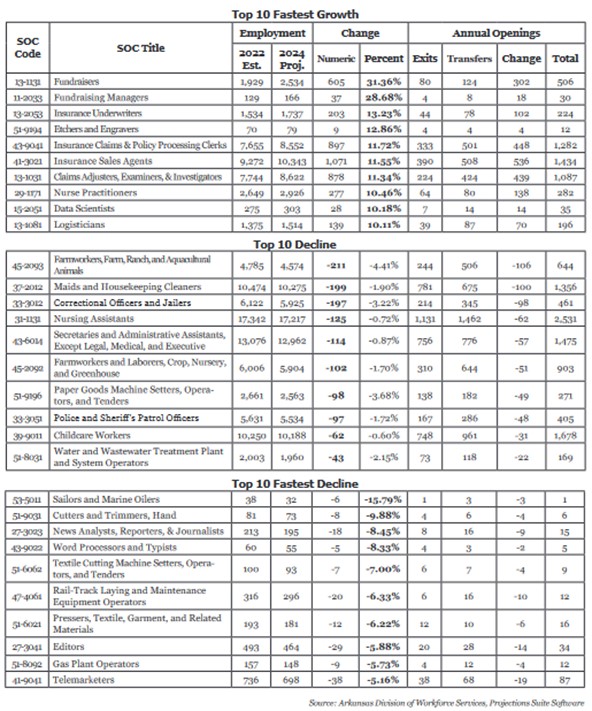
The dining industry, specifically Restaurants and Other Eating Places, is expected to be the leading sector for job growth in Arkansas, with a projected addition of 3,714 new positions between 2022 and 2024. This surge will elevate the overall workforce in the state's foodservice sector to 93,472. Meanwhile, Electronic Shopping and Mail Order Houses are poised to experience remarkable growth, anticipating a 38.81% increase in jobs and emerging as the fastest-growing industry in Arkansas.
Contrastingly, the outlook for Local Government, Excluding Education and Hospitals appears challenging, with an estimated loss of 941 jobs or 2.38% of the workforce, reducing total employment to 38,581 by 2024. The Land Subdivision industry is expected to undergo the most significant decline, with a workforce reduction of 46.25%, resulting in a workforce level of 43.
On the broader scale, the Trade, Transportation, and Utilities super sector are forecasted to be the top-performing category, with an expected addition of 7,186 new jobs, reflecting a growth rate of 2.71% during the specified projection period.
Source: https://www.discover.arkansas.gov/_docs/Publications/Economic-Report-OCI/Economic-Report.pdf
Source: https://www.discover.arkansas.gov/_docs/Publications/Economic-Report-OCI/Economic-Report.pdf
Employers’ Employment Needs
Arkansas, mirroring the national economic landscape, stands at the forefront of evolution, embodying diverse industries and hosting prominent Fortune 500 companies. The state's business environment extends beyond its borders, featuring major operations of renowned companies headquartered elsewhere. Arkansas continues to thrive in energy extraction, minerals, timber production and agriculture, creating a substantial number of jobs and contributing to the production of value-added products.
Despite much of Arkansas being predominantly rural, the state is home to numerous contract manufacturers and producers of unique goods, presenting both challenges and opportunities for economic development. Notably, the Arkansas Workforce Development System recognizes the dynamic employment needs of the state and has strategically identified 15 target industries. These industries, ranging from Advanced Food Manufacturing to Smart Grid Technologies, showcase the state's commitment to fostering diverse enterprises.
Arkansas’ focus on advanced food manufacturing, aerospace/aviation, biosciences, data centers, distribution and logistics services, firearms and ammunition, paper and timber products, regional headquarters, smart grid technologies, software development and data management services, steel production, sustainable building products and fixtures, technical support services, transportation equipment manufacturing, and Walmart suppliers illustrates the richness of Arkansas' economic landscape. Aligning with the national trend, service industries are expected to be primary revenue generators, particularly in metropolitan areas. This strategic focus underscores the state's dedication to meeting the employer employment needs for skilled workers across a broad spectrum of industries, contributing to sustained economic growth and development.
To equip workforce boards for development planning, this report leverages data from the Arkansas Division of Workforce Services Labor Market Information (LMI) website. The information has been transformed into interactive visualizations, accessible for download in image or PDF format. These tools aim to empower stakeholders at both state and local levels, facilitating a nuanced understanding of future industry and occupational needs.
Arkansas' economic outlook, while sharing similarities with the nation, reveals distinctive facets that underscore its unique position in the evolving economic landscape. WIOA serves as a comprehensive framework in the United States for addressing employer employment needs through the public workforce system. WIOA emphasizes the development of a skilled and adaptable workforce to meet the dynamic demands of the labor market. Employers can engage with the public workforce system to fulfill their workforce requirements in several ways. WIOA is designed to enhance the competitiveness of the nation's workforce by aligning education and training programs with the current and future needs of employers. Through the public workforce system, WIOA aims to meet the following employer employment needs:
- Skilled Workforce Development: WIOA supports the development of a highly skilled and adaptable workforce by facilitating training and education programs that align with the specific skills demanded by employers in various industries. This includes both technical skills and essential soft skills necessary for success in the modern workplace.
- Talent Recruitment and Placement: The public workforce system, under WIOA, assists employers in identifying and recruiting qualified candidates for job openings. This involves the creation of a talent pool that matches the skills and qualifications sought by employers, streamlining the hiring process and reducing recruitment challenges.
- Customized Training Programs: WIOA encourages the customization of training programs to meet the unique needs of employers. This can involve collaborations between training providers, educational institutions and employers to design curricula that directly address the specific skill gaps within particular industries or companies.
- Apprenticeship Opportunities: WIOA promotes apprenticeship programs as a valuable pathway for individuals to acquire industry-specific skills while meeting the workforce needs of employers. These programs facilitate a hands-on learning experience, ensuring that workers are well-prepared for the demands of their chosen professions.
- Workforce Diversity and Inclusion: The public workforce system, under WIOA, emphasizes the importance of fostering diversity and inclusion in the workplace. By supporting initiatives that promote equal opportunities and inclusivity, WIOA contributes to creating a workforce that reflects the diverse talents and perspectives of the broader community.
- Labor Market Information: WIOA facilitates the provision of up-to-date labor market information to employers. This includes data on current and projected skill demands, industry trends and emerging occupations, enabling employers to make informed decisions about their workforce needs and strategies. By addressing these key aspects, WIOA and the public workforce system play a pivotal role in connecting job seekers with employment opportunities.
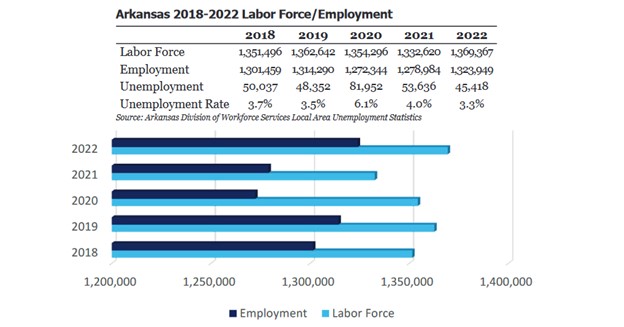
The labor force increased by 36,747 between 2021 and 2022 and employment increased by 44,965 over the same period. Unemployment decreased by 8,218 from 2021 to 2022 and has seen a decrease of 4,619 since 2018. The state’s unemployment rate declined by 0.7% from 2021 to 2022. Over the 2018-2022 period, the unemployment rate declined 0.4 percentage points to 3.3 percent for 2022. The state’s unemployment rate was 2.6% in July 2023.
Source: Source: https://www.discover.arkansas.gov/_docs/Publications/Economic-Report-OCI/Economic-Report.pdf