



Located in:
- III. Operational Planning Elements
The Unified or Combined State Plan must include an Operational Planning Elements section that supports the State’s strategy and the system-wide vision described in Section II(c) above. Unless otherwise noted, all Operational Planning Elements apply to Combined State Plan partner programs included in the plan as well as to core programs. This section must include—
- b. State Operating Systems and Policies
The Unified or Combined State Plan must include a description of the State operating systems and policies that will support the implementation of the State strategy described in section II Strategic Elements. This includes—
- b. State Operating Systems and Policies
III. b. 3. A. State Agency Organization
Describe the organization and delivery systems at the State and local levels for the programs covered in the plan, including the organizational structure. Include an organizational chart.
Current Narrative:
CareerSource Florida
The state workforce development board, known as the CareerSource Florida Board of Directors, is established pursuant to WIOA, Public Law 113-128, Title I, Section 101. Chaired by the Governor, the state workforce development board establishes and directs the vision for the state workforce system, known as the CareerSource Florida network, to align with strategic partners within workforce development, education, and economic development systems. The CareerSource Florida network’s strategic partners are those described within the federal WIOA and Florida Statutes.
The CareerSource Florida network comprises the state workforce development board, FloridaCommerce, LWDBs, chief local elected officials, local boards of directors, and local career centers.
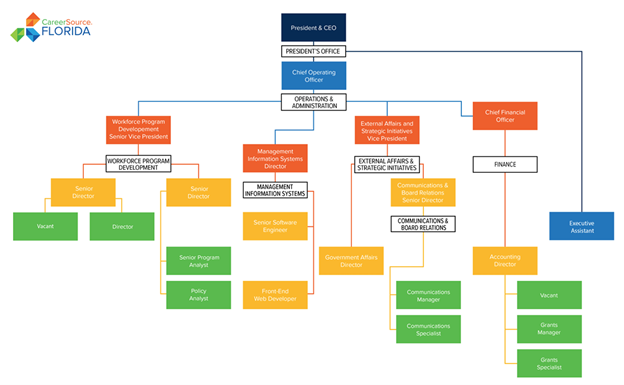
The state board hires the President and CEO of CareerSource Florida, Inc. and authorizes CareerSource Florida to develop and coordinate, under the consent and guidance of the board, the strategic, policy development, financial, and programmatic direction of its vision for the state’s workforce system.
Figure 3.06
CareerSource Florida, Inc. Organizational Chart
FloridaCommerce
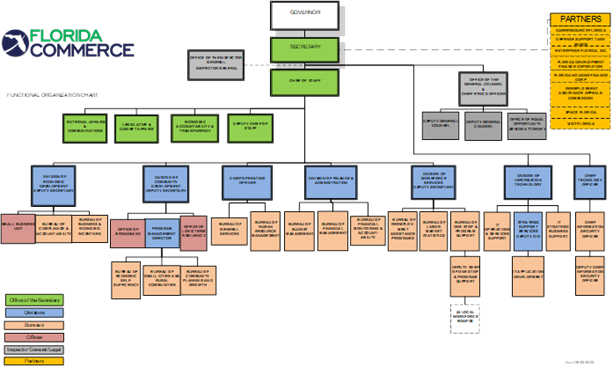
FloridaCommerce is the Governor’s agency for workforce support and training, economic development, and community development. FloridaCommerce partners with CareerSource Florida and the state’s 24 LWDBs to strengthen Florida’s business climate by supporting employers and helping Floridians gain employment, remain employed, and advance in their careers. FloridaCommerce oversees the administration of the state’s workforce system and receives and accounts for federal funds for the system.
FloridaCommerce reports financial and performance information to USDOL and other federal organizations. FloridaCommerce distributes workforce guidance and policy initiatives and provides training, technical assistance, and monitoring to LWDBs. FloridaCommerce operates Florida’s WIOA Title I (Adult, Dislocated Worker and Youth) and Title III (WP), TAA Program, JVSG, RA, CSBG, and Labor Market Statistics Programs.
Figure 3.07
FloridaCommerce Organizational Chart
Administration of the state’s workforce policy, programs and services is carried out by FloridaCommerce and the business-led LWDBs. Services are delivered through over 100 career centers (which includes affiliate sites and specialized centers) throughout Florida and through the state’s online labor exchange and case management system, Employ Florida, at www.employflorida.com.
Programmatic and administrative requirements are described in a Grantee-Sub-Grantee Agreement executed by FloridaCommerce and each LWDB, requiring their compliance with all federal and state laws, regulations, and any special state requirements.
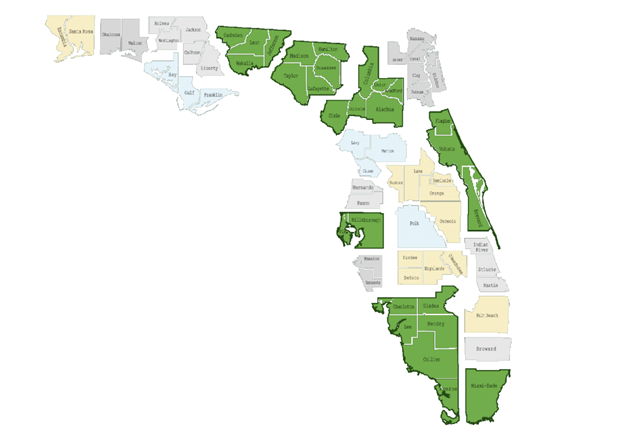
In 2023, the State Board approved the Florida Workforce System Transformation Plan which reduced the number of LWDBs from 24 to 21. The Governor approved this plan and by July 1, 2024, 21 new workforce areas will be designated for the state of Florida. Alignment and consolidation actions include the following:
- Realign Jefferson County with CareerSource Capital Region.
- Realign CareerSource North Florida as a five-county region serving Madison,
Taylor, Lafayette, Hamilton and Suwannee counties.
- Consolidate CareerSource North Central Florida and CareerSource Florida Crown.
- Consolidate CareerSource Flagler Volusia and CareerSource Brevard.
- Consolidate CareerSource Tampa Bay and CareerSource Pinellas.
- Realign Monroe County with CareerSource Southwest Florida.
- Realign CareerSource South Florida as a single-county area serving Miami-Dade County.
Figure 3.09
Alignment and Consolidation Map
of Florida Local Workforce Development Boards
Florida is currently in the process of designating new regional planning areas to align workforce development activities and resources with larger regional economic development areas and available resources to provide coordinated and efficient services to both job seekers and employers. The state board approved a strategic policy setting forth requirements for regional planning areas in September 2023 and FloridaCommerce implemented an administrative policy in December 2023 defining the process for LWDAs to request designation as a planning area. Florida is requiring all LWDAs to be part of a regional planning area that consists of two or more areas.
As of the submission of this plan, the state board received and designated two regional planning areas:
- CareerSource Escarosa (LWDB 1), CareerSource Okaloosa Walton (LWDB 2), CareerSource Chipola (LWDB 3), and CareerSource Gulf Coast (LWDB 4).
- CareerSource Research Coast (LWDB 20) and CareerSource Palm Beach (LWDB 21).
While the state board awaits additional requests for designation, the remaining LWDAs remain designated as regional planning areas that correspond to their individual designated LWDA.
FDOE
The mission of FDOE is to increase the proficiency of all students within one seamless, efficient system, by providing them with the opportunity to expand their knowledge and skills through learning opportunities and research valued by students, parents, and communities and to maintain an accountability system that measures student progress.
FDOE serves more than 2.9 million students, 3,674 public schools, 28 FCS institutions, 176,000 K-12 public school teachers, 40,613 FCS faculty and administrators, and 340,000 full-time school district staff throughout the state; the department enhances the economic self-sufficiency of Floridians through programs and services geared toward college, workforce education, apprenticeships, job-specific skills, and career development.
FDOE manages programs that assist individuals who are blind, visually impaired, or have other disabilities succeed either in school settings or careers – encouraging independence and self-sufficiency – and provides oversight to 28 locally governed public state colleges and 49 school district technical centers.
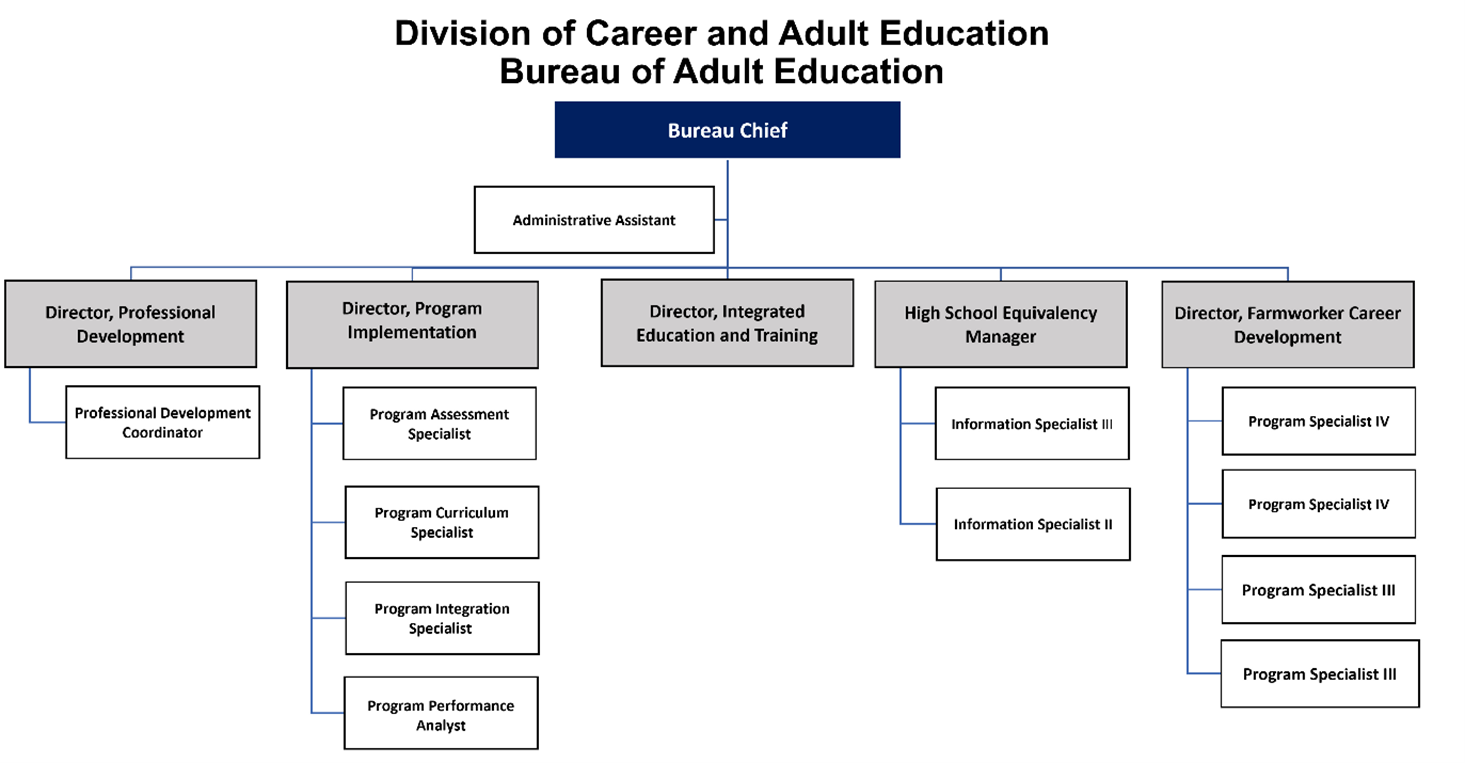
FDOE is currently appropriated 2,123.75 total full-time positions, including 884 positions in VR, 290 positions in FDBS, and 77 positions in DCAE. The department’s annual operating budget for all entities in fiscal year 2024-2028 is approximately $23.3 billion.
The FDOE organizational and governance structure includes the State Board of Education which consists of seven members appointed by the Governor to staggered four-year terms, subject to confirmation by the Senate. Except for the SUS, the State Board of Education is the chief implementing and coordinating body of public education in Florida.
The state board focuses on high-level policy decisions and has the authority to adopt rules to implement provisions of federal and state law. General duties include adopting education objectives and long-range plans for public education in Florida, exercising general supervision over the department, submitting an annual coordinated Pre K-20 education budget, and adopting uniform standards of student performance.
FDOE policies and operations are led by the department’s senior leadership team, consisting of the Commissioner of Education, chief of staff, division leaders, and directors of support divisions (see organizational chart below). FDOE manages the core WIOA programs for adult and career education, VR, and blind services. The senior leadership team develops strategies, designs operational policies, and manages the department’s business processes. Senior leader meetings are held weekly. Strategy development meetings are conducted quarterly. Strategies are tracked and adjusted as needed. FDOE financial and operational performance is reported on a regularly scheduled basis to the USDOE, the Executive Office of the Governor, and the Florida Legislature.
Figure 3.09
FDOE Organizational Chart

DCAE
The DCAE has oversight over the adult education system implemented in districts, colleges, and community-based organizations. The division coordinates the distribution of federal adult education grants. DCAE works closely with local programs and provides guidance on state and federal guidelines, professional development, and support in reporting data and technical assistance on program improvement plans.
Figure 3.10
DCAE Organizational Chart

Figure 3.11
DCAE Bureau of Adult Education Organizational Chart
VR
VR is a federal program established under the Rehabilitation Act, as Amended (1998) and reauthorized as a core program of WIOA (2014) operating under Chapter 413 of Florida Statutes. In Florida, VR is a division of FDOE comprising 884 positions located in a headquarters office, seven regional areas and 96-unit offices located throughout Florida where customers receive direct services. The VR program is funded as a federal-state partnership, in which 21.3 percent of state general revenue matches a 78.7 percent federal grant. Most programmatic oversight and governance are established in the federal laws and code of federal regulations. VR provides annual planning updates and annual/quarterly/semi-annual performance and financial reports to the federal RSA which conducts regulatory and programmatic monitoring and oversight activities approximately every four years.
VR’s organizational structure is represented in Figure 3.12.
Figure 3.12
VR Organizational Chart

FDBS
FDBS employment program is a federally established program under the Rehabilitation Act, as amended (1998), and reauthorized as a core program of WIOA (2014). FDBS is part of FDOE and serves blind and visually impaired Floridians. Fifteen district offices and the Rehabilitation Center for the Blind administer and coordinate employment related services. Utilizing funds procured through a combination of state, federal, and community funding, FDBS provides services to consumers based on individual needs in partnership with community rehabilitation providers and other local partners.
Figure 3.13
FDBS Organizational Chart

TANF Workforce Programs
The TANF program provides states and territories with flexibility in operating programs designed to help low-income families with children achieve economic self-sufficiency. States use TANF to help low-income families with children achieve economic self-sufficiency. States use TANF to fund monthly cash assistance payments to low-income families with children, as well as a wide range of services. The Temporary Cash Assistance (TCA) program provides cash assistance to families with children under age 18 (or under age 19 if they are full time students in a secondary school or its equivalent) that meet the program’s technical, income, and asset requirements. TCA helps families become self-sufficient so the children may remain in their own homes or the homes of relatives. Pregnant women, with no other dependent children, in their third trimester of pregnancy may also be eligible to receive TCA, if their physician restricts them from work. Otherwise, TCA eligibility is available in the ninth month of pregnancy.
Figure 3.14
TANF Needed Families Workforce Programs
Organizational Chart

Florida administers the TANF program through three state departments, a network of LWDBs, and a workforce services delivery system. A description follows of how these organizations work together to deliver programs to assist TANF/TCA recipients make the transition from welfare to self-sufficiency and provide other family support that meet one of the four purposes of TANF:
- DCF: Eligibility Determination, TCA Payment, and Nonrecurring Short-term Benefit Programs. The Department is the recipient of the TANF block grant and is responsible for determining eligibility for a TCA payment to eligible families and imposing penalties for a participant who fails to meet WT work requirements. In addition, the Department contracts with other public and private organizations to provide some of the TANF family support services (non-assistance) programs described in this State Plan.
- : Administration and Accountability. FloridaCommerce is the designated State agency for administering workforce programs, funding, and personnel. The Florida Legislature appropriates TANF funds to , and charges it with providing administrative and program guidance for the merged workforce and TANF/WT support delivery system. FloridaCommerce also serves as the administrative and fiscal entity for the State Board, and FloridaCommerce ensures the appropriate administration of workforce programs and funds.
- State Workforce Development Board and CareerSource Florida, Inc.: Planning, Policy, and Strategic Direction. Pursuant to WIOA the state workforce development board consists of a board of directors and chair appointed by the Governor. The state workforce development board is the state’s chief workforce policy organization and provides policy direction and oversight to Florida’s LWDBs. CareerSource Florida is the administrative entity created by the Florida Legislature to act under the state workforce development board. The state’s broad workforce strategic vision and goals are expressed through the WIOA Unified State Plan.
- LWDBs: Local Control, Accountability, and Delivery of Services. The LWDBs are responsible for implementing the state’s workforce programs, including WT, other TANF non-assistance programs, and employment support services at local career centers. The LWDBs develop innovative programs tailored to the specific economic and employment needs of the community. Primarily made up of local business representatives in each area, the LWDBs focus on planning, policy implementation, and fiscal and programmatic oversight of the local workforce system.
- Workforce System: Job Training, Education, and Employment Options. The workforce system provides a full menu of job training, education, and employment options for workers, job seekers, WT participants, and local businesses at the local career centers or via electronic access. The workforce delivery system includes numerous partners, including the Department, working together under memoranda of agreement, customer referral procedures, specifying services provided, and cost allocation formulas.
- FDOE Division of Early Learning: Administration of TANF Childcare Services. The Division of Early Learning functions as the funding and oversight entity for the local coalitions providing childcare assistance to current and transitional TANF participants.
SNAP E&T
Supplemental Nutrition Assistance Program (SNAP) Employment and Training (E&T) is funded by the United States Department of Agriculture, Food and Nutrition Service. Florida’s SNAP E&T program is designed to assist eligible SNAP E&T participants obtain skills through education, training, or work experience that will increase self-sufficiency and lead to employment. DCF is responsible for the administration of SNAP E&T. FloridaCommerce, in partnership with the LWDBs, is responsible for the delivery of SNAP E&T activities.
Figure 3.15
SNAP Program
Employment and Training
Organizational Chart

Florida’s mission and vision for the SNAP E&T program is to ensure participants gain the education and skills necessary to obtain and retain employment while earning a self-sustaining wage and meeting the workforce needs of businesses in their local communities. Florida offers SNAP E&T services to mandatory E&T participants, which includes Able-Bodied Adults Without Dependents (ABAWDs) and individuals subject to general work requirements between the ages of 18 and 59 who do not have children under age 18 in the home, do not meet an exemption and determined eligible for the program by DCF.
The Florida SNAP E&T program offers participants the opportunity to meet the ABAWD and general work requirements of the program through participation in qualifying program components available through LWDBs and career centers across the state. The program is intended to assist participants in gaining employment in in-demand occupations within their local area. This is both critical in helping individuals find a path to economic self-sufficiency and ensuring that businesses have a sustainable talent pipeline to meet their current and projected needs.
Florida’s SNAP E&T components that are offered to mandatory E&T participants include:
- Supervised Job Search.
- Job Search Training.
- Work Experience.
- Education.
- Vocational Training.
- Job Retention Services.
SCSEP
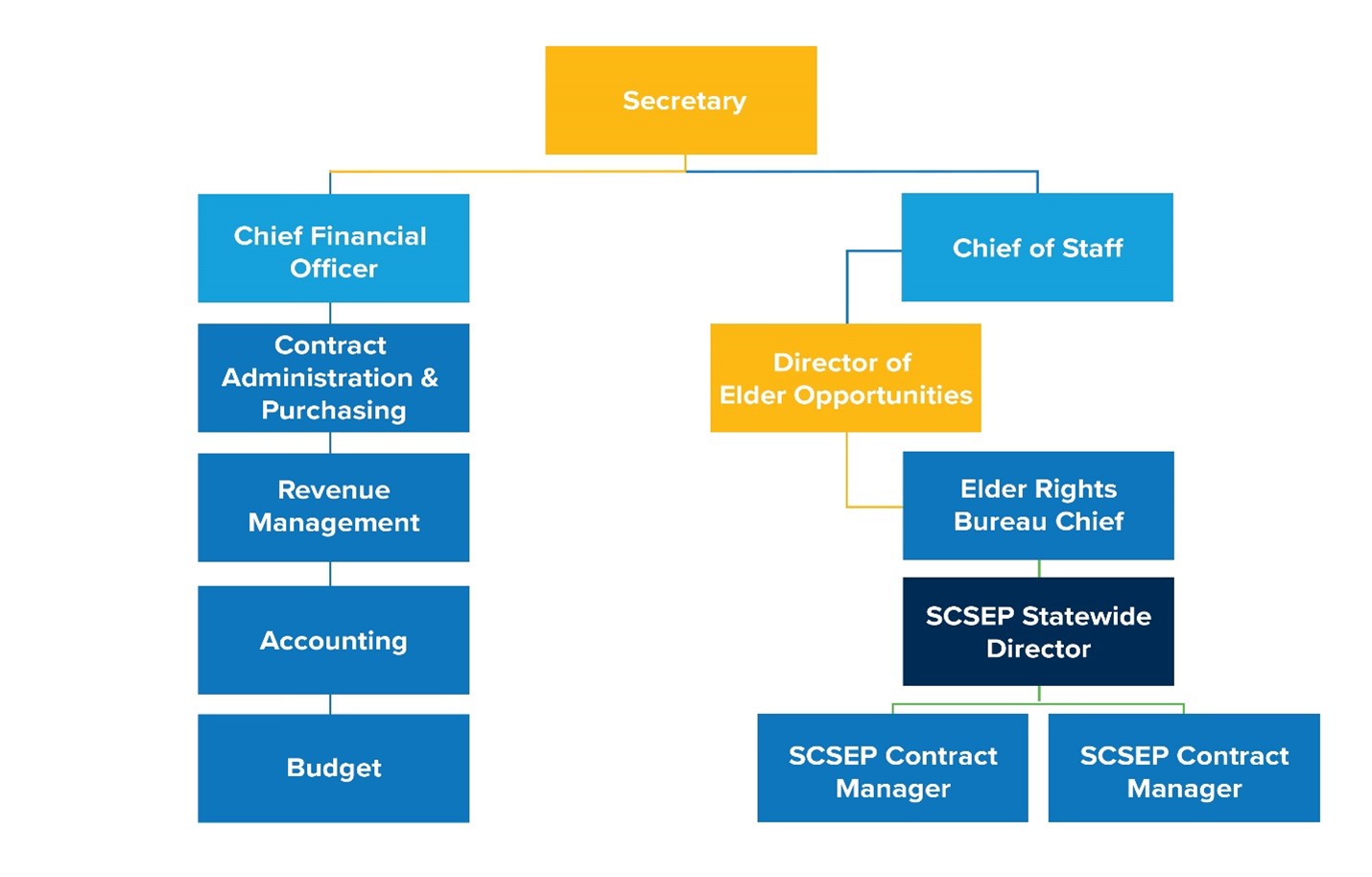
Section 503 of the Older Americans Act requires the Governor, or the highest government official in each state, to submit a State Plan. The State Plan must include a four-year strategy for the statewide provision of community service training and other authorized activities. The plan may be submitted as an independent document or as part of the WIOA Combined Plan. The State of Florida’s SCSEP State Plan will be submitted as a combined plan with FloridaCommerce, CareerSource Florida, and other core and required stakeholders.
SCSEP is a community service and work-based job training program for older Americans. Authorized by the OAA, the Title V program provides training for low income, unemployed seniors. The program provides hand on training though part-time community service assignments with not-for-profit organizations and government agencies to assist program participants in developing skills and experience to facilitate their transition to unsubsidized employment.
Figure 3.16
SCSEP Organizational Chart
SCSEP’s role in Florida continues to grow. Florida has the highest population percentage of residents aged 65 or older in the nation. Of the estimated 900 people moving to Florida daily, more than half are over age 60. According to the FDOEA, Florida is home to nearly 5.5 million residents aged 60 and older and currently ranks first in the nation for the 65 and older populations. As our senior population continues to increase, Florida’s future is linked to the financial, health, and physical security of Florida’s senior population. According to the U.S. Census Bureau it is estimated that 32.5% of Florida's population will be 60 and older by the year 2030. SCSEP continues to be a lifeline for many Floridians who feel they do not have many employment and training options available to them as they become more advanced in age. Additionally, SCSEP relieves financial strains placed on social service agencies. SCSEP plays an important role in the vitality and health of the senior population by reducing isolation, improving economic conditions, and promoting healthy aging by staying physically and mentally active.
By including SCSEP in the statewide workforce development plan, Florida is better positioned to serve eligible individuals.