



Located in:
- II. Strategic Elements
The Unified or Combined State Plan must include a Strategic Planning Elements section that analyzes the State’s current economic environment and identifies the State’s overall vision for its workforce development system. The required elements in this section allow the State to develop data-driven goals for preparing an educated and skilled workforce and to identify successful strategies for aligning workforce development programs to support economic growth. Unless otherwise noted, all Strategic Planning Elements apply to Combined State Plan partner programs included in the plan as well as to core programs. Where requirements identify the term “populations”, these must include individuals with barriers to employment as defined at WIOA Section 3. This includes displaced homemakers; low-income individuals; Indians, Alaska Natives, and Native Hawaiians; individuals with disabilities, including youth who are individuals with disabilities; older individuals; ex-offenders; homeless individuals, or homeless children and youths; youth who are in or have aged out of the foster care system; individuals who are English language learners, individuals who have low levels of literacy, and individuals facing substantial cultural barriers; farmworkers (as defined at section 167(i) of WIOA and Training and Employment Guidance Letter No. 35-14); individuals within 2 years of exhausting lifetime eligibility under the Temporary Assistance for Needy Families program; single parents (including single pregnant women); and long-term unemployed individuals. Additional populations include veterans, unemployed workers, and youth, and others that the State may identify.
- a. Economic, Workforce, and Workforce Development Activities Analysis
The Unified or Combined State Plan must include an analysis of the economic conditions, economic development strategies, and labor market in which the State’s workforce system and programs will operate.
- a. Economic, Workforce, and Workforce Development Activities Analysis
II. a. 1. A. Economic Analysis
The Unified or Combined State Plan must include an analysis of the economic conditions and trends in the State, including sub-State regions and any specific economic areas identified by the State. This must include—
i. Existing Demand Industry Sectors and Occupations
Provide an analysis of the industries and occupations for which there is existing demand.
ii. Emerging Demand Industry Sectors and Occupations
Provide an analysis of the industries and occupations for which demand is emerging.
iii. Employers’ Employment Needs
With regard to the industry sectors and occupations identified in (A)(i) and (ii), provide an assessment of the employment needs of employers, including a description of the knowledge, skills, and abilities required, including credentials and licenses.
Current Narrative:
Alabama’s economic output grew about 1.9 percent in 2023. Sustained consumer spending from pandemic lockdown savings and bailouts alongside increased exports from improved global supply chains helped to fuel that growth. Strong consumer spending is expected in 2024 alongside a GDP growth of 1.2 percent as openings in the labor market outpace labor supply.
The state’s economy is expected to continue to be resilient in 2024 due to relatively strong consumer spending and an expected decline in inflation. However, based on the Alabama Economic Outlook from the Center for Business and Economic Research (CBER) at the University of Alabama (2024) real output growth is projected to exceed 3.0 percent in only these few sectors.

(i) Existing Demand Industry Sectors and Occupations
With historic investments in communities across America, the Bipartisan Infrastructure Law (BIL) aims to fund change within climate, energy, and the environment sectors. The Creating Helpful Incentives to Produce Semiconductors Act (CHIPS) aims to strengthen American manufacturing, supply chains, and national security by investing in the workforce to secure our place as a leader in technology for future generations. The following investments in Alabama are expected based on the above funding sources:
Highway Safety Traffic Programs and Road and bridge repair ($4B), Broadband infrastructure ($1B), Climate, Energy, and the Environment ($500M), and Clean Water & Other ($7M). Research and Development funding are expected to impact Tuskegee University through semiconductor manufacturing technologies, with $351,000 in funding; The University of Alabama through Fuse (Future of Semiconductors) program with $371,00.
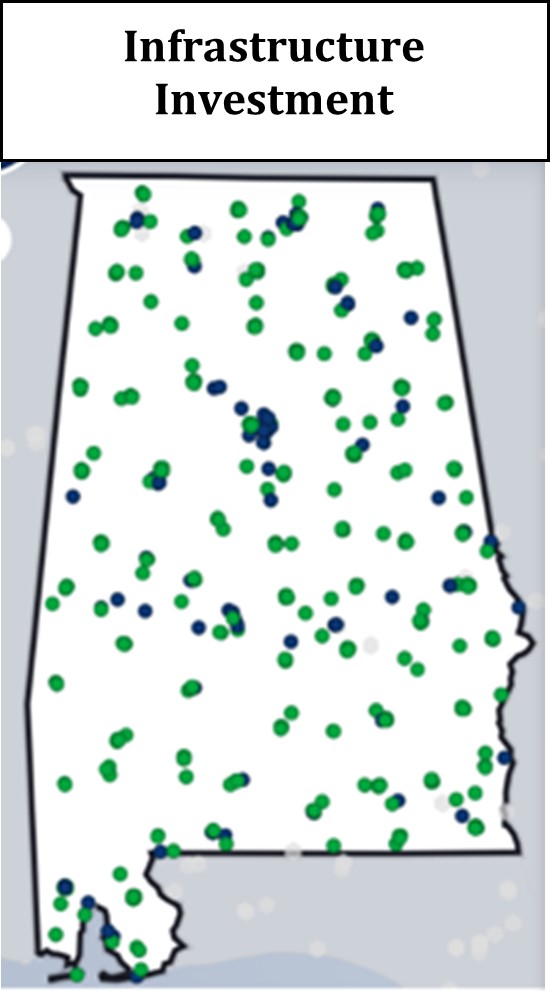
Private sector investment totals in Alabama will total $5 Billion within industries like Electric Vehicle & Batteries Manufacturing, Clean Energy Manufacturing, Bio-Manufacturing, Heavy Industry, and Clean Power.
Between Federal and private-sector investment, Alabama is set to lead the way to clean energy production and electric vehicle manufacturing but potential challenges within workforce development are yet to be seen. Training programs will need to address potential shortfalls in the workforce and will need to address these quickly as needs arise. Requests for current post-secondary training programs to support both BIL and the CHIPS act have not been answered as of the creation of this document but are expected soon.
Occupations requiring at least some postsecondary training, that potentially require additional programs developed across the state, may include: Urban and regional planners; Industrial production managers; Chemical engineers; Electrical engineers; Electronics engineers, except computer; Industrial engineers; Materials engineers; Mechanical engineers; Mechanical engineering technicians; Mechanical drafters; Software developers; Commercial and industrial designers; Chemists; Materials scientists; Electrical and electronic engineering technologists and technicians; Buyers and purchasing agents; Electrical and electronics drafters; and Computer hardware engineers. Other occupations may become more prevalent as technologies and industries adapt and improve.
According to CBER, even with labor shortages, supply chain challenges and inflation, Alabama’s nonfarm employment grew by 38,100 jobs from December 2022 to December 2023, posting an employment of 2,146,400 jobs during the last month of 2023. This figure surpasses the 2022 jobs estimate of 2,111,700 and helps to push away the last vestiges of COVID employment recovery. All of Alabama’s metropolitan areas experienced job gains over the12 month period ending in October 2023, with a net growth across all metros of 33,400 jobs. The largest gains where in the Huntsville metro (+9,400 jobs), Birmingham-Hoover (+8,800), Mobile and Tuscaloosa each added jobs (+3,200 each), Daphne-Fairhope-Foley Metro (+2,400), Auburn-Opelika (+1,500), Montgomery (+1,200), Anniston-Oxford-Jacksonville (+1,100), Dothan (+1,000) and Florence-Muscle-Shoals with an additional 100 jobs.
Unemployment has remained low in the metropolitan areas of state because of ongoing labor shortages and high consumer spending. Older workers are retiring causing workforce shortages.
(ii) Emerging Demand Industry Sectors and Occupations
Over 2.25 million workers will be employed in Alabama by 2030, an increase of 134,090 jobs. This increase reflects an annual growth rate of .62 percent. Due to COVID-19, the base year (2020) in this projection cycle will be relatively lower than previous cycles due to restrictions and lost jobs. The pandemic recovery accelerating growth and the assumption in the methodology that the economy will reach full employment by the projected year (2030) results in higher-than-average growth rates over the 2020-2030 period.

Within the Goods Producing domain, Manufacturing is projected to have the highest net (23,920) and percent (9.26) growth over the 2020-2030 period. Durable goods manufacturing is projected to have higher growth than nondurable goods manufacturing at 12.26 and 3.61 percent, respectively. The largest contributor to growth within durable goods manufacturing is Transportation Equipment Manufacturing, with 15,790 new jobs, due to announcements in new and expanding facilities by Mercedes-Benz U.S. International, Mazda Toyota Manufacturing USA, and AIRBUS.
The Services Providing domain’s growth is largely attributed to the Health Care & Social Assistance sector. Offices of Physicians, Home Health Care Services, and General Medical & Surgical Hospitals contribute the most jobs, making up 44.28 percent of Health Care & Social Assistance sector’s net growth. Both at 11.96 percent, the two sectors showing the highest percentage growth are Arts, Entertainment, & Recreation and Accommodation & Food Services. Pandemic recovery is a large contributor to this growth, pushing the annual average growth rate up 0.43 percent from the previous projection cycle (2018-2028).
The fastest growing industry in Alabama continues to be Motor Vehicle Manufacturing with 39.27 percent change over period. By 2030 this will reflect an additional 5,640 jobs. The average annual growth rate outpaces national growth at 3.37 compared to 2.28 percent. Home Health Care Services will provide the needed growth for the aging population with an additional 16,100 jobs by 2030. This faster than average annual growth than the nation at 2.98 and 2.24 respectively. Motor Vehicle Parts Manufacturing is included in the fast-growing industries with an expected net change of 26.3 percent, or 5,730 jobs.
Across the state, Textile and Fabric Finishing and Fabric will have the greatest decline over the 2030 projection horizon at -31.18%. Newspaper, Periodical, Book, & Directory Publishers (NAICS 5111) is expected to show a percent change of -20.52%, or 540 positions. Overall, 2030 employment for this industry should drop to 2,080 by 2030. Book, Periodical, & Music Stores will decline by 150 as well as Apparel Knitting Mills, losing 250 in employment and dropping that 2030 employment to 1,120 jobs.
Alabama’s total employment is projected to grow from 2,119,950 to 2,254,040 over the 2020-2030 projection period. The projection period’s annual growth rate of 0.62%, higher than the previous cycle’s (2018-2028) annual growth rate of 0.48%. Most annual openings are projected to be from transfers and exits, 93,425 and 145,745, respectively. Around 13,000 openings are projected as a result from growth. The total number of projected workers by major occupational group are 773,450 in various professional occupations, 560,990 in service and sales occupations, 251,260 in office and administrative support occupations, 103,960 in construction and extraction occupations, 30,810 in farming, fishing, and forestry occupations, 533,570 in installation and maintenance, production, and transportation occupations.
Alabama’s leisure and hospitality sector is projected to have the fastest growth over the period at 11.96%, likely due to pandemic recovery. The health care and social assistance industry contributes the highest number of new jobs at 29,560. Of the major occupational groups, healthcare support occupations are projected to growing the fastest over the projection period at 14.54%. Largely contributing to this growth are home health and personal care aids, medical assistants, and nursing assistants with growth of 4,210, 1,850, and 1,600, respectively. Computer and mathematical and food preparation and serving-related occupational groups are the second and third fast growing groups at 11.14% and 11.06% respectively.
The occupations with the highest number of openings due to growth include cooks, restaurant (520), fast food and counter workers (435), home health and personal care aides (420), registered nurses (415), laborers and freight, stock, and material movers, hand (360), industrial machinery mechanics (345) and miscellaneous assemblers in fabricators (345). Growth for occupations falling into the food preparation and serving-related and the healthcare practitioners, technical, and support occupational groups largely result from pandemic recovery and loosening of pandemic restrictions. Due to the growing manufacturing industry in Alabama, production occupations continue to follow an upward trend in growth.
Occupations requiring a high school diploma, or equivalent, or no formal education credential account for 65% of projected occupations over the 2020-2030 period. Many of these occupations require no prior work experience or short-term on-the-job training for entry.
Office and administrative support occupations continue to decrease with the lowest percent (-3.09) and net (-8,020) changes. Advances in technology and virtual outsourcing continue to allow reduction in support staff, including word processors and typists (-35.12%), switchboard operators, including answering services (-22.51%), secretaries and administrative assistants, except legal, medical, and executive (-4,337), and tellers (-967).

Region 1 shows the fastest growth over the projection period at 7.27%, along with the highest annual total openings. Production, transportation and material moving, healthcare practitioners and technical, and computer and mathematical occupational groups are the largest contributors to this growth, netting approximately 16,700 new jobs. Region 5 follows closely as the second fastest growing at 7.22%. With the announcement of Amazon being a major contributor, transportation and material moving occupations have the highest net change adding 2,930 jobs.
Region 7 is the third fastest growing at 7.18% with a net change of 22,700. The top three occupational groups with the highest net change include: food preparation and serving-related occupations (6,040), healthcare practitioners and technical occupations (2,270), and transportation and material moving occupations (2,220).
Region 2’s occupations contributing most to growth include miscellaneous assemblers and fabricators (350), industrial machinery mechanics (230), home health and personal care aides (230), stockers and order fillers (230), and heavy and tractor-trailer truck drivers (200). Within region 3, retail sales workers, food and beverage serving workers, material moving workers, and assemblers and fabricators show the highest total openings totaling 38,005. Region 4 is projected to see a net gain of 29,870 new jobs over the projection period. The occupations with the highest net growth include registered nurses (1,380), cooks, restaurant (1,230), home health and personal care aides (1,170), heavy and tractor-trailer truck drivers (870), and fast food and counter workers (840). While most regions show negative growth for farming, fishing, and forestry occupations, Region 6 is projected to show growth at 0.44%.
iii Employers’ Employment Needs
With regard to the industry sectors and occupations identified in in the previous sections, the following discussion highlights educational attainment and projected credential demand across the state and workforce development regions. In all areas of Alabama, more jobs will require a minimum of postsecondary education. Growth across the state will create an increased demand for skills and credential attainment.

Looking at the top occupations that are expected to be in demand, fast growing, or high earning, fast growing occupations in Alabama will require a bachelor’s or master’s degree, although some occupations will only require a high school diploma or the equivalent. Anticipated demand occupations will largely require at least a bachelor’s degree. A bachelor’s degree or doctoral degree and higher will be required of the highest earning occupations. Active listening, speaking, monitoring, coordination, and critical thinking top the list of skills needed to fill projected 2030 occupational openings.
Skill and education requirements for jobs keep rising in Central AlabamaWorks. Educational attainment in this region is slightly lower than the state for graduates with at least a high school diploma but is higher for those with at least a bachelor’s degree. Of the population aged 25 and over, 86.6 percent had graduated from high school from 2016 to 2020, compared to 86.9 percent for the state. During the same period, 27.6 percent of people in the region had at least a bachelor’s degree versus the state’s 26.2 percent. This highlights a strong need to raise educational attainment in the region especially since only three counties—Autauga, Lee, and Montgomery—had higher bachelor’s degree attainment than Alabama. Projected requirements of high-earning, fast-growing, and high-demand occupations indicate that 21 of the high demand occupations will require a bachelor’s degree which will also produce the top earnings.
Overall, educational attainment in Central Six is above that of the state. Over 89 percent of residents aged 25 and over graduated from high school from 2016 to 2020, compared to 87 percent for Alabama; 32 percent have a bachelor’s or higher degree versus 26 percent for the state. However, educational attainment varies greatly as Blount, Chilton, St. Clair, and Walker counties lag the region and the state. In this region, as others, 25 of the top demand occupations require at least a bachelor’s degree. Only 5 require a high school degree or the equivalent. 9 of the top fast-growing occupations require a bachelor’s or more, however 8 of the top 20 fast growing occupations will require a high school diploma through associate degree. Forty-six of the top 50 Top earning occupations will need a bachelor’s degree or higher.
Educational attainment in East AlabamaWorks is low compared to the state overall. About 84 percent of residents aged 25 and over have graduated from high school, compared to 87 percent for Alabama. In the region, about 17 percent of people have a bachelor’s or higher degree, versus 26 percent for the state. Skill and education requirements for jobs keep rising. This highlights a very strong need to raise educational attainment in the entire region. This region can expect that 17 of the top 40 high demand occupations will require a high school diploma or equivalent while 16 of those occupations will need a bachelor’s or master’s degree. Although 8 of the fast-growing occupations only require a high school diploma or equivalent, the 47 occupations with top earnings will require bachelors through doctoral degrees.
Educational attainment inNorth AlabamaWorksis higher for bachelor’s degree but slightly lower for high school graduates than the state. During the period 2016 to 2020, 86.0 percent of residents aged 25 and over had high school diplomas or the equivalent, compared to 86.9 percent for Alabama, whereas 27.0 percent had a bachelor’s or higher degree versus 26.2 percent for the state. A high school diploma or the equivalent is the education needed for 6 of the top fast-growing occupations. A master’s degree will be the expected requirement for the 5. A bachelor’s degree is the standout requirement for 30 of the highest demand occupations and will provide the highest earnings. A bachelor’s degree and higher will provide the highest earnings.
Educational attainment in Southeast AlabamaWorks generally lags the state. About 85 percent of residents aged 25 and over graduated from high school from 2016 to 2020, compared to 87 percent for Alabama. Of the age 25 and over population, about 20 percent had a bachelor’s or higher degree versus 26 percent for the state. Sixteen of the 40 high demand occupations are expected to require a bachelor’s degree or higher. Of note, 46 of the top 50 high earning occupations require at least a bachelor’s degree and higher, while 4 high earning occupations require a minimal high school diploma or equivalent.
Southwest AlabamaWorks leads the state for graduates with a high school diploma or higher but is lower for those with a bachelor’s degree or higher. Of the region’s residents aged 25 and over 87.4 percent graduated from high school from 2016 to 2020, compared to 86.9 percent for the state. About 25 percent of the population had a bachelor’s or higher degree versus 26 percent for Alabama. Only Baldwin County had higher educational attainment than the state.
Educational attainment in the West AlabamaWorks region is lower compared to the state. Over the period between 2016 to 2020, 86.9 percent of residents aged 25 and over graduated from high school and 24.2 percent had a bachelor’s or higher degree. This educational attainment is same as Alabama’s 86.9 percent for high school diploma and lower than 26.2 percent for a bachelor’s or higher degree. Most of the counties in the region have lower educational attainment than the state.
Demand occupations by career cluster for the projection horizon 2030 have been developed in cooperation with the Alabama Committee on Credentialing and Career Pathways (ACCP). Occupations are listed by order of the 2020-2030 occupational demand.
Statewide, the Business, IT, Health, and Marketing career clusters with occupations in high demand. IT (Software Developers and Software Quality Assurance Analysts & Testers), Business (General and Operations Managers and Management Analysts), Transportation, Distribution and Logistics (Logisticians) clusters lead the demand in North AlabamaWorks. In East AlabamaWorks, the top 5 are Business (General and Operations Managers) , Health (Registered Nurses and Medical and Health Services Managers), Education (Postsecondary Teachers), and Manufacturing (Miscellaneous Assemblers and Fabricators).In West AlabamaWorks, top demand occupations are found in Education(Postsecondary Teachers), Business (General and Operations Managers), Health (Registered Nurses and Medical and Health Services Managers), and Education (Education Administrators, Postsecondary) clusters. The Central Six AlabamaWorks region is led by Business (General and Operations Managers), IT (Software Developers and Software Quality Assurance Analysts and Testers), Health (Medical and Health Services Managers), Finance (Financial Managers), and Education (Postsecondary Teachers). Top demand in Central AlabamaWorks is Business (General and Operations Managers), Health (Registered Nurses and Medical and Health Services Managers), and IT (Software Developers and Software Quality Assurance Analysts and Testers) clusters. Southeast AlabamaWorks has demand in Business (General and Operations Managers), Health (Registered Nurses and Medical and Health Services Managers), Transportation, Distribution and Logistics (Heavy and Tractor-Trailer Truck Drivers) and Finance (Accountants and Auditors) clusters. Finally, in the Southwest AlabamaWorks region the top 5 demand occupations by career cluster are: Business (General and Operations Managers), Health (Registered Nurses and Medical and Health Services Managers), Marketing (Sales Representatives, Wholesale and Manufacturing, Except Technical and Scientific Products), and IT (Software Developers and Software Quality Assurance Analysts and Testers).