


Located in:
- II. Strategic Elements
The Unified or Combined State Plan must include a Strategic Planning Elements section that analyzes the State’s current economic environment and identifies the State’s overall vision for its workforce development system. The required elements in this section allow the State to develop data-driven goals for preparing an educated and skilled workforce and to identify successful strategies for aligning workforce development programs to support economic growth. Unless otherwise noted, all Strategic Planning Elements apply to Combined State Plan partner programs included in the plan as well as to core programs. Where requirements identify the term “populations”, these must include individuals with barriers to employment as defined at WIOA Section 3. This includes displaced homemakers; low-income individuals; Indians, Alaska Natives, and Native Hawaiians; individuals with disabilities, including youth who are individuals with disabilities; older individuals; ex-offenders; homeless individuals, or homeless children and youths; youth who are in or have aged out of the foster care system; individuals who are English language learners, individuals who have low levels of literacy, and individuals facing substantial cultural barriers; farmworkers (as defined at section 167(i) of WIOA and Training and Employment Guidance Letter No. 35-14); individuals within 2 years of exhausting lifetime eligibility under the Temporary Assistance for Needy Families program; single parents (including single pregnant women); and long-term unemployed individuals. Additional populations include veterans, unemployed workers, and youth, and others that the State may identify.
- a. Economic, Workforce, and Workforce Development Activities Analysis
The Unified or Combined State Plan must include an analysis of the economic conditions, economic development strategies, and labor market in which the State’s workforce system and programs will operate.
- a. Economic, Workforce, and Workforce Development Activities Analysis
II. a. 1. A. Economic Analysis
The Unified or Combined State Plan must include an analysis of the economic conditions and trends in the State, including sub-State regions and any specific economic areas identified by the State. This must include—
i. Existing Demand Industry Sectors and Occupations
Provide an analysis of the industries and occupations for which there is existing demand.
ii. Emerging Demand Industry Sectors and Occupations
Provide an analysis of the industries and occupations for which demand is emerging.
iii. Employers’ Employment Needs
With regard to the industry sectors and occupations identified in (A)(i) and (ii), provide an assessment of the employment needs of employers, including a description of the knowledge, skills, and abilities required, including credentials and licenses.
Current Narrative:
Missouri is strategically located in the Midwest and borders eight states. With a population of over 6 million, it also houses over 224,000 employers. The largest employers are concentrated in the health care, food service, and utility industries, as well as a state government, which employs 6,250 workers.
In order to serve Missouri citizens, the Missouri Public Workforce System (MPWS) must understand the drivers behind its economy and workforce. Working Missourians define the economy by providing the goods and services to support the citizens and provide the necessary health, education, and support services to help communities thrive. Understanding the economic conditions and demographics of the state allows the MPWS to identify trends and address gaps which impact both employers and jobseekers.
Gross Domestic Product
The broadest measure of economic activity is the gross domestic product (GDP). Gross Domestic Product by State (GSP) measures the value-added from industries in that state. According to estimates from the U.S. Bureau of Economic Analysis, in 2021, Missouri ranked 22nd nationally in GSP at $295.73 billion in inflation-adjusted dollars, a 4.6 percent increase from 2020 to 2021. Nationally, inflation-adjusted GDP increased 5.7 percent over the same period.
Missouri’s private sector improved 0.4 percent from the previous year and contributed over $263.3 billion to Missouri’s GSP in 2021 whereas Government receded by 0.4 percent and contributed $32.5 billion.
Missouri’s GDP by industry measures the state's output or size of the state's economy by industry. Industry-level analysis helps to show which industries make the largest contribution to the state's economy. The percent change shows either an increase or decline in the contribution between the most current two years of data. This data lags by one calendar year.
Among private sector industries, Manufacturing represents the largest share of GSP in the state at 12.3 percent. Real Estate, Rental and Leasing (11.4%), and Health Care and Social Assistance (9.1%) are other top contributing industries to Missouri’s GSP.
A 2011-2021 analysis of Missouri GSP industry-shares shows growth in some sectors and decline in others. Finance and Insurance decreased in share by 0.8 percentage points from 2011 to 2021, while Information decreased from 4.9 percent of GSP in 2011 to 4.7 percent in 2020. Professional, Scientific, and Technical Services had a 1.8 percentage point increase in share of GDP over the past 10 years. Agriculture, forestry, fishing, and hunting increased by 0.9 percent, Healthcare, and Social Assistance increased by 0.6 percent, Management of Companies and Enterprises increased its share of GSP by 0.5 percent when compared to 2011.
Industry Concentration
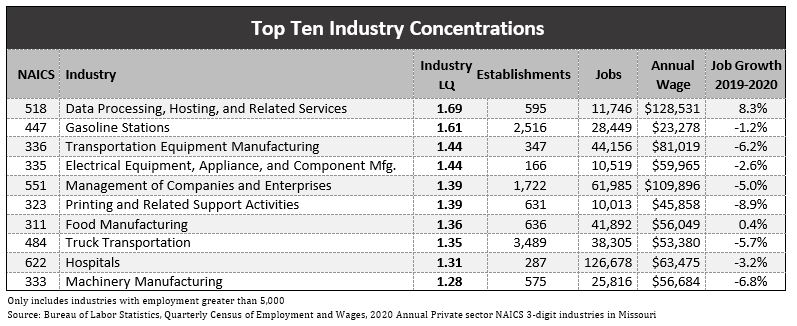
Industry concentration analysis, using location quotients (LQ), helps identify the industries that are more specialized in an area. Businesses that are more specialized due to exporting goods and services, or because they draw customers in from outside the state, are important sources of new income.
A high LQ for an industry indicates that the industry is more specialized, and employment is more concentrated for that industry in the state, as compared to the United States as a whole. This could be because that industry is more export oriented, or it is drawing customers into the state.
All industries can be grouped into one of two domains: Goods-Producing and Service-Providing. Goods-Producing industries represent 18 percent of Missouri’s employment, while Service-Providing industries represent 82 percent. This is very similar to the makeup of the nation’s employment, as Missouri’s Goods-Producing and Service-Providing industry domains both have an LQ of 1.
Overall, the Manufacturing sector in Missouri has an LQ of 1.15, indicating the industry is more concentrated in the state than in the U.S. At the three-digit NAICS industry level, Manufacturing represents half of the top 10 most concentrated industries in Missouri. The other half of the top 10 industries are Service-Providing, with Data Processing, Hosting, and Related Services having the highest LQ. Data Processing also had a high growth rate of 8.3 percent from 2019 to 2020, the period when many industries lost employment due to the effects of COVID-19.
Regional Economies
Note: On July 1, 2023, the Northwest and Northeast regions in Missouri combined into the single North region. This report includes data for Northwest and Northeast based on available information at the time. Future reports will include data for North only.
Central Region
The Central Region is comprised of 19 counties in the center of the state. The region’s civilian labor force numbers over 325,000, or 10.6 percent of Missouri’s total labor force. The regional unemployment rate was 2.4 percent in 2022, and the preliminary rate for May 2023 is 2.8 percent.
Industries in the Central Region with the highest levels of employment in 2022 were Health Care and Social Assistance, Retail Trade, Educational Services, Accommodation and Food Services, and Manufacturing. The Finance and Insurance industry added the most jobs, gaining over 2,000 jobs since 2018.
Industries projected to experience the largest numeric growth through 2030 in the Central Region are Educational Services; Ambulatory Health Care Services; Administrative and Support Services; Professional, Scientific, and Technical Services; and Social Assistance. Occupational projections for the highest number of total openings, as well as the highest percentage of growth, are occupations that would typically support these industries.
Kansas City Region
The Kansas City Region is comprised of five counties in the west central portion of the state. The region’s civilian labor force numbers over 625,000, or 20.4 percent of Missouri’s total labor force. The regional unemployment rate was 2.7 percent in 2022, and the preliminary rate for May 2023 is 2.9 percent.
Industries in the Kansas City Region with the highest levels of employment in 2022 were Health Care and Social Assistance; Retail Trade; Accommodation and Food Services; Professional, Scientific, and Technical Services; and Manufacturing. Construction and Manufacturing added the most jobs, with each gaining 4,100 and 3,700 jobs, respectively, from 2018 to 2022.
Industries projected to experience the largest numeric growth through 2030 in the Kansas City Region are Professional, Scientific, and Technical Services; Hospitals; Warehousing and Storage; Specialty Trade Contractors; and Ambulatory Health Care Services. Occupational projections for the highest number of total openings, as well as the highest percentage of growth, are occupations that would typically support these industries.
Northeast Region
The Northeast Region is comprised of 16 counties in the northeastern portion of the state. The region’s civilian labor force numbers over 127,000, or 4.2 percent of Missouri’s total labor force. The regional unemployment rate was 4.2 percent in 2022, and the preliminary rate for May 2023 is 2.9 percent.
Industries in the Northeast Region with the highest levels of employment in 2022 were Health Care and Social Assistance, Manufacturing, and Retail Trade. Industries with the greatest employment increase from 2018 to 2022 were Administrative and Support, Waste Management, Remediation Services, and Manufacturing.
Industries projected to experience the largest numeric growth through 2030 in the Northeast Region are Food Services and Drinking Places; Ambulatory Health Care Services; and Specialty Trade Contractors. Occupational projections for the highest number of total openings, as well as the highest percentage of growth, are occupations that would typically support these industries.
Northwest Region
The Northwest Region is comprised of 18 counties in the northwestern portion of the state. The region’s civilian labor force numbers over 120,000, or 4.0 percent of Missouri’s total labor force. The regional unemployment rate was 2.4 percent in 2022, and the preliminary rate for May 2023 is 2.7 percent.
Industries in the Northwest Region with the highest levels of employment in 2022 were Manufacturing, Health Care and Social Assistance, and Retail Trade. Industries with the greatest employment increase from 2018 to 2022 were Professional, Scientific, and Technical Services and Retail Trade.
Industries projected to experience the largest numeric growth through 2030 in the Northwest Region are Food Manufacturing; Social Assistance; Professional, Scientific, and Technical Services; and Food Services and Drinking Places. Occupational projections for the highest number of total openings, as well as the highest percentage of growth, are occupations that would typically support these industries.
Ozark Region
The Ozark Region is comprised of seven counties in the southwest quadrant of the state. The region’s civilian labor force numbers over 280,000, or 9.2 percent of Missouri’s total labor force. The regional unemployment rate was 2.3 percent in 2022, and the preliminary rate for May 2023 is 2.7 percent.
Industries in the Ozark Region with the highest levels of employment in 2022 were Health Care and Social Assistance, Retail Trade, Accommodation and Food Services, Manufacturing, and Education Services. Industries with the greatest employment increase from 2018 to 2022 were Manufacturing, Construction, and Transportation and Warehousing.
Industries projected to experience the largest numeric growth through 2030 in the Ozark Region are Hospitals; Professional, Scientific, and Technical Services; Warehousing and Storage; and Truck Transportation. Occupational projections for the highest number of total openings, as well as the highest percentage of growth, are occupations that would typically support these industries.
South Central Region
The South Central Region is comprised of 12 counties in the center of the southern portion of Missouri. The region’s civilian labor force numbers over 80,000, or 2.6 percent of Missouri’s total labor force. The regional unemployment rate was 3.0 percent in 2022, and the preliminary rate for May 2023 is 3.7 percent.
Industries in South Central Region with the highest levels of employment in 2022 were Health Care and Social Assistance, Manufacturing, Retail Trade, Accommodation and Food Services, and Educational Services. Industries with the greatest employment increase were Accommodations and Food Services and Retail Trade.
Industries projected to experience the largest numeric growth through 2030 in the South Central Region are Food Services and Drinking Places, Social Assistance, and Machinery Manufacturing. Occupational projections for the highest number of total openings, as well as the highest percentage of growth, are occupations that would typically support these industries.
Southeast Region
The Southeast Region is comprised of 13 counties in the southeastern portion of the state. The region’s civilian labor force numbers over 161,000, or 5.3 percent of Missouri’s total labor force. The regional unemployment rate was 2.8 percent in 2022, and the preliminary rate for May 2023 is 3.2 percent.
Industries in the Southeast Region with the highest levels of employment in 2022 were Health Care and Social Assistance, Manufacturing, Retail Trade, and Accommodation and Food Services. Industries with the greatest employment increase from 2018 to 2022 were Retail Trade; Professional, Scientific, and Technical Services; and Transportation and Warehousing.
Industries projected to experience the largest numeric growth through 2030 in the Southeast Region are Professional, Scientific, and Technical Services; Crop Production; and Ambulatory Health Services. Occupational projections for the highest number of total openings, as well as the highest percentage of growth, are occupations that would typically support these industries.
Southwest Region
The Southwest Region is comprised of seven counties in the southwestern corner of the state. The region’s civilian labor force numbers over 134,000, or 4.4 percent of Missouri’s total labor force. The regional unemployment rate was 2.4 percent in 2022, and the preliminary rate for May 2023 is 3.0 percent.
Industries in the Southwest Region with the highest levels of employment in 2022 were Manufacturing, Health Care and Social Assistance, Retail Trade, and Accommodation and Food Services. Industries with the largest increases in employment from 2018 to 2022 were Professional, Scientific, and Technical Services; Transportation and Warehousing; Accommodation and Food Services; and Retail Trade.
Industries projected to experience the largest numeric growth through 2030 in the Southwest Region are Truck Transportation; Educational Services; and Warehousing and Storage. Occupational projections for the highest number of total openings, as well as the highest percentage of growth, are occupations that would typically support these industries.
St. Louis Region
The St. Louis Region is comprised of five counties in the eastern part of the state. The region’s civilian labor force numbers over 1,070,000, or 35.2 percent of Missouri’s total labor force. The regional unemployment rate was 2.4 percent in 2022, and the preliminary rate for May 2023 is 2.8 percent.
Industries in the St. Louis Region with the highest levels of employment in 2022 were Health Care and Social Assistance, Retail Trade, Manufacturing, and Accommodation and Food Services. Industries with the largest increases in employment from 2018 to 2022 were Professional, Scientific, and Technical Services; Transportation and Warehousing; Construction; Health Care and Social Assistance; and Manufacturing.
Industries projected to have the largest numeric growth through 2030 in the St. Louis Region are Food Services and Drinking Places; Professional, Scientific, and Technical Services; Administrative and Support Services; Ambulatory Health Care Services; and Hospitals. Occupational projections for the highest number of total openings, as well as the highest percentage of growth, are occupations that would typically support these industries.
West Central Region
The West Central Region is comprised of 13 counties in the west central part of Missouri. The region’s civilian labor force is over 125,000, or 4.1 percent of Missouri’s total labor force. The region’s unemployment rate was 2.7 percent in 2022, and the preliminary rate for May 2023 is 3.1 percent.
Industries in the West Central Region with the highest levels of employment in 2022 were Health Care and Social Assistance, Manufacturing, Retail Trade, and Educational Services. Industries with the largest increases in employment from 2018 to 2022 were Manufacturing, Construction, and Retail Trade.
Industries projected to experience the largest numeric growth through 2030 in the West Central Region are Food Services and Drinking Places, Hospitals, Educational Services, and Ambulatory Health Care Services. Occupational projections for the highest number of total openings, as well as the highest percentage of growth, are occupations that would typically support these industries.
Current Industry Demand
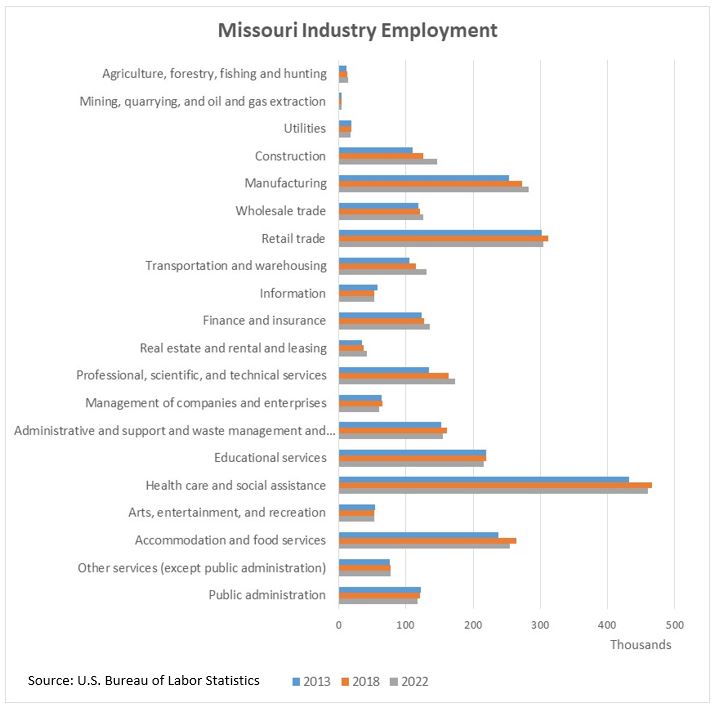
In 2022, Missouri’s total covered employment was 2,820,000. This was an increase of 79,000, or 2.9 percent, compared to 2021. Compared to 2013, or ten years ago, Missouri employment increased by 183,500, or 7.0 percent. This period includes both economic growth prior to the COVID-19 pandemic and recovery after the pandemic.
Comparing 2022 to 2013, the largest growing industries were Professional, Scientific, and Technical Services; Construction; Manufacturing; and Health Care and Social Assistance. The fastest growing industries were Construction; Professional, Scientific, and Technical Services; and Transportation and Warehousing. The most significant declines in employment over the 10-year period were in Information, Public Administration, and Management of Companies and Enterprises.
Seven industries experienced employment growth above the state average between both 2022 compared to 2018 and 2022 compared to 2013. Those industries are Professional, Scientific, and Technical Services; Real Estate and Rental and Leasing; Finance and Insurance; Transportation and Warehousing; Manufacturing; Construction; and Agriculture, Forestry, and Fishing and Hunting. These industries with continued growth indicate areas of opportunity for the state.
Current Occupational Demand
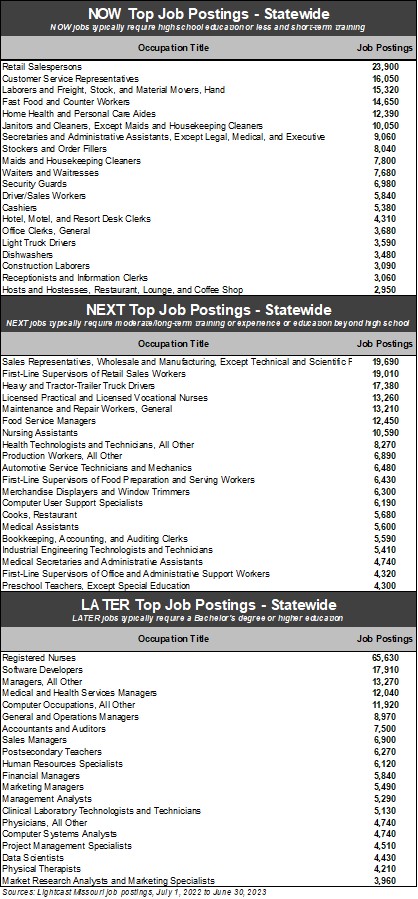
Current occupational demand can be attained through the job ads placed by employers. From July 2022–June 2023, over 900,000 online job ads were placed for jobs located in Missouri, according to Lightcast.
Job ads were placed for positions at every skill and education level. Missouri uses a system of Now, Next, and Later to categorize jobs according to the typical education and experience required for success on the job. Now jobs typically require a high school education or less and short-term training. Next jobs typically require moderate- to long-term training, experience or education beyond high school. Later jobs typically require a bachelor’s degree or higher education.
Now occupations with the highest number of job postings include Retail Salespersons; Customer Service Representatives; Laborers and Freight, Stock, and Material Movers; Fast Food and Counter Workers; and Home Health and Personal Care Aides.
Occupations with the most job postings in the Next category are Sales Representatives, Wholesale and Manufacturing; First-Line Supervisors of Retail Sales Workers; Heavy and Tractor-Trailer Truck Drivers; Licensed Practical and Licensed Vocational Nurses; and Maintenance and Repair Workers.
Later occupations with the highest number of job postings are Registered Nurses; Software Developers; Managers; Medical and Health Services Managers; and Computer Occupations.
Industry Projections
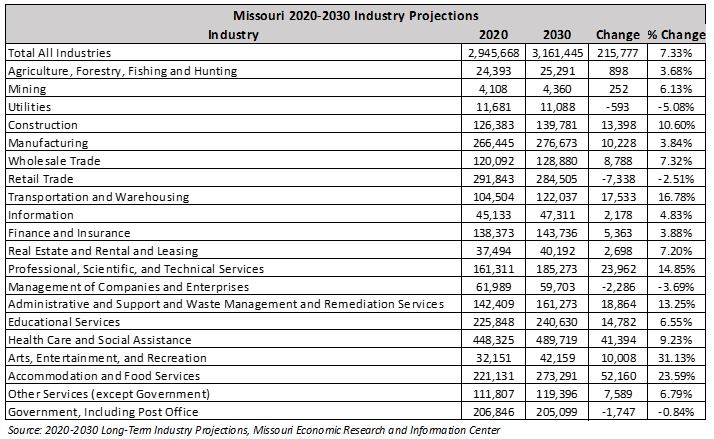
The long-term industry projections help determine the industries that are expected to add positions within their organizations over time. The latest round of projections is through the ten-year period ending in 2030.
The projections reveal several industries with both high employment numbers and above average growth rates compared to the state average. The top five industries by numeric employment change are Accommodation and Food Services; Health Care and Social Assistance; Professional, Scientific, and Technical Services; Administrative and Waste Management Services; and Transportation and Warehousing.
It is important to note that the base year of 2020 for the latest long-term projections was significantly impacted by the economic shock of the COVID-19 pandemic.
Missouri experienced large job losses in 2020, due to the initial impact of the COVID-19 pandemic, as did the rest of the United States. The 2020 to 2030 projections, therefore, are starting from a base year that had relatively low employment. Due to that relatively low base year and the recovery from the pandemic, a relatively high growth rate is projected between 2020 and 2030. Some of this growth is attributable to recovering jobs that were lost during the pandemic.
While the impact of the COVID-19 pandemic on employment was widespread, some industries and occupations were impacted far greater than others. Industries related to accommodation, entertainment, food services, and personal services declined by a greater margin than those less centered on direct interactions between people.
The Accommodation and Food Services industry sector is projected to have the largest employment growth, with an increase of 52,160 jobs between 2020 and 2030. Most of this employment growth (86%) is due to recovery from the pandemic. Accommodation and Food Services was heavily impacted by the pandemic, losing 44,673 jobs, or 17 percent of its employment, from 2019 to 2020. It is expected that much of this employment growth will occur in the early years of the decade.
The Arts, Entertainment, and Recreation industry sector was the most affected by the pandemic, losing one quarter of its employment in 2020. All of the projected employment growth in this sector is expected to be due to the recovery.
With this consideration, industries that are projected to have more growth outside of pandemic recovery include Health Care and Social Assistance; Professional, Scientific, and Technical Services; Transportation and Warehousing; and Construction.

Occupational Projections
Job openings occur due to three reasons – exits, transfers, and growth. Exits occur as people leave the workforce for reasons such as retirement. Transfers occur when workers leave one occupation for a different occupation. Occupational growth occurs as businesses grow and need more workers to serve their customers.
Emerging occupations can be identified through growth openings. The chart below identifies occupations that have the highest number of growth openings projected by 2030. The total number of openings indicates the projected number of vacancies that businesses will need to fill annually.
Growth openings are projected at all education and training levels and are listed by the highest number of growth openings. The highest number of growth openings in Now occupations are Home Health and Personal Care Aides; Fast Food and Counter Workers; Waiters and Waitresses; Laborers and Freight, Stock, and Material Movers, Hand; and Stockers and Order Fillers.
The largest growth in Next occupations is in the occupations of Cooks, Heavy and Tractor-Trailer Truck Drivers, First-Line Supervisors of Food Preparation and Serving Workers, Maintenance and Repair Workers, and Electricians.
Later occupations with the highest growth are Software Developers and Software Quality Assurance Analysts and Testers, General and Operations Managers, Registered Nurses, Nurse Practitioners, and Market Research Analysts and Marketing Specialists.
These occupations are consistent with the industries identified as emerging industries.

Real-Time Labor Market Data
Job ads placed by employers offer another source of information on the knowledge, skills, and certifications requested by Missouri’s employers. Lightcast™ is a data tool that spiders to over 51,000 different web sources with job ads. The information found in the ads is placed in a database that can be queried to gain intelligence on employer needs.
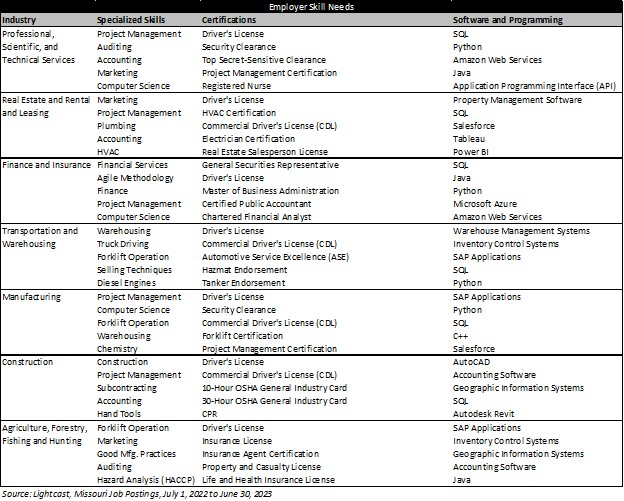
Seven industries growing faster than the state average over the last 5 and 10 years were identified in the Economic Analysis section of the Missouri Combined State Plan. These industries are listed below with the specialized skills, certifications, and software and programming requested most by employers in job ads from July 1, 2022 to June 30, 2023.
In the software and programming category, Microsoft Office and its products such as Word, Excel, PowerPoint, and Access ranked at the top of the list across all industries. Industry-specific programs identified in the job ads are listed in the table.
Specialized skills that are in-demand for more than one industry include Project Management, Computer Science, Marketing, and Forklift Operation. Certifications that are common across multiple industries are Driver’s License and Commercial Driver’s License (CDL). Software and programming skills have many points of overlap among the top growing industries. The SQL programming language was an in-demand skill in six of the seven industries. Python and Java also were requested in job postings in at least three industries.
Skills Shortages and Employer Needs
Missouri conducted a survey of employers in 2023 to understand current hiring trends and challenges for employers in the state. In the Missouri Workforce 2023 Employer Survey, employers indicated a primary concern of hiring and retaining top talent and two-thirds of job postings taking more than 30 days to fill. The top barrier to is a shortage of applicants with knowledge or skills needed for the position.
The primary shortcomings of applicants were poor work habits, general business or industry knowledge, critical thinking and problem-solving skills, and communications or interpersonal skills.
Companies employ workers in a variety of functional areas with different work responsibilities. The Patient Care, Skilled Trades, and Manufacturing functional areas had the largest percentage of employers reporting shortages of skilled applicants. Skill shortages in Customer Service have increased substantially, increasing from 25 percent in 2019 and 31 percent in 2020, to 47 percent in 2021, decreasing slightly to 45 percent in 2023.

Employers take a variety of measures to address these shortages. Similar to previous surveys, 80 percent of the respondents reported hiring less experienced workers and train them as a measure to address skill shortages in the applicants. Other popular remedial measures were offering increased wages (67%) and offering flexible work schedules (52%). Offering increased wages rose as a remedial measure from 49 percent of respondents in 2019 to 64 percent in 2020 and 67 percent in 2023.
Needs for the areas where employers are reporting the greatest shortages align with the state’s target industry groups and career pathways analysis. The Patient Care area is included in the Health Science career pathway. Patient interaction, infection control, understanding of drugs and medications, as well as the knowledge of diagnostic procedures, scientific methods, and technology are some of the skills needed for success in this industry.
Some of the most in-demand occupations in this area include Home Health and Personal Care Aides, Licensed Practical and Licensed Vocational Nurses, and Nursing Assistants. The career pathways analysis shows that certificates such as Home Health Aide, Certified Caregiver, and First Aid CPR AED can provide entry into the Patient Care field. For advancement, education, training, and apprenticeships in the areas of Nursing Assistant certification, Licensed Practical Nurse (LPN), and Emergency Medical Technician (EMT) can provide either career advancement or other pathways of entry into Health Science and Patient Care.
One of the areas of Skilled Trades is in the Construction industry. Construction has a set of industry-wide technical competencies that represent the knowledge and skills necessary to be successful in this industry. Some of the skills that may be needed for success in Construction are craftsmanship, both building and construction design, building, and installation, as well as business fundamental skills such as contracts, budgeting, and cost estimating. Growing occupations in this industry include Construction Laborers and Electricians. Apprenticeships can help fill this area of need including in areas such as plumbing, carpentry, electrical work, and HVAC engineering and technology.
In the area of Manufacturing and Maintenance, skills include manufacturing process design, development, maintenance, repair, knowledge of and compliance with government regulations, as well as the ability to adapt and consider new ways of doing things. For meeting shortages and expanding career pathways in Manufacturing, certifications in areas such as forklift operation and industrial maintenance can help prepare workers for needs in entry-level production and maintenance occupations, such as Production Workers and Maintenance and Repair Workers. In addition, opportunities to progress in the industry could be supported by certification or education in the areas of CNC Machinist Technology and CAD certification.